Whilst the National Energy Regulator of South Africa (NERSA) public hearings on the guidelines for the electricity reseller tariffs were ongoing inside Gallagher convention centre today, Earthlife Africa Johannesburg and different community based organisations were demonstrating their frustrations over the unreasonably high electricity tariffs charged by Eskom and its many electricity resellers outside the venue.
UK government’s approach to nuclear waste disposal ?bullying and bribing
Communities could be paid £40m for considering nuclear waste dump Damian Carrington The Guardian, Thursday 24 July 2014 “……..The government said the new approach to waste disposal will involve two years of work to come up with a “more sophisticated” process by which the views of local communities affect decision taking, but it said the ability of a council to veto had gone.
“All levels of local government must be involved but we are keen that no one level has an absolute veto,” said a spokeswoman for the Department of Energy and Climate Change (Decc).
She said the new plan would give communities access to independent advice. “We hope putting in place these actions will mean volunteer communities will understand better what it is all about,” she said. “One of the lessons from our [Cumbria] experience and experience internationally is that the immediate reaction is negative, because ‘nuclear must be bad’, but once people to get to dig into the detail they get more positive.”
Construction of the underground waste dump, sited between 250m and 1000m down, will then take 10-15 years, meaning it could be almost 2050 before any waste is buried.
Germany, Sweden, Finland and the US are currently considering deep geological disposal for nuclear waste. The UK currently has around 600,000 cubic metres of nuclear waste, enough to fill the Royal Albert Hall six times over. Waste from any new nuclear plants will be more concentrated and current government projection for new reactors would mean another two more Albert Halls’ worth.
The UK underground waste site is estimated to cost £12bn, more than the £9bn Olympic Games in London in 2012. The government says the sum is already accounted for in spending plans of the Nuclear Decommissioning Authority.
Despite extensive previous geological examination, a new national screening process will take place to identify suitable regions, but it will not pinpoint a site.
The chair of the campaign group Nuclear Free Local Authorities (NFLA), councillor Mark Hackett, said: “NFLA welcomes the new policy of carrying out a national geological screening exercise, rather than assuming waste can be buried near Cumbria where the geology has been shown to be unsuitable. We also welcome the idea of assisting communities to obtain independent third party expertise………
Craig Bennett, at Friends of the Earth, said: “We’re still not even close to figuring out an adequate solution for the nuclear industry’s legacy of toxic radioactive waste. The fact that the government is now having to offer bribes to communities to even talk to them, while making it clear they will override their views anyway, makes it crystal clear that this is a technology of the past, not the future. UK governments have wasted immense amounts of money and political effort on nuclear power down the years. If even half of that had been put into renewables and energy efficiency, we’d all be in a much better place”.
Greenpeace UK’s Louise Hutchins said: “This is a bullying and bribing approach by a government that is getting desperate about solving this problem. First David Cameron reneged on his promise [on nuclear waste], now he’s resorting to bribing reluctant communities.”http://www.theguardian.com/environment/2014/jul/24/communities-could-be-paid-40m-for-considering-nuclear-waste-dump
Lack of preparation for the next nuclear power disaster
No Big Deal But We’re Not Ready for The Next Nuclear Disaster http://gawker.com/no-big-deal-but-were-not-ready-for-the-next-nuclear-dis-1610776894 Hamilton Nolan 126 July 14 Hey, what’s up, good morning to you. In the news today is sports, weather, and nuclear disaster (potentially).
There is nothing wrong our nation’s nuclear power plants, right now. They’re all functioning well! This could change under certain circumstances, though. A report out yesterday from the National Academy of Sciences says that the nuclear power industry’s disaster planning and safety regulations “are clearly inadequate for preventing core-melt accidents and mitigating their consequences.”
Heck.
The U.S. nuclear industry should prepare for unlikely, worst-case scenarios when designing, building and regulating plants, the report recommends.
That is the big lesson the industry should take away from the March 2011 Fukushima Daiichi nuclear accident in Japan, the report says. Earthquakes, floods, tsunamis, solar storms and situations that seem rare are precisely the events that triggered the world’s three major nuclear disasters: Fukushima, Three Mile Island and Chernobyl.
Jerry-NetherlandHamilton NolanFortunately, this monstrosity, a 40 year blight on one of the most exquisite stretches of pristine beachfront in California, has been decommissioned and will soon be history.
Lack of knowledge about potential cancer risks of electromagnetic radiation from cell phones
Here’s What We Know About Mobile Phones And Cancer, Business Insider LAUREN F FRIEDMAN JUL 22 2014, “……..Mobile phones emit “non-ionizing electromagnetic radiation” (the kind that comes from microwaves), not “ionizing radiation” (the kind that comes from X-rays). And it turns out that’s an important difference.
“Exposure to ionizing radiation, such as from radiation therapy, is known to increase the risk of cancer,” the National Cancer Institute explains, although even there, the dose matters a lot. “However, although many studies have examined the potential health effects of non-ionizing radiation from radar, microwave ovens, and other sources, there is currently no consistent evidence that non-ionizing radiation increases cancer risk.”
Non-ionizing radiation also does not cause DNA damage, something that’s usually considered a necessary trigger for cancer.
While people spend much more time with their cell phones than their microwaves, it’s still hard to get a good idea of the dose of non-ionizing radiation we get from them. The amount of radiation absorbed by individuals will vary depending on the kind of phones they have and how they use them.
A lot of uncertainty also comes from improved cell phone technology and increased usage over the years — the research just can’t keep up.
The Research So Far
“Studies thus far have not shown a consistent link between cell phone use and cancers of the brain, nerves, or other tissues of the head or neck,” the National Cancer Institute notes on their website. But their fact sheet addressing the topic is not conclusive for the reasons above.
Since proximity is so important in radiation exposure, most research has looked for links between cell phones and brain cancer specifically, which only represents 2% of all cancers……….
The World Health Organisation, in 2011, concluded that the radiation emitted by cell phones was “possibly carcinogenic to humans” based on evidence they describe as “limited.” …..
More recent research, however, suggests that if anyone is at risk, it would be the heaviest cell phone users, not those who use their phones with moderation.
What’s Next
While the research has been inconclusive so far, scientists are working to figure out if there is a link between cancer and cell phone use — or if such a link can be ruled out.
One study in the U.K., known as COSMOS, began in 2010 and will follow 290,000 cell phone users for 20-30 years. Researchers will have access to participants’ phone records, which should give a much more reliable picture of usage than previous studies, which relied largely on people’s recollections of their cell phone usage from many years ago.
Such ongoing research will be crucial.
“It often takes many years between the use of a new cancer-causing agent — such as tobacco — and the observation of an increase in cancer rates,” Dr. John Moynihan, of the Mayo Clinic, points out. “At this point, it’s possible that too little time has passed to detect an increase in cancer rates directly attributable to mobile phone use.”
In the meantime, people concerned about the potential but as yet wholly unknown risks from cell phones can minimize usage, text instead of call, use a headset, and keep a distance from the phone as much as possible. http://www.businessinsider.com.au/do-cell-phones-cause-cancer-2014-7
British Journal of Cancer and Cancer Research UK covers up health effects from nuclear contamiination
The BJC has now printed a similar article (Bunch et al, 2014) which, if anything, is even worse than the 2013 one. The new article also should never have been published.
[…]
This study is reassuring for anyone who happens to be living near a power plant
Dr Julie Sharp, Cancer Research UK (from article linked at bottom of post)
July 25, 2014
http://www.ianfairlie.org/news/comments-on-another-bjc-article/

In 2013, the British Journal of Cancer published an article (Bithell et al, 2013) (for references see below) purporting to show there were no leukemia increases in young children near UK nuclear power plants (NPPs). I published a post criticising this article stating that it should not have been published. The BJC has now printed a similar article (Bunch et al, 2014) which, if anything, is even worse than the 2013 one. The new article also should never have been published.
The new report concludes, first, that children, teenagers and young adults currently living close to Sellafield and Dounreay are not at an increased risk of developing cancer. Second, it concludes there is no evidence of any increased cancer risk later in life among those resident in these areas at birth.
However a close reading of the actual data in the report’s table 3 in fact reveals statistically significant cancer increases measured across all years and ages. The data layout in their table 3 carefully hides these increases so the data are more clearly laid out below (for Seascale ward), together with p values kindly added by Dr Alfred Körblein.
The very low p values in Seascale ward show that the cancer increases there are statistically significant, ie are not due to chance. It is notable that these increases and their accompanying p values are NOT discussed in the new report.
Total leukaemias (0-24 y)
| Obs | Exp | SIR | P value* | RR | P value** | |
| study region | 6 | 0.91 | 6.59 | 0.0004 | ||
| control region | 68 | 76.33 | 0.89 | 0.8442 | 7.40 | 0.0002 |
All malignancies (0-24 y)
| Obs | Exp | SIR | P value* | RR | P value** | |
| study region | 12 | 3.66 | 3.28 | 0.0004 | ||
| control region | 321 | 322.27 | 1.00 | 0.5356 | 3.29 | 0.0005 |
Obs= observed, Exp= expected, SIR= standardised incidence ratio, RR= relative risk
*one-sided P value (Poisson test), **one-sided P value (Binomial test) both calculated by Dr Alfred Körblein
So, at Seascale, the leukemia risk is 7.4-times greater than the control area (RR=7.4, P=0.0002), and for all malignancies, the risk is 3.3 times greater than the control area (RR= 3.3, P=0.0005).
The new article should therefore have reported that statistically significant cancer increases occurred across all ages and cancers in Seascale, about 4 km from Sellafield. Instead, the printed conclusions refrain from this and make misleading inferences in selected analyses which appear to show the opposite. This is poor science.
Let’s unpack that first conclusion that “children, teenagers and young adults currently living near Sellafield are not at an increased risk of developing cancer”. This is presumably based on the most recent data (1991-2006) which show 1 observed case (0-14 yr olds) and 1 observed case (15-24 yr olds). In fact, these are increases over the expected numbers, but you can’t say anything definite one way or the other as the numbers are far too small for meaningful conclusions. Also these data are now eight years old: can we really say that young people currently living near Sellafield are not running risks?
Let’s unpack the second conclusion that “there is no evidence of any increased cancer risk later in life among those resident in these areas at birth”. This is presumably based on the data for those aged 15-24, but in fact, these again show actual increases (Observed 4, Expected 1.43 for all cases). Again you can’t be definite from such small numbers as the increases are still not statistically significant, but to say there was no increased risk when in fact the numbers show the opposite is perverse and misleading.
Japanese monkeys’ abnormal blood linked to Fukushima disaster – study
Prof Hayama said that caesium levels were used as an indicator of the radiation exposure of the monkeys. “The low haematological values in the Fukushima monkeys could have therefore been due to the effect of any radioactive materials,” he said. “We did not conclude the low-blood cell counts are caused by caesium but so far we cannot find other reasons except radiation.”
“This first data from non-human primates — the closest taxonomic relatives of humans — should make a notable contribution to future research on the health effects of radiation exposure in humans,” he said. The work, which ruled out disease or malnutrition as a cause of the low blood counts, is published in the peer-reviewed journal Scientific Reports.
Primates in Fukushima region found to have low white and red blood cell levels and radioactive caesium
Wild monkeys in the Fukushima region of Japan have blood abnormalities linked to the radioactive fall-out from the 2011 nuclear power plant disaster, according to a new scientific study that may help increase the understanding of radiation on human health.
The Japanese macaques (Macaca fuscata) were found to have low white and red blood cell levels and low haemoglobin, which the researchers say could make them more prone to infectious diseases.
But critics of the study say the link between the abnormal blood tests and the radiation exposure of the monkeys remains unproven and that the radiation doses may have been too small to cause the effect.
The scientists compared 61 monkeys living 70km (44 miles) from the the Fukushima Daiichi nuclear power plant with 31 monkeys from the Shimokita Penisula, over 400km (249 miles) from Fukushima. The Fukushima monkeys had low blood counts and radioactive caesium in their bodies, related to caesium levels in the soils where they lived. No caesium was detected in the Shimokita troop.
Professor Shin-ichi Hayama, at the Nippon Veterinary and Life Science University in Tokyo, told the Guardian that during Japan’s snowy winters the monkeys feed on tree buds and bark, where caesium has been shown to accumulate at high concentrations.
Fukushima Spent Fuel Pools & Nuclear Waste by Robert Alvarez
MsMilkytheclown
Published on 23 Jul 2014
Robert Alvarez, former senior adviser to the U.S. Department of Energy, is currently a senior researcher at the Institute of Political Studies, where he works on the subject of nuclear disarmament, the environment and energy policies. He speaks here of the dangers of low secure storage of spent nuclear fuel in many plants, Japan or the United States pools. It is also in America found closest to saturation pools, in 2015, battered fuel having suffered the highest rate of combustion in the world. There is also talk of high activity radioactive waste produced by the defense sector, which nobody really knows what to do in 60 years in terms of stabilization and final disposal. Resources mentioned in the video:
http://cryptome.org/eyeball/daiichi-n…
COMMERCIAL NUCLEAR WASTE
Effects of a Termination of the Yucca Mountain Repository Program and Lessons Learned
EIS-0250: Final Environmental Impact Statement
http://energy.gov/nepa/downloads/eis-…
NUREG-1889 http://pbadupws.nrc.gov/docs/ML0729/M… and NUREG-1887
http://pbadupws.nrc.gov/docs/ML0724/M…
Video made the symposium “The medical and Ecological Consequences of the Fukushima nuclear accident” (medical & environmental consequences of the nuclear accident at Fukushima) organized by the Helen Caldicott Foundation 11 & 12 March 2013 in New York.
http://nuclearfreeplanet.org/symposiu…
Original Video: … Video http://www.totalwebcasting.com/view/ better by Cinema Forum Fukushima:
http://www.totalwebcasting.com/view/?…
According to the English transcription of HO & AK (http://Afaz.at). Robert Ash translation, proofreading Odile Girard
http://fukushima-is-still-news.over-b… July 23, 2014
TEPCO using secondhand tanks to store radioactively contaminated water
, Pierre Fetet http://www.fukushima-blog.com/ and kna60 Editing and subtitle by kna60. http://kna-blog.blogspot.com/
original upload here Piscines à combustible nucléaire usé et déchets radioactifs – R. Alvarez 12 03 13 http://youtu.be/RNSe7_MQNJ0 Pools for spent nuclear fuel and radioactive waste – March 12, 13 R. Alvarez
Critical analysis of Fukushima report by the United Nations Scientific Committee on the Effects of Atomic Radiation
Fukushima: Bad and Getting Worse – Global Physicians Issue Scathing Critique of UN Report on Fukushima CounterPunch, by JOHN LaFORGE, 20 July 14
There is broad disagreement over the amounts and effects of radiation exposure due to the triple reactor meltdowns after the 2011 Great East-Japan Earthquake and tsunami. The International Physicians for the Prevention of Nuclear War (IPPNW) joined the controversy June 4, with a 27-page “Critical Analysis of the UNSCEAR Report ‘Levels and effects of radiation exposures due to the nuclear accident after the 2011 Great East-Japan Earthquake and tsunami.’”
IPPNW is the Nobel Peace Prize winning global federation of doctors working for “a healthier, safer and more peaceful world.” The group has adopted a highly critical view of nuclear power because as it says, “A world without nuclear weapons will only be possible if we also phase out nuclear energy.”
UNSCEAR, the United Nations Scientific Committee on the Effects of Atomic Radiation, published its deeply flawed report April 2. Its accompanying press release summed up its findings this way: “No discernible changes in future cancer rates and hereditary diseases are expected due to exposure to radiation as a result of the Fukushima nuclear accident.” The word “discernable” is a crucial disclaimer here.

Cancer, and the inexorable increase in cancer cases in Japan and around the world, is mostly caused by toxic pollution, including radiation exposure according to the National Cancer Institute.[1] But distinguishing a particular cancer case as having been caused by Fukushima rather than by other toxins, or combination of them, may be impossible – leading to UNSCEAR’s deceptive summation. As the IPPNW report says, “A cancer does not carry a label of origin…”
UNSCEAR’s use of the phrase “are expected” is also heavily nuanced. The increase in childhood leukemia cases near Germany’s operating nuclear reactors, compared to elsewhere, was not “expected,” but was proved in 1997. The findings, along with Chernobyl’s lingering consequences, led to the country’s federally mandated reactor phase-out. The plummeting of official childhood mortality rates around five US nuclear reactors after they were shut down was also “unexpected,” but shown by Joe Mangano and the Project on Radiation and Human Health.
The International Physicians’ analysis is severely critical of UNSCEAR’s current report which echoes its 2013 Fukushima review and press release that said, “It is unlikely to be able to attribute any health effects in the future among the general public and the vast majority of workers.”
“No justification for optimistic presumptions”
The IPPNW’s report says flatly, “Publications and current research give no justification for such apparently optimistic presumptions.” UNSCEAR, the physicians complain, “draws mainly on data from the nuclear industry’s publications rather than from independent sources and omits or misinterprets crucial aspects of radiation exposure”, and “does not reveal the true extent of the consequences” of the disaster. As a result, the doctors say the UN report is “over-optimistic and misleading.” The UN’s “systematic underestimations and questionable interpretations,” the physicians warn, “will be used by the nuclear industry to downplay the expected health effects of the catastrophe” and will likely but mistakenly be considered by public authorities as reliable and scientifically sound. Dozens of independent experts report that radiation attributable health effects are highly likely………. http://www.counterpunch.org/2014/07/18/fukushima-bad-and-getting-worse/
Fukushima nuclear reactor No.5 plagued by radioactive leaks
Japan Newspaper: Leaks plaguing Fukushima No. 5 reactor — Experts: Indicates “deterioration in the system” — Report: Water contains up to 3,000 Bq/liter of Cobalt-60, had been used to cool spent fuel (PHOTOS) http://enenews.com/japan-newspaper-leaks-are-plaguing-fukushima-no-5-reactor-experts-this-indicates-deterioration-in-the-system-report-water-contains-up-to-3000-bqliter-of-cobalt-60-was-used-to-cool-spe?utm_source=feedburner&utm_medium=email&utm_campaign=Feed%3A+ENENews+%28Energy+News%29
Asahi Shimbun, July 20, 2014: Water leaks continue to plague No. 5 reactor at Fukushima plant— A leak of radioactive water was found in the piping of water used to cool the spent fuel pool […] a sign of possible deterioration in the system. [TEPCO] said water from the cooling pond leaked […] TEPCO employee found a pool of water in each of two boxes–75 centimeters by 50 cm–that house a control valve in the cooling water piping system on the fifth floor […] The water had collected to a depth of 9 cm in one box and 18 cm in the other. The water contained 2-3 becquerels of cobalt 60 per cubic centimeter [2,000 to 3,000 Bq/liter], according to the utility. This particular piping section has been unused since July 6, when a similar leak was discovered at another section. Experts say the continuing leaks indicate that valves are deteriorating, and that the utility’s inspections are inadequate. […] the pumping of cooling water was temporarily halted after a leak in a similar piping system [inside the No. 6 reactor building] was detected on July 11.
See also: Cobalt-60 detected in Unit 4 fuel pool during first month of disaster
TEPCO official: “We are aware that our approach proved to be lax as we were unable to detect the problem until the leak occurred. We are reviewing the way checks should be conducted.”
Similar incident at Unit 5 on July 6 — Fukushima Daiichi NPS Prompt Report, Jul 8, 2014: The cooling of the spent fuel pool of Unit 5 […] was stopped due to seawater leak found at a pipe resumed cooling by another system at 15:40 today […] A system that cools the spent fuel pool at Unit 5 has been stopped on July 6 2014, after seawater was found leaking from a pipe […] the cooling of 994 fuel assemblies inside the spent fuel pool will be continued through another system […]
Nuclear power bad for climate: Climate Change bad for nuclear power
 How Nuclear Worsens Climate Change, Sierra Club, Dave Andrews May 28, 2014 The nuclear industry has been selling the world a story that nuclear power is a solution to climate change because it does not generate carbon dioxide (CO2), a major greenhouse gas. While this is true of the nuclear chain reaction itself, the front and back ends of nuclear power generate a large volume of CO2 and leave a trail of endlessly dangerous radioactivity along the way.
☢ Nuclear power has a big carbon footprint. At the front end of nuclear power, carbon energy is used for uranium mining, milling, processing, conversion, and enrichment, as well as for transportation, formulation of rods and construction of nuclear reactors (power plants). At the back end, there is the task of isolation of highly radioactive nuclear waste for millennia—a task which science has so far not been able to address. Large amounts of water are also used, first in mining and then in cooling the reactors.
All along the nuclear fuel chain, radioactive contamination of air, land and water occurs. Uranium mine and mill cleanup demands large amounts of fossil fuel. Each year 2,000 metric tons of high-level radioactive waste and twelve million cubic-feet of low-level radioactive waste are generated in the U.S. alone. None of this will magically disappear. Vast amounts of energy will be needed to isolate these dangerous wastes for generations to come.
☢ Nuclear power takes too long to deploy. Construction of the 1500 new reactors that the nuclear industry claims are needed to address global warming would mean opening a new reactor once every 2 weeks for the next 60 years. Reactors can take 10-15 years to build with an estimated cost of $12-15 billion each. In the past, cost and time needed for construction have each more than doubled from original estimates. We need to supply low-carbon energy sources NOW.
☢ Nuclear power is not suited for warming climates. Nuclear reactors need enormous amounts of cool water to continually remove heat from their cores. Reactors have been forced to close during heat waves due to warmth of sea, lake or river water — just when electricity is being used most. Low water levels during heat and drought have also forced reactors to shut down. In addition, cooling causes serious damage to aquatic life, killing millions of fish and untold numbers of macroinvertebrates, aquatic eggs and larvae.
☢ Six times as much carbon can be saved with efficiency or wind. Benjamin Sovacool from the Institute for Energy and Environment at Vermont Law School averaged the high and low estimates of carbon pollution from nuclear power. His study revealed that nuclear power’s carbon emissions are well below scrubbed coal-fired plants, natural gas-fired plants and oil. However, nuclear emits twice as much carbon as solar photovoltaic and six times as much as onshore wind farms. Energy efficiency and some of the other renewables also beat nuclear by sixfold or more.
☢ Nuclear power is not flexible. Nuclear is all-or-nothing power. A reactor can’t be geared to produce less power when electricity from renewables (like wind and solar) increases on the grid. This can make it challenging to increase renewables past a certain point. (continued on page 2)
When a reactor shuts down due to accident, planned upgrade or permanent closure, a large amount of power has to be found elsewhere. And nuclear plants are being closed, not opened — some because they no longer are making a profit. It’s important to develop renewablesNOW to be able to replace the electricity when utilities announce plans to close reactors.
☢ Nuclear subsidies rob research on renewables. Nuclear power has been subsidized throughout most of its fuel chain. In 2011 the Union of Concerned Scientists published Nuclear Power, Still Not Viable without Subsidies. This report shows that in some cases subsidies were greater than the value of the electricity produced. Subsidies are supposed to be for new innovations — not for propping up outdated technologies like fossil fuels and nuclear. Nuclear is also a dirty extractive industry – and like coal, oil and gas, nuclear depends on a limited supply of natural resources (uranium) in the ground.
☢ Cost of nuclear is going up, while cost of renewables is going down.Estimates for new reactors are, on average, four times higher than estimates from just eight years ago. Estimates for new reactors are invariably far less than the final cost, with the final cost often doubling. Sometimes, as in the cases of the Columbia Generating Station, Cherokee, and Perry, billions were spent while the reactors were never finished. Costs of renewables continue going down while their efficiency increases. ……. http://content.sierraclub.org/grassrootsnetwork/sites/content.sierraclub.org.activistnetwork/files/teams/documents/SierraNuclearClimate%20%284%29.pdf

A global record – hot temperatures in June this year
 June a global scorcher as records melt, The Age July 22, 2014 Peter Hannam Environment Editor, The Sydney Morning Herald Last month was a scorcher for global temperatures with warmth over land and sea breaking records for June while sea-surface temperatures posted their largest departure from long-term averages for any month.
Combined average temperatures over land and sea were 0.72 degrees above the 20th century average of 15.5 degrees, making it the hottest June and adding to the record May and equal record April, according to the US National Oceanic and Atmospheric Administration (NOAA).
More striking for climatologists, though, were the sea-surface temperatures. These came in 0.64 degrees above the 20th century average of 16.4 degrees – the first time any month had exceeded the long-run norm by more than 0.6 degrees.
Parts of all major ocean basins notched their warmest June, with almost all the Indian Ocean and regions off south-eastern Australia the hottest on record.
An El Nino event remains about a 70 per cent chance of forming during the northern summer, which could see more records tumble. The weather pattern sees the central and eastern equatorial Pacific Ocean becoming relatively warm compared with western regions, and typically brings hotter, drier than usual conditions to south-east Asia and Australia.
Australia posted its hottest 12 months on record in the year to June, while 2013 was the hottest calendar year in more than a century of records, according to the Bureau of Meteorology.
While June was another month of above-average temperatures, Western Australia and the Northern Territory were cooler than normal – breaking a sequence begun in February in which every state or territory had above-average warmth, NOAA noted.
June was the 352nd month when global temperatures were above the 20th century average – with the last below-average month in February 1985……….
Small is Beautiful – solar power for remote Indonesian island
 Stand-Alone Solar Power “Container” Supports Educational Development on Remote Indonesian Island
>Panasonic, Jul 22, 2014 Indonesia consists of approximately 13,000 islands, many of which lack access to electricity due to the difficulty building large power plants and running power lines in the distinctive geography. Panasonic chose Karimunjawa Island, an island located not far from Java Island, near Jepara District, as the recipient of our installation of the Power Supply Container, an easy to set up and transport electrical supply system, in aims to make life better for the people living there.
In total, 250 people attended the ceremony, including Governor KH. Ahmad Marzuki of Jepara District, Minister Yoshiko Kijima of the Embassy of Japan in Indonesia, Representative Director Iskandar Budisaroso Kuntoadji of IBEKA, and the Executive Director Tri Mumpuni as guests of honor; and teachers and students. The guests of honor delivered congratulatory speeches; Mrs. Kijima told that she felt really happy about regional contributions through support by a Japanese company.
People in Karimunjawa Island can only use electricity at night from 6pm-6am, utilizing diesel generators. As no power is available during daytime, their crucial activities are interfered including commercial activities and certain education curriculum. In particular the opportunity to utilize electronic devices, such as fans, computers, or even lighting during the day ultimately hamper the economical development of the island. To solve this social issue, Koperasi Pundih Artah, which receives Grant Assistance for Grassroots Human Security, IBEKA and Panasonic have launched a project for improving the educational environment, by utilizing the Power Supply Container, under the cooperation of Jepara District and the Embassy of Japan in Indonesia.
During school hours, the Power Supply Container gives support to improve the educational environment; children can use lighting fixtures, ceiling fans and audiovisual educational materials through personal computers and TVs. When there are no classes, the electricity is sold to nearby areas through a management association of the Power Supply Container to contribute to activation of the regional community and improve the regional electricity infrastructure.
Panasonic made efforts to provide the Power Supply Container and to offer IBEKA with technical assistance in this project. Meanwhile, IBEKA is giving support for establishing management associations in Karimunjawa for independent operation of power supplies as well as provides training and supports for their operation, management and maintenance to achieve a sustainable power supply in Karimunjawa……..http://news.panasonic.net/stories/2014/0722_28041.html
Scotland’s tax-payers to pay for new nuclear power?

 Row over contract to help nuclear firms, Herald Scotland, Daniel Sanderson Wednesday 23 July 2014
FIVE years ago the First Minister branded nuclear power “a busted flush”.
However, Scottish Enterprise, the quango that received £233million in Scottish Government funding in 2012-13, apparently holds a different view to that of its paymasters.
The body is to invest hundreds of thousands of pounds of public cash in a project aimed at helping Scottish firms move into the nuclear power industry.
As part of its Nuclear Supply Chain Phase II initiative, Scottish Enterprise has advertised for expert companies to come forward to assist Scottish firms to win business in the sector. In a document provided to firms interested in winning the three-year contract, worth up to a third of a million pounds excluding VAT, it says that as well as extensive opportunities for businesses to play a role in decommissioning old plants, there is also “considerable commitment to nuclear new-build” in the UK and overseas that could be exploited.
The contract has been offered despite Scottish Energy Minister Fergus Ewing saying last year that support for nuclear was “misguided” after the UK Government announced it planned to build another plant in England. Mr Ewing added that economic powerhouses, including France and Germany, were scaling back or eliminating their reliance on the power source and that investment should instead be diverted to renewable energy sources.
While Scottish Enterprise said it believed the “vast majority” of new activity would involve the decommissioning of old plants, environmentalists have hit out at the agency, accusing it of wasting public money by “chasing the nuclear dream”.
Meanwhile, opposition MSPs have accused the SNP of “hypocrisy” after details of the project emerged. Murdo Fraser, energy spokesman for the Scottish Conservatives, said: “The Scottish Government continually argues that nuclear power is declining, yet is now looking for a firm to deliver a programme designed to help businesses take advantage of nuclear power opportunities.”
Dr Richard Dixon, director of Friends Of The Earth Scotland, said he believed the Scottish Enterprise project was “a waste of time”, and said the cash would be far better spent on creating jobs in green energy. He said: “Scotland is a world leader in renewable energy but has no useful expertise in new nuclear. Scottish Enterprise should concentrate on playing to our strengths in renewables and not be distracted by the nuclear white elephant.”……..http://www.heraldscotland.com/news/home-news/row-over-contract-to-help-nuclear-firms.24830973
United Nations Scientific Committee on the Effects of Atomic Radiation (UNSCEAR) has 10 major flaws
 Fukushima: Bad and Getting Worse – Global Physicians Issue Scathing Critique of UN Report on Fukushima CounterPunch, by JOHN LaFORGE, 20 July 14 Physicians find ten grave failures in UN report
The majority of the IPPNW’s report details 10 major errors, flaws or discrepancies in the UNSCEAR paper and explains study’s omissions, underestimates, inept comparisons, misinterpretations and unwarranted conclusions.
1. The total amount of radioactivity released by the disaster was underestimated by UNSCEAR and its estimate was based on disreputable sources of information. UNSCEAR ignored 3.5 years of nonstop emissions of radioactive materials “that continue unabated,” and only dealt with releases during the first weeks of the disaster. UNSCEAR relied on a study by the Japanese Atomic Energy Agency (JAEA) which, the IPPNW points out, “was severely criticized by the Fukushima Nuclear Accident Independent Investigation Commission … for its collusion with the nuclear industry.” The independent Norwegian Institute for Air Research’s estimate of cesium-137 released (available to UNSCEAR) was four times higher than the JAEA/UNSCEAR figure (37 PBq instead of 9 PBq). Even Tokyo Electric Power Co. itself estimated that iodine-131 releases were over four times higher than what JAEA/UNSCEAR) reported (500 PBq vs. 120 BPq). The UNSCEAR inexplicably chose to ignore large releases of strontium isotopes and 24 other radionuclides when estimating radiation doses to the public. (A PBq or petabecquerel is a quadrillion or 1015 Becquerels. Put another way, a PBq equals 27,000 curies, and one curie makes 37 billion atomic disintegrations per second.)
2. Internal radiation taken up with food and drink “significantly influences the total radiation dose an individual is exposed to,” the doctors note, and their critique warns pointedly, “UNSCEAR uses as its one and only source, the still unpublished database of the International Atomic Energy Association and the Food and Agriculture Organization. The IAEA was founded … to ‘accelerate and enlarge the contribution of atomic energy to peace, health and prosperity throughout the world.’ It therefore has a profound conflict of interest.” Food sample data from the IAEA should not be relied on, “as it discredits the assessment of internal radiation doses and makes the findings vulnerable to claims of manipulation.” As with its radiation release estimates, IAEA/UNSCEAR ignored the presence of strontium in food and water. Internal radiation dose estimates made by the Japanese Ministry for Science and Technology were 20, 40 and even 60 times higher than the highest numbers used in the IAEA/UNSCEAR reports.
3. To gauge radiation doses endured by over 24,000 workers on site at Fukushima, UNSCEAR relied solely on figures from Tokyo Electric Power Co., the severely compromised owners of the destroyed reactors. The IPPNW report dismisses all the conclusions drawn from Tepco, saying, “There is no meaningful control or oversight of the nuclear industry in Japan and data from Tepco has in the past frequently been found to be tampered with and falsified.” Continue reading
Anti uranium protest in Johannesburg South Africa
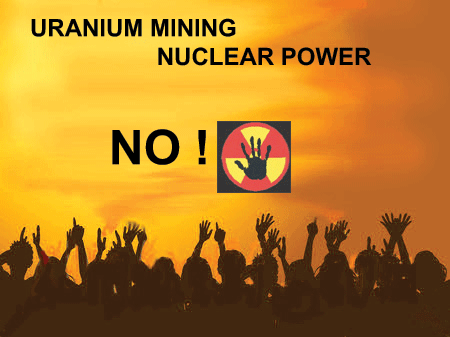
 PROTESTERS RAISE CONCERNS OF THE ENVIRONMENTAL INJUSTICE POSED BY NUCLEAR http://earthlife.org.za/2014/07/protesters-outside-nersa-public-hearing/
http://earthlife.org.za/2014/07/protesters-outside-nersa-public-hearing/“…………..protesters are concerned that South African consumers are not seeing the promised investment in social infrastructure because of the huge national debt being accumulated by Eskom. But one of the reasons for the debt is the cheap electricity supply deal that the power utility holds with Australian company BHB Billiton resulting in losses estimated at more than R11.5 billion. Lerato Maragele, Education and Outreach Officer at Earthlife Africa Jhb, explains that: “NERSA must investigate and widely publicise how lost Eskom revenue translates into electricity tariff increases for households.”
Thirdly, protesters are concerned by NERSA’s apparent inactivity on Eskom’s failure to build electricity power stations to budget and on time, and the resultant electricity price increases. “The mandate of NERSA is to promote the protection of the interests of vulnerable groups within the Electricity Supply Industry. The delays at Medupi and Kusile are causing a ripple effect throughout the whole supply chain and impacting on the most vulnerable consumers,” explains Dominique Doyle, Energy Policy Officer at Earthlife Africa Johannesburg.
CONTACTS:
Earthlife Africa Johannesburg:Makoma Lekalakala
Senior Programme Manager
Tel (w): 011 339 3662
Mobile: 082 682 9177
Email: makoma [at] earthlife.org.za Dominique Doyle
Energy Policy Officer
Tel (w): 011 339 3662
Mobile: 079 331 2028
Email: dominique [at] earthlife.org.za
A plea for support for anti uranium protesters arrested in Niger
Dear South African Fellows of the SALT
 Please note that it was agreed by common consent this year
that the campaign to end uranium mining in Niger with regard
would be a primary focus of the African Uranium Alliance,
founded in Tanzania in 2010.
Now our comrades in Niger have been arrested for their dissent
and need our active support in South Africa, through BRICS,
through the Department of International Relations and through
the African Union, not to mention Amnesty International and the
United Nations.
Remember how much we were supported in our struggles against
Apartheid by foreign governments, by overseas donors, and by
ordinary citizens of the global Anti-Apartheid Movement.
Now let us return the favour by standing by our leaders in Niger.
Contact your local press, your radio stations, and television stations.
Write to your local Member of Parliament, your leaders in Faith and
your union leaders. Raise the matter on Facebook, Twitter and by way
of public speaking.
The citizens of Niger cannot be held accountable for resistance to the
unjust and unacceptable system of uranium exploitation. Rather should
they be listened to with respect and their basic human rights to free speech
and free association afforded by the State of Niger and its allies in France.
The French Government would never be allowed to get away with
such a breach of human rights in their own country. They should not be
given any right to do so in their former colonies abroad.
After all, they are the architects of the slogan, “Liberte, Egalite, Fraternite”.
Let them practise today what their ancestors did before them.
Let the NIGER TEN go free.
-
Archives
- February 2026 (228)
- January 2026 (308)
- December 2025 (358)
- November 2025 (359)
- October 2025 (376)
- September 2025 (258)
- August 2025 (319)
- July 2025 (230)
- June 2025 (348)
- May 2025 (261)
- April 2025 (305)
- March 2025 (319)
-
Categories
- 1
- 1 NUCLEAR ISSUES
- business and costs
- climate change
- culture and arts
- ENERGY
- environment
- health
- history
- indigenous issues
- Legal
- marketing of nuclear
- media
- opposition to nuclear
- PERSONAL STORIES
- politics
- politics international
- Religion and ethics
- safety
- secrets,lies and civil liberties
- spinbuster
- technology
- Uranium
- wastes
- weapons and war
- Women
- 2 WORLD
- ACTION
- AFRICA
- Atrocities
- AUSTRALIA
- Christina's notes
- Christina's themes
- culture and arts
- Events
- Fuk 2022
- Fuk 2023
- Fukushima 2017
- Fukushima 2018
- fukushima 2019
- Fukushima 2020
- Fukushima 2021
- general
- global warming
- Humour (God we need it)
- Nuclear
- RARE EARTHS
- Reference
- resources – print
- Resources -audiovicual
- Weekly Newsletter
- World
- World Nuclear
- YouTube
-
RSS
Entries RSS
Comments RSS
 nuclear-news