ISIS insurgents get hold of nuclear materials in Iraq

 Iraq tells UN that ‘terrorist groups’ have seized nuclear materials SMH, July 10, 2014 – Michelle Nichols New York: ISIL insurgents in Iraq have seized nuclear materials used for scientific research at a university in the country’s north, Iraq has told the United Nations in a letter appealing for help to “stave off the threat of their use by terrorists in Iraq or abroad”.
Nearly 40 kilograms of uranium compounds were kept at Mosul University, Iraq’s UN Ambassador Mohamed Ali Alhakim told UN Secretary-General Ban Ki-moon in a letter this week.
“Terrorist groups have seized control of nuclear material at the sites that came out of the control of the state,” Mr Alhakim wrote, adding that such materials “can be used in manufacturing weapons of mass destruction”. However, US security sources said it would be difficult to make weapons from the material.
“These nuclear materials, despite the limited amounts mentioned, can enable terrorist groups, with the availability of the required expertise, to use it separate or in combination with other materials in its terrorist acts,” Mr Alhakim said.
He warned that they could also be smuggled out of Iraq.
A US government source familiar with the matter said the materials were not believed to be enriched uranium and therefore would be difficult to use to manufacture into a weapon………http://www.smh.com.au/world/iraq-tells-un-that-terrorist-groups-have-seized-nuclear-materials-20140710-zt2eb.html#ixzz378WRoppD
Solar energy in Japan attracting nuclear workers – for clean, safe, and better paid jobs
Stigmatized nuclear workers quit Japan utility. Bloomberg Business Week, By By Yuri Kageyama July 10, 2014 TOKYO (AP) —”………While TEPCO is out of favor with the public, the skills and experience of its employees that span the gamut of engineers, project managers, maintenance workers and construction and financial professionals, are not.
Energy industry experience is in particular demand as the development of solar and other green energy businesses is pushed along in Japan by generous government subsidies.
Currently the government pays solar plants 32 yen ($0.31) per kilowatt hour of energy. The so-called tariff for solar power varies by states and cities in the U.S., but they are as low as several cents. In Germany, it’s about 15 cents.
Sean Travers, Japan president of EarthStream, a London-based recruitment company that specializes in energy jobs, has been scrambling to woo TEPCO employees as foreign companies do more clean energy business in Japan.
“TEPCO employees are very well trained and have excellent knowledge of how the Japanese energy sector works, making them very attractive,” he said. Two top executives at U.S. solar companies doing business in Japan, First Solar director Karl Brutsaert and SunPower Japan director Takashi Sugihara, said they have interviewed former TEPCO employees for possible posts.
Besides their experience, knowledge of how the utility industry works and their contacts, with both private industry and government bureaucracy, are prized assets.
“It’s about the human network and the TEPCO employees have all the contacts,” said Travers, who says he has recruited about 20 people from TEPCO and is hoping to get more.
Yoshikawa, the former TEPCO maintenance worker, said he has received several offers for green-energy jobs that paid far better than his salary at TEPCO of 3 million yen ($30,000) a year.
Since September 2012, all TEPCO managers have had their salaries slashed by 30 percent, while workers in non-management positions had their pay reduced 20 percent. http://www.businessweek.com/ap/2014-07-10/stigmatized-nuclear-workers-quit-japan-utility
Fukushima Women Against Nuclear Power – At the Foreign Correspondents Club of Japan July 3, 20l4
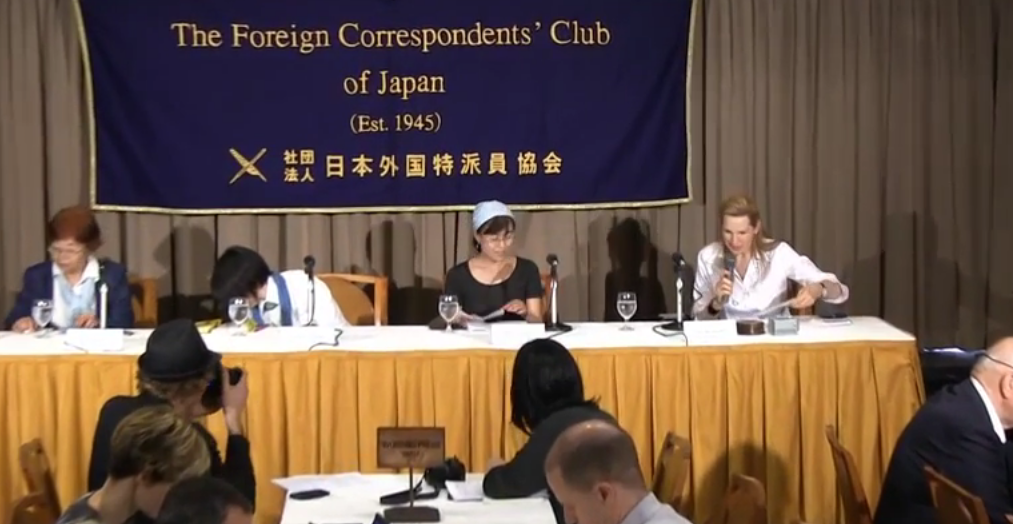
Statement in Japanese http://onna100nin.seesaa.net/
We, The Fukushima Women against Nuclear (Women of Fukushima Demand End to Nuclear Power) have submitted the following 4 demands to the Ministry of Environment, which has critical responsibilities for the decontamination and monitoring of radioactive materials, removal of earthquake debris and tainted soil as well as health care program for victims of the nuclear accidents;
l. Make plans to reduce radioactive exposure and carry them out immediately, getting out of too much dependence on decontamination.
2. Based on the principle of the Act for the relief and support of the nuclear power plant disaster victims, especially the affected children, make drastic changes to the policies of the Ministry of Environment in dealing with the affected areas with its victims, and radioactive contamination.
3. Listen to voices of victims and reflect them into the policies from now on.
4. Environment Minister, Nobuteru lshihara, should resign.
The demands are to protest against the skull session with the experts about decontamination held in Fukushima on June 15th, as well as the remark of Environment Minister lshihara “What matters in the end is the money” on the following day.
The skull session had been closed-door in the original plan, rejecting the participation of public audience. Several experts and hosts are associated with organizations which promote nuclear power, so that the selection of members wasn’t well balanced at all. There were also practices which are totally lack of transparency and fairness, such as;
– Acts to obscure affiliations of experts and hosts in a subtle manner.
– Absence of residents’ participation or representation.
– Substantive downgrade of decontamination target by shifting to measured results of personal dosimeter which measures only a part of external exposure
We strongly protest all of those practices. Yet this is not only about the Ministry of Environment, but it’s spread over various governmental agencies including the Reconstruction Agency, the Ministry of Economy, Trade and lndustry, and the Ministry of Education, Culture, Sports, Science and Technology. Their common premises are:
– No harm would be affected by this level of radioactive contamination.
– No health issues due to the nuclear power plant accident have been identified yet.
– Continuous living in the affected area is desirable both for victims and for economy of the country.
To derive policies aligned with those premises, they practiced actions such as;
– Sabotage of important investigations.
– Denial of the existence of the subjective symptoms of poor health by individuals.
– Underestimation and disregard of initial contamination and internal exposure.
– Disregard of the reports about the health effects of the Chemobyl accident from the local doctors.
– Unfair procedures to prevent submission of objections or counterarguments from citizens.
– Diffusion of the radioactive materials by policies with priority on economy and vested interests.
(The policies in place are going in the completely opposite direction to where it should be going to minimize damages of the nuclear accident;
rubble processing in the wide area and construction of incineration facilities for radioactive debris.)
The lack of sincerity on the part of the government has brought unnecessary contamination to citizens. They haven’t carried out their missions to prevent expansion of the damage.
In Fukushima Prefecture, among the youth and children under l8-year-old at the time of the disaster, the number of patient of thyroid cancers has been increasing. According to the announcement made on June 10th 2014, 89 children have or are suspected to have thyroid cancer. And many out of the 50 who already underwent operations have been suffering more severe symptoms such as lymph node metastasis, lung transition, and hoarseness. We are anxiously awaiting for the publication of reports with more detailed and accurate information.
There are also concerns of immunity system, respiratory system, circulatory organ system, alimentary system, nerve system, psychiatric disorders and others. Yet thorough investigations haven’t been conducted and the government has acted to suppress the voices of concern.
However, we are aware of the data about children who live in the post-Chemobyl nuclear-disaster Ukraine and Belarus. The number of diseases and immunity deficiencies has been increased throughout 28 years and even now. Because operations of decontamination haven’t achieved satisfactory results, the Government shouldn’t downgrade the target and left children, who are susceptible to radioactivity, in the affected area. We believe it’s unforgivable, and it’s sure from a viewpoint of preventive medicine. The Government shouldn’t confine the children in the areas of high air dose, but they should implement comprehensive measures to reduce radiation exposure, and to prevent health hazards. And it shouldn’t rely solely on decontamination work. For families who want to evacuate out of a contaminated area, they should be offered practical plans to meet their needs based on their right to evacuate. For families who decided to stay on, a program should be developed to provide periodical recreation and regular medical check-ups.
Moreover, the support for evacuees, including the voluntary evacuees, runs very short. And serious issues have come out, such as suicides and solitary deaths in evacuation home, child-abuse, unwanted retuning to the original residence, and family breakup. There is an urgent need to investigate the situation, and to provide practical supports to the victims.
Minister lshihara said “Ultimately what matter is the money.” in his answer to the question from a press after he briefed Chief Cabinet Secretary, Yoshihide Suga, about the meeting with local residents on an interim storage facility.
What we desire as the victims of this nuclear disaster is not money, but the hometown and the life we had before March11th 2011. And we do understand it’s extremely difficult. From the depth of sadness and agony, what we are asking from the Government is;
– Policies based on their determination to do the best to secure health of people and to preserve the environment.
– Minimization of the damage of the Eukushima Daiichi nuclear power plant disaster, which has not yet ended.
– Maximum preparation for the potential crisis following a big aftershock.
– Prevention of recurrence of nuclear disaster elsewhere.
However, what they’ve done is to make damage invisible with utmost effort, instead of preventing it. They’ve been accelerating diffusion of radioactive materials, and hiding initial radiation exposure and intemal exposure. On top of those, the Govemment adheres the capability of nuclear weapons through restarting nuclear power plants on the Japanese Islands which have entered into the period of great crust change.
The continuation of nuclear-fuel-cycle planning, and export of nuclear power plants to overseas such as Turkey which is another seismic country . Those activities trample on the sentiment of the victims of the Fukushima nuclear disaster, and we must say that it is the policy which has no respect for the lives of other people in the world.
Two days ago, the Abe Cabinet pushed through the Cabinet decision to approve the exercise of the right-of-collective-self-defense which rocks the foundation of constitutionalism and pacifism of the Constitution of Japan. We believe that such militarization of the country, nuclear power plant promotion, and forced toleration of radiation exposure are the Trinity, and we strongly oppose to them all.
To the People of the World,
We would like you to be aware of this serious reality in Japan, and to pay attention to it. We need your help to our activities toward the minimum damage of nuclear power disaster.
July 3, 20l4 Fukushima Women against Nukes
(Women of Fukushima Demand End to Nuclear Power)
Statement source ; http://onna100nin.up.seesaa.net/image/Speech20At20the20Foreign20Correspondents20Club20of20Japan20July2032C202014.pdf
THIS WEEK in nuclear news

Christina Macpherson’s websites & blogs
Fukushima. A new critical problem – as the cooling system at nuclear fuel pool 5 is not working.
USA. Wisconsin town faces economic disaster, with the closing of Kewaunee nuclear power plant, and the prospect of 60 years of clean-up – the first of many tons to have to cope with the nuclear power aftermath. As USA’s nuclear industry declines, renewed efforts to beat China, Russia, France, South Korea, in selling nukes to Vietnam.
Underground danger, and continuing radiation release from USA’s crippled Waste Isolation Pilot Project (WIPP) in New Mexico
Escalation in nuclear armed submarines, their $100 billion costs now amplified with associated costs to $347 billion.
UK. Quakers speak out against Trident nuclear missile program. The proud Scottish peaceniks, of the 32 years’ campaign to shut down Trident nuclear weapons, renew their drive, in view of the coming referendum on Scotland’s independence. Did you know that Last March, two Peace Campers, Heather Stewart and Jamie Watson, broke into the naval base and climbed on board a nuclear powered Astute submarine? That feat of civil disobedience did not get into the news, did it? A security failure too, wasn’t it?
National Archives release a chilling list of nuclear targets in the cold war – perhaps the same targets today?
Ukraine. Continued conflicts there raise a very real danger of attack or accident to their 19 nuclear power plants.
India did a very bad nuclear deal with USA, Russia and France, in order to engage in international nuclear commerce, despite its status as a nuclear weapons state outside the Nuclear Non-Proliferation Treaty. Indian govt is nowcriminalising nuclear and environmental dissent.
A critical problem: no cooling system now working at Fukushima No.5 fuel pool
 Fox News: “Leak at Fukushima nuclear plant threatens dangerous meltdown… Trouble is looming” — Officials: “No idea when it can resume cooling system for spent fuel pool” (PHOTOS) http://enenews.com/fox-news-leak-at-fukushima-nuclear-plant-threatens-dangerous-meltdown-trouble-is-looming-officials-no-idea-when-it-can-resume-cooling-system-for-spent-fuel-pool-photos
NHK WORLD, Jul. 7, 2014: No prospect to resume cooling No.5 fuel pool — The operator of the Fukushima Daiichi nuclear power plant says it has no idea when it can resume the cooling system for one of the spent fuel pools. [TEPCO] halted the cooling system at the No.5 reactor on Sunday after workers found seawater leaking from a pipe. Seawater is used to lower the temperature of coolant water […] they are still considering how to repair the pipe. […] TEPCO says the temperature will reach the company’s safety limit of 65 degrees in a little over a week. The operator plans to channel seawater into the pool to curb the rise in temperature.
Fox News, Jul. 7, 2014: Leak at Fukushima nuclear plant threatens dangerous meltdown — Trouble is looming at Japan’s Fukushima nuclear plant, as a leak has forced the shutdown of a cooling system that could cause temperatures to exceed dangerous levels. […] If the system is not repaired within the next nine days, temperatures are expected to soar […] Sunday, the temperature in the pool that holds the rods was about 73 degrees Fahrenheit but started increasing by 0.193 degrees per hour, TEPCO says. If no new cold water is pumped in at this rate, it will reach the dangerous threshold of 149 degrees (F) in roughly the next week. Such temperatures would increase the possibility of dangerous reactions and more radiation leaks in the plant.
The coming economic disaster for USA’s nuclear towns, starting with Kewaunee
 Wisconsin Reactor’s Demise Shows Nuclear Towns’ Plight Bloomberg News By Tim Jones July 08, 2014 “……..The Wisconsin facility is part of what Moody’s Investors Service describes as the largest wave of U.S.-based nuclear and coal electric-plant retirements in the past 35 years. The closings stem from abundant supplies of cheaper natural gas and changes in environmental policies. The consequences can be sudden and drastic, affecting school funding, real-estate values and economic development that were linked to the facilities.
Unlike abandoned industrial plants, which can be retooled for another manufacturer, nuclear plants leave another legacy: radioactive waste, which at the Kewaunee site sits in concrete canisters about 100 yards (91 meters) from Lake Michigan.
“The challenge that local officials have to face is large,” said Julie Beglin, one of the report’s co-authors……..
“It was cheaper to purchase energy on the open market than to produce it at Kewaunee,” said Mark Kanz, a company spokesman. “I’m sure it won’t be the last to close. There will be other plants that go through decommissioning, whether it’s economics or from equipment-related issues.”…….
While the economics of power generation can change, two factors work against the nuclear industry, said David Lochbaum, director of the Nuclear Safety Project at the Union of Concerned Scientists.
“The cost of non-nuclear electricity is trending down,” Lochbaum said, “and the cost of maintaining aging nuclear power reactors is trending up.”……
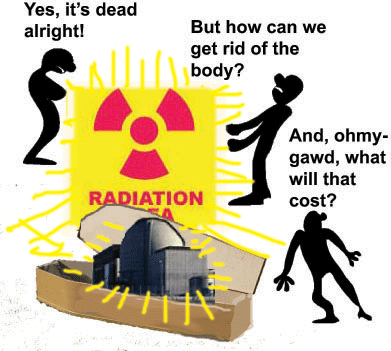 Six Decades The aftermath of a nuclear power plant’s leaving a community is more complicated and lengthy than the end of a conventional industrial facility. Federal regulations governing the decommissioning of sites are designed to protect the public.
The process must be completed within 60 years, according to the Nuclear Regulatory Commission. Seventeen plants, including Kewaunee, are in some phase of decommissioning, the NRC said on its website…….http://www.businessweek.com/news/2014-07-08/wisconsin-reactor-s-slow-motion-end-shows-nuclear-towns-plight
32 years of the peaceniks’ camp and civil disobediance against nuclear weapons
 THESE HIPPIES ARE CAMPING IN THE FOREST TO RID SCOTLAND OF ITS NUKES VICE By Alex Rodin Jul 8 2014 On the banks of Gare Loch, on the west coast of Scotland, a bunch of anti-nuke hippie peaceniks are taking on the might of the British armed forces and its nuclear submarines by living in camper vans. Faslane Peace Camp has occupied the roadside verge preceding HM Naval Base Clyde, home to the UK’s Trident nuclear missile submarines, for 32 years—more than three decades of sleeping in the forest in an effort to rid the UK of nukes.
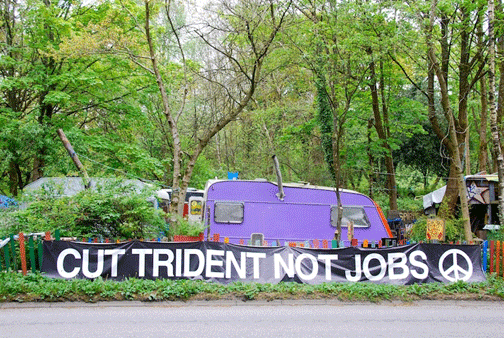
This year’s independence referendum, which would make Scotland its own country, raises the possibility that the Scots could actually get rid of the nukes on their soil. Meanwhile in London, the government is striking a deal tying the UK’s nuclear future closer to the US. I decided it was a good time to pay the camp a visit. ……
Last March, two Peace Campers, Heather Stewart and Jamie Watson, broke into the naval base and climbed onboard a nuclear powered Astute submarine. They stood on the deck ringing its bell as a gaggle of surprised police officers came running.
“How the hell did you get in here?” one of the officers asked as they were being arrested. It seemed a logical question, given the razor wire, the security cameras, the motion-activated alarms that run along the perimeter fence, and the patrols that circle the base……
having been arrested and after 33 hours in custody, the pair emerged to discover that nobody else cared. The media wasn’t much interested in publicizing their exploits and, except for some backslapping within the peace movement, the world moved on without noticing………
The activists are holding out for Scottish independence. September’s referendum is returning Trident to the limelight as the Yes Scotland campaign dangles promises of a nuclear-free country. But in London, government ministers have other plans. They’ve been quietly meeting with their American counterparts to renegotiate a treaty that would wrap up Britain’s nuclear future with the United States. The 1958 UK-US Mutual Defense Agreement (MDA) has long facilitated cooperation between the US and the UK on nuclear technology. However, according to the Royal United Services Institute (RUSI), “collaboration between the two countries under the MDA has evolved to the extent that the boundary between the design and construction of UK and US warheads has blurred.”
A RUSI paper published in March explained that many of the “components within the UK’s current warhead are supplied by the US under the MDA, and the UK presently lacks the capability to develop domestic alternatives.” As such, “The future of the UK’s nuclear arsenal is therefore inextricably linked to that of the US.” The revised MDA is likely to be signed any day now…….http://www.vice.com/read/faslane-scotland-peace-camp-independence-619
Internal radiation emitters causing cancers, birth deformities: depleted uranium’s legacy in Iraq
 Depleted Uranium And The Iraq War’s Legacy Of Cancer, Mint Press News, Depleted uranium was used in Iraq warzone weaponry, and now kids are playing in contaminated fields and the spent weapons are being sold as scrap metal. By Frederick Reese @FrederickReese | July 2, 2014 As instability in Iraq is forcing the United States to consider a third invasion of the Middle Eastern nation, the consequences of the first two invasions are coming into focus. For large sectors of the Iraqi population, American intervention has led to sharp spikes in the rates of congenital birth defects, premature births, miscarriages and leukemia cases.
According to Iraqi government statistics, the rate of cancer in the country has skyrocketed from 40 per 100,000 people prior to the First Gulf War in 1991, to 800 per 100,000 in 1995, to at least 1,600 per 100,000 in 2005.
The culprit behind all of these health issues is depleted uranium, a byproduct of uranium enrichment. With a mass fraction a third of what fissile uranium would have, depleted uranium emits less alpha radiation — up to 60 percent less than natural uranium, according to the U.S. Department of Defense. This “relative” safety offered a rationale for many nations — particularly, the U.S. — to put the waste material to use.
As depleted uranium is 1.67 times denser than lead, a depleted uranium projectile can be smaller than an equivalent lead projectile but produce similar results. This smaller size means a smaller diameter, less aerodynamic drag and a smaller area of impact, meaning that depleted uranium bullets can travel faster and inflict more pressure on impact, causing deeper penetration. Additionally, depleted uranium is incendiary and self-sharpening, making depleted uranium ideal for anti-tank ammunition. It is also used as armor plating for much of America’s tank fleet.
The problem with using depleted uranium, however, lies in the fact that depleted uranium is mostly de-energized. In practical terms, depleted uranium can have — at a minimum — 40 percent the radioactivity of natural uranium with a half-life that can be measured in millennia (between 703 million to 4.468 billion years). While the depleted uranium presents little to no risk to health via radiation due to its relatively weak radioactivity, direct internal contact with the heavy metal can have chemical toxicity effects on the nervous system, liver, heart and kidneys, with DNA mutations and RNA transcription errors being reported in the case of depleted uranium dust being absorbed in vitro.
While depleted uranium is not as toxic as other heavy metals, such as mercury or lead, pronounced toxicity is still possible through repeated or chronic exposure………http://www.mintpressnews.com/depleted-uranium-iraq-wars-legacy-cancer/193338/
China’s underground nuclear reactors
 The Untold Story of China’s Forgotten Underground Nuclear Reactor, FP BY JEFFREY LEWIS JULY 8, 2014 How social media and a little sleuthing turned up a Mao-era nuclear program. “……despite official secrecy about China’s production of plutonium for nuclear weapons, my colleague Catherine Dill and I discovered an underground nuclear reactor that China attempted to construct near Yichang in Hubei province during the 1960s and 1970s……..
In the early 1960s, China had one plant to make highly enriched uranium near Lanzhou and was completing one nuclear reactor to produce plutonium at Jiuquan. In 1964, China began the “Third Line” effort — a massive construction effort to relocate all of China’s heavy industries, nuclear and otherwise, in the interior of the country. Often these factories, including things as mundane as steel mills, were placed underground to protect them from Soviet or American attack. As you might expect, the disruption of attempting to relocate the country’s heavy industries to underground caverns in the rural interior was a complete and total cluster… well, you know. Wikipedia calls the Third Line “an economic fiasco,” which seems to me to be an example of the wisdom of crowds.
As part of the Third Line effort, China’s nuclear engineers were supposed to build a copy of the first reactor — the one where Cui worked — in an underground cavern being dug near Fuling. But placing a nuclear reactor under a mountain is about as slow and arduous as you might expect. At some point in 1969, with relations between Moscow and Beijing collapsing, Beijing decided it could not wait for the engineers to finish Fuling. The first proposal suggested physically picking up and moving the reactor near Jiuquan somewhere else. Eventually the technical personnel convinced the Chinese leadership this was total madness. So, instead, China started building a temporary replacement above ground, near a place called Guangyuan in Sichuan.
I always wondered how, in the middle of the paranoia associated with the Cultural Revolution, Chinese leaders came to their senses and ditched the underground reactor at Fuling in favor of the above-ground copy at Guangyuan. It turns out they didn’t. Instead of replacing one crazy project with a more sensible one, the Chinese doubled-down on crazy — continuing the reactor project at Fuling, starting a new one at Guangyuan and, we now know, starting the underground reactor at Yichang. … As best we can tell, China never finished the heavy water at Yichang, just as it never finished Fuling or any other number of wildly implausible Third Line projects. Construction at Yichang lumbered on through the 1970s, before being shut down around 1980 or so. At this point, the Chinese government took a number of steps to transition its nuclear industry to civilian power generation, converting and eventually decommissioning the reactor near Jiuquan, as well as giving up on Fuling and Yichang. China would not build a heavy water reactor until it bought CANDU heavy water reactors from Canada, one in 2002 and another in 2003. (CANDU is a portmanteau of “Canada” and “deuterium oxide,” better known as heavy water.) Yichang is just a footnote. A crazy, implausible footnote…….
Of the two plutonium production reactors that China finished, Jiuquan closed in the late 1980s and Guangyuan closed sometime in the 1990s. China never finished the reactors at Fuling or Yichang. China’s surprisingly small stockpile of plutonium isn’t so surprising once we know this historical context. They tried to make more. They just couldn’t…..
There will be more disclosures. Like yet another unfinished secret underground nuclear reactor that I haven’t mentioned. That’s right, there is a third underground nuclear reactor project that we’ve found. …..http://www.foreignpolicy.com/articles/2014/07/08/the_untold_story_of_chinas_forgotten_underground_nuclear_reactor_yichang_827_plant
Nuclear colonialism- pushing nuclear sales to Vietnam

Meanwhile, Vietnam Plus of the Vietnam News Agency reported that the US Congress began considering a cooperation proposal on May 9. It has 90 days to consider the issue before making a final decision.
Prior to that, the Vietnamese and US representatives signed a Vietnam-US nuclear cooperation agreement in Hanoi on May 6 (Agreement 123).
Vietnamese officials and scientists have expressed their satisfaction about the agreement.Minister of Science and Technology Nguyen Quan said at the signing ceremony that the agreement can be seen as an open door for both the US and Vietnam to accelerate projects on nuclear energy development…….
 The US Nuclear Energy Institute (NEI) and the US nuclear energy firms have unanimously urged the US Congress to ratify the agreement soon, emphasizing that the strengthened cooperation with Vietnam in the sector would help boost exports and create more jobs.
The US firms can expect to earn $10-20 billion from the deals with Vietnam…..David Durham from GE Hitachi Nuclear Energy (GHE) has warned that if the US Congress does not ratify the agreement, US firms will lose the lucrative market of Vietnam……http://english.vietnamnet.vn/fms/science-it/106944/vietnam-nuclear-power-market-eyed-by-three-major-countries.html
The costs, the dangers, the madness of nuclear-armed submarines
Doom from the Depths: Coming Your Way The World Post Lawrence Wittner Become a fan Professor of History emeritus, SUNY Albany 7 July 14 Ever since the horrors of submarine warfare became a key issue during World War I, submarines have had a sinister reputation. And the building of new, immensely costly, nuclear-armed submarines by the U.S. government and others may soon raise the level of earlier anxiety to a nuclear nightmare.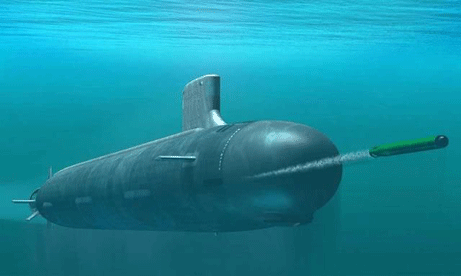
This spring, the U.S. government continued its steady escalation of research and development funding for the replacement of its current nuclear submarine fleet through one of the most expensive shipbuilding undertakings in American history — the phasing-in, starting in 2031, of 12 new SSBN(X) submarines. Each of these nuclear-powered vessels, the largest submarines the Navy has ever built, will carry up to 16 Trident ballistic missiles fitted with multiple nuclear warheads. All in all, this new submarine fleet is expected to deploy about 1,000 nuclear warheads —70 percentof the U.S. government’s strategic nuclear weapons.
From the standpoint of the U.S. military, nuclear-armed submarines are very attractive. Capable of being placed in hidden locations around the world and remaining submerged for months at a time, they are less vulnerable to attack than are ground-launched or air-launched nuclear weapons, the other two legs of the “nuclear triad.” Moreover, they can wreak massive death and destruction upon “enemy” nations quite rapidly. The Defense Department’s Quadrennial Defense Review of 2014 explained that the U.S. Navy’s future fleet would “deliver the required presence and capabilities and address the most important war-fighting scenarios.”
From the standpoint of civilians, the new Trident submarine fleet is somewhat less appealing. Strategic nuclear weapons are the most destructive weapons in world history, and the use of only one of them over a large city could annihilate millions of people instantly. If the thousands of such weapons available to the U.S. government and other governments were employed in war, they would incinerate most of the planet, reducing it to charred rubble. Thereafter, radioactivity, disease, nuclear winter, and starvation would end most remaining life on earth.
Of course, even in an accident, such weapons could do incredible damage. And, over the years, nuclear-armed submarines have been in numerous accidents. …….
Taxpayers, particularly, might be concerned about the unprecedented expense of this new submarine fleet. According to most estimates, building the 12 SSBN(X) submarines will cost about $100 billion. And there will be additional expenditures for the missiles, nuclear warheads, and yearly maintenance, bringing the total tab to what the Pentagon estimated, three years ago, at $347 billion. The expected cost is so astronomical, in fact, that the Navy, frightened that this expenditure will prevent it from paying for other portions of its shipbuilding program, has insisted that the money come from a special fund outside of its budget. This spring, Congress took preliminary steps along these lines……http://www.huffingtonpost.com/lawrence-wittner/doom-from-the-depths-comi_b_5564287.html
India: Two big utilities investing in renewable energy
 Tata, Reliance Power bet big on renewable energy, to spend Rs 1,500 crore each, Economic Times, By Shuchi Srivastava, ET Bureau | 9 Jul, 2014, MUMBAI: Two of the country’s largest power producers Tata PowerBSE -5.04 % and Reliance PowerBSE -7.70 % are betting big on renewable energy and will spend about Rs 1,500 crore each on clean energy projects this fiscal.
“Reliance Power is keen to be a part of the journey to position India as one of the world’s major solar power producers in the coming years. Given the exciting new opportunities such as the ultra mega solar PV projects and the shortfall in meeting the renewable purchase obligations by various state discoms,” said the company. http://economictimes.indiatimes.com/articleshow/38044771.cms?utm_source=contentofinterest&utm_medium=text&utm_campaign=cppst
Does Tepco own a radioactive marshland in Oze national park it can not sell?
Op Ed by Arclight2011
Published on 7 July 2014
Posted to nuclear-news.net
At the early stages of the Fukushima nuclear disaster I wondered if the Oze National park had been contaminated from nuclear fallout. Chris busby had tested car air filters from Tokyo and found high levels of radioactive particles and he also tested a filter from an apartment in Tokyo and found high levels of radioactive lead Pb.

A Japanese scientist was refused to check for radionuclides in the environment and had to leave his university position and then tested for contamination and found high levels of radionuclides in the forest in the mountains.
The map below shows a radionuclide dispertion different from the IAEA/UNSCEAR version in that it shows a wide dispertion that finds its way into the mountains nearly as far as Tokyo.

Image source ; http://backyardworld.wordpress.com/maps/
A recent finding posted by Iori at Fukushima Diary asks why is the level of contamination in Tokyo drinking water as high as Fukushima and even higher than Myiagi prefecture (that is nearer than Tokyo)? A reason might be that the reservoirs that supply Tokyo are contaminated from the higher levels of contaminates washed down from the mountains and or through the rivers from the marshes at Oze National Park, these past 3 years.
If we look at the waters that feed the marshland in Oze National Park that is south of the Fukushima Daichi nuclear site, we might wonder if the waters that feed Oze National Park might also be suffering from contamination.
There are no known studies of this area that have been made public.However an article published in Japan in July 2011 states that in a Spa near to the mountain range that an atmospheric reading showed that the contamination was as much as 50 percent of the contamination found in Fukushima city (0.45 mcSv/h at the spa).
TEPCO own some 70 percent of this unique wildlife area and were asked to sell it to compensate the people of Fukushima but the Yukio Edano, a government minister, was reported to ask TEPCO to not sell it . This is odd as the area had been losing visitors for many years before the disaster and therefore TEPCO were not showing themselves to be good stewarts of the land anyway. In fact, an OECD report from 1999 said that conflicts between the private sector (TEPCO and the Oze Forest Management Co. owned by Tepco and runs 5 lodges in Oze, four of which are in the Special Protection Zone against other park organisers wishes) and the environment agency and conservation NGO`s caused difficulties that would be easier to deal with if the environment agency had overall say in the running of Oze National park.
The fact that TEPCO only provide 200 million Yen a year to the overall 1.4 billion Yen a year running costs (600 million Yen of which comes from the government and 400 Million Yen from NGO`s). A sluice gate that provided water from the park helps to feed the Tone River which is used for irrigation and which dams have been constructed on its headwaters to produce hydroelectricity and to form reservoirs to supply water to the Keihin Industrial Zone. This river meets the pacific just north of Tokyo near the heavily contaminated area of Chiba.
The questions really are “why has TEPCO not sold its shares in the National Park? Is it because the area is contaminated and this might be found out by the new owners? Why is the government saying Tepco should not sell it if the OECD report says that it would be more simple not to have the ownership shared with a private company?
Also the aquifer that feeds the lower marshland is connected to the same aquifer that the nuclear disaster site is situated on. So TEPCO would want control of this large area to cover up any cross contamination from the nuclear site?
The contaminated ground water at Daichi is above another layer of groundwater that is deeper. The water at the lower level was found to have less pressure than the water above that is contaminated. So that means that the lower layer of ground water has been contaminated over the last 3 years and that contaminated water may be making its way slowly towards the Oze national park marshlands that TEPCO owns.
The idea of the ice wall is to possibly lower the pressure of the upper layer under the nuclear reactors and slow down the process. Although it is reported that TEPCO have started the ice wall it seems that this means that they are drilling holes for sensors and the freezing process is not yet begun. I can find no report that the freezing of the water has started. So this means that the heavily contaminated high pressure water is still mixing with the lower pressure deeper layer and likely traveling outwards from there.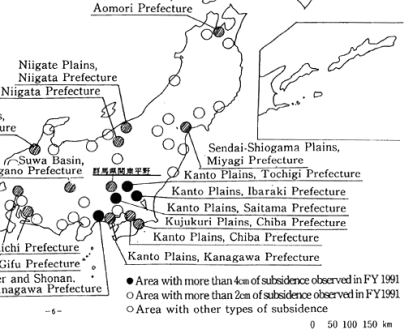
A Japanese government report from 1993 shows that this whole area was effected by industry using this ground water to supply its factories and nuclear plants. This caused a vast subsidence all along the coast and on the Fukushima plain.needless to say, TEPCO need to be very careful how they manage these layers of ground water because it covers a vast area. And this was likely the reason for the need for a sluice gate to replace the ground water restrictions brought in after the ground subsidence issues reported above.
Below I leave you with some relevant quotes and links;
Continue reading
Economics, Time, and Terrorism make a thorium nuclear industry unlikely to happen
 Writing in Oil Price, Andrew Topf 18 June 2014 discusses the very real impediments to starting a thorium nuclear reactor industry
“One large hole that can be punched in the argument for thorium involves the economics of thorium reactors. Experts say compared to uranium, the thorium fuel cycle is more costly and would require extensive taxpayer subsidies.
Another issue is time. With a viable thorium reactor at least a decade away if not more, the cost of renewable alternatives like solar and wind may come down to a point where thorium reactors won’t be economical. Critics also point out that the nuclear industry has invested too much in uranium reactors – along with government buy-in and a set of regulations around them – to be supplanted by thorium.
As for the “green nuclear” argument, thorium’s detractors say that isn’t necessarily the case. While thorium reactors produce less waste, they also produce other radioactive by-products that will need safe disposal, including U-232, which has a half-life of 160,000 years.
“It will create a whole new volume of radioactive waste from previously radio-inert thorium, on top of the waste from uranium reactors. Looked at in these terms, it’s a way of multiplying the volume of radioactive waste humanity can create several times over,” said Oliver Tickell, author of Kyoto2, speaking to The Guardian.”
The enormous and intractable problem of Fukushima’s radioactive soil
 Fukushima’s radioactive soil sparks fights, exposes the enormity and hopelessness of clean-up taskStraight, by MARTIN DUNPHY on JUL 4, 2014 “…….Soil would fill how many B.C. Places?In the months after the 2011 earthquake-and-tsunami catastrophe, environment ministry experts estimated that the amount of radioactive topsoil from parts of four surrounding prefectures that would have to be “decontaminated” and stored could be as high as 29 million cubic metres.
That would be about enough dirt to fill the 59,000-capacity B.C. Place Stadium 23 times.
However, Yuichi Moriguchi, a University of Tokyo environmental-engineering professor, pegged the amount at closer to 100 million cubic metres, enough to fill 80 B.C. Places.
Minister Ishihara had told reporters in Tokyo on June 16 that the dragged-out and often acrimonious soil-storage negotiations between Abe’s Liberal Democratic Party–led administration and local and state governments in Fukushima would be solved once the issue of “monetary value” was settled.
Fukushima residents, evacuees, the governor, and the mayors of Futaba and Okuma—the two towns adjacent to Daiichi that have been tentatively earmarked for storage facilities—were outraged by the comment.
They called it insensitive and said it failed to take into account their dislocation, fears, and sense of helplessness. They said it made them seem to be concerned only with compensation.
Minister underestimated reaction
The environment minister quickly backtracked, saying he was misconstrued, but he refused to retract his statement. After opposition pressure, however, he apologized during a June 19 parliamentary session and retracted his remark………
Many of the sites are already at or near capacity.
Costs could be wildly inaccurate
In December 2013, Tokyo announced that it would spend almost $1 billion to store 132,738 tonnes of radioactive soil already removed from near the crippled power plant. No towns came forward to offer to sell the approximately three to five square kilometres of land estimated to be needed to build the supposedly “interim” facility to house the waste, currently stored temporarily in different locations around Japan.
(That plan covers less than 150,000 tons of soil. Greenpeace International has claimed that as of February 2013, more than fourmillion tons of radioactive waste had been produced.)
The $1-billion cost of this plan might be severely underestimated, however. A disposal centre in Rokkasho, Aomori Prefecture, for low-level radioactive waste from the country’s nuclear plants (including metal parts and work clothing) cost $2 billion to build.
And it holds only 200,000 cubic metres of material.
The true cost for the planned “interim” facility could be in the tens of billions of dollars—or much higher.
Waste needs to be stored for 30 years
Prefecture officials and residents expressed skepticism about the unclear future location of “permanent” storage sites, noting that the material would have to be stored away for a minimum of 30 years and voicing fears that their towns would become the preferred perpetual spots…….
There are many areas outside this district that are contaminated as well, to varying degrees, including isolated “hot spots”. Some of these were found in Tokyo, more than 200 kilometres away from Daiichi. On the other hand, that original clean-up area consists of up to 70 percent woodlands, hills, and mountains, much of which (if not most) will probably never be touched by decontamination efforts.
Some areas may be deserted forever
And if more than five centimetres of topsoil needs to be scraped off to remove radioactive cesium, after years of rain and groundwater movement, the volume of material needing to be stored will rise accordingly. Prof. Tomoko M. Nakanishi, from the University of Tokyo’s graduate school of agriculture, conducted soil research in Fukushima post-disaster and had this to say about how readily radioactive cesium was absorbed by the soil: “It was like pollen with superglue.”
Friends of the Earth, an international network of environmental groups, reported in 2012 that a test soil-decontamination program for only three houses in Fukushima generated 35 tons of soil waste.
In the end, it will probably be areas around parks, residences, schools, hospitals, and other public buildings that will see the most attention from decontamination efforts.
Some parts of the surrounding prefectures may never see a return to levels of human activity to compare with pre-Fukushima. And some areas may remain deserted forever.
Oh, yeah, then there’s the ocean
This is without even mentioning the incalculable amount of radioactive groundwater and cooling water that has flowed into the Pacific Ocean nonstop since the first day of the disaster almost three-and-a-half years ago. Woods Hole Oceanographic Society scientists labelled this “the largest accidental release of radiation to the ocean in history”.
According to Greenpeace International, one month after the meltdowns, cesium-137 levels in the sea near Daiichi were 50 million times higher than pre-disaster measurements. (Cesium-137 has a half-life of 30 years; cesium-134’s is a bit more than two years.)
And Asahi—using data provided by Tokyo Electric Power Co. (TEPCO), the Daiichi plant operator—says that 462TBq (a terabecquerel equals one trillion Becquerels) of radioactive strontium have been dumped into the Pacific. Strontium is potentially far more dangerous to human life than either cesium-134 or cesium-137.
There have been conflicting reports about the amounts of even deadlier plutonium that might have been released into the soil, air, or water……http://www.straight.com/news/680196/fukushimas-radioactive-soil-sparks-fights-exposes-enormity-and-hopelessness-clean-task
-
Archives
- February 2026 (233)
- January 2026 (308)
- December 2025 (358)
- November 2025 (359)
- October 2025 (376)
- September 2025 (258)
- August 2025 (319)
- July 2025 (230)
- June 2025 (348)
- May 2025 (261)
- April 2025 (305)
- March 2025 (319)
-
Categories
- 1
- 1 NUCLEAR ISSUES
- business and costs
- climate change
- culture and arts
- ENERGY
- environment
- health
- history
- indigenous issues
- Legal
- marketing of nuclear
- media
- opposition to nuclear
- PERSONAL STORIES
- politics
- politics international
- Religion and ethics
- safety
- secrets,lies and civil liberties
- spinbuster
- technology
- Uranium
- wastes
- weapons and war
- Women
- 2 WORLD
- ACTION
- AFRICA
- Atrocities
- AUSTRALIA
- Christina's notes
- Christina's themes
- culture and arts
- Events
- Fuk 2022
- Fuk 2023
- Fukushima 2017
- Fukushima 2018
- fukushima 2019
- Fukushima 2020
- Fukushima 2021
- general
- global warming
- Humour (God we need it)
- Nuclear
- RARE EARTHS
- Reference
- resources – print
- Resources -audiovicual
- Weekly Newsletter
- World
- World Nuclear
- YouTube
-
RSS
Entries RSS
Comments RSS
 nuclear-news