Does Tepco own a radioactive marshland in Oze national park it can not sell?
Op Ed by Arclight2011
Published on 7 July 2014
Posted to nuclear-news.net
At the early stages of the Fukushima nuclear disaster I wondered if the Oze National park had been contaminated from nuclear fallout. Chris busby had tested car air filters from Tokyo and found high levels of radioactive particles and he also tested a filter from an apartment in Tokyo and found high levels of radioactive lead Pb.

A Japanese scientist was refused to check for radionuclides in the environment and had to leave his university position and then tested for contamination and found high levels of radionuclides in the forest in the mountains.
The map below shows a radionuclide dispertion different from the IAEA/UNSCEAR version in that it shows a wide dispertion that finds its way into the mountains nearly as far as Tokyo.

Image source ; http://backyardworld.wordpress.com/maps/
A recent finding posted by Iori at Fukushima Diary asks why is the level of contamination in Tokyo drinking water as high as Fukushima and even higher than Myiagi prefecture (that is nearer than Tokyo)? A reason might be that the reservoirs that supply Tokyo are contaminated from the higher levels of contaminates washed down from the mountains and or through the rivers from the marshes at Oze National Park, these past 3 years.
If we look at the waters that feed the marshland in Oze National Park that is south of the Fukushima Daichi nuclear site, we might wonder if the waters that feed Oze National Park might also be suffering from contamination.
There are no known studies of this area that have been made public.However an article published in Japan in July 2011 states that in a Spa near to the mountain range that an atmospheric reading showed that the contamination was as much as 50 percent of the contamination found in Fukushima city (0.45 mcSv/h at the spa).
TEPCO own some 70 percent of this unique wildlife area and were asked to sell it to compensate the people of Fukushima but the Yukio Edano, a government minister, was reported to ask TEPCO to not sell it . This is odd as the area had been losing visitors for many years before the disaster and therefore TEPCO were not showing themselves to be good stewarts of the land anyway. In fact, an OECD report from 1999 said that conflicts between the private sector (TEPCO and the Oze Forest Management Co. owned by Tepco and runs 5 lodges in Oze, four of which are in the Special Protection Zone against other park organisers wishes) and the environment agency and conservation NGO`s caused difficulties that would be easier to deal with if the environment agency had overall say in the running of Oze National park.
The fact that TEPCO only provide 200 million Yen a year to the overall 1.4 billion Yen a year running costs (600 million Yen of which comes from the government and 400 Million Yen from NGO`s). A sluice gate that provided water from the park helps to feed the Tone River which is used for irrigation and which dams have been constructed on its headwaters to produce hydroelectricity and to form reservoirs to supply water to the Keihin Industrial Zone. This river meets the pacific just north of Tokyo near the heavily contaminated area of Chiba.
The questions really are “why has TEPCO not sold its shares in the National Park? Is it because the area is contaminated and this might be found out by the new owners? Why is the government saying Tepco should not sell it if the OECD report says that it would be more simple not to have the ownership shared with a private company?
Also the aquifer that feeds the lower marshland is connected to the same aquifer that the nuclear disaster site is situated on. So TEPCO would want control of this large area to cover up any cross contamination from the nuclear site?
The contaminated ground water at Daichi is above another layer of groundwater that is deeper. The water at the lower level was found to have less pressure than the water above that is contaminated. So that means that the lower layer of ground water has been contaminated over the last 3 years and that contaminated water may be making its way slowly towards the Oze national park marshlands that TEPCO owns.
The idea of the ice wall is to possibly lower the pressure of the upper layer under the nuclear reactors and slow down the process. Although it is reported that TEPCO have started the ice wall it seems that this means that they are drilling holes for sensors and the freezing process is not yet begun. I can find no report that the freezing of the water has started. So this means that the heavily contaminated high pressure water is still mixing with the lower pressure deeper layer and likely traveling outwards from there.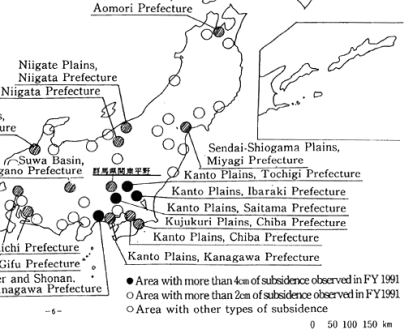
A Japanese government report from 1993 shows that this whole area was effected by industry using this ground water to supply its factories and nuclear plants. This caused a vast subsidence all along the coast and on the Fukushima plain.needless to say, TEPCO need to be very careful how they manage these layers of ground water because it covers a vast area. And this was likely the reason for the need for a sluice gate to replace the ground water restrictions brought in after the ground subsidence issues reported above.
Below I leave you with some relevant quotes and links;
Ever since peaking at about 640,000 in 1996, the number of visitors to Oze has been on a decline. The past few years saw numbers sitting at about 300,000, though in 2010 a year-on-year increase was recorded for the first time in two years.
Hot spring spa also suffers
Visitor numbers to Shiobara hot spring spa in Nasushiobara, Tochigi Prefecture–about 120 kilometers away from the Fukushima No. 1 nuclear power plant–have also plummeted since the disaster.
The amount of radiation measured in the city stood at 0.45 microsievert per hour as of Monday, less than half of that recorded in the city of Fukushima. Despite this, the number of guests to the spa fell 75 per cent in March, 60 per cent in April and 25 per cent in May, from the same months last year.
The Yomiuri Shimbun/Asia News Network
Fri, Jul 08, 2011
http://news.asiaone.com/News/Latest%2BNews/Asia/Story/A1Story20110708-288089.html#sthash.QLwF7uVM.dpuf
<Oze National Park Series- I>
– Plants in Oze –
Oze is a large scale marshland in the world and is often praised for its unique landscape created thanks to its location at high altitude (1400 to 1600 m).
What is called “Marshland” varies in its nature place to place, and in case of Oze, peats made of grass and moss (grow under humid condition) are accumulated 4 to 5 meters without being dissolved because of its cool climate throughout a year. This type of marshland is called “High moor” which is the final stage of a process of transformation from low, intermediate through to high. It is also said that it takes 10,000 years to get this final stage that Oze is currently in.
In Oze, we can enjoy seeing a variety of plants which account of 10 % (900 kinds) of all the plant species identified in Japan, and this includes some remaining plants from Ice Age. Asian skunk cabbage (“Mizu-basho” in Japanese) is one of such having survived to date after the epoch, and it blooms every late May in Oze as an opening of the high season of the park, which looks truly lovely and somewhat innocent in white color.
Note: The white part looks like a petal, but is actually a leaf, and the yellow stick-like standing up in the center is flower.
* TEPCO is the land owner of 40 % (16,000 hectares) of the Oze national park that is designated as a special national treasure of Japan, which covers 70% of special protection area in the park. TEPCO aims to be a company that coexists with the local community through both communication (services) and the facilities.
(Asian skunk cabbage: Images taken by Tepco)
No comments yet.
1 This Month
23-25 October – on Zoom – World BEYOND War’s annual global conferenc


Shut down the radiation-damaged Heysham nuclear reactors now
To see nuclear-related stories in greater depth and intensity – go to https://nuclearinformation.wordpress.com

Say No to NASA’s Reckless Nuclear Reactor on the Moon
Say No to NASA’s Reckless Nuclear Reactor on the Moon
-
Archives
- October 2026 (160)
- September 2026 (339)
- August 2026 (330)
- July 2026 (355)
- June 2026 (287)
- May 2026 (306)
- April 2026 (356)
- March 2026 (251)
- February 2026 (267)
- January 2026 (308)
- December 2025 (358)
- November 2025 (359)
-
Categories
- 1
- 1 NUCLEAR ISSUES
- business and costs
- climate change
- culture and arts
- ENERGY
- environment
- health
- history
- indigenous issues
- Legal
- marketing of nuclear
- media
- opposition to nuclear
- PERSONAL STORIES
- politics
- politics international
- Religion and ethics
- safety
- secrets,lies and civil liberties
- spinbuster
- technology
- Uranium
- wastes
- weapons and war
- Women
- 2 WORLD
- ACTION
- AFRICA
- Atrocities
- AUSTRALIA
- Christina's notes
- Christina's themes
- culture and arts
- Events
- Fuk 2022
- Fuk 2023
- Fukushima 2017
- Fukushima 2018
- fukushima 2019
- Fukushima 2020
- Fukushima 2021
- general
- global warming
- Humour (God we need it)
- Nuclear
- RARE EARTHS
- Reference
- resources – print
- Resources -audiovicual
- Weekly Newsletter
- World
- World Nuclear
- YouTube
-
RSS
Entries RSS
Comments RSS


Leave a Reply