Top scientist backs Scottish independence to get rid of immoral and expensive Trident nuclear nuclear missiles
“I intend to vote ‘yes’ to independence,” he said. “My principal reason for doing so is because it would finally sever us from a reliance on nuclear weapons, carried by Trident submarines and based in Faslane.
“They are the most conspicuous, useless, immoral and expensive symbols of Westminster’s hankering for imperial grandeur since Winston Churchill first pronounced his determination to defend the empire in November 1942.”
by JANE BRADLEY
11 July 2014
Distinguished mathematician, Sir Michael Atiyah, has added his support to the Yes campaign, claiming that he backs independence mainly due to a separate Scotland’s anti-nuclear weapon stance.
Sir Michael, one of the only scientists to have been resident of both the Royal Society of Edinburgh and the Royal Society in London, believes the anti-nuclear policy is more important than the issues surrounding academia, which have been cited by many of his contemporaries as reasons for remaining in the union.
Song lyrics from the song in the video above;
In the town where I was born
Live some weapons beside the sea
I was told about their lives
In our yellow nuclear powered ballistic missile submarines
We all live in a yellow nuclear powered ballistic missile submarine
Yellow nuclear powered ballistic missile submarine
Yellow nuclear powered ballistic missile submarine
Yellow nuclear powered ballistic missile submarine
It’s gonnae cost a bob or two
To buy new missles for me and you
You can’t afford to feed the weans
But their priority is in Faslane
We all live in a yellow nuclear powered ballistic missile submarine
Yellow nuclear powered ballistic missile submarine
Yellow nuclear powered ballistic missile submarine
Yellow nuclear powered ballistic missile submarine
A hundred billion of our pounds
Ignore the misery that’s all around
Let’s buy some nukes! Prepare for war.
While child poverty is one in four.
We all live in a yellow nuclear powered ballistic missile submarine
Yellow nuclear powered ballistic missile submarine
Yellow nuclear powered ballistic missile submarine
Yellow nuclear powered ballistic missile submarine
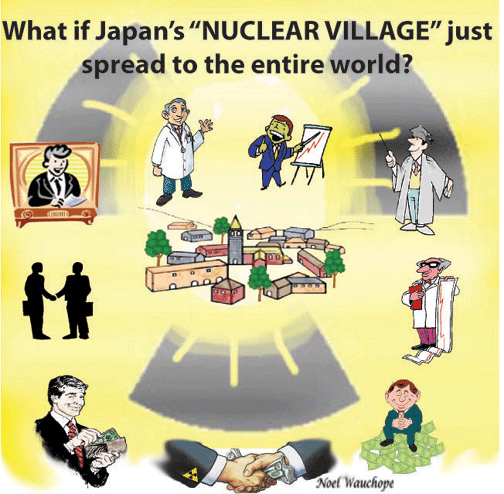
Japanese honour for Sir John Beddington for covering up the effects of the Fukushima nuclear disaster!
“The advice that he gave during the disaster was very important to reassure not only the British citizens in Japan but also the Japanese people and rest of the world, and also helped the Japanese Government gain public confidence regarding its response to and basic policy on the Fukushima Daiichi accidents.
Image source ; https://nuclear-news.net/2014/03/13/like-japan-uk-seems-to-be-developing-an-academic-nuclear-village/
http://www.oxfordmartin.ox.ac.uk/news/201407_Beddington_Honour
11 Jul 2014
Sir John Beddington, Senior Adviser to the Oxford Martin School, has been recognised by the Government of Japan for his contributions to strengthening the co-operation between Japan and the UK in the areas of science and technology.
At a ceremony at the Japanese Embassy in London on 26 June, Sir John, former Chief Scientific Adviser to the UK Government, was presented with the Order of the Rising Sun, Gold Rays with Neck Ribbon.
Announcing the honour, an embassy spokesman said: “Sir John played a significant role in advising the UK Government not to evacuate the British Embassy in Tokyo or UK nationals in Japan, after the tragic earthquake and tsunami and its subsequent effect on TEPCO’s Fukushima Daiichi Nuclear Power Station.
“The advice that he gave during the disaster was very important to reassure not only the British citizens in Japan but also the Japanese people and rest of the world, and also helped the Japanese Government gain public confidence regarding its response to and basic policy on the Fukushima Daiichi accidents. We, the Japanese government and the Japanese people, recognise and sincerely appreciate his support when we were dealing with the crisis.
“He has made significant contributions to strengthen the co-operation between Japan and the UK in the area of science and technology for many years, and his contributions to Japan in the area of science and technology have improved the overall bilateral relations between our countries.”
The embassy also cited Sir John’s joint leadership of the UK-Japan Joint Committee on Cooperation in Science and Technology, his participation in the Japanese Science and Technology in Society forum and his involvement with Japanese research institutions, and thanked him for the advice he had given to Japanese researchers and government delegations visiting the UK.
The spokesman added: “The Government of Japan highly appreciates the significant contribution Sir John has made throughout his career. He greatly deserves to be honoured for his outstanding contribution to Japan-UK relations.”
To find out about the full extent of the cover up please check these links;
https://nuclear-news.net/?s=science+media+centre
“….In 2011, as their share value continued to plummet[Because of fukushima Arclight2011], EDF formed a stakeholder advisory panel, employing Chris Patten, chair of the BBC Trust, as chair of the panel and Diane Coyle, vice chair of the BBC Trust, as a member the panel. She is married to BBC News Technology Correspondent, Rory Cellan-Jones. Other members of the panel include Will Hutton, former editor of the Observer and a leading commentator on social and political affairs, and Sir Richard Lambert, former director of the CBI and former editor of the Financial Times. Chris Patten is linked to David Cameron through Patten’s former chief of staff, who is now chief of staff to Cameron….[Also, The UK SMC and the USA senseaboutscience began its promotion of the “right” science. Arclight2011]“ https://nuclear-news.net/2013/09/24/the-bbc-and-edf-corrupts-nuclear-science-with-the-help-of-the-usa/
“…An article at nuclear-news.net provides a number of references revealing how experts from SMCs have downplayed the seriousness of the nuclear disaster. I note that the “experts” writing about ionising radiation and health were nuclear engineers — not radiation biologists……
how do general journalists scrutinise and distinguish between what is an independent science story and what is a pro business story? How easy might it be for general journalists to be discouraged from covering certain topics?….If the subject is complex – the health effects of Fukushima radiation – it is all too easy to go to the science media centre and get a comforting article from a nuclear engineer….” https://nuclear-news.net/2013/07/26/sloppy-science-writing-in-australias-media/
“….7 March 2014
In 2012 Francis Maude, Minister for the Cabinet Office, announced the intention to fundamentally overhaul and replace the existing information classification and marking scheme as part of the government’s Civil Service Reform programme.
Sellafield Ltd’s security regulator, ONR (Office for Nuclear Regulation), have instructed Sellafield Ltd and the wider civil nuclear industry to adopt the new GSC protective marking scheme known as Government Security Classifications (GSC).
Government Security Classifications
The new three tier system has three classifications: OFFICIAL, SECRET and TOP-SECRET.
Additionally ONR have mandated the use of an additional classification: OFFICIAL-SENSITIVE for Sensitive Nuclear Information which is classified below SECRET.
Implementing GSC
In line with the rest of UK government, the new GSC scheme is coming into operation on April 2nd 2014. All documents (including commercial correspondence, drawings, specifications, data sheets etc) created by Sellafield Ltd after this date for issue to suppliers will carry the new markings. Documents created prior to this date will continue to carry their existing markings until such time as they are amended in the normal course of work when the new markings will be applied at the same time.…..” https://nuclear-news.net/2014/03/09/the-uk-follows-japan-in-determining-extent-of-nuclear-transparency-by-extending-secrecy-and-protecting-corruption/
Anti nuclear activist and composer Ryuichi Sakamoto has throat cancer
Since the March 2011 tsunami set off a nuclear catastrophe in Japan, Sakamoto has been one of the most vocal celebrities against nuclear power along with Nobel-winning writer Kenzaburo Oe and visual artist Yoshitomo Nara.
Sakamoto, who also acted in and wrote the score for the 1983 film “Merry Christmas, Mr. Lawrence,” directed by Nagisa Oshima, has appeared at anti-nuclear protests and urged Japan to reflect on what he called the mistake of Fukushima.
In a July 2012 rally, he got up on stage and read from notes on an iPhone, warning Japan not to risk people’s lives for electricity.
“Life is more important than money,” he said in Japanese, then added in English, “Keeping silent after Fukushima is barbaric.”
July 11, 2014
TOKYO (AP) — Japanese musician Ryuichi Sakamoto, who shared an Oscar for Bernardo Bertolucci’s “The Last Emperor” score, has been diagnosed with throat cancer and has canceled his upcoming performances to focus on his health.
“I promise to return after a full recovery,” Sakamoto, 62, said Thursday on his official website.
He apologized for bowing out of his upcoming events, saying he would not be able to attend the First Sapporo International Art Festival, which starts later this month. He said he was also “deeply upset” at having to cancel a July 30 concert for the Park Hyatt Tokyo’s 20th anniversary, where he had planned to unveil new material.
At “the end of June, I was diagnosed with throat cancer,” he said on his website. “I have decided to take time off of work in order to concentrate on treating it. I deeply regret causing so many people considerable inconvenience.”
Hideaki Tamamushi, spokesman at Avex Group, which manages Sakamoto, said that in early June the musician went for a checkup after feeling a strange sensation in his throat, and the diagnosis came toward the end of the month. He said the company has been deluged with calls asking about Sakamoto. Tamamushi declined to release further details about his condition.
Sakamoto’s daughter and musician Miu Sakamoto said on her Twitter account that her father was going to stay for a while in the U.S., where he is based.
“I would like my father to take a good rest after working so hard all the time. I hope he will recover completely and return to playing his great music with all his heart,” she tweeted.
Sakamoto, born in Tokyo, rose to fame as a member of the electronic pop band Yellow Magic Orchestra in the 1970s and 1980s. He has been based in New York in recent years, although he visits Japan often.
Since the March 2011 tsunami set off a nuclear catastrophe in Japan, Sakamoto has been one of the most vocal celebrities against nuclear power along with Nobel-winning writer Kenzaburo Oe and visual artist Yoshitomo Nara.
Sakamoto, who also acted in and wrote the score for the 1983 film “Merry Christmas, Mr. Lawrence,” directed by Nagisa Oshima, has appeared at anti-nuclear protests and urged Japan to reflect on what he called the mistake of Fukushima.
In a July 2012 rally, he got up on stage and read from notes on an iPhone, warning Japan not to risk people’s lives for electricity.
“Life is more important than money,” he said in Japanese, then added in English, “Keeping silent after Fukushima is barbaric.”
___
Follow Yuri Kageyama on Twitter at twitter.com/yurikageyama

Nuclear power is no answer to global warming – Ian Fairlie
Ian Fairlie
10th July 2014
If we’re serious about cutting CO2 emissions, there’s no place for nuclear power, writes Ian Fairlie – because it’s the least cost-effective way to do it. By far the best way is to improve energy efficiency. But tell the Government the truth, and it’ll close you down.
In terms of $ per tonne of CO2 saved, Amory Lovins found that nuclear was among the worst methods. The best, by some margin, was energy efficiency.
It’s quite clear that climate change is an extremely serious problem for mankind and that we desperately need carbon-free or low-carbon energy and transport policies.
Many people, even a few who claim to be ‘environmentalists’, remain convinced that nuclear power is an important or even necessary way to reduce our CO2 emissions.
However even the most cursory examination reveals big problems with that view, and when the matter is examined in detail, one wonders how on earth so many people are taken in by it.
Nuclear power stations emit no CO2 … ?
Let’s take the most obvious issue: surely nuclear reactors don’t produce CO2 emissions? Well, true, they don’t when in operation, but reactor operation is only one step in the long nuclear fuel chain.
You need to consider uranium mining, milling and concentration, nuclear fuel fabrication and U-235 enrichment, then reactor construction, spent fuel storage and construction of whatever underground nuclear fuel dump is decided upon in future: none has been built yet.
All of these steps have heavy carbon footprints, especially uranium mining, U-235 enrichment, reactor construction and deep underground excavation.
In such situations, it’s normal to carry out Life Cycle Analyses (LCAs) of all the steps involved. Here the nuclear scenario would be modelled to estimate the number of tonnes of CO2 produced from all the steps per MWh of electricity generated, and compared with similar figures from LCAs of other forms of electricity generation.
Nuclear is low-carbon, not zero-carbon
The problem is that LCAs are prone to different results because of differing assumptions used in modelling scenarios. The most reliable studies are those by independent groups who are not paid by the nuclear industry as their results are less likely to be biased towards industrial viewpoints.
In recent years, two such studies have been published – by the Öko Institut in Germany, and by Dr Storm van Leeuwen and his team in the Netherlands. Both groups found that nuclear produced less CO2 than coal, oil or gas, but the amounts of carbon saved by nuclear power were relatively small.
Van Leeuwen estimated that nuclear produced about 1/3 as much CO2as a modern co-gen gas-fired plant. In other words, nuclear is a low-carbon, not a zero-carbon, source of electricity, as often touted by the Government and others.
But you may say, shouldn’t we still promote nuclear, as a 2/3rds saving compared with gas is still worthwhile?
Perhaps, but there are several better ways of reducing CO2 emissions than gas-fired stations. These include demand reduction measures via greater energy efficiency, and renewables such as biomass, wind, wave, geothermal and solar PV.
DECC refusing to accept the truth
If we’re really serious about reducing CO2 emissions, then we should be examining how much each method costs per tonne of CO2 saved. But the Government and its nuclear acolytes seem to be avoiding this.
Fukushima’s children are dying as the world looks on!
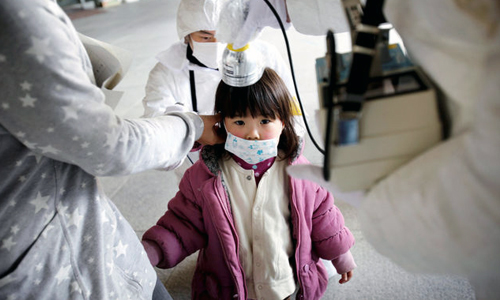
More than 48 percent of some 375,000 young people—nearly 200,000 kids—tested by the Fukushima Medical University near the smoldering reactors now suffer from pre-cancerous thyroid abnormalities, primarily nodules and cysts
https://www.transcend.org/tms/2014/07/fukushimas-children-are-dying/
by Harvey Wasserman, EcoWatch – TRANSCEND Media Service
ASIA & THE PACIFIC, 7 July 2014
Some 39 months after the multiple explosions at Fukushima, thyroid cancer rates among nearby children have skyrocketed to more than forty times (40x) normal.
More than 48 percent of some 375,000 young people—nearly 200,000 kids—tested by the Fukushima Medical University near the smoldering reactors now suffer from pre-cancerous thyroid abnormalities, primarily nodules and cysts. The rate is accelerating.
More than 120 childhood cancers have been indicated where just three would be expected, says Joseph Mangano, executive director of the Radiation and Public Health Project.
The nuclear industry and its apologists continue to deny this public health tragedy. Some have actually asserted that “not one person” has been affected by Fukushima’s massive radiation releases, which for some isotopes exceed Hiroshima by a factor of nearly 30.
But the deadly epidemic at Fukushima is consistent with impacts suffered among children near the 1979 accident at Three Mile Island and the 1986 explosion at Chernobyl, as well as findings at other commercial reactors.
The likelihood that atomic power could cause such epidemics has been confirmed by the Canadian Nuclear Safety Commission, which says that “an increase in the risk of childhood thyroid cancer” would accompany a reactor disaster.
In evaluating the prospects of new reactor construction in Canada, the Commission says the rate “would rise by 0.3 percent at a distance of 12 kilometers” from the accident. But that assumes the distribution of protective potassium iodide pills and a successful emergency evacuation, neither of which happened at Three Mile Island, Chernobyl or Fukushima.
The numbers have been analyzed by Mangano. He has studied the impacts of reactor-created radiation on human health since the 1980s, beginning his work with the legendary radiologist Dr. Ernest Sternglass and statistician Jay Gould.
Speaking on http://www.prn.fm’s Green Power & Wellness Show, Mangano also confirms that the general health among downwind human populations improves when atomic reactors are shut down, and goes into decline when they open or re-open.
Nearby children are not the only casualties at Fukushima. Plant operator Masao Yoshida has died at age 58 of esophogeal cancer. Masao heroically refused to abandon Fukushima at the worst of the crisis, probably saving millions of lives. Workers at the site who are employed by independent contractors—many dominated by organized crime—are often not being monitored for radiation exposure at all. Public anger is rising over government plans to force families—many with small children—back into the heavily contaminated region around the plant.
Following its 1979 accident, Three Mile Island’s owners denied the reactor had melted. But a robotic camera later confirmed otherwise.
The state of Pennsylvania mysteriously killed its tumor registry, then said there was “no evidence” that anyone had been killed.
But a wide range of independent studies confirm heightened infant death rates and excessive cancers among the general population. Excessive death, mutation and disease rates among local animals were confirmed by the Pennsylvania Department of Agriculture and local journalists.
In the 1980s federal Judge Sylvia Rambo blocked a class action suit by some 2,400 central Pennsylvania downwinders, claiming not enough radiation had escaped to harm anyone. But after 35 years, no one knows how much radiation escaped or where it went. Three Mile Island’s owners have quietly paid millions to downwind victims in exchange for gag orders.
At Chernobyl, a compendium of more than 5,000 studies has yielded an estimated death toll of more than 1,000,000 people.
The radiation effects on youngsters in downwind Belarus and Ukraine have been horrific. According to Mangano, some 80 percent of the “Children of Chernobyl” born downwind since the accident have been harmed by a wide range of impacts ranging from birth defects and thyroid cancer to long-term heart, respiratory and mental illnesses. The findings mean that just one in five young downwinders can be termed healthy.
Physicians for Social Responsibility and the German chapter of the International Physicians for the Prevention of Nuclear War have warned of parallel problems near Fukushima.
The United Nations Scientific Committee on the Effects of Atomic Radiation (UNSCEAR) has recently issued reports downplaying the disaster’s human impacts. UNSCEAR is interlocked with the United Nations’ International Atomic Energy Agency, whose mandate is to promote atomic power. The IAEA has a long-term controlling gag order on UN findings about reactor health impacts. For decades UNSCEAR and the World Health Organization have run protective cover for the nuclear industry’s widespread health impacts. Fukushima has proven no exception.
In response, Physicians for Social Responsibility and the German International Physicians for the Prevention of Nuclear War have issued a ten-point rebuttal, warning the public of the UN’s compromised credibility. The disaster is “ongoing” say the groups, and must be monitored for decades. “Things could have turned for the worse” if winds had been blowing toward Tokyo rather than out to sea (and towards America).
There is on-going risk from irradiated produce, and among site workers whose doses and health impacts are not being monitored. Current dose estimates among workers as well as downwinders are unreliable, and special notice must be taken of radiation’s severe impacts on the human embryo.
UNSCEAR’s studies on background radiation are also “misleading,” say the groups, and there must be further study of genetic radiation effects as well as “non-cancer diseases.” The UN assertion that “no discernible radiation-related health effects are expected among exposed members” is “cynical,” say the groups. They add that things were made worse by the official refusal to distribute potassium iodide, which might have protected the public from thyroid impacts from massive releases of radioactive I-131.
Overall, the horrific news from Fukushima can only get worse. Radiation from three lost cores is still being carried into the Pacific. Management of spent fuel rods in pools suspended in the air and scattered around the site remains fraught with danger.
The pro-nuclear Shinzo Abe regime wants to reopen Japan’s remaining 48 reactors. It has pushed hard for families who fled the disaster to re-occupy irradiated homes and villages.
But Three Mile Island, Chernobyl and the plague of death and disease now surfacing near Fukushima make it all too clear that the human cost of such decisions continues to escalate—with our children suffering first and worst.
ISIS Terrorist seizure of nuclear materials in Iraq of minimal concern says USA BUT WHAT ABOUT THE COBALT?


(CNN) — Militants in Iraq have taken hold of nuclear materials at university science facilities near the northern city of Mosul, the Iraqi government has said in a letter to the United Nations.
But two U.S. officials told CNN on Wednesday that the small amounts of uranium aren’t enriched or weapons-grade, prompting only minimal concern.
The letter from Iraq’s U.N. ambassador about the uranium compounds asks for help “to stave off the threat of their use by terrorists in Iraq or abroad” as the country struggles with a deadly insurgency.
In the letter, obtained Wednesday by CNN, Iraqi Ambassador Mohamed Ali Alhakim said that “terrorist groups have seized control” of nearly 40 kilograms (90 pounds) of uranium compounds at science departments at the University of Mosul after the sites “came out of control of the state.”
The Islamic State in Iraq and Syria, an al Qaeda splinter group, has led Sunni insurgents who have taken over large areas of northern and western Iraq in an offensive that began last month. The terrorist group has also made major gains in Syria in its quest to establish an Islamic state spanning both countries.
In his letter, dated Tuesday, Alhakim said the nuclear materials were used in “very limited quantities” for scientific study and research. But he warned that despite the small amounts, the materials could be used by terrorists in Iraq or smuggled out of the country.
“Such materials can be used in manufacturing weapons of mass destruction,” Alhakim wrote in the letter, which was first reported by Reuters.
Iraq witnessed another violent day Wednesday as the country’s security and political crises deepened.
More than 50 unidentified bodies were found in the predominantly Shiite town of Alexandria on Wednesday, Iraqi security officials said.
The bodies of two children were among the dozens found in different parts of the town.
Details about the circumstances of the deaths were not immediately available, and officials did not say when the people may have been killed.
Not far from Alexandria, at least five people were killed and 17 wounded by three car bombs that exploded in front of a courthouse in the town of Hilla, security and medical officials said.
Hilla is about 92 kilometers (57 miles) south of Baghdad and is the first sizable town south of the capital.
2006 – http://www.iraqwatch.org/government/Iraq/IAEC%20reports/iaec1982-1983.htm
THE NUCLEAR MEDICINE CENTRE, MOSUL
The initiative help and enthusiasm of the Iraqi Atomic Energy Commission for the medical uses of radiation centres could not be better shown than the building of the Mosul centre. The whole project was established by the Iraqi AEC and it is now a centre for the Teaching Hospital of the Medical College of Mosul University.
The centre has facilities for all in – vitro and in – vivo use of open sources of radioisotopes.
A cobalt 60 teletherapy unit for external radiotherapy is also within the campus of the Hospital. This cobalt unit was a gift from the International Atomic Energy Agency and it has been replaced recently by a new one.
The Mosul Nuclear Medicine Centre was built on fairly wide ground with the possibility of future addition and extension in mind.
This centre now serves the northern area of Iraq and renders facilities for the medical uses of radioisotopes in clinical diagnosis and medical research.
Most of the diagnostic applications of nuclear medicine well as therapy of the thyroid disease are done at the centre. These include:
Static and dynamic scan of the brain.
Thyroid scanning and other in-vivo thyroid studies.*
Lung liver and spleen scintigraphy.
Renography and kidney scanning.
Bone scanning.
All in – vitro radioimmunoassay of hormones (There are two specialists in nuclear medicine and four practitioners with good experience in nuclear medicine apart from supporting physicists chemists technicians nursing and administrative staff).
Since the opening of the centre in 1971, the number of patients has increased and now it totals over five thousands new patients a year.
* Incidentally Mosul and the surrounding area are amongst the well known regions infested with endemic goitre.

1 This Month

of the week – Shut Down Drone Warfare!


Tell the Ukrainian Government to Drop Prosecution of Peace Activist Yurii Sheliazhenko

Petition to revoke the licensing of the Near Surface Nuclear Disposal Facility (NSDF) at Chalk River. https://www.ourcommons.ca/petitions/en/Petition/Details?Petition=e-7247
To see nuclear-related stories in greater depth and intensity – go to https://nuclearinformation.wordpress.com
-
Archives
- March 2026 (230)
- February 2026 (268)
- January 2026 (308)
- December 2025 (358)
- November 2025 (359)
- October 2025 (376)
- September 2025 (257)
- August 2025 (319)
- July 2025 (230)
- June 2025 (348)
- May 2025 (261)
- April 2025 (305)
-
Categories
- 1
- 1 NUCLEAR ISSUES
- business and costs
- climate change
- culture and arts
- ENERGY
- environment
- health
- history
- indigenous issues
- Legal
- marketing of nuclear
- media
- opposition to nuclear
- PERSONAL STORIES
- politics
- politics international
- Religion and ethics
- safety
- secrets,lies and civil liberties
- spinbuster
- technology
- Uranium
- wastes
- weapons and war
- Women
- 2 WORLD
- ACTION
- AFRICA
- Atrocities
- AUSTRALIA
- Christina's notes
- Christina's themes
- culture and arts
- Events
- Fuk 2022
- Fuk 2023
- Fukushima 2017
- Fukushima 2018
- fukushima 2019
- Fukushima 2020
- Fukushima 2021
- general
- global warming
- Humour (God we need it)
- Nuclear
- RARE EARTHS
- Reference
- resources – print
- Resources -audiovicual
- Weekly Newsletter
- World
- World Nuclear
- YouTube
-
RSS
Entries RSS
Comments RSS
 nuclear-news