Scotland question: just who are Britain’s nuclear targets?
A right to know nuclear targets http://www.scotsman.com/news/opinion/letters/a-right-to-know-nuclear-targets-1-3460159 The Scotsman Joseph G Miller, Dunfermline29 June 14 SURELY the people of Scotland are entitled to know the targets of the 200 nuclear warheads stationed at Faslane.
Is Russia a target? Russia, whose leader suggested dismantling Syria’s poisonous gas installations instead of bombing them, as proposed by the US?
Is China a target? Is China a military threat? Or is it Iran? Until a few days ago this seemed likely as we’ve heard so much about Iran’s “illegal” nuclear programme. Now we, the West, are relying on Iran to bolster Iraq’s faltering regime.
The IRA can no longer be a target if, indeed, it ever was. Even if all the above are targets, it still leaves an awful lot of missiles unaccounted for.
Does Westminster really have so many enemies on this little planet? If so, should they not be sweet-talking them?
As they are clearly not, and seem determined to cling to the nuclear trigger, voting Yes would seem to provide Scotland with 200 new friends overnight. Come to think of it, it could also save civilisation as we know it.
Should we worry about electromagnetic radiation?
Radiation protection – sense or nonsense? Geovital 30 June 14 Is radiation protection meaningful or just hype among a few crazy people?
This question misses the point… It is not a question of whether radiation protection is meaningful or not – nowadays it is a necessity!
The question should be: What more has to happen to health before man will take action?……..
The ether is filled with microwave radiation from mobile phone telecommunication, directional antennas, wireless, radio, TV, GPS, amateur radio, police, fire departments, aviation, radar, hotspots in cafes and restaurants, and all the local radio stations… this is probably the greatest source of man-made pollution today.
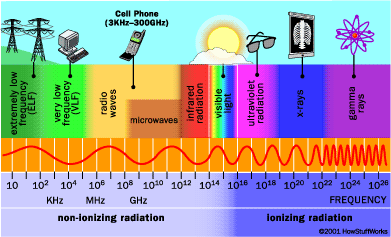
One could even go further and raise the following hypothesis:………http://aus.geovital.com/radiation-protection-sense-or-nonsense/
Arclight request for donations and a big thank you to my supporters
http://www.gofundme.com/9yubhk
UPDATE This GO FUND ME account has been closed qithout warning or any notification ..
Hello nuclear-news.net viewers. Sorry I haven’t been posting as regularly as I usually have been.
I have managed to finally get some accommodation and at least some work. I have been living from hand to mouth and sleeping on the smallest two seater sofa known to mankind this past month or so. I now have a bed that is big enough to sleep on, without my feet dangling over the edge.
I haven supported by some wonderful people that have got me this far and I have regained my lost weight and sorted out my erratic sleeping pattern. I wish to thank those that helped me from the bottom of my heart. You know who you are but i understand your wish to remain anonymous.
The move to Ireland has been successful for me and I am tentatively getting back on my feet after the terrible situation I found myself dealing with in the UK, as described in my earlier posts and you tube videos. My heart goes out to those many activists left in the UK who are or will be, dealing with similar harassment from the police and security services for their beliefs and concerns. And to those activists I have had close contact with and have developed a close and warm relationships with over these past few years, I miss you all very much and hope to carry on the fight from a stronger position here in Ireland ( a much more free, democratic and caring society than the UK has turned out to be).
I have opened up a go fund me account (linked above) that will allow people to send me small donations easily. I have set a limit of 2,000 Euros to cover the expenses for some computer hardware and various items for my new accommodation. I have set this limit as I have steady work on the horizon and hope to return to the self funding of my activism that I had up until the beginning of this year.
This donation request is designed to bridge the gap until my earnings from the day job start coming in and to set up the tools for my Internet research and article posting and OpEds. Also, I am developing some exciting anti nuclear projects with some other bloggers and I hope to inform you of these projects in the very near future. 2014 will be the beginning of the development of and consolidation of the new media platforms I hope.
Please feel free to send in any amount that you can reasonably afford. The smallest donation will be received with deep gratitude in these times of austerity.
Finally, from tomorrow I will be returning to my regular daily posting of the news and occasional personal OpEds here on Nuclear-news.net ..
I thank you for your attentions and patience over these past weeks.
Peace Light and Love
S. McGee
Aka arclight 2011
Passionate calls from shareholders to shut down Fukushima nuclear power station
 Japan’s TEPCO shareholders demand shutdown http://www.sbs.com.au/news/article/2014/06/26/japans-tepco-shareholders-demand-shutdown
Dozens of demonstrators with loud speakers and banners said on Thursday Tokyo Electric Power Co (TEPCO), which wants to restart some of the reactors at the world’s largest nuclear plant, amongst others, must act to not repeat the 2011 Fukushima Daiichi disaster.
There was pushing and shoving between security guards and demonstrators as they tried to approach shareholders going into the gathering. Activists from conservation group Greenpeace wore full protective suits and industrial face masks to remind shareholders what families who lived near Fukushima – where three reactors went into meltdown after an earthquake-sparked tsunami – must wear to check on their homes.
Katsutaka Idogawa, former mayor of Futaba town, which hosts the plant, lashed out at supporters of nuclear power, including TEPCO’s management, urging them to put their own ancestral land at risk.
“Why don’t you get exposed to radiation yourself? Why don’t you lose your homeland?” he asked as shareholders filed into Tokyo International Forum for the company’s annual meeting.
His town remains evacuated because of elevated levels of radiation, amid expectations that it will be decades before it is safe to return, if ever.
Idogawa, who bought TEPCO shares last year, said the firm has been slow to offer compensation to those who lost homes, jobs, farms and their communities, and that which has been offered has been inadequate. “You don’t pay enough compensation and don’t take responsibility (for the accident). I can’t forgive you!” he said. The sentiment was echoed during the meeting by fellow shareholders whose communities host other nuclear plants.
A woman from Niigata prefecture, where TEPCO hopes to start a major power station, also expressed her desire for the utility to end nuclear energy. “Are we going to make the same mistake that we had in Fukushima, also in Niigata?” she said. “Fellow shareholders, please support this proposal of scrapping the Kashiwazaki-Kariwa nuclear plant… and revitalising the site with plans for renewable energy,” she said.
Japan’s entire stable of 48 working reactors is offline, shuttered for safety checks in the months after the 2011 disaster.
The government and electricity companies, like TEPCO, would like to fire them up again, but public unease has so far prevented that, as has a new, toothier watchdog.
TEPCO has argued that restarting selected reactors at Kashiwazaki-Kariwa, the world’s largest nuclear power plant, is the key to ensuring the company’s survival as it battles huge costs.
The calls for an end to nuclear power were expected to be rejected by TEPCO, which is majority-owned by a government-backed fund designed to rescue it.
The government has poured billions of dollars into TEPCO to keep afloat a company that supplies electricity to Tokyo and its surrounding area, as it stumps up cash for decommissioning the reactors, cleaning up the mess they have made and paying compensation.
Nuclear decommissioning costs shooting up in Sweden
 Sweden plans big rise in fees to nuclear decommissioning fund http://economictimes.indiatimes.com/news/international/business/sweden-plans-big-rise-in-fees-to-nuclear-decommissioning-fund/articleshow/37335517.cms By Reuters | 27 Jun, 2014 OSLO: Sweden on Friday proposed a sharp rise in fees nuclear power producers have to pay the country’s nuclear decommissioning fund, saying previous cost estimates were too low.
Sweden has three nuclear power plants with ten reactors in operation, generating about 40 per cent of the country’s electricity needs. The oldest reactors are expected to be shut at the beginning of the next decade.
OSLO: Sweden on Friday proposed a sharp rise in fees nuclear power producers have to pay the country’s nuclear decommissioning fund, saying previous cost estimates were too low. The Swedish Radiation Safety Authority (SSM) said it has proposed raising fees by 73 per cent to 0.038 crowns ($0.01) per kilowatt-hour from 0.022 crowns for 2015.
It said the Swedish Nuclear Fuel and Waste Management Company (SKB) had to recalculate fees to the nuclear decommissioning fund for the period of 2016-2017.
“The SSM has assessed that the costs for decommissioning and final disposal for the Swedish nuclear power industry may be underestimated by SKB by at least 11 billion Swedish crowns ($1.63 billion),” the authority said in a statement.
Sweden’s state-owned utility Vattenfall operates seven reactors and Germany’s E.ON three. Finnish utility Fortum has stakes in six Swedish nuclear reactors.
Looks like Thorium Nuclear Energy has no future in USA
 G. Bothun · University of Oregon Researcj gaste ( apro nuke forum) 27 June 14
1) Currently the timescale to go from permit to actual turning ON line any nuclear power plant is about 15 years (I think currently there are only 2 recently (2012) approved plans coming on line in Georgia and that will take likely another 8–10 years) – meaning that this really isn’t a “bridge fuel” (especially compared to fracked natural gas – which is being rapidly depleted)
2) The whole US nuclear infrastructure is based on handling Uranium. Thorium has much more stringent handling requirements and I just don’t think the US will ramp up an infrastructure to deal with this. Its probably not even wise to do so as those investments are better made in renewable energy and/or carbon capture and storage projects (like the one in Michigan)
In just 8 years, German State goes from 30% to 100% renewable energy
 German State to Reach 100% Renewable Power This Year http://inhabitat.com/german-state-to-reach-
100-renewable-power-this-year/ by Josh Marks, 06/25/14 Germany recently smashed three solar energy records in just two weeks and set a new overall renewables record last month with 74 percent clean energy use during the middle of the day. Now the Federal Republic’s northernmost — and windiest — state of Schleswig-Holstein is set to generate all of its electricity from green energy this year. The state, which borders Denmark and the North and Baltic Seas, has a goal to generate 300 percent of its electricity needs from renewables.
Related: Germany Smashes Three Solar Energy Records in Just Two Weeks!
Schleswig-Holstein is home to more than 200 businesses in the wind energy sector with around 7,000 employees. As of 2010, wind power in Germany provided more than 96,000 jobs and that figure is expected to increase as the nation commits to phasing out nuclear energy and replacing it with renewables.
While Schleswig-Holstein aims to become the first of Germany’s 16 states to pass the 300 percent renewables mark, a Bavarian village has already blown past that milestone. In 2011, Wildpoldsried produced a whopping 321 percent of its electricity from clean energy, generating four million Euro (US $5.7 million) in revenue by selling it back to the national grid. Via CleanTechnica
Very high levels of radiation again at WIPP nuclear facility
Radiation spikes at WIPP nuclear facility — Hits highest levels since initial hours of radioactive release in February — Document link removed from official website — Gov’t analyzing samples for “potential impact on human health” http://enenews.com/large-spike-radiation-levels-wipp-nuclear-facility-highest-measurements-recorded-first-days-incident-govt-analyzing-potential-impact-human-health?utm_source=feedburner&utm_medium=email&utm_campaign=Feed%3A+ENENews+%28Energy+News%29
: June 27th, 2014 Station A and B Filter Readings for Public Release 6-16-14, New Mexico Environment Department Air Filter Station Sampling Data (pdf):
(Note: Measurements are taken after air passes through the filtration system. Also, the June data is shown in 4-hour intervals, while most in February are around 8 hours.)
*See the archived version of the NMED’s document list here and the current version here
How Toyota and Ogilvy and Mather help to cover up health effects caused by radiation in Fukushima
“…..so that is why the Audubon article made a comment from 3 anonymous sources and did not point out that Christelle Adam-Guillermin et al are actually in a competitive adversarial position to Moller et al. ….”

Posted to nuclear-news.net
posted on 27th June 2014
posted by Shaun Mc Gee
aka arclight
A new article that discusses Mollers et al findings on the effects of radioactive contamination on bird wildlife in the Fukushima area was recently posted on line.
Within the article 2 scientists were commented as saying that these findings were important and that the study was efficient.
http://mag.audubon.org/articles/birds/chernobyl-s-radiation-seems-be-robbing-birds-their-sperm
However, one scientist was quoted;
“Christelle Adam-Guillermin points out that the researchers based their statistics on ambient radiation levels in the environment rather than on each bird’s absorbed dose, or the amount of radiation it’s exposed to both internally and externally. “
Christelle Adam-Guillermin thought that this study was flawed and with a little bit of digging I found that she also was doing a similar bird study in Fukushima in 2013 supported by Japanese scientists and the French IRSN (with whom she works).
The link to that study is here ..
Also in this article 3 scientists (who preferred to remain anonymous), said that Moller had made a mistake and although he did admit this mistake, they thought that he had done it fraudulently an should never be forgiven . Even though this mistake was made many years ago (11 years ago, concerning a 1998 mistake ), these 3 anonymous scientists were still quoted.
This is not the first time that Mousseau, Galvan and Moller have had the results of their work in Fukushima twisted to suit the views of the big energy companies connected to the nuclear industry.
In a recent article by the Sciencedaily.com magazine, findings showing that some birds eventually developed an immunity to the radiation, were twisted to make the reader think that there was very little problems with wildlife in the nuclear contaminated areas of Japan. The true extent of the damage was not discussed though if one looked at the actual report, one would see that many species had died out and the surviving species had suffered catastrophic loss in order to get the result of “radioactive proof birds”. The link to a breakdown of that article is here;
You might ask why the IRSN, nuclear lobby an the Audubon organisation might want to challenge Moller et als findings in such a nasty way? In the field of epidemiology there has been little study on the effects of radiation on humans. However, funding for some butterfly and bird species has been made available (though limited). The small amount of funding ( in the case of Moller et al) was made up by the fact that the team including Galvan worked very hard at gleaning as much evidence in their short time in Japan whilst the IRSN team seemed to have a good party (It does look like they may have some work also ). The evidence to the IRSN having a party can be found here (along with their inconclusive findings) ; 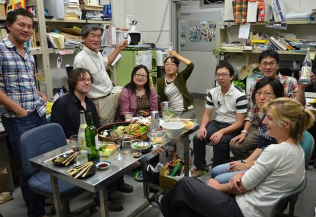
https://wiki.ceh.ac.uk/download/attachments/196083904/Effects%20on%20birds%20and%20frogs.pdf?version=1&modificationDate=1369323874000&api=v2
Obviously, the IRSN and anonymous scientists themselves would not be able to give the impression that they were the only real, informed and superior scientists on bird epidemiology without the connivance of the media outlets and authors that present articles on these topics.
You might ask why such a media outlet as Audubon might want to do this?
“….. What do a car company and a conservation organization have in common? Plenty. Innovation. Leadership. Commitment to community. Dedication to diversity. And a focus on meeting the needs of the present while investing in the future. When Audubon and Toyota joined forces to create Toyota TogetherGreen, we knew we wanted to create a conservation program that modeled those qualities. http://www.togethergreen.org/about ….”
Toyota are hoping to make it big in the “renewable”car field.. they dont want efficient and clean chemical batteries created and maintained by small local industries but want to use old style energy systems that require global sized large energy infrastructure to operate. Of course Toyota have decided to go for the hydrogen fuel cell as batteries may be replace with this chemical battery; https://nuclear-news.net/2013/05/03/an-aluminium-fuel-cell-why-is-uk-government-blocking-it/
Media outlets are reliant on advertising revenue to survive and the big PR companies that supply this essential revenue work directly with the large energy corporations that support the nuclear industry. A recent Manga story that showed possible health effects from radiation in Fukushima prefecture had to be pulled as the publisher was refused advertising spots from a large amount of media organisations.
Added to the fact that fictional Manga articles (based on real people and situations), real discussion on health effects from the nuclear disaster have been banned and health professionals and journalists are under threat from imprisonment if they release any information that shows any health effects.
https://nuclear-news.net/2014/06/25/the-manga-oishinbo-controversy-radiation-and-nose-bleeding-in-the-wake-of-3-11/
So, summarising as to why Moller et als study is being attacked. Because the findings seem to point at a number of health effects (some shocking) in the wildlife in the contaminated areas, it would make sense that other scientists with a financial and academic interest would want to attack any study that might stop the nuclear industry and increase costs in compensation from the nuclear accident.
Their very jobs and funding are at risk. It is the same for the media companies that have to place strategic comments on their articles that detract from the honesty and accuracy of such findings. The media companies would also face litigation from corporate legal teams representing nuclear connected industry interests as well as losing advertising spaces and reduced business from their corporate customers, so that is why the Audubon article made a comment from 3 anonymous sources and did not point out that Christelle Adam-Guillermin et al are actually in a competitive adversarial position to Moller et al.
Here is some info on the PR campaign connections with WPP and Ogilvy and Mather (who covered up the Fukushima daichi nuclear disaster effects for the Japanese government) ;
“….Toyota is the most valuable car brand in the world. This is according to the annual BrandZ Top 100 study conducted by marketing research firm Millward Brown Optimor.
The BrandZ Top 100 Most Valuable Global Brands ranking assesses brand value with the help of financial data and feedback from potential and current buyers. ……… It was started by Millward Brown Optimor, which is a unit of Kantar. Kantar is the data investment management arm of advertising firm WPP.
The Toyota brand took the top spot in the 2014 study with value of $29.6 billion, a 21 percent jump over last year’s figure. In the nine years the study has been conducted, it has been named the number one global automotive brand seven times. Toyota is in the 26th spot in the list of the top global 100 brands. 22 may 2014 ….”
Toyota have recently decided to use the hydrogen fuel cell in their cars and are soon bringing working vehicles on line. They hope to use nuclear reactors to create the hydrogen needed for the fuel…
Nuclear power is relevant to road transport and motor vehicles in three respects: (1) hybrid vehicles potentially use off-peak power from the grid for recharging; (2) Nuclear heat can be used for production of liquid hydrocarbon fuels from coal; and (3) hydrogen for oil refining and for fuel cell vehicles may be made electrolytically, and, in the future, thermochemically using high-temperature nuclear reactors. December 2009
High proportion of deformities in migratory birds in Japan
Emergency research underway in Japan after birds found with perplexing deformities — “Something unusual occurring inside their bodies” — Never reported in 500,000 exams done before 3/11 — Now observed at every site across country, some over 1,000 km from Fukushima (PHOTO) http://enenews.com/emergency-surveys-in-japan-after-birds-found-with-perplexing-deformities-something-unusual-occurring-inside-their-bodies-never-reported-in-500000-exams-done-before-311-now-its-see?utm_source=feedburner&utm_medium=email&utm_campaign=Feed%3A+ENENews+%28Energy+News%29
 Asahi Shimbun, June 25, 2014: [Noboru Nakamura, a researcher at the Yamashina Institute for Ornithology] has visited the riverbed [in Fukushima] 20 times […] looking into whether the earthquake or the accident at the Fukushima No. 1 nuclear power plant caused abnormal changes among wild birds. […] [Researchers] first verified abnormal change [200 kilometers from Fukushima Daiichi] in Niigata Prefecture […] Oct. 24, 2011, a common reed bunting, a small migratory bird, was found with uneven tail feathers that had a moth-eaten appearance. The institute started emergency surveys […] The most perplexing thing was the overly long feathers […] Its feathers very reliably grow to a certain length […] [Kiyoaki Ozaki, Yamashina Institute for Ornithology deputy director-general,] could not imagine a reason for them to be longer. By March 2012, the same abnormality was identified at all research sites across Japan, such as Tochigi, Ibaraki, Tokyo, Shizuoka, Shimane, Kagawa and Fukuoka [over 1,000 kilometers from Fukushima]. The proportion of birds with the abnormality was 13.8 percent. In at least one place, the ratio exceeded 25 percent. Birds born in 2011 account for 97.3 percent of the specimens with the abnormality. […] Researchers have found feathers that already appear moth-eaten when they split open the sheath. Some birds even grew back feathers with the same deformity after the researchers plucked out older, misshapen feathers. […] One thing is certain: The common reed […] pass through or stop in the Tohoku region during their migration.
Noboru Nakamura, a researcher at the Yamashina Institute for Ornithology: “In Iitate, I caught a Japanese bush warbler in the net yesterday. It had feathers missing from the back of its head, and its skin was dark on that part. I found the same thing last year and the year before in Minami-Soma. I don’t know the reason.”
Kiyoaki Ozaki, Yamashina Institute for Ornithology deputy director-general: “Bird banding surveys of the common reed bunting began in 1961, and nearly 480,000 of the birds have been examined […] we monitor [their tail feathers] closely. But this sort of abnormality hasn’t been reported before. I’ve seen thousands of the birds, but it was the first time for me to see tail feathers like these. […] There is something unusual occurring inside the birds’ bodies, perhaps with their genes or hormone secretion. [It’s] in the realm of possibility [that it could be the effect of radioactive substances].”
Fukushima: Record high radiation levels at 18 locations between reactors and Pacific
 TV: New concerns at Fukushima; Radioactive material “spilling into ocean” from layer 80 feet deep, officials suspect — Jiji: Record high radiation levels at 18 locations between reactors and Pacific; Crisis far from under control (VIDEO) http://enenews.com/tv-new-concerns-at-fukushima-radioactive-material-spilling-into-ocean-from-layer-80-feet-deep-officials-suspect-jiji-new-record-high-radiation-levels-at-18-locations-near-pacific-problems?utm_source=feedburner&utm_m
Jiji Press, June 18, 2014: Radioactive contamination of groundwater at [Fukushima Daiichi] is far from being under control […] the source of contamination remains unclear and new record levels of radioactive substances have been detected in groundwater taken at a number of measuring points on the ocean side of the plant’s No. 1 to No. 4 reactors. Radioactivity levels in groundwater have hit new record highs at 18 of 32 measuring points on the ocean side since April, according to TEPCO. At the most polluted well, located east of the No. 2 reactor [there’s] 860,000 becquerels of beta ray-emitting radioactive substances such as strontium-90.
NHK WORLD, June 25, 2014: [TEPCO] has found that radioactive water can now easily spread in a deep layer of groundwater. It says it will speed up construction work on a barrier aimed at preventing contaminated water from leaking into the ocean. The deep layer of water is about 25 meters [82 feet] below the surface. […] water pressure in the [deep] layer was lower […] this makes it easier for contaminated water to spread [..] They suspect the radioactive water could be spilling into the ocean. TEPCO officials say the ongoing construction of the barrier may be to blame for the lower pressure. The work involves drilling into the deep layer. […] TEPCO officials say they will take more action to keep radioactive water from spreading in the deep layer. This will involve fortifying holes in an underground frozen-soil wall. Those holes go through the layer and are filled with pipes. […]
See also: Japan Nuclear Expert: Fukushima’s fuel could be about 100 ft. underground in 2 years (AUDIO)
France’s energy plan boosts renewables, drops nuclear power down
 Renewables Up, Nuclear Flat in French Energy Plan IEEE Spectrum, By Peter Fairley 24 Jun 2014 After months of negotiation, the French government has unveiled a long-awaited energy plan that is remarkably true to its election promises. The legislation’s cornerstone is the one-third reduction in the role of nuclear power that President François Hollande proposed on the campaign trail in 2012.
Under the plan, nuclear’s share of the nation’s power generation is to drop from 75 percent to 50 percent by 2025, as renewable energy’s role rises from 15 percent today to 40 percent to make up the difference. That is a dramatic statement for France, which is the world’s second largest generator of nuclear energy, after the United States. France has a globally-competitive nuclear industry led by state-owned utility Electricité de France (EDF) and nuclear technology and services giant Areva…….http://spectrum.ieee.org/energywise/energy/nuclear/renewables-up-nuclear-down-in-french-energy-plan
USA’s EPA carbon plan makes coal the loser, but nuclear power loses out, too
 The EPA carbon plan: Coal loses, but nuclear doesn’t win, Bulletin of the Atomic Scientists Mark Cooper. 19 June 14 MARK COOPER The claims and counterclaims about EPA’s proposed carbon pollution standards have filled the air: It will boost nuclear. It will expand renewables. It promotes energy efficiency. It will kill coal. It changes everything. It accomplishes almost nothing.
Evaluating the impact of the so-called Clean Power Plan requires a clear view of how the new rule will work. The plan centers on performance standards, which have yielded effective outcomes in other energy areas—such as appliance efficiency standards and fuel economy standards for light-duty vehicles. It sets a moderate, mid-term target for carbon reductions, but allows for flexibility because it does not dictate the use of specific technologies or products. States are allowed to design programs in response to local conditions.
The EPA plan picks a loser: coal. It does not, however, pick winners among the low-carbon options available. It does not offer much in the way of sweeteners for any specific technology. Assuming that states generally adhere to the prime directive of public utility resource acquisition—choosing the lowest-cost approach—the proposed rule will not alter the dismal prospects of nuclear power, which will therefore play no role in the reduction of carbon emissions from power plants.
EPA’s analysis of the proposed carbon pollution guidelines reflects this reality. EPA forecasts for nuclear power are flat-lined, which means that other resources—including energy efficiency, natural gas, wind, and solar—will carry the full weight of carbon reductions.
It is unlikely that the states will act irrationally enough to make the EPA analysis miss the mark by a wide margin. The marketplace and 48 of the 50 states have declined to embrace nuclear energy during the past decade, despite the incentives included in the Energy Policy Act of 2005……….http://thebulletin.org/epa-carbon-plan-coal-loses-nuclear-doesnt-win7253
The health toll of India’s uranium mining
India’s uranium mines expose villages to radiation, DW 25 June 14 India plans to source a quarter of its energy from nuclear power by 2050. But this ambitious goal could come at a cost. Radioactive waste from uranium mines in the country’s east is contaminating nearby communities…….Local activist Kavita Birulee says the villagers here are terrified of the radioactive waste. In Jadugoda, rates of cancer, miscarriages and birth defects are climbing…….
Health-related deformities
Just 40 years ago, Jadugoda was a quiet and lush green locality with no dust or radiation pollution. The people here lived a quiet rural life. But things changed when the Indian government started mining operations here in 1967.
Radioactive waste generated by three nearby government-owned mines has caused serious health-related problems in Jadugoda. The mines belong to Uranium Corporation of India Limited – or UCIL. They employ 5,000 people and are an important source of income for villagers in this relatively remote area. But the waste has put 50,000 people, mostly from tribal communities, at risk.
A recent study of about 9,000 people in villages near the mines has documented cases of congenital deformities, infertility, cancer, respiratory problems and miscarriages.
Nuclear scientist Sanghmitra Gadekar, who was responsible for conducting the survey on radioactive pollution in villages near the mines, says there was a higher incidence of miscarriages and still births.
“Also, laborers were given only one uniform a week. They had to keep on wearing it and then take it home. There, the wives or daughters wash it in a contaminated pond, exposing them to radiation. It’s a vicious circle of radioactive pollution in Jadugoda,” he said…….
Grim future
The mines are on the doorstep of the area’s largest city, Jamshedpur. If radiation pollution isn’t controlled, more people will be affected in the future. Local officials, however, are proud of their role in India’s nuclear defense industry.
Anti-nuclear pollution activist Xavier Dias has been trying to alert locals about the dangers presented by the mines.
“When you are talking about Jamshedpur, you are talking about a thousand ancillary industries, a huge population,” he said. “These are dust particles that fly around. They enter the water, the fauna, flora, the food system. And they are killers, but they are slow killers. They kill over generations.” http://www.dw.de/indias-uranium-mines-expose-villages-to-radiation/a-17730703
USA coastal communiities monitoring sea-borne Fukushima radiation plume
Fukushima radiation concerns coastal communities Tracy Loew, Statesman Journal 25 June 14, Talk in the Oregon coast town of Bandon often turns to the approaching plume of sea-borne radiation from Japan’s crippled Fukushima nuclear power plant.
“We’ve been worried about it and worried about it,” said Zac Adams, owner of Bandon Designsconstruction company. “We’re really concerned about it affecting the fisheries, the wildlife, the tourism, and most importantly our health.”…….
The radiation is expected to hit the U.S. this year at very low levels that wouldn’t harm humans or the environment. But no federal agency is monitoring it.
So Adams joined a citizen-science project, crowd-sourcing funds in his community to test a sample of seawater that he will soon collect.
Four hours north, the Tillamook Estuaries Partnership has funded two collection sites, in Tillamook and Pacific City.
“Over the last year-and-a-half, it’s been an issue that’s been raising in prominence along the coastline,” said Lisa Phipps, executive director of the partnership. “In our area, there have been groups that have been coming together to talk about what is happening in the ocean.”
And fund-raising is underway for two more sites, in Newport and Winchester Bay.
Altogether about 30 sites, from Alaska to Baja, Calif., have been funded, said Ken Buesseler, a chemical oceanographer at the Woods Hole Oceanographic Institution who put together the project, called “How Radioactive is Our Ocean?”
It uses crowd-sourced money and volunteers to collect water samples along the Pacific Coast, then ship them to Buesseler in Massachusetts to be analyzed on an $80,000 instrument………
Buesseler is looking for increased levels of Cesium-137, which already is in all oceans from previous nuclear testing and accidents; and for Cesium-134, a “fingerprint” of Fukushima.
Because of its short, two-year half-life, any Cesium-134 could only have come from the plant, he said.
So far, Buesseler said, no samples have indicated that the plume has reached the West Coast.
Buesseler posts results on the project’s website. They show Cesium-134 and increased levels of Cesium-137 off the coast of Japan and across the ocean.
“We know it’s out there,” Buesseler said. “We’ve seen it more than halfway across the Pacific.”
Northwest of Hawaii, for example, Buesseler has found Cesium-134 at concentrations as high as 3.8 becquerels per cubic meter.
But to put that in context, he said, the U.S. drinking water limit is 7,400 of those units.
“Every additional radiation exposure causes additional risks for cancer,” he said. “But when the numbers are in the one to 10 range, that’s a very small additional risk.”
That’s the range that is expected to hit our shores, with lower levels coming first.
“As the contamination arrives, we expect the concentrations to go up over the next two years,” Buesseler said……..http://www.statesmanjournal.com/story/tech/science/environment/2014/06/25/fukushima-radiation-concerns-coastal-communities/11377463/
-
Archives
- February 2026 (228)
- January 2026 (308)
- December 2025 (358)
- November 2025 (359)
- October 2025 (376)
- September 2025 (258)
- August 2025 (319)
- July 2025 (230)
- June 2025 (348)
- May 2025 (261)
- April 2025 (305)
- March 2025 (319)
-
Categories
- 1
- 1 NUCLEAR ISSUES
- business and costs
- climate change
- culture and arts
- ENERGY
- environment
- health
- history
- indigenous issues
- Legal
- marketing of nuclear
- media
- opposition to nuclear
- PERSONAL STORIES
- politics
- politics international
- Religion and ethics
- safety
- secrets,lies and civil liberties
- spinbuster
- technology
- Uranium
- wastes
- weapons and war
- Women
- 2 WORLD
- ACTION
- AFRICA
- Atrocities
- AUSTRALIA
- Christina's notes
- Christina's themes
- culture and arts
- Events
- Fuk 2022
- Fuk 2023
- Fukushima 2017
- Fukushima 2018
- fukushima 2019
- Fukushima 2020
- Fukushima 2021
- general
- global warming
- Humour (God we need it)
- Nuclear
- RARE EARTHS
- Reference
- resources – print
- Resources -audiovicual
- Weekly Newsletter
- World
- World Nuclear
- YouTube
-
RSS
Entries RSS
Comments RSS
 nuclear-news