Effects on the brain from nuclear radiation – reports from Hanford
 NBC stations reveal nuclear workers suffering severe brain damage, dementia — Toxic waste raining down from sky, wore baseball caps for protection — Brains being eaten away, teeth falling out — Workers raising safety issues framed using false evidence, fired — Gov’t not allowed in to investigate (VIDEO) http://enenews.com/nbc-stations-reveal-nuclear-workers-suffering-severe-brain-damage-dementia-toxic-waste-raining-down-from-sky-wore-baseball-caps-for-protection-brains-being-eaten-away-workers-raising-safety NBC Right Now,Apr. 30, 2014: Former Hanford Worker Sick from Nuclear Waste
- Jane Sander, reporter: A nuclear waste spill happened hours before at the tank farm.
- Lonnie Poteet, Hanford worker: I was already burning from my glove line to my t-shirt line and… starting to lose a little bit of vision in my right eye… Why didn’t they say something?
- Sander: Poteet describes living his life now as recluse… sharp pains in his head, they cause him to often twitch. He says medication prevents him from collapsing in pain due to severe nerve damage in his brain.
- Poteet: [More Hanford workers] are going to be exposed to the same situation… Nobody is going to do anything to stop it… As long as there’s profit… and they get their bonuses on a decent time, that’s all they care about… Most of the workers onsite right now are running scared. They will not bring up any safety concerns because as soon as you do, you’re going to be labeled and thrown off the site, just as fast as they can go. They’ll either create stuff that never happened, or they’ll find ways to get you.
NBC Right Now, June 5, 2014: Sick Former Hanford Worker Speaks Out
- Jane Sander, reporter: He sadly lives his life with a deadly disease…
- Lawrence Rouse, Hanford worker: I have toxic encephalopathy… it eats your brain away.
- Sander: Near the end of his almost 20 years at Hanford… he began to develop severe symptoms. Stuttering, memory loss, losing teeth…emotionally unstable…violent outbursts.
- Rouse: [My son] wrote this letter, this little poem, and said that his dad is gone… It would rain the chemicals on you from the stack. That’s why we wore the baseball caps.
- Sander: The Washington Dept. of Labor and DOE denied [compensation]… Since the [EEOICPA] program began in 2001, they’ve paid more than $1 billion in compensation and medical bills to [6,936 Hanford] workers…
- Rouse: DOE has always denied everything. And that’s not going to change.
- Sander: More Hanford workers continue to file claims for their illnesses.
- Watch the broadcast here
KING 5 Seattle (NBC), June 4, 2014: It’s an unprecedented series of workplace accidents in the state. Since mid-March the number Hanford workers seeking medical help after breathing in chemical vapors has risen to 34.
- Susannah Frame, reporter: Vapors causing serious illnesses at Hanford is not new… at the most contaminated workplace in the nation, OSHA can’t get past the gates to investigate.
- Diana Gegg, Hanford worker: It’s turned my life upside down.
- Frame: Brain damage, sudden tremors, vision loss, dementia – Illnesses the gov’t admits were caused by exposure… she can’t go out without a wheelchair, cook, or drive.
Finland’s Green Party in government firmly against new nuclear power
 Greens meet to strategise, remain cold on new nuclear power, http://yle.fi/uutiset/greens_meet_to_strategise_remain_cold_on_new_nuclear_power/7284419 UUTISET, 6 June 14 Delegates from Finland’s Green League are gathered at an annual party congress in Jämsä, central Finland to hammer out a campaign platform ahead of parliamentary elections due next year. Green party chair Ville Niinistö said although the party wants to stay in governmen it’s holding its ground on its opposition to new nuclear power in Finland.
 One thing became clear from the start of this year’s three-day Green League party congress: the Greens want to stay in government. Green party chair and Environment Minister Ville Niinistö pointed to the party’s recent achievement in orchestrating government agreement on a proposal for climate change legislation.
However, the party is not prepared to give way on its opposition to new nuclear power facilities in Finland. It intends to hold fast to the current government programme, which stipulates that no new decisions-in-principle on nuclear energy should go before the parliament…….
The party has hinted that it is prepared to leave the government if a revised permit for the proposed Fennovoima nuclear power plant returns to parliament for consideration.
Niinistö added that nuclear power contractors are now experiencing great difficulties.
Nuclear power “not rational” for Finland
“The question is, at what stage will the parties admit their mistake, which is that holding on to nuclear power no matter what at the taxpayers’ expense isn’t rational for the Finnish economy, for our jobs, our business community, or for us to develop domestic forms of renewable energy,” Niinistö
Why Is There A Nuclear Waste Crisis?
 National Nuclear Security Administration (NNSA convinced State Department negotiators that it had a way of converting nuclear bombs into reactor fuel…………
Even if it had worked – converting nuclear weapons into reactor fuel – these efforts would have produced massive amounts of additional toxic high-level nuclear waste
 Breaking Bad: A Nuclear Waste Disaster By Joseph Trento, DC Bureau, June 5th, 2014 “……..The WIPP accident is symptomatic of a much bigger problem at DOE and that is the scale of nuclear waste that decades of weapons production, nuclear research, and civilian and university reactors have produced. In addition, U.S. foreign policy and the fall of the Soviet Union made DOE the agency with the responsibility of converting old nuclear weapons into supposedly safer materials. That job is done by a little known but very powerful government agency, inside the Department of Energy, called the National Nuclear Security Administration (NNSA). To government policymakers and politicians, NNSA, despite its poor record, is indispensible in managing excess nuclear weapons materials from around the world. When the president makes a deal to accept another nation’s nuclear material, NNSA is the government agency that is tasked with getting the nuclear material out of the other nation’s inventory and transporting it to the United States. These actions have added greatly to the amount of high-level nuclear waste with which the Untied States must contend.
NNSA is in Charge of the Nuclear Waste Stream
Congress created the NNSA in 1999. It was structured as a semi-autonomous agency within the Department of Energy (DOE) after DOE labs suffered a series of spy scandals. The NNSA was charged with the maintenance and modernization of the nuclear warhead stockpile, the operation of research laboratories, and nuclear and non-nuclear weapons production sites, and the management of nuclear non-proliferation activities and naval reactors.
NNSA was created with the full support of the Pentagon. The military no longer wanted to be technically responsible for “special” or nuclear weapons. Revelations involving a secret multi-billion dollar slush fund to resume atmospheric nuclear testing called SAFEGUARD C and a tragic 1991 nuclear exercise called MIDNIGHT TRAIL were part of the reason the military decided to offload the nuclear weapons portfolio and wind down its own nuclear weapons administrative operations.
During the MIDNIGHT TRAIL exercise, a live nuclear weapon was actually lost for a time and a 19-year-old Air Force guard name Laurie Lucas was killed during the fake “surprise” exercise. The Guam incident and intense nuclear negotiations over limiting U.S. and post-Soviet nuclear stockpiles convinced the Clinton administration that nuclear weapons activities should be under an agency independent of the military. By the beginning of the George W. Bush administration, that policy evolved into the NNSA.
The Department of Energy was created in 1997 during the Carter administration with the mandate to make the United States energy independent. Because of its nuclear weapons responsibilities, the NNSA gets the bulk of the DOE budget. As a result, the NNSA – in charge of the nation’s nuclear weapons development and nuclear nonproliferation programs – is much more powerful than its umbrella department. The military, however, still controls the nuclear weapons budget. Greg Mello says that is why NNSA follows the Pentagon’s instructions that the productions of nuclear weapons and delivery systems come before “everything else like cleanup and waste mitigation at DOE.”
Early in the Obama administration, massive amounts of stimulus funds went to DOE to cleanup the Cold War legacy waste. Those monies were almost completely squandered by DOE contractors. In response, the NNSA was allowed to take over effective control of what was once the independent environmental side of DOE.
Give Us Your Nuclear Weapons
NNSA officials successfully convinced Congress, the State Department and the arms control community that it had the technical ability to safely convert nuclear weapons into safe and usable reactor fuel. So in the post Cold War world, U.S. policymakers encouraged some of the former Soviet Republics, South Africa and other countries to give the NNSA its nuclear warheads and other nuclear waste in exchange for providing civilian nuclear reactor fuel.
In the meantime, from the Ukraine to Japan, deadly materials are brought back to the United States and processed into reactor fuel or simply stored on American soil. NNSA assurances that it could provide these services are the basis of promises and treaty obligations our government has made.
NNSA convinced State Department negotiators that it had a way of converting nuclear bombs into reactor fuel…………
Even if it had worked – converting nuclear weapons into reactor fuel – these efforts would have produced massive amounts of additional toxic high-level nuclear waste .http://www.dcbureau.org/201406059835/natural-resources-news-service/breaking-bad-nuclear-waste-disaster.html
America’s MOX nuclear waste recycling boondoggle

they must stop making this radioactive trash
Failed Nuclear Weapons Recycling Program Could Put Us All in Danger io9, Mark Strauss, 7 June 14, Some government screw-ups are so epic that they require decades of effort. Such was the case for the recently cancelled plan to convert surplus weapons-grade plutonium into nuclear fuel. Not only did the U.S. waste $4 billion dollars, it increased the likelihood that terrorists could obtain bomb-making materials.
It sounded like a good idea at the beginning. Let’s turn megatons into megawatts!
In 2000, the United States and Russia signed the Plutonium Management and Disposition Agreement (PMDA). Each country pledged to dispose of at least 34 metric tons of plutonium from their nuclear weapons programs. U.S. nuclear weapons contain less than four kilograms of plutonium, so the combined total of 68 metric tons is enough for some 17,000 nuclear weapons. Disposing of this plutonium would make it more difficult to reverse U.S.-Russian nuclear weapons reductions and would prevent terrorists from gaining access to the material.
The United States settled on a plan to convert most of its surplus plutonium into fuel for nuclear reactors. A massive reprocessing plant would be built at the Savannah River Site in South Carolina, which, during the Cold War, had refined nuclear material for deployment in warheads. Now, the site would have a new mission: creating nuclear fuel from a mixture of plutonium and uranium oxide, otherwise known as mixed oxide fuel, or MOX. Although nuclear power plants in the U.S. use fuel made from low-enriched uranium (LEU), other countries had demonstrated that MOX was a viable alternative.
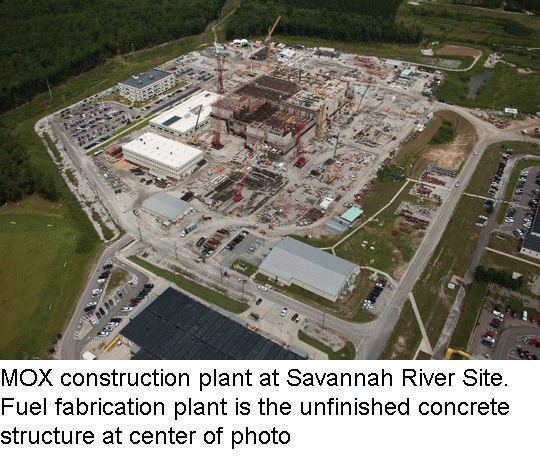
Instead, the final outcome was a mothballed facility and a still-increasing supply of surplus plutonium. Like I said, this isn’t your typical government boondoggle. It was twenty years in the making………. Continue reading
Hypocrisy of nuclear company Exelon – claims to be ‘green’, while trying to kill wind energy
 “The public policy position of Exelon is to oppose subsidies for wind and solar while the company itself purports to be this super-green company and also wants more subsidies for nuclear,” he said. “That’s just hypocritical.”
Nuclear Giant Exelon Blasts Win, by Elliot Negin, Director of News & Commentary, Union of Concerned Scientists Corporate executives often tout the benefits of competition in a free-market economic system, but it’s striking just how much large corporations don’t like it. In fact, some companies will do all they can to squash it, lobbying for favors and subsidies while working to deny them to their competitors.
The squabble over a key federal tax break for the wind industry is a case in point. Called the production tax credit (PTC), it has helped quadruple the wind industry’s generation capacity over the last five years, and six states now have enough wind turbines to meet more than 15 percent of their annual demand
Unlike most coal, nuclear, and oil and gas subsidies, the PTC — which has been around only since the mid-1990s — is not permanent. Congress has to renew it periodically. Last December, Congress let it expire yet again, and lawmakers likely will not restore it until after the November mid-term elections, if at all. The PTC represents roughly $1.2 billion in annual tax savings to the wind industry.
Wind’s more-established competitors want the PTC dead.
ExxonMobil, the Koch brothers and their front groups, for example, want Congress to let it die. Never mind that the oil and gas industry has been receiving an average of$4.86 billion annually in today’s dollars in subsidies and tax breaks since 1918. Or the fact that Congress exempted natural gas developers from key provisions of seven major environmental laws, including the Clean Air Act and Clean Water Act.
The nuclear power industry doesn’t like the wind tax break, either. Its most outspoken critic is Exelon, the nation’s largest nuclear plant owner with 23 reactors at 14 plant sites. Continue reading
South Dakota’s community livelihood at risk from uranium polluted water
 Uranium mine would affect more than West River http://www.argusleader.com/story/opinion/readers/2014/06/07/letter-uranium-mine-affect-west-river/10109709/ Kim C. Kraft Are you aware of the potential problem of uranium mining in western South Dakota to the rest of the state? Presently, there are more than 200 abandoned uranium mines leaching radioactive debris into our rivers. Radioactive residue from these mines can be detected as far as Vermillion. So it is not just a West River problem.
Now we have Powertech/Azarga, a China-based investment company, wanting to take vast amounts of water from two major aquifers of the Southern Black Hills for in situ mine leaching of uranium. Not only will they take the water from our ranchers, who desperately need it during the drought, but contaminating it for any future use by the ranchers and surrounding communities. With the Western states becoming dryer from prolonged drought, we cannot afford to waste clean water for the benefit of foreign countries. Our state government is allowing this. Our governor and Legislature have removed oversight and control over water usage in the Southern Black Hills, thus allowing the mining companies to use up precious clean water, pollute it and then leave with no responsibility to clean the mess up. They are putting our livelihoods on the line. Remember this for the November elections.
Management Problems in USA’s failed Nuclear Weapons Recycling Program
 Failed Nuclear Weapons Recycling Program Could Put Us All in Danger io9, Mark Strauss, 7 June 14 “…….In 2004, the National Nuclear Security Administration estimated that the Savannah River MOX facility would cost $1.6 billion. Three years later, that estimate jumped to $4.9 billion. In 2012, the forecasted expenditure increased again, to $7.7 billion. By this time, $4 billion had already been spent and the project employed more than 1,800 construction workers, designers and engineers. Then, in April 2013, an internal review conducted by the Department of Energy revealed that the total lifetime operating cost of the facility—including construction, maintenance and disposal of all the plutonium—would be $24.2 billion.
TJust one example of the poor management that led to cost overruns: NNSA and its primary contractor underestimated the number of safety systems required to meet Nuclear Regulatory Commission (NRC) requirements, which further increased equipment installation costs. More specifically, they were unaware of the costs associated with building a facility that could withstand an earthquake. The source of their confusion? The MOX facility’s design is based on a similar facility in France, but the NRC regulatory requirements differ from those in France.
The Department of Energy was also at fault, because it approved the initial cost and schedule estimate, when the overall design of the MOX facility was only about 58% complete.
A report published two weeks ago by the Department’s Inspector General noted:
In a separate July 2006 memorandum to the NNSA Administrator, NNSA’s Associate Administrator for Infrastructure and Environment expressed his concern regarding the MOX Facility project. He expressed the belief that incomplete project planning could lead to an unintended “design-build-design” process similar to that experienced by other major Departmental projects including the Waste Treatment Plant and the Highly Enriched Uranium Materials Facility. The Waste Treatment Plant at the Hanford Site was given the approval to start construction when the design was only about 45 percent complete. Since then, total project costs for that facility have increased significantly and the project is considerably behind schedule. He pointed out that, similarly, a comprehensive design review had not been conducted on the complete MOX Facility project and that the project had high-risk potential for increasing downstream costs and schedule.
The White House did its part, as well. In 2010, President Obama announced a loan guarantee of $8.3 billion to help the Southern Company build two new nuclear reactors in Georgia. As a result, workers with nuclear engineering design and manufacturing experience were suddenly in very high demand. The MOX construction site had an employee turnover of 20% per year because, after workers completed additional training at the Savannah River Site, they quit to take higher paying jobs in Georgia. The U.S. government was subsidizing its own labor shortfall.
Finally, in March 2014, the White House announced that it would put the whole project on “cold standby”—essentially, preparing it for shutdown—while the administration evaluated “alternative plutonium disposition technologies to MOX that will achieve a safe and secure solution more quickly and cost effectively.”
Adding up the losses
MOX may be mothballed, but the problem of what to do with our surplus weapons-grade plutonium remains. And, despite cool relations between Washington and Moscow, the disposal agreement still stands.
The Department of Energy has established a Plutonium Disposition Working Group that will spend the next 12 to 18 months trying to come up with a plan. You can see an initial working paper here. The options are depressingly similar to the ones suggested by the National Academy of Sciences, 20 years ago.he sticker shock prompted the Department of Energy to note in its Fiscal Year 2014 budget request that, “This current plutonium disposition approach may be unaffordable…due to cost growth and fiscal pressure.”
Any lingering doubts that the MOX program was on its last legs were dispelled when the Government Accountability Office (GAO) published a report in February 2014. Even by GAO standards, the assessment was scathing.
One of the biggest mistakes, according to the GAO, was entrusting this project to the National Nuclear Security Administration, which is a semi-autonomous agency within the Department of Energy:
NNSA has not analyzed the underlying, or root, causes of the Plutonium Disposition program construction cost increases to help identify lessons learned and help address the agency’s difficulty in completing projects within cost and schedule, which has led to NNSA’s management of major projects remaining on GAO’s list of areas at high risk of fraud, waste, abuse, and mismanagement.
………Even if we got this facility up and working, nobody wants what it’s making. The companies that run commercial nuclear reactors have lost confidence in the program. They can’t be certain that it would provide a reliable, steady supply of fuel, or keep enough surplus fuel on hand in case it was needed. And why would commercial nuclear reactors purchase MOX when low-enriched uranium is cheaper, easier to transport and doesn’t present a security risk? Adding to the climate of skepticism: a MOX fuel irradiation test in a commercial reactor had to be prematurely terminated in 2008 because of unanticipated problems.
The loss to the United States can be measured in more than the $4 billion to build the facility and the hundreds of millions of dollars sent to Russia to subsidize their program. The greater loss is that the U.S. could have spent those funds to shore up other nonproliferation programs…….. http://io9.com/failed-nuclear-weapons-recycling-program-could-put-us-a-1586851270
Political donations got the Texas Waste Control site going
Breaking Bad: A Nuclear Waste Disaster By Joseph Trento, DC Bureau, June 5th, 2014 “………Former President George W. Bush and Texas Governor Rick Perry’s single largest political contributor, the late Texas billionaire Harold C. Simmons, founded Waste Control Specialists and used his political influence to get the West Texas nuclear disposal site approved by state and federal licensing officials. The political efforts used to secure the licensing caused years of controversy in Texas. Environmentalists opposed the site because it is on an important aquifer in Texas. Another reason is that one of Simmons’s companies had operated a lead incinerator in Dallas that became an EPA Superfund Site.
Despite this environmental pedigree, LANL and DOE officials chose Waste Control Specialists to administrator their alternative nuclear waste storage site. While technically the company has licenses only for low-level nuclear waste, under its Texas permit, Waste Control can accept certified waste from federal agencies.
DOE officials said the Waste Control site is just a temporary alternative to the disabled WIPP. That is not true. Los Alamos and other national laboratories with high-level nuclear waste have been planning to use the Texas site for years, well before is licenses had been approved. The political promises that were made that it would be only for low-level waste were a ruse. As long as four years ago, during a Savannah River Site Citizens Advisory Board meeting in Aiken, South Carolina, DOE officials and SRS contractors talked openly about using the Texas site to offload uranium waste from SRS.
In late May, DOE investigators became so concerned about the Los Alamos containers being stores in what amounts to an open pit, they halted the shipments to Waste Control. The 112 canisters already at Waste Control were ordered to be isolated and surrounded by large concrete containers as well monitored by television camera. As of May 28, seventy-three Los Alamos containers have been segregated and covered with the cement and gravel-filled barriers.
Harold Simmons’s team lobbied hard to get only the second license in U.S. history from DOE for a private nuclear dump. They got the licensing in the last days of the Bush administration. Prior to the LANL decision to ship containers of transuranic waste to the site, there were warnings to Waste Control that it had already been accepting waste it was not permitted to receive.
Pressure has been building for years for DOE to stabilize and isolate its growing high-level nuclear waste stream. After the WIPP explosion, the DOE suddenly concluded that the thousands of feet below earth in salt beds were no longer needed to store the most deadly radioactive material on earth. Open trenches in the West Texas desert would be good enough. On April 2, tractor trailers hauled the first of the Los Alamos casks of radioactive high-level waste to the Andrews County dump before the WIPP investigation team succeeded in halting the shipments……….http://www.dcbureau.org/201406059835/natural-resources-news-service/breaking-bad-nuclear-waste-disaster.html
‘No Consequences’ At Hanford For Safety Failures; America’s Nuclear Insanity
Published on 6 Jun 2014
The continuing series of workplace safety incidents at Hanford — just last weeksix more workers received medical attention after breathing toxic vapors — shines a light on a little-known exception for the government-owned nuclear waste site in southeastern Washington.
Unlike every other workplace in the state — from the BP oil refinery at Cherry Point to corporate offices in downtown Seattle — the 586 square mile Hanford Site is exempt from federal and state workplace safety oversight and enforcement.
http://www.king5.com/news/investigato…
The dangers posed by radioactive waste from the Los Alamos National Laboratory, as well as other US cities that exemplify America’s nuclear waste problems.
http://rt.com/shows/breaking-set-summ…
NBC stations reveal nuclear workers suffering severe brain damage, dementia — Toxic waste raining down from sky, wore baseball caps for protection — Brains being eaten away, teeth falling out — Workers raising safety issues framed using false evidence, fired — Gov’t not allowed in to investigate (VIDEO)
http://enenews.com/nbc-stations-revea…
http://www.nrc.gov/info-finder/reacto…
Waste Isolation Pilot Plant Biennial Environmental Compliance Report
“14.2.10 Special Requirements for Plutonium Shipments, 10 CFR §71.63
Shipments containing plutonium must be made with the contents in
solid form if the contents contain greater than 0.74 TBq
[terabecquerel] (20 Ci [curies]) of plutonium.
The applications for the TRUPACT-II, the HalfPACT, the RH-TRU 72-B Cask, and the
CNS 10-160B Cask describe the allowable plutonium contents of the packaging. The
NRC reissuance of the C of C confirms that the packaging continues to meet the
applicable requirements.”
http://pbadupws.nrc.gov/docs/ML0836/M…
Health Effects Message Testing: Detonation of Improvised Nuclear Device
National Center for Environmental Health
Radiation Studies Branch
http://cryptome.org/2014/05/health-me…
NUCLEAR WEAPONS
Actions Needed by NNSA to Clarify Dismantlement
Performance Goal
http://cryptome.org/2014/04/gao-14-44…
CRlTlCAL ANALYSIS OF THE UNSCEAR FUKUSHIMA HEALTH REPORT – Conclusion
“… The people of Fukushima are not being helped by false claims and premature reassurances that no health effects are to be expected. They need proper information, health monitoring, support and most of all, they need acknowledgment of their right to a standard of living adequate…”
“….radioactive contamination knows no boundaries, and fallout has not been confined to Fukushima Prefecture alone. Parts of Tochigi, Miyagi, Ibaraki, Gunma, Saitama and Chiba have also been contaminated. At present, government programs responding to the nuclear disaster are largely limited to Fukushima Prefecture. A national approach based on contamination levels, not prefectural boundaries is needed…”
“….Currently, the absence of both effective cancer registries in most prefectures in Japan and comprehensive registers of exposed persons with close estimates that can be used to assess long term health outcomes means that potential impacts will go undetected….”
“….Through the combination of a man-made nuclear disaster, corrupt operators, regulatory institutions and politicians, inadequate emergency measures, and finally through the systematic underestimation of radiation closes and expected health effects, the people of Fukushima are being deprived of their right to a standard of living adequate for their health and wellbeing….”
Comment by Shaun McGee
Contributer to Nuclear-news.net
Posted on 7 June 2014
This report has been put together by health professionals from around the world. This is the summary to that report that challenges the UNSCEAR report that has minimised and confounded debate on the health effects from the Fukushima nuclear disaster and placed the victims at the mercy of corrupt officials and greedy corporations that want to save money without regard to the human and environmental consequences of their actions and inactions. The full report is on this link;
http://www.fukushima-disaster.de/fileadmin/user_upload/pdf/english/Akzente_Unscear2014.pdf
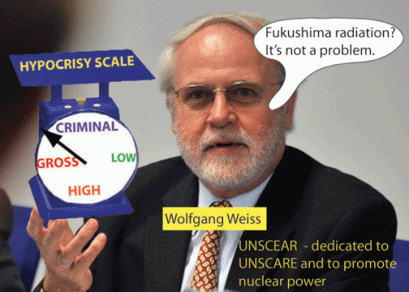 Image source ; https://nuclear-news.net/2014/04/03/unclear-unscear-report-aims-to-unscare/
CONCLUSION TO THE CRITIQUE OF THE UNSCEAR REPORT
The Fukushima nuclear disaster is far from over. Despite the declaration of “cold shutdown” by the Japanese government in December of 2011, the crippled reactors have not yet achieved a stable status and even UNSCEAR admits that emissions of radioisotopes are continuing unabated. TEPCO is struggling with an enormous amount of contaminated water, which continues to leak into the surrounding soil and sea. Large quantities of contaminated cooling water are accumulating at the site. Failures in the makeshift cooling systems are occurring repeatedly.
The discharge of radioactive waste will most likely confinue for a long time.
Both the damaged nuclear reactors and the spent fuel ponds contain vast amounts of radioactivity and are highly vulnerable to further earthquakes, tsunamis, typhoons and human error. Catastrophic releases of radioactivity could occur at any time and eliminating this risk will take many decades. Moreover, many of Japan’s other nuclear power stations are just as sensitive to seismic catastrophes as the Fukushima Daiichi plant.
Attempts to make reliable forecasts for the next decade seem futile against the backdrop of so much uncertainty.
While much ofthe UNSCEAR report represents useful and important groundwork for future assessments, it does not in any wayjustify the type of ‘all-clear’ that UNSCEAR is proposing.
It is impossible at this point to come up with an exact prognosis of the effects that the Fukushima nuclear disaster will have on the population in Japan. However, based on the arguments presented in this paper, it has to be stated that the UNSCEAR report represents a systematic underestimation and conjures up an illusion of scientific certainty that obscures the true impact ofthe nuclear catastrophe on health and the environment.
In its report, UNSCEAR calculates the collective effective doses and absorbed thyroid doses for the Japanese population. However, the admitted uncertainties regarding exposure closes, questionable data selection, faulty assumptions and the fact that ongoing radioactive emissions were not considered undermine the validity of these calculations. The resulting close estimates are most likely underestimated and do not reflect the true extent of radiation received by the affected population.
By utilizing more neutral sets of data, acknowledging inherent uncertainties in close estimates, citing the full range of possible exposure rates rather than the best-case scenarios, and by incorporating the latest information about ongoing radioactive emissions, UNSCEAR could have presented a more realistic picture of what effects people can expect from the radioactive fallout in the coming decades, including thyroid cancer, leukemia, solid tumors, non—cancer diseases and genetic defects, all of which have been found in the population affected by the Chernobyl nuclear catastrophe.
Even with more realistic data, however, the number of cancer cases induced by Fukushima radioactive fallout may still be considered insignificant to the members of UNSCEAR, especially given the relatively high baseline in cidence of cancer in Japan. From a physician’s perspective however, every preventable case of cancer is one too many and the tragic consequences that cancer has on a person’s physical and mental health, as well as the situation of the entire family have to be considered.
To reduce the horrible effects of the Fukushima nuclear disaster on tens of thousands of families to a statistical problem and to dismiss these individual stories of suffering by stating that “radiation exposure following the nuclear accident at Fukushima—Daiichi […] is unlikely to be able to attribute any health effects in the future among the general public and the vast majority of workers” is inappropriate for a committee of the United Nations, an organization that prides itself on the Declaration of Universal Human Rights.
How UNSCEAR fooled the world on health effects on Fukushima children
“…There are also some other inconsistencies in the UNSCEAR report regarding the Fukushima thyroid examinations.
While the report was released in April of 2014, it only used the data ofthe thyroid examinations up to July 31st, 2013. More current publications by Fukushima Medical University from November 12th, 2013 and February 7th, 2014 were not included, even though the number of diagnosed thyroid cancers has increased from the 9 cases mentioned in UNSCEAR’s report to the current number of 33…”“….UNSCEAR fails to mention, however, that the cohorts were not matched for age, sex or other demographic characteristics and consisted primarily of students from institutions associated with national universities, not representative of the general population…..”
“….”The prevalence of clinically occult small papillary thyroid cancers could be as high as 35% in many parts of the world,” suggesting that the high rates of cancers found in the Fukushima thyroid examinations are simply screening effects and that other pediatric populations would have similar rates of cancer if screened . This statement, however, is solely based on a Finnish autopsy study, which, interestingly enough, mentions a prevalence of 27% and not 35% and specifically found
no clinically occult thyroid cancers in children under the age of 18….”

Image source ; http://blogs.reuters.com/photographers-blog/2014/03/10/fukushimas-children/
Comment by Shaun McGee
Contributer to Nuclear-news.net
Posted on 7 June 2014
These are extracts from a new report that has analysed the UNSCEAR 2013 fukushima report on the health effects from the Fukushima nuclear disaster of 2011. This critique of the methodology employed by UNSCEAR to form their report was done by a number of health professionals from around the world. This part of the report looks at the issues concerning the reports of “no health effects on children from radiation from the nuclear disaster” that is claimed by many pro nuclear officials. The full report is here;
http://www.fukushima-disaster.de/fileadmin/user_upload/pdf/english/Akzente_Unscear2014.pdf
A recent meta-analysis found that “qualitative and quantitative physiological and epidemiological evidence supports infants being more vulnerable to cancer” and estimated that infants have about 10 times higher radiation risks per unit close when it comes to radioactive fallout than adults,265 while the more conservative International Commission on Radiological Protection (ICRP) assumes that the sensitivity to ionizing radiation in young children and fetuses is higher than in adults by only a factor of 3.266 Several international studies also found that thyroid nodules in children have a much higher malignancy rate than in adults, between 2 and 50%.
It becomes clear that any assessment of thyroid pathologies in the wake of a nuclear disaster needs to adopt a differentiated approach towards the different age groups. Looking at the methodology of the UNSCEAR close assessments, it is highly questionable whether all of these factors were appropriately taken into consideration.

Image source ;https://nuclear-news.net/2013/03/22/fukushima-deletes-radiation-data-needed-for-exposure-assessment/
While it is often claimed by the nuclear lobby that the rise of thyroid cancer is of relatively small concern clue to
good treatment options, we should not underestimate the impact of such diseases on children and their families.
The necessary operation and removal of the entire thyroid carries with it notjust a psychological impact, but also
certain perioperative risks connected with general anesthesia and the close proximity of the vagus nerve to the
operation field.
The lifelong need to take artificial thyroid hormones, frequent medical follow-ups, blood tests, ultrasounds, possibly fine-needle biopsies and the constant fear of a possible relapse are all very serious issues for the individual patients and their families. The US National Council on Radiation Protection and Measurements (NCRP) estimates that 7% of thyroid cancers caused by radiation would be fatal. This would mean that of the approximately 1,000 estimated excess cases of thyroid cancers, about 70 would lead to death. The number of non-fatal cases, which lead to substantial hospitalization and loss of quality of life cannot be adequately assessed, but also have to be taken into consideration.
In addition to the predictions of future thyroid cancer cases on the basis of close estimates, there is already epidemiological data available from the first round of thyroid examinations on children aged 18 or less on 11 March
2011, performed between October 2011 and March 2014. It is important to note that from this first round
of screening, it is not possible to make assertions regarding the incidence of thyroid cancer, as the screening of
the entire cohort of children in the prefecture yields the prevalence (i.e. the total number of cases in the population) of thyroid cancers and only future screenings will reveal the incidence (i.e. the rise in numbers from year to year).
So far, the prevalence of tumor-suspect thyroid biopsies in Fukushima is 29.1 per 100,000 children under the age of 18 (absolute number: 74) and the prevalence of confirmed cases of thyroid cancer 13.0 per 100,000 (absolute number 33). In comparison, the incidence of thyroid cancer in Japanese youths (< 19 years) in the years 2000 to 2007 was 0.35 per 100,000.22” While we cannot directly compare the prevalence found in the screening program to the incidence levels before the Fukushima disaster, this is nonetheless a worrying number, with the numbers of detected thyroid cancers higher than expected.
1 This Month


Tell the Ukrainian Government to Drop Prosecution of Peace Activist Yurii Sheliazhenko

Petition to revoke the licensing of the Near Surface Nuclear Disposal Facility (NSDF) at Chalk River. https://www.ourcommons.ca/petitions/en/Petition/Details?Petition=e-7247


of the week – STOP SMALL MODULAR REACTORS IN CANADA
To see nuclear-related stories in greater depth and intensity – go to https://nuclearinformation.wordpress.com
-
Archives
- March 2026 (212)
- February 2026 (268)
- January 2026 (308)
- December 2025 (358)
- November 2025 (359)
- October 2025 (376)
- September 2025 (258)
- August 2025 (319)
- July 2025 (230)
- June 2025 (348)
- May 2025 (261)
- April 2025 (305)
-
Categories
- 1
- 1 NUCLEAR ISSUES
- business and costs
- climate change
- culture and arts
- ENERGY
- environment
- health
- history
- indigenous issues
- Legal
- marketing of nuclear
- media
- opposition to nuclear
- PERSONAL STORIES
- politics
- politics international
- Religion and ethics
- safety
- secrets,lies and civil liberties
- spinbuster
- technology
- Uranium
- wastes
- weapons and war
- Women
- 2 WORLD
- ACTION
- AFRICA
- Atrocities
- AUSTRALIA
- Christina's notes
- Christina's themes
- culture and arts
- Events
- Fuk 2022
- Fuk 2023
- Fukushima 2017
- Fukushima 2018
- fukushima 2019
- Fukushima 2020
- Fukushima 2021
- general
- global warming
- Humour (God we need it)
- Nuclear
- RARE EARTHS
- Reference
- resources – print
- Resources -audiovicual
- Weekly Newsletter
- World
- World Nuclear
- YouTube
-
RSS
Entries RSS
Comments RSS
 nuclear-news