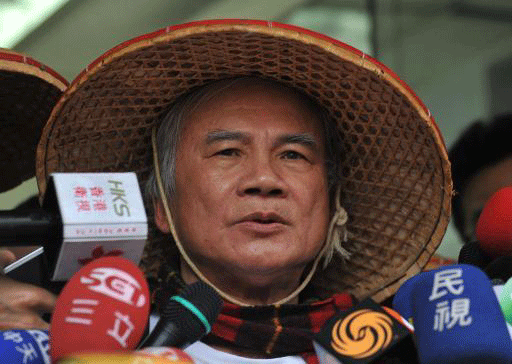
Hunger Striker Ends Fast, but Not Fight, Against Nuclear Power in Taiwan NYT, By AUSTIN RAMZYMAY 1, 2014, A former head of Taiwan’s Democratic Progressive Party has announced that he is ending his hunger strike, but not his campaign, against nuclear power on the island.
The former leader, Lin Yi-hsiung, 72, began his protest on April 22, and it drew attention from Taiwan’s leaders and from protesters, who converged on central Taipei in recent days to say they were inspired by Mr. Lin’s sacrifice.
In announcing the end of his fast on Wednesday, Mr. Lin thanked protesters for their recent campaign against nuclear power.
“Over the past half month, the people of Taiwan’s outstanding display has been unprecedented, which leaves one feeling moved, full of admiration and deeply appreciative,” he wrote in a blog post.
On Monday, the government announced that it was halting work on the Lungmen nuclear power plant in northeast Taiwan, about 20 miles outside Taipei, pending a referendum on its future. The project, known as No. 4, was started more than a decade ago and has cost more than $9 billion………
The 2011 Fukushima disaster in Japan has raised concerns among many people in Taiwan about the safety of nuclear power, particularly with a plant that is near the ocean and the island’s largest urban area.
After Sunday’s demonstration, which the police estimated drew 28,500 people and organizers say had as many as 50,000, a smaller number of protesters converged on a main street near Taipei’s main train station. They were forcibly removed by the police using water cannons.
With the halt to construction on the plant and the end of Mr. Lin’s hunger strike, the momentum for antinuclear demonstrations has ebbed somewhat. But smaller protests have continued outside the legislature building this week, and Mr. Lin has called on his supporters to continue pushing for the shutdown of Taiwan’s three other nuclear power plants.
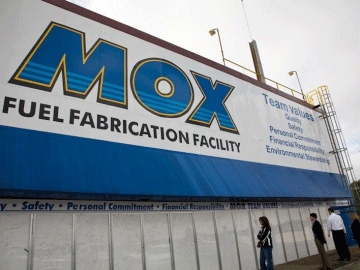
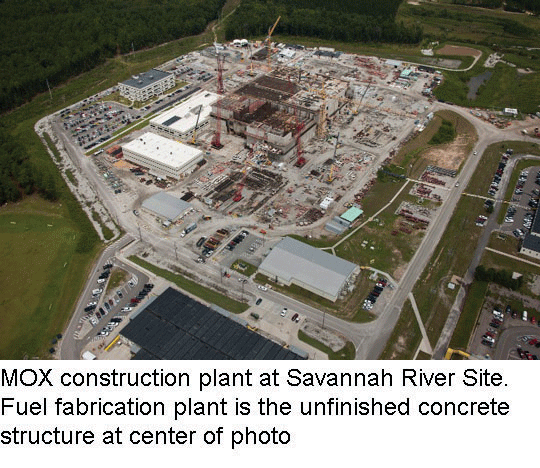
South Carolina Gov. Nikki Haley has recently said that if MOX is shelved, she wants the plutonium out of South Carolina. That is silly, but it reflects a 2002 federal law that U.S. Sen. Lindsey Graham had demanded.
Apparently, idiocy is endemic.
First, our plutonium problem. With welcome reductions in our nuclear arsenal, we now have about a hundred tons of plutonium in storage. In the wrong hands, less than 20 pounds of it could make a nuclear bomb. That would be a catastrophe. We must store it securely for decades. Savannah River Site would be logical for this job, with its huge area and a staff experienced in handling plutonium. This would provide good jobs that the governor should have jumped at.
MOX’s design capacity is to disable one ton of plutonium per year, so if MOX were the way to work it off, it would take more than a hundred years. A stock of one ton requires as much protection as for 100 tons.
With the huge increase in fixed costs from construction, would it be profitable? If we plan to cancel the program, we would end up writing off the sunk costs, so why not do it anyway? Would it then be profitable? If MOX fuel can’t be sold at a profit, why continue with it?
In summary, MOX has no value in ridding us of our stored plutonium.
Alternatives must be sought for that. The United States will need to have one or several plutonium storage sites, indefinitely. South Carolina should accept the job for one of them.
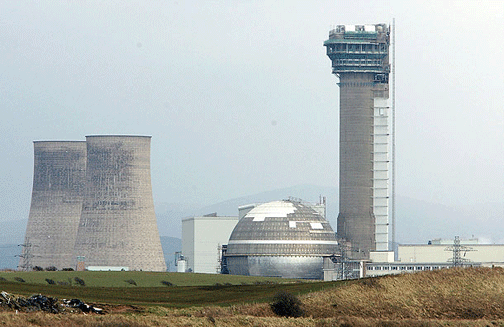
Nuclear power undermines nuclear security, The Ecologist, Dr David Lowry 2nd May 2014 “…… In Britain, the biggest nuclear security problem is the huge nuclear facility at Sellafield, originally built in the early 1950 on England’s northwest coast, in Cumbria, which is also home of the wonderful Lake District National Park.
Sellafield however is also the home of hundreds of decaying and decrepit building, many stores of liquid and solid radioactive waste, and, from a security perspective, most importantly, 111 tonnes of weapons – useable plutonium.
Let me give you that figure in another way. 111 tonnes is 111,000 kilogrammes. A nuclear bomb can be made with as little as 5 kilograms of plutonium – a lump about the size of a large orange.
Note: the ‘Fat Man’ nuclear bomb detonated above Nagasaki in August 1945, with a blast equivalent to 21,000 tons of TNT, contained jut 6.2 kg of plutonium
The Sellafield deer
And how well prepared are Sellafield’s managers for the unexpected? Not very, as we can see from the story of the Sellafield deer.
As a result of a recent security review, the Sellafield management decided to strengthen the perimeter fence around the site. Unfortunately in doing so they unintentionally captured a small herd of wild deer.
But rather than releasing the corralled deer, they shot them, as the local newspaper, the Whitehaven News revealed early on 3rd April. Their headline ran: “Three deer shot dead as Sellafield carries out cull”.
Now – if the deer could find themselves, un-noticed, on the wrong side of the security fence, what about people? The insecurity of the storage buildings for the waste products arising from operating nuclear power reactor is a a huge and as yet unsolved problem.
We are often told these stores are robust against terrorist attack. …….
UK score on nuclear security: 11%
NTI publishes a table in its new report (see below) that ought to set the alarm bells ringing in DECC and across Whitehall. The NTI assessed the nuclear security of 25 countries identified as having the nuclear materials capable of making nuclear nuclear WMDs. The UK ranked bottom with a score of just 11/100.
But the problem is clearly systemic. The five permanent members of the UN Security Council, who also happen to be the ‘Big Five’ nuclear weapons states – the US, Russia, China, UK and France – all ranked 18th or worse out of 25, with scores of 34/100 or worse.
John Baron MP: It’s time to recognise our nuclear test veterans http://www.conservativehome.com/platform/2014/05/john-baron-mp-its-time-to-recognise-our-nuclear-test-veterans.html By John Baron MP , 2 May 14,John Baron MP is a member of the Foreign Affairs Select Committee. When compared with how other countries treat their nuclear test veterans, Britain has a shameful record. Ministry of Defence (MoD) references to war pensions do not wash. The very high rate of serious ill health amongst veterans’ offspring reinforces the fact that, although no side can lay hold to firm scientific evidence, there is a case to be answered. The Government needs to build on its good track record of acknowledging past wrongs, and finally recognise the debt of gratitude we owe to these veterans and their families.
During the 1950s and 1960s, over 20,000 British and Commonwealth servicemen, many of whom were on national service, took part in British nuclear tests in the South Pacific and Australia. They played an essential part in developing Britain’s independent nuclear deterrent, and their contribution to winning the Cold War can not be overstated.
The tests were carried out at the very beginning of the nuclear age, and the science was imperfectly understood. Precautions for the servicemen were primitive and inadequate. The only people wearing protective suits were the scientists. Many veterans believe their health, and that of their descendants, has been adversely affected by their presence during the nuclear tests.
The veterans feel forgotten, and some years ago came together to form the British Nuclear Test Veterans’ Association (BNTVA), the principal charity which campaigns on their behalf. I am honoured to be their Patron, and since 2011 we have been running a cross-party campaign in Parliament. The campaign has involved two stages. The first was to secure a Health Needs Audit from the MoD, to ease the path of our veterans through the NHS, which we have now secured. The second has been to secure official recognition of their service from the Government. This has not been forthcoming, and is very important not only to the diminishing number of veterans – only around 3,000 are still alive – but also to the descendents of those no longer with us. An acknowledgement from the Prime Minister, either orally or in writing, would make a huge difference.
A further aspect of our recognition campaign is to secure an ex gratia payment of £25 million from the Government to help establish a Benevolent Fund to distribute grants to veterans and their descendents to help with their care. Access to the Fund would be on the basis of need, not entitlement – thus reinforcing the fact our campaign is one of recognition, not compensation. For the record, the BNTVA has never taken part in any of the legal proceedings against the MoD.
Our recognition campaign was launched in Parliament last June, and over 80 MPs have expressed support for its aims. In October, I led a Parliamentary debate on the issue, during which I highlighted that Britain lies towards the bottom of the ‘international table of decency’ when it comes to how we treat our test veterans.
Canada and the US, for example, both offer payments to nuclear servicemen of £47,000 and £15,000 respectively. Crucially, no causal link between presence at a test and illness is required – this is in contrast to our war pensions scheme, which inevitably finds against veterans. The Isle of Man, our near neighbour, makes an £8,000 payment to any resident nuclear veteran. In all three cases, nuclear veterans receive free health care. Even the Russians ply their test veterans with medals and pensions, in recognition of their contribution.
Underlining the veterans’ case is the fact that their descendants suffer a much higher rate of congenital illness at birth. Against a national rate of around 2.5 per cent, over a third of veterans’ offspring have a serious medical condition. Figures obtained from French nuclear test veterans are broadly similar. Though this may not be scientific, it is nevertheless strong circumstantial evidence that the veterans’ service has cast a long shadow, and explains why the Benevolent Fund must be extended to veterans’ descendants.
Faced with the prevalence of ill health amongst descendants, a significant number of veterans opted to take the life-changing step not to have any children, and still more have terminated pregnancies rather than take the risk. These, together with the sad toll of multiple miscarriages and stillbirths, make up a ‘hidden story’ of anguish and uncertainty precipitated by service at nuclear tests.
The MoD’s defence of the indefensible is the existence of its war pensions scheme. But 90 per cent of nuclear test veterans have failed to get a war pension, in part because they find it difficult to establish a casual link between their presence at the tests and their ill health. This is despite the fact some of these veterans have received money through American schemes. Derek Spackman was a British navigator in an RAF Canberra aircraft. Flying out of Darwin, in 1954 he was tasked with sampling radiation levels following the American tests on the Marshall Islands. His widow was repeatedly denied a war pension by the MoD; however the US Government awarded her $75,000 for his service.
No doubt further information will come to light, as veterans respond to the BNTVA’s ‘call for evidence’. What comes through strongly is that the veterans have a compelling case, and that the goals of the campaign – official recognition and a £25m Benevolent Fund – are in truth very modest.
The BNTVA and I are hosting a Parliamentary film reception for veterans, their families and supporters on June 25. Having met the Prime Minister just before Easter, he is now going to ask further questions within government. Our hope is that he will recognise that our campaign is fair and just. After 60 years of waiting, the nuclear test veterans and their descendants deserve no less.
SENATORS TO NRC: DO NOT EXEMPT DECOMMISSIONING NUCLEAR REACTORS FROM EMERGENCY RESPONSE AND SECURITY MEASURES NEWS RELEASE — SEN. PATRICK LEAHY, SEN. BERNIE SANDERS
May 2, 2014
Contact:
Mike Briggs (Sanders) 202-224-5141
David Carle (Leahy) 224-3693
Washington (May 2, 2014) – In a letter sent today to Nuclear Regulatory Commission (NRC) Chairman Allison Macfarlane, Senator Edward J. Markey (D-Mass.), Senate Environment and Public Works Committee Chairman Barbara Boxer (D-Calif.), and Senators Bernard Sanders (I-Vt.), Patrick Leahy (D-Vt.) and Kirsten Gillibrand (D-N.Y.) called on the agency to stop the “unwise policy” of issuing exemptions for emergency response regulations to decommissioning nuclear reactors which house decades-worth of spent nuclear fuel.
Exemptions for compliance with the emergency response regulations – such as those that require evacuation zones and siren systems to warn of problems – have been granted to all of the ten reactor licensees that have requested them in the past. Moreover, the licensees of reactors that are or will soon begin the decommissioning process (including San Onofre in California and Vermont Yankee) have already submitted a wide range of exemption requests from emergency response, security and other regulations to the NRC.
The NRC is currently in the process of finalizing its finding that spent nuclear fuel can be stored safely for at least 60 years beyond the licensed life of a nuclear power plant, and based this determination in part on the assertion that emergency preparedness and security regulations remain in place during decommissioning. Accidents or attacks on spent fuel pools would put neighboring communities at great risk of experiencing radioactive releases, fires, and widespread contamination.
Full text of the letter is attached with appendices and below.
May 2, 2014
The Honorable Allison M. Macfarlane
Chairman
Nuclear Regulatory Commission
Rockville, MD 20852
Dear Chairman Macfarlane:
We write to request that the Nuclear Regulatory Commission (NRC) cease exempting licensees of decommissioning nuclear reactors from its emergency response and security regulations. NRC repeatedly cites these regulations to demonstrate the long-term safety and security of spent nuclear fuel. Yet it has granted each and every one of the ten requests for exemptions from emergency response requirements that it has received from reactors that have permanently shut down, generally within 2 years of the reactors’ closure and without regard to how much spent fuel is still stored in spent fuel pools. ……….
NRC is currently in the process of finalizing its Waste Confidence decision that spent nuclear fuel can be stored safely for at least 60 years beyond the licensed life of a nuclear power plant, and based this determination in part on the assertion that emergency preparedness and security regulations remain in place during decommissioning.The Commission is also voting on whether there is a benefit to accelerating the transfer of spent nuclear fuel to dry casks, and the document being voted on assumes the continued application of emergency response and security requirements.
Japanese utilities post losses, seek state support Star Online 2 May 14 TOKYO: Japan’s nuclear-reliant utilities reported losses for the third straight year and warned of further electricity rate hikes to pay for surging fuel imports as they face an uncertain outlook for restarting idled reactors.
Six of Japan’s nine big regional power companies, all of which own reactors, reported a combined net loss of US$3.3bil as they face the rising fuel costs and also spend billions of US dollars to upgrade nuclear facilities to meet new regulatory standards. “We can no longer deny the possibility that we will not be able to restart a nuclear plant for some time,” Kansai Electric Power president Makoto Yagi told an earnings briefing, adding that another electricity rate hike might become inevitable. It raised rates by 9.75% last May.
Kansai Electric, Japan’s second-largest utility by revenue which supplies nearly one-fifth of the nation’s electricity, reported a 97.4 billion yen (US$950mil) net loss for the fiscal year that ended on March 31, its third consecutive year of losses.
Kyushu Electric Power and Hokkaido Electric Power said on Wednesday they would request financial support from the government-affiliated Development Bank of Japan, asking it to buy 150 billion yen in preferred shares in the two utilities.
Kyushu Electric serves Japan’s southern main island which is home to several auto and chip plants, while Hokkaido Electric serves the northern-most island.
The three consecutive years of net losses for utilities will make it difficult for them to secure further private-sector loans under standard Japanese banking practices, pushing firms like Kyushu and Hokkaido to seek public support……..Even in the most optimistic scenario, analysts and industry watchers say Japan may only be able to restart one-third of its reactors, while 17 are unlikely ever to come back online due to their age, location or proximity to suspected active fault lines. — Reuters http://www.thestar.com.my/Business/Business-News/2014/05/02/Japanese-utilities-post-losses-seek-state-support/
Nuclear power undermines nuclear security, The Ecologist, Dr David Lowry 2nd May 2014 Opponents of nuclear power rightly focus on issues of cost, operational danger and waste disposal, writes David Lowry. But they should not forget the towering ‘elephant in the room’ – nuclear security and the risk of proliferation and terrorist attacks. This week over 150 countries began a two week meeting at the United Nations in New York, preparing for the latest five-yearly review conference of the 190-member state Nuclear Non Proliferation Treaty (NPT).
The conference will no doubt split between the vast majority of non-nuclear weapons states and the ‘Permanent-Five’ nuclear WMD possessor states – UK, US, France, China and Russia.
At issue will be the continual, chronic lack of progress in nuclear disarmament by the nuclear WMD states – indeed, in the case of the USA in particular, its colossal program to modernise its nuclear arsenal.
However there is scope for common cause in one area: combatting nuclear terrorism. There’s only one problem here – the nuclear WMD states are themselves among the least secure in their custody of nuclear materials.
Nuclear power and nuclear security
This discussion will put the focus squarely on the 25 states that possess nuclear materials, most of them for civil nuclear programs for the generation of electricity.
Despite reassurances that these nuclear materials present little or no proliferation hazard, the reverse is the case. Nuclear security is the ‘elephant in the room’ of the nuclear power debate
The final communiqué of the Global Nuclear Security Conference that was held last month in The Hague insisted that “measures to strengthen nuclear security will not hamper the rights of States to develop and use nuclear energy for peaceful purposes.”
Dr Victor Gilinsky, a former member of the US Nuclear Regulatory Commission, noted in 2009 in his paper ‘A call to resist the nuclear revival’ (Bulletin of the Atomic Scientists, 27 January 2009) that
“even so-called arms controllers fall over themselves trying to establish their bona fides by supporting nuclear energy development and devising painless proposals … “
That mentality was in evidence at the NSS, just as it was at the IAEA nuclear security conference in Austria last July.
But sensibly Gilinsky advocates a reversal of priorities: “Security should come first – not as an afterthought. We should support as much nuclear power as is consistent with international security; not as much security as the spread of nuclear power will allow.”
And if we adopt that approach, it can mean only one thing: zero nuclear power………
‘A grave sovereign responsibility’
“There is no question that securing nuclear materials is a grave, sovereign responsibility. At the same time, the threat is global, and all countries must work to reduce that threat.”
That was the conclusion of the authoritative Nuclear Threat Initiative, 2014 Report, published in Washington DC, on 8 January this year.
On April 2, UNSCEAR published its long-awaited Report on Fukushima. Of prime importance are its estimates of collective doses to the Japanese population.
Page 60 of Annex A of the UNSCEAR report contains the following table 8 on estimated collective effective doses and collective absorbed doses to the thyroid for the population of Japan (approximately 128 million in 2010).
Exposure duration
Over first year
Over ten years
Up to age 80 years
Collective effective dose
18,000 man-Sv
36,000 man-Sv
48,000 man-Sv
Collective absorbed dose to thyroid
82,000 man-Gy
100,000 man-Gy
112,000 man-Gy
These estimates are slightly higher than in the draft UNSCEAR report in November 2013. For example, the 80 yr whole body dose was 41,000 man Sv and thyroid dose was 110,000 man Sv in last year’s draft.
In an early preliminary view, these are realistic collective doses, as they are relatively consistent with some independent estimates in Europe. For example, the most detailed model used by the Report published by IPPNW Germany in late March 2013 estimated 95,000 man Sv: ie the UNSCEAR 48,000 man Sv estimate is within a factor of 2 of this, which is good agreement given the uncertainties in the IPPNW’s methodology and in this area generally.
My own estimate in early March 2013 for Fukushima Prefecture (the most contaminated region) alone was 34,000 man Sv. If I were to add an estimate for the rest of Japan of ~13,000[1] man Sv, this would total 47,000 man Sv – very close to UNSCEAR’s estimate of 48,000 man Sv. In fact, the agreement is slightly unnerving!
In terms of the fatal cancers these doses would cause, the new UNSCEAR estimates imply (via the LNT theory) that in future ~5,000 people in Japan will die from Fukushima’s fallout, if we applied a fatal cancer risk of 10% per Sv. (This is because the UNSCEAR report like the previous WHO reports no longer applies a DREFF of 2 to risk estimates.)
However a more detailed scrutiny will be required of the methodologies and assumptions used in the new UNSCEAR report before a final view can be given.
PS. The UNSCEAR report on page 60 adds that “The collective effective dose to the population of Japan due to a lifetime exposure following the FDNPS accident is approximately 10-15% of the corresponding value for European populations exposed to radiation following the Chernobyl accident. Correspondingly, the collective absorbed dose to the thyroid was approximately 5% of that due to the Chernobyl accident.”
From this, one can work out what UNSCEAR now thinks the whole body collective dose to Europe was from Chernobyl: ie 320,000 to 480,000 man Sv, leading to ~32,000 to ~48,000 fatal cancers. This has never been stated before by UNSCEAR. These estimates are close to the 2006 independent TORCH report’s estimates of 30,000 to 60,000 fatal cancers.
[1]UNSCEAR estimates the average whole body dose to the rest of Japan outside Fukushima Prefecture was ~0.1 mSv. Multiplied by 126,000,000 people outside Fukushima gives a collective dose of 12,600 or 13,000 to 2 sig figs.
The impact of the nuclear crisis on global healthAustralian Medical Student Journal By Helen Caldicott in Volume 4, Issue 2 2014
“………Conclusion In summary, the radioactive contamination and fallout from nuclear power plant accidents will have medical ramifications that will never cease, because the food will continue to concentrate the radioactive elements for hundreds to thousands of years. This will induce epidemics of cancer, leukemia and genetic disease. Already we are seeing such pathology and abnormalities in birds and insects, and because they reproduce very fast it is possible to observe disease caused by radiation over many generations within a relatively short space of time.
Pioneering research conducted by Dr Tim Mousseau, an evolutionary biologist, has demonstrated high rates of tumors, cataracts, genetic mutations, sterility and reduced brain size amongst birds in the exclusion zones of both Chernobyl and Fukushima. What happens to animals will happen to human beings. [7]
The Japanese government is desperately trying to “clean up” radioactive contamination. But in reality all that can be done is collect it, place it in containers and transfer it to another location. It cannot be made neutral and it cannot be prevented from spreading in the future. Some contractors have allowed their workers to empty radioactive debris, soil and leaves into streams and other illegal places. The main question becomes: Where can they place the contaminated material to be stored safely away from the environment for thousands of years? There is no safe place in Japan for this to happen, let alone to store thousands of tons of high level radioactive waste which rests precariously at the 54 Japanese nuclear reactors.
Last but not least, Australian uranium fuelled the Fukushima reactors. Australia exports uranium for use in nuclear power plants to 12 countries, including the US, Japan, France, Britain, Finland, Sweden, South Korea, China, Belgium, Spain, Canada and Taiwan. 270,000 metric tons of deadly radioactive waste exists in the world today, with 12,000 metric tons being added yearly. (Each reactor manufactures 30 tons per year and there are over 400 reactors globally.)
This high-level waste must be isolated from the environment for one million years – but no container lasts longer than 100 years. The isotopes will inevitably leak, contaminating the food chain, inducing epidemics of cancer, leukemia, congenital deformities and genetic diseases for the rest of time.
This, then, is the legacy we leave to future generations so that we can turn on our lights and computers or make nuclear weapons. It was Einstein who said “the splitting of the atom changed everything save mans’ mode of thinking, thus we drift towards unparalleled catastrophe.”
The question now is: Have we, the human species, the ability to mature psychologically in time to avert these catastrophes, or, is it in fact, too late? http://www.amsj.org/archives/3487
Thursday, May 01, 2014 by: Jonathan Benson, staff writer (NaturalNews)Disillusioned by the government’s questionable position on radiation dangers throughout the region, many Japanese families living in and around the Fukushima prefecture where a large nuclear power station sustained three full meltdowns back in 2011 are deciding to send their children away to greener, safer pastures.
Associated Press (AP) reporter Yuri Kageyama reports that many families living within the so-called “no-go zone,” which covers a six-mile radius surrounding the plant, are not so sure that their children are safe there. At least 33 children throughout the region have been diagnosed with thyroid cancer since the Fukushima disaster, and many more are suffering from other symptoms possibly caused by radiation.
This is why Yukie Hashimoto and her husband decided to send their 12-year-old daughter 200 miles away to a resort town in central Japan. Concerned that the girl might eventually develop symptoms from perpetual exposure to low-dose radiation, the Hashimotos decided to take advantage of an offer by the town’s mayor to take in, educate and care for young Fukushima refugees.
“The low-dose radiation is continuing,” stated Hashimoto to reporters about the decision. “There is no precedent. We don’t know what effect that will have on our children.”
Local leader says radiation levels four times higher around Fukushima than after Chernobyl
And the Hashimotos aren’t alone. The families of at least seven other children near Fukushima have reportedly decided to do the same thing to protect their children from long-term harm. This comes as local leader Katsutaka Idogawa, former mayor of Futaba, a town near Fukushima, recently issued a warning about radiation levels near Fukushima being four times higher than they were near Chernobyl.
“It is by no means safe, no matter what the government says,” he is quoted saying to RT.com.
Many residents in the area feel the same way, having expressed concerns about the validity of government reassurances that radiation levels are too low to be harmful. If recent radiation readings are any indication, it is clear that things are hardly as rosy as the world is being led to believe.
“I didn’t really believe things are as safe as the government is telling us,” Hashimoto said to AP reporters. “We made our decision with her future, 10 years and 20 years later, in mind.”
Thyroid-cancer-surgeon-turned-mayor to care for refugee children
In Matsumoto, the ski town where their daughter and a handful of others have now been sent, the children will receive an education and be cared for by local families. If complications should arise from earlier radiation exposure, the children will have access to the town’s mayor, a medical doctor who previously performed more than 100 thyroid cancer surgeries following Chernobyl.
“If my fears turn out to be unfounded, nothing would be better news,” stated Akira Sugenoya, the mayor in question, to the AP last fall when he first announced taking in refugee children living near Fukushima. “But if they become reality, then there is little time before it’s too late.”
For the Hashimotos, not everyone in the family is necessarily on board with this precautionary measure. The young girl’s older brother and grandmother both think her relocation is extreme, and she herself is worried about her leaving her six-year-old brother behind, since he is too young to be accepted into the program. But at the end of the day, her parents are certain that the decision is sound.
“The bottom line is: No one knows for sure,” stated Hiroshi Ueki, a former Fukushima resident who moved with his wife and two children to Matsumoto to lead the project. “What we do know is that the cases of cancer are up, and so naturally we are worried.”
KYODO An international nuclear expert expressed skepticism Thursday over Tokyo Electric Power Co.’s plan to set up an ice wall to ultimately stop radioactive water from further increasing at the troubled Fukushima No. 1 nuclear complex.
“I’m not convinced that the freeze wall is the best option,” former U.S. Nuclear Regulatory Commission Chairman Dale Klein, who heads a supervisory panel tasked with overseeing the plant operator’s nuclear safety efforts, said in an interview with Kyodo News.
“What I’m concerned about is unintended consequences,” Klein said.
“Where does that water go and what are the consequences of that? I think they need more testing and more analysis,” he said.
Former British Atomic Energy Authority Chairwoman Barbara Judge, who was also present at the interview in Tokyo and is part of the panel, said there is a need to assess during summer whether the ice wall method would be effective. The remarks by the two overseas experts came at a time when concerns over the plan are being raised by Japan’s Nuclear Regulation Authority and engineering experts. Their opinions may cast a shadow on Tepco’s plan to begin operating the ice wall by the end of next March.
“No one has built a freeze wall this long for this period of time. Typically, you build a freeze wall for a few months,” Klein said.
Faced with a string of problems including radioactive water leaks at the Fukushima plant, Tepco is attempting to freeze 1.5 kilometers of soil around the basement areas of the Nos. 1 to 4 reactor buildings.
The ice wall is envisioned to block groundwater from seeping into the reactor buildings’ basement areas and mixing with highly toxic water used to cool the plant’s three crippled reactors.
“I am much in favor of the bypass system,” Klein said, referring to the groundwater bypass system in which Tepco pumps groundwater at the Fukushima plant to direct it into the sea to reduce the amount of water seeping into the reactor buildings.
“The freeze wall is expensive,” he said, urging Tepco and the government to look at the cost of building one and whether the plan is making the “best use of limited resources.” “I would encourage them to get international advice a little bit more,” Klein said about Tepco, in terms of its decontamination work and future plans to scrap the plant.
Klein also urged the company to work with and share information with relevant authorities in the United States and Britain given that those nations are experienced in water management and decontamination efforts at former military or weapons-related sites.
NHK WORLD,, Apr. 30, 2014: Fukushima evacuees complain of health problems […] nearly 70 percent of households that evacuated after the March 2011 disaster have members who complain of health problems. The prefecture polled more than 62,800 evacuee households. About one-third responded. [68%] said one or more of their members complain of health problems such as lack of sleep or depression.
AP,, Apr. 30, 2014: […] It’s difficult to imagine ever living again in Tomioka, a ghost town about 10 kilometres from the former Fukushima Dai-chi nuclear plant. […] The streets were abandoned […] The neighbourhood was eerily quiet except for the chirping of the nightingales. […] The long-term goal is to bring annual exposure down to one millisievert […] considered the safe level before the disaster, but the government is lifting evacuation orders at higher levels.
CNN: Fukushima’s Exclusion zone a Ghost Town
It says it will monitor the health and exposure of people who move back to such areas. In the yellow restricted zone […] a visitor exceeds one millisievert in a matter of a few hours. […] “The prime minister says the accident is under control, but we feel the thing could explode the next minute,” said Michiko Onuki, who ran a ceramic and craft shop out of their Tomioka home. “We would have to live in fear of radiation. This town is dead.” […] “I can survive anywhere, although I had a plan for my life that was destroyed from its very roots,” said [Tomioka city assemblyman Seijun] Ando, tears welling up in his eyes. […]
Abe’s visit spurs signing of deal to build nuclear plant Ft.com, By Kiran Stacey and Guy Chazan 2 May 14, Britain’s nuclear power industry was given a boost on Thursday as one of Japan’s largest companies took a step closer to building a £10bn nuclear power plant in the north-west.
Toshiba, the engineering and technology company, signed an agreement giving it the right to build at Sellafield, in west Cumbria, during a visit by Shinzo Abe, Japanese prime minister, to London, in an effort to boost trade and investment between the two countries.
The land option agreement for the new nuclear site will involve total payments by Toshiba and its partners to Britain’s Nuclear Decommissioning Authority of over £200m by the time the option is exercised, the energy department said……….
The NuGen consortium, a joint venture between Toshiba/Westinghouse and France’s GDF Suez, owns a site near Sellafield in west Cumbria that has been earmarked for three new reactors. …….
The leaders of the two countries also agreed to launch negotiations on sharing supplies and transport services between their militaries, as well as accelerating a plan to jointly develop military equipment.
Mr Abe’s willingness to discuss military co-operation is a sign of his efforts to make Japan a more significant player on the world stage, something he refers to as making a “greater contribution to peace”.
But while officials in both countries welcomed the deal as a sign of healthy trading ties, the warm words mask deeper Japanese unease about Britain’s role in Europe. Mr Abe used his visit to Downing Street to press home the urgency of signing a trade agreement between Japan and the EU, something he wants to achieve by 2015……….http://www.ft.com/intl/cms/s/0/6fa6824e-d144-11e3-bdbb-00144feabdc0.html#axzz30asoDSeZ
Tokyo Electric Power (Tepco) was teetering on the brink as cleanup and compensation costs stoked huge losses and threatened to collapse the sprawling utility until Tokyo stepped with a multi-billion dollar rescue.
The company at the center of the worst nuclear accident in a generation said it earned 438.65 billion yen ($4.3 billion) in the fiscal year to March, compared with a net loss of 685.3 billion yen in the same period a year earlier.
Sales rose 11.0 percent to 6.63 trillion yen, it said.
The company’s results got a boost from a rate hike, and helped offset a decline in the amount of electricity Tepco sold owing to warmer-than-usual winter weather, it said.
It also booked a special gain of 1.8 trillion yen based on funds the company received from a government-backed bailout fund as well as asset sales.
But it added that rising fossil fuel costs after Japan switched off its nuclear reactors were pressuring its bottom line.
“The business environment that surrounds us remains very serious,” Tepco president Naomi Hirose told a news conference.
The Fukushima plant’s cooling systems were swamped by the 2011 tsunami, sparking reactor meltdowns and radiation leaks.
Tens of thousands of people were evacuated from around the plant with decommissioning of the site expected to take decades.
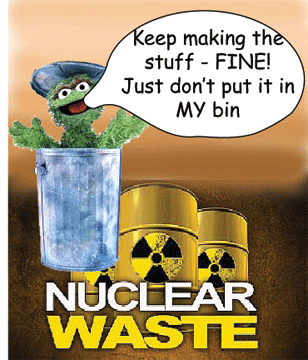
Don’t bring more nuclear waste to SRS, Greenville Online, May 1, 2014
State should be wary of plan for more nuclear waste to SRS after years of broken promises. Plans for reprocessing, permanent storage in Nevada all have fallen by the wayside as waste piles up. The Savannah River Site near Aiken was not designed as a permanent or even a long-term storage site for high-level nuclear waste. Yet, because of broken promises and foot-dragging by the federal government, SRS has become just that. Now, there is word that the United States and Germany are in discussions about bringing even more nuclear waste to the site. Such a proposal should be met with extreme circumspection.
The United States Department of Energy is evaluating a plan to accept waste from a German prototype reactor, according to a recent report in The Greenville News. The talks began in 2011, and there is no agreement in place. However, it is troubling that there would even be discussion about bringing in more nuclear waste even as material that was supposed to be temporarily stored at SRS continues to sit with no viable plan in place to move it or process it.
The discussions are over approximately 1 ton of nuclear material that would be transported in canisters to SRS.
There already is a great deal of high-level nuclear waste at the Savannah River Site, including 37 million gallons of liquid radioactive waste that the government promised would be cleaned up by the mid-2020s. Instead, in some cases, the containers holding the waste are leaking, creating a dangerous situation. Much of the waste at SRS was brought in under the promise that it would be reprocessed and then removed from the state. That has yet to happen. Until it does, South Carolina should resist plans to bring more nuclear waste to the Savannah River Site. The arrival of the German waste is far from imminent, and it should stay that way until promises already made are being fulfilled. That day right now seems to be a long way off.
The broken promises for South Carolina have come over the course of several years.
SRS was supposed to be home to a fuel reprocessing plant that would have turned much of the waste at the site into fuel for nuclear power plants. The Obama administration now is strongly urging that the proposed reprocessing plant be put on hold. Given that there are no apparent buyers for the fuel, it is difficult to challenge the administration’s decision on a practical level while at the same time it is completely reasonable to expect the administration to make good on promises to South Carolina.
It stands as a deplorable failure of the federal government to deliver on promises made when former Gov. Jim Hodges unsuccessfully fought efforts to ship plutonium to South Carolina. Work on the Mixed Oxide reprocessing plant began in 2007. Years of delays and cost overruns have contributed to the apparent demise of this facility. Initially estimated to cost $3.8 billion, the budget has surged past $7.5 billion and the facility remains unfinished……….
The federal government has not been a trustworthy partner when it comes to shipping radioactive material to the Savannah River Site. As a spokesman for Gov. Nikki Haley told The News, the federal government has failed to live up to long-standing promises to this state. Until it begins to fulfill those promises, there should be strong opposition to bringing any more of this dangerous waste to a facility the government seems willing to turn into a de facto nuclear waste dump. http://www.greenvilleonline.com/story/opinion/editorials/2014/05/01/editorial-bring-nuclear-waste-srs/8578027/












 nuclear-news