Uranium Film Festival starts May 14 in Rio de Janeiro
 Marcia Gomes de Oliveira Executive Director International Uranium Film Festival Rio de Janeiro 5 May 14 In a few days will start the IV International Uranium Film Festival Rio de Janeiro 2014.
Open Letter to Evo Morales about nuclear energy
This post is also available in: Italian, Spanish
Olivier Turquet
Dear Evo Morales,
First of all we would like to emphasize that those who sign this letter consider themselves to be friends of the Bolivian people. We applaud what your government has done over the years for the welfare of the people of Bolivia, for the recovery of control over your natural resources as well as for social justice and the redistribution of wealth. We also support the strong stance you and your government have taken on the protection of the environment, with the institution of the Day of Mother Earth and the acts against the exploitation of food resources for purposes other than the nourishment of the people. Moreover, we have been fighting for years, in our countries and internationally, against military and civilian nuclear energy.
In this light, as friends, we have been surprised by the announcement of your government’s plans to start the process of building a nuclear plant in Bolivia.
We believe this to be a move in the wrong direction and we wish to explain why in the following few points. We also hope that this debate can be continued with the participation of the entire Bolivian society. We therefore welcome positions different from ours and are always available to participate in an open discussion with further contributions.
1) That for nuclear energy is a choice without return, and no visible end! No one knows precisely what it costs to dismantle a nuclear power plant, but it is likely to be comparable to the cost of constructing one; no durable solution for the disposal of radioactive wastes has yet been found. These wastes constitute a heavy legacy that is expensive to store and remains deadly for thousands of years.
2) The idea of acquiring autonomy and independence by the use of nuclear energy is illusory and false: uranium is a finite resource (the most optimistic forecasts count with its depletion in about a century) and supplies of nuclear fuel are held by a handful of rich countries.
3) The costs of a nuclear programme are much higher than those of any other form of energy production; the budgeted cost for nuclear power reactor is around US$8-10 billion and building times are unpredictable. Besides there are huge costs involved in adjusting the connected infrastructure – industrial, technical, medical, etc. – and in training the staff only to make them extremely specialised and in this sector only.
4) The safety of a nuclear plant is a myth, fuelled by industry supporters and industrialists, but clearly denied by the facts: the last half-century shows that we must expect an extremely serious accident every few years. The consequences of a major nuclear accident are worse than those of any other accident. The legacy of the Fukushima accident alone will last for decades to burden Japan and the world!
5) Nuclear energy is a vulnerable target to terrorist attacks and leads to a militarization of the surrounding territory.
6) For all these reasons, the production of energy by nuclear means is in steep decline all around the world and is likely to continue that way; it is reasonable to expect that the construction of new nuclear power plants and their total number will decrease in the future.
7) Nuclear power on planet Earth represents the quintessential “anti-nature” form of energy production. Nature uses nuclear reactions in the creation of new worlds in stars. That however is fusion, not fission; on Earth its use is purely episodic and marginal.
8) There is a tight bond between civil and military nuclear energy production. The materials and basic techniques are the same, with plutonium – the ‘explosive’ material ideal for nuclear power generation as well as nuclear weapons – resulting as a by-product during the chain reaction.
We believe these arguments to be sufficient to dissuade any government from investing a nation’s resources and scientific potential in the nuclear industry, and we wish to see the Bolivian people take a more constructive way forward, prioritizing those renewable forms of energies of which your country is richly endowed. Such a choice and development path would generate infinitely more energy on a sustainable basis, thus bringing more welfare, autonomy and jobs than any nuclear project.
We are ready to provide the scientific details of our statements to your government and we warmly embrace you with love and esteem.
Anna Polo, World without Wars and Violence, Italy
Olivier Turquet, chief editor Pressenza Italy
Angelo Baracca, Professor of Physics, University of Florence, Italy
Mairead Corrigan Maguire, Nobel Peace Laureate, Ireland
Tony Robinson, International spokeperson of World without Wars and Violence
Carlos Vassaux M.D., USA
Dr. Jouni Ylinen, Finland
Ira Helfand, MD, USA, co-President International Physicians for the Prevention of Nuclear War, recipient of the 1985 Nobel Peace Prize
Claudio Giangiacomo, Italy
Nnimmo Bassey, Health of Mother Earth Foundation (HOMEF), Nigeria
Roberto Renzetti, Professor of Physics, Faculty of Mechanical Engineering of Roma 3 and essayist, Italy
People for Nuclear Disarmament, Australia
Human Survival Project, Australia
Dr. Scilla Elworthy, Founder of Oxford Research Group, Founder of Peace Direct, Councillor of the World Future Council, UK
Giorgio Parisi, Professor of Physics, University of Roma I, La Sapienza, Italy
Romi Elnagar, author of “Fukushima: Meltdown on the Ring of Fire” in Green Horizon, USA
Alice Slater, Global Council of Abolition 2000, USA
Dr. Anthony Gronowicz, Green Party, USA
Salvatore Fanara, USA
Jane Milliken, USA
Rachel Clark, Interpreter, Global Coordinator, Language instructor, USA
Bruce K. Gagnon, Coordinator Global Network Against Weapons & Nuclear Power in Space, USA
Pauline Tangiora, Member of the World Future Council and the Earth Council, New Zealand
Gerson Lesser, M.D., USA
Debbie Peters, J.D., USA
Prof. Francesco Bottaccioli, Founder and President of the Italian Society of Psiconeuroendocrinoimmunology. Direction and Teaching Master Degree in “PNEI and science of integrated care”, University of L’Aquila, Italy
Roberto Romizi, President of International Society of Doctors for the Environment – ISDE, Italy
Tahia Devisscher, UK
Yukari Saito and Gerard Blaylock, Founders of the Documentation Center “Seeds beneath the snow” Pisa, Italy
Prof. Jürgen Renn, Director of the Max Planck Institute for the History of Science, Berlin, Germany
Dr. Celestino Panizza, President ISDE Brescia, Italy
Paola Manduca, ISDE, Italy
Paul Larudee, Free Palestine Movement, USA
Giuseppe Masera, ISDE, Italy
Giuseppe Miserotti, ISDE Emilia-Romagna, Italy
Pedro Portugal Mollinedo, director of Pukara magazine, Bolivia
Pol D’Huyvetter, Mayors for Peace, Brazil
Giorgio Ferrari, Italy
Paolo De Santis, Professor of Physics, University of Roma 3 – Alternativa, Italy
Luisa Memore, president ISDE Torino, Italy
Giuseppe Vitiello, Professor of Theoretical Physics, University of Salerno, Italy
Antonio M. Calabrò, Aerospace Engineer Researcher, Italy
Marco Caldiroli, Luigi Mara, Chiara Rodeghiero, Fulvio Aurora, Maurizio Marchi, Patrizia Gentilini,
Antonio Valassina, Medicina Democratica, Italy
Kate Hudson, General Secretary of Campaign for Nuclear Disarmament (CND), UK
Patrick Boylan, NoWar-Rome, Italy
Pax Christi Metro New York, USA
Nelson Arias Ávila, Physic, PhD, Colombia
Takao Takahara, Professor of International Politics and Peace Research, Faculty of International Studies, Meiji Gakuin University, Japan
Gabriella Filippazzo, ISDE Palermo, Italy
Lee Hsiujung, Vice Secretery General of Taiwan Environmental Protection Union, Taiwan
Marshall Islands takes on Nuclear Establishment in legal case
 Nuclear WMD states sued – by the Marshall Islands http://www.theecologist.org/News/news_round_up/2383793/nuclear_wmd_states_sued_by_the_marshall_islands.html Robert Dodge 4th May 2014
The US threatens to attack Iran if it tries to build a nuclear bomb, yet the US and other nuclear WMD states have ignored their treaty obligation to work toward nuclear disarmament, writes Rober Dodge. Now the Marshall Islands has gone to court to enforce compliance.
Historic lawsuits have been field by the tiny Republic of the Marshall Islands against the US and the eight other Nuclear Weapons States (NWS) to meet their treaty obligations to disarm.
Since 1970, the Nuclear Non-Proliferation Treaty (NPT) has obligated nations to negotiate in good faith for complete disarmament – a world without nuclear weapons.
Forty-four years later, with no negotiations in sight, the world has become a more dangerous place with stockpiles of more than 17,000 nuclear weapons.
$1 trillion to spent on nuclear WMD over the next decade Four more nations now have nuclear weapons, and the original five continue to invest in and modernize their nuclear forces with expenditures expected to be in excess of $1 trillion over the next 10 years.
But one small nation has stood up to say “enough is enough”. The Republic of the Marshall Islands (RMI) has taken action in the International Court of Justice and in the US Federal District Court to compel the nine nuclear weapons nations to comply with their obligations, under the NPT and customary international law, and begin negotiations for nuclear zero.They suffered a 12-year blitz of nuclear bomb tests
The Marshallese people know first-hand about the destructive consequences of living in a world with nuclear weapons. From 1946-1958, the US conducted 67 nuclear weapon tests in the Marshall Islands, the equivalent explosive power of one-and-a-half Hiroshima bombs detonated daily for 12 years.
They seek no compensation through these legal actions. Rather they act for the seven billion of us who live on this planet, to end the nuclear weapon threat hanging over all humanity.
For the past year, the Nuclear Age Peace Foundation (NAPF) has served as a consultant to the RMI in support of this courageous initiative to fulfill the world’s nuclear disarmament obligation.
They understand, as do the people of the Marshall Islands, that the only way to keep our loved ones safe is to relentlessly strive for the total elimination of nuclear weapons.
The issue is human survival
This is not a partisan issue, it is a survival issue. As a variety of world leaders have made clear, including former US Secretary of State George Shultz:
“The nuclear club should be abolished and anybody who has a nuclear weapon is the enemy of mankind.”
And Archbishop Desmond Tutu, Nobel Peace Laureate:
“The failure of these countries to uphold important commitments and respect the law makes a more dangerous place. This is one of the most fundamental moral and legal questions of our time.”
As a physician, I recognize nuclear weapons pose the greatest existential and public health threat to our world. There is no adequate response to nuclear war. Prevention is essential and abolition of these weapons is the only way to accomplish that goal.
Wind power and energy storage bringing 100% renewable power to Denmark

 Carbon Dioxide and Denmark’s Plan for 100 Percent Renewable Energy by 2050 http://guardianlv.com/2014/05/carbon-dioxide-and-denmarks-plan-for-100-percent-renewable-energy-by-2050/ by Sara Watson on May 3, 2014. Studies have shown that levels of carbon dioxide currently in the atmosphere are at an all time high. The time for change regarding energy choices is now. One nation has already taken up the charge to change the way we create and use energy. Denmark is leading the world in making changes regarding energy sources. The nation has a plan to be 100 percent dependant on renewable sources by 2050. This will create new jobs, decrease dependency on international resources and increase their exports to other nations. Continue reading
Iran’s President Rouhani up against hard-liners, over nuclear talks
 Hassan Rouhani faces growing criticism in Iran over nuclear talks, Simon Tisdall in Tehran, theguardian.com, Sunday 4 May 2014
At a meeting at the former American embassy building in central Tehran on Saturday, a newly formed group of MPs and rightwing activists calling itself “We’re Worried” claimed Iran‘s negotiating team was ignoring national interests in the nuclear talks, which resume on 13 May in Vienna.
“The whole nation believes the main intention of the United States is to fully halt the Iranian nuclear programme,” said Fatemeh Alia, a central committee member of the hardline Islamic Revolution Resistance Front, previously allied to the former president Mahmoud Ahmadinejad…….
The US and Britain have expressed guarded confidence that a final nuclear deal with Iran can be reached by the deadline of 20 July, describing the talks as “very substantive”.
Rouhani and his chief negotiator, Mohammad Javad Zarif, have echoed those sentiments. “Iran is optimistic about the results of the talks and has taken great steps to reach a comprehensive deal and aims to achieve a win-win result,” Rouhani told Iranian television last week.
Rouhani hit back angrily at his critics. “Through lies and hype some people are trying to derail the government from its path, and this is against national interests and the leader’s order … Iran does not compromise on the people’s interests,” he said………http://www.theguardian.com/world/2014/may/04/hassan-rouhani-iran-nuclear-talks
Ukraine crisis highlights the very real peril of nuclear war
 Another View: Ukraine crisis puts focus on danger of nuclear war Des Moines Register By Ira Helfand May 3, 2014 The ongoing crisis in Ukraine has made it clear that the danger of nuclear war is still with us and may be greater than at any time since the height of the Cold War. What does that mean for United States nuclear policy?
There are today more than 15,000 nuclear warheads in the world. The vast majority, more than 95 percent, are in the arsenals of the United States and Russia. Some 3,000 of these warheads are on “hair-trigger” alert. They are mounted on missiles that can be fired in 15 minutes and destroy their targets around the world less than 30 minutes later.
During the Cold War, there was a widespread understanding of what nuclear weapons could do.
That is not true today.
Those who lived through the Cold War have put this painful information out of mind, and a generation has come of age that never learned about the terrible effects of nuclear war. This must change if we are to make rational decisions about nuclear policy. Continue reading
Russia tried floating nuclear plants – costly and risky
 Russia’s Plans for Floating Nuclear Power Motley Fool, By Maxx Chatsko May 4, 2014 | “………. Scientists at the Massachusetts Institute of Technology have proposed building a floating nuclear power plant roughly five to nine miles offshore. Huh? Is that even possible?
I’m all about American innovation, but the idea was not originally conceived by MIT researchers, although their designs are novel. The original idea for floating nuclear power plants was actually developed in Russia. More surprising is that its more than just an idea — designs are being constructed and commercialized as you read this article. Is the world really ready for floating nuclear power?
Russia’s plans
The Russian designs for floating nuclear power plants were created by Rosatom, which originally planned to build up to eight facilities by 2015. Those plans were proven overly ambitious, but the first two reactors were installed (non-operable) last October and are expected to be deployed in Pevek. Each power plant will consist of two nuclear reactors ranging from capacities of 35 MWe to 325 MWe each and boasting a lifetime of 38 years. The plan is to tow the facility back to port every 12 years for one year of maintenance and fuel reloading. Some will produce power exclusively for the grid in remote locations lacking access to Russia’s abundant natural gas reserves and extensive pipeline network through underwater transmission cables, while others will act as cogeneration facilities capable of feeding the grid and desalinating large quantities of seawater. Meanwhile, the ship hulls are being constructed in Russia, although South Korea and China have been rumored to be possible partners in future facilities.
It’s not difficult to imagine the ambitious and pioneering projects experiencing cost overruns — and that’s exactly what has happened. Planned facilities have been canceled, moved, sold, bought, and resold in their relatively short existence. Whether the floating nuclear power plants can produce power economically remains to be demonstrated, although the cost is expected to drop with each new facility………
The potential risks are numerous,….Unfortunately, the risk increases for unproven and unverified designs. There would be unique threats such as terrorists, pirates, or stray tankers, as well as familiar threats such as equipment malfunctions…. environmentalists would be sure to interpret proposed designs as humanity’s disregard for marine life,
US Senators wait for an answer from NRC on nuclear emergency plans

 Senators fight to keep nuclear protection zones in place http://www.wptz.com/news/vermont-new-york/plattsburgh/sentors-fight-to-keep-nuclear-protection-zones-in-place/25802730#ixzz30stpJkOWFor decomissioning power plants BRATTLEBORO, Vt. —U.S. senators from Vermont, Massachusetts, New York and California are calling on the federal regulators to stop reducing or eliminating emergency preparedness zones around decommissioning nuclear power plants.
Sen. Patrick Leahy and Bernie Sanders of Vermont have signed a letter to the Nuclear Regulatory Commission along with Sen. Edward Markey of Massachusetts, Sen. Barbara Boxer of California, and Sen. Kirsten Gillibrand of New York.
The Brattleboro Reformer reports that the senators are concerned that lessons learned from the nuclear disaster at Fukushima in Japan show that offsite emergency planning should continue while nuclear waste is stored in a spent fuel pool.
Vermont Yankee in Vernon is scheduled to be closed at the end of the year.
The NRC says it will review the letter and provide a timely response.
America’s nuclear radioactive trash just piles up, with no solution in sight
 Weird trick to cure nuclear waste problem Augusta Chronicle Damon Cline | Sun, May 4 “…….The government still has no Plan B, but it keeps collecting waste fees at a rate of $750 million a year (the current repository fund balance is $31 billion). And the nation’s nuclear power plants churn out 2,000 tons of new high-level waste each year.
Georgia, home to the Vogtle and Hatch nuclear plants, holds more than 2,700 tons of it; South Carolina, home to four plants, is sitting on more than 4,900 tons. Combined, the two states have shoveled more than $2 billion down the Yucca Mountain hole.
Ironically, Obama’s home state of Illinois ranks No. 1 in nuclear waste, with more than 9,000 tons.
WITH USED-FUEL POOLS full, plant operators started to free up pool space for newer, “hotter” fuel assemblies by moving the oldest ones to “dry-cask storage” containers –150-ton steel-and-concrete “casks” that sit above ground. The air-cooled caks are designed to be earthquake-proof, hurricane-proof and capable of withstanding an attack from conventional weapons.
Southern Co.’s Plant Vogtle, one of the nation’s youngest plants, has just now hit its pool limit and is transitioning to a dry-cask system at a cost of about $200 million. That’s on top of the estimated $14 billion Vogtle’s co-owners are spending to build Units 3 and 4…
Africa’s powerful future with renewable energy
 Renewable energy will power Africa’s ambitious future Adnan Amin May 3, 2014 It’s time to prove wrong the widely held stereotype about renewable energy only being for rich countries.
With smart planning and prudent investment, all African countries can reduce their dependence on fossil fuels and leapfrog into a sustainable future. And, as Africa makes the transition to renewable energy in the coming years, new projects will provide much-needed jobs and power economic growth………Irena’s initiative encourages the deployment of hydro, geothermal, biomass, wind and solar options from Cairo to Cape Town to increase capacity, stabilise the grid, and reduce fossil fuel dependency. It is a regional approach, promoting international cooperation across countries of the eastern and southern African power pools to develop vast energy resources, optimise the energy mix and attract more investment. The plan identifies development zones to cluster renewable plants in areas with high potential, resource planning, new financing models and knowledge and capacity building.
This week, as we convene for the Abu Dhabi Ascent, we are welcoming many African ministers who have engaged with us on this project.
The Africa Clean Energy Corridor is one of the many concrete steps needed that offer a cost-effective, economically viable solution to the climate challenge that lies ahead of us.
With the right combination of policy, investment and rapid deployment, we can make substantial progress in decarbonising the world’s energy mix while generating growth and employment. http://www.thenational.ae/thenationalconversation/comment/renewable-energy-will-power-africas-ambitious-future#ixzz30tYRkXQl
Monitoring report on the results of observation of the rally “Chernobyl Way march 2014”
Under the stated number of participants up to 950 people, at the venue of the event there have been only about 510 people; about 420 people participated in the action on the way to the Druzhby Narodau Park and 30 people took part in the rally.
[Arclight notes that there is no update on this situation ; https://nuclear-news.net/2014/04/25/maksim-viniarski-goes-on-hunger-strike-chernobyl-remembrance-march-because-of-world-hockey-match/ ]

http://freeales.fidh.net/2014/05/monitoring-results-observation-chernobyl-way-march-2014/
On the anniversary day of the Chernobyl disaster, 26 April 2014, an authorized rally was held in Minsk. The event is traditional for the Belarusian opposition and non-governmental environmental organizations. During the action a public observation by RHRPA “Belarusian Helsinki Committee” and Human Rights Centre “Viasna” was conducted by 10 observers. The observers filled unified observation charts in order to assess objectively the nature of the event as well as to note the possible human rights violations during it.
According to the information from these charts the course of the mass event and the actions of the law enforcement officers and the participants has been noted. Certain aspects of the results of observation, analysis of compliance with international standards of mass action in the sphere of freedom of peaceful assembly, as well as recommendations for governmental officials and organizers are noted in the following report.
I. Conclusions:
1 – Peaceful nature of the mass event (“if its organizers have professed peaceful intentions and the conduct of the assembly is non-violent”) should be noted during the whole action.
2 – There were cases of limitations of the right to peaceful assembly as one of the organizers was denied to hold the mass event, the time and the route were arbitrary changed and excessively unreasonable security measures have been taken;
3 – The special concern is caused by the cases of arbitrary detentions: preventive ones (8 persons – the names are provided in the list above) as well as detentions after the event (cases of detention of Yury Rubtsou, Leanid Smouzh, Mikalai (the surname is being specified) and other three activists are known), which can be considered as the gross violation of the rights of these persons;
3.1. The detentions of the participants of the mass event were illegal by its nature and were aimed at intimidation of the protesters as well as continuation of the practise of political repressions against political opposition and civil activists.
4 – Inability to identify the law enforcement officers should be noted as most of them are not wearing the uniform and even those who do are not having the ID cards on them.
Besides, it is important to note that regulation of the order of holding mass gatherings by the Law of the Republic of Belarus “On Mass Events in the Republic of Belarus” adopted on 30 December 1997 (as amended by 8 November 2011) is not consistent with the international standards. The joint opinion of the Venice Commission and OSCE/ODIHR(CDL-AD (2012) 006) notes: “The Law on Mass Events is characterized by a detailed over regulation of the procedural aspects of holding assemblies. The Law creates a complicated procedure of compliance with a rigid and difficult authorization procedure, while at the same time leaving administrative authorities with a very wide discretion on how to apply the Law. This procedure does not reflect the positive obligation of the State to ensure and facilitate the exercise of freedom of peaceful assembly and freedom of expression.” Besides, the UN Committee on Human Rights has repeatedly documented violations of the freedom to peaceful assembly from the Belarus side (Art. 21 of the International Covenant on Civil and Political Rights).
II. Context of the mass event
An application for conducting the mass event was filed on 8 April 2014 on behalf of three organizers – Yanukevich A.A., Chairman of BPF Party, Khomich M.U., head of the youth wing of BCD Party) and Dabratvor I.N., political activist. It was originally planned to gather the participants around 11.30 a.m. at the area at the entrance of “Kastrychnik” cinema and then hold the demonstration along the route Khmelnitskaha street – Y.Kolasa street – Lahoiski trakt street – Mirashnichenka street – Kurapaty tract (followed by a rally there). However, Dabratvor I.N. was rejected as an organizer of the mass event by the decision of Minsk city executive committee № 4-3/776 of 17.04.2014 on the grounds that he is responsible for the violation of the law on mass events (24.03.2014 – Art.23.34 of the Administrative code of the Republic of Belarus) and therefore under the Art.4 of the Law of the Republic of Belarus “On Mass Events in the Republic of Belarus” adopted on 30 December 1997 (as amended by 8 November 2011) “cannot be organizer of the mass event, act as an organizer or on behalf of organizers in media, global internet network and other information networks”. Besides, Minsk city executive committee has changed time and venue of the mass event by its decision of 17.04.2014 г. № 4-3/775. The organizers had to obey to this decision.
We consider these decisions as restricting in the context of realisation of the right to freedom of assembly which should not take place in a legal state and do not have a legal basis according to international standards.
It worth mentioning, that previous to this mass event 8 persons were detained: Maksim Viniarsky, Illia Dabratvor, Aliksandr Stsepanenka, Uladzislau Siargeyeu, Dmitry Dashkevich, Aliaksandr Frantskevich, Anatoly Mirashnichenka and Uladzislau Zapasau. Detentions and administrative arrests were carried out on fabricated charges in petty hooliganism and other groundless reasons. These detentions can be classified as arbitrary. Internal affairs bodies as well as courts practically exercise practice of unlawful detentions under fabricated charges, which not only violate national laws, but also international obligations.
III. Conduct of the mass event
Japans government still in denial on the Human Rights of its children living in the radioactive contaminated zones. Hidden ONHCR report – March 11th 2014
What best practices can you mention in the promotion and protection of human rights in post-disaster situations?
In Fukushima Prefecture
-Helped to create indoor playgrounds for kids. (They cannot play outdoors as much as they wish due to fears of radiation.)
-Gave support to various children’s programs, aiming to provide them with opportunities to interact with one another and fully enjoy the natural environment in a relaxed manner.
In Myiagi Prefecture
– Building of local communities:
Playgrounds with large playing equipment have been constructed. Creating such a playground can attract children as well as parents, facilitates their interaction, and can be a starter for building a new community.
(Extract for the above questions and answers at bottom of this article)
Op Ed by Arclight2011part2
Dated 3 May 2014
Posted to Nuclear-news.net
On the third anniversary of the Fukushima disaster on March 2014 a little mentioned report came out from the ONHCR concerning the update to Anand Grovers findings in 2013. Although recommendations were made concerning the rights of the people of Fukushima it would appear that only the minimal amount of work has been done by the Japanese Government to mitigate the issues raised. There will be more information in June 2014 but I will update you on the recent reports and comments from various sources at the UN.
Council holds interactive dialogue with Independent Experts on Human Rights and the Environment and on Foreign Debt.
11 March 2014
The Japanese government is on of the four biggest contributers to the UN Aid program but Cephas Lumina said Japans international development cooperation programme was to be commended, it nonetheless could be strengthened by the integration of a human rights-based approach.This in the context that Illicit financial flows, “including those that derived from corruption and embezzlement by public officials, had considerable negative impacts on the realization of human rights, particularly in developing countries.” The Japanese response was to say “it supported developing countries in setting foundations for good governance and protecting the environment and paid attention to human rights situations in recipient countries”.
However, in the same report, the Japanese Workers’ Committee for Human Rights said that about three years had passed since the Fukushima disaster, but about 100,000 persons were living as internal displaced persons.The Government and Tokyo Electric Power company had not fairly compensated victims.They were still prioritizing profit over life, and promotion and export of atomic power generation.
Human Rights Now expressed grave concern over the human rights situation of people affected by the Fukushima nuclear disaster. The Government’s effort had not been sufficient or effective to protect people’s right to health and had not conducted any health monitoring of affected people outside the so-called evacuation zones, except for children’s thyroid cancer in limited areas.
And in response to the Japanese response Cephas Luminar said that human rights issues were highly politicised and finished by saying that “The Independent Expert said that he was troubled by some countries which thought they had the solution to all the global problems; that attitude needed to change”.
Full Document here;
http://www.ohchr.org/SP/NewsEvents/Pages/DisplayNews.aspx?NewsID=14355&LangID=E
While trawling through the ONHCR website I came across a statement made by Navi Pillay who had some stunning points to make about Japans lack of self assessment and how this could, and indeed has, led to alleged abuses by Japan on its own people due to a lack of Transparency regarding its nuclear program.
Extract;
“The International Human Rights Treaty System: Impact at the domestic and international levels”: Lecture at the Washington College of Law by UN High Commissioner for Human Rights Navi Pillay
1 October 2013
Every State is obliged periodically to furnish a report to treaty bodies on its implementation of the covenant or convention it is party to. The reports must show evidence of honest and rigorous self-assessment as well as serious dialogue with civil society. Unfortunately, some States parties finds all this too onerous, but the record shows that regular reporting can help prevent human rights abuses and even serve as early warning of looming violations.
Prevention is of course notoriously difficult to measure, but the following example is instructive. In 2001, the Committee on Economic, Social and Cultural Rights indicated its concern about Japan’s nuclear power programme. The Committee, which tends to the International Covenant on Economic, Social and Cultural Rights, cited lack of transparency, insufficient disclosure of safety-related information as well as the absence of preparation at community and national levels for the prevention and handling of nuclear accidents. Had the State party more actively followed the Committee’s recommendations for improving prevention, the population might have been better prepared and some of the worst aspects of the recent nuclear tragedy in Fukushima might have been avoided.
Full document here;
http://www.ohchr.org/ar/NewsEvents/Pages/DisplayNews.aspx?NewsID=13939&LangID=C
Navi Pilay finished of his speech with this comment concerning Japans close International partner and the fact that the international rights of the child not being formalised, thereby limiting the legal challenges by NGO`s in Japan to challenge the situation for children living in the contaminated areas in Japan. A recent WHO report backed up with findings from the UNSCEAR denied any health effects although hidden in that report there was some stunning evidence of health effects in Fukushima which was known but still denied publicly throughout the world.
Evidence for that here;
https://nuclear-news.net/2014/05/02/new-unscear-report-on-fukushima-actually-show-40000-cases-of-cancer-in-europe-from-chernobyl-not-stated-before/
Before concluding, I have another question for you: There are only three countries in the whole world that have not yet ratified the Convention on the Rights of the Child. Do you know which ones?
They are Somalia, South Sudan and the US. Somalia and South Sudan surely have better excuses than the US to explain why their legislative bodies still have not gotten around to ratifying the Convention.- Navi Pillay
The quotes at the top of this article are from this questionaire from 2012 and the answers by the Japanese government. The full Word document is below and here is the link for that;
www.ohchr.org/Documents/HRBodies/HRCouncil/AdvisoryCom/PostDisaster/Japan.docx
Human Rights in post-disaster and post-conflict situations
QUESTIONNAIRE
as part of the consultations undertaken by the Human Rights Council Advisory Committee with States with a view to preparing a research-based report on best practices and main challenges in the promotion and protection of human rights in post-disaster and post-conflict situations, pursuant to Council resolution 22/16.
Nuclear reactors, radioactive waste dumps always sited near the poor and under-privileged
miningawareness
miningawareness.wordpress.comx 3 May 14 I think most people don’t see the reactors, whatever the country, and so don’t really know they are there.
Do you see reactors in Paris? No, but in the countryside you do. Do you see reactors in Zurich, Switzerland? No, but there is a lot of nuclear stuff to the NW of Zurich and they want to put a nuclear dump 40 minutes due north of Zurich. I checked and that area of South Carolina is around 48% black which for a country (USA) which is 13% black is high. Very sad that they were so proud of their black president, who is now dumping German waste on them!
 Ditto for Shelby county (48% black) around Memphis, Tennessee where they are dumping low level rad waste in poor conditions – possibly the low level German rad waste burned at Oak Ridge Tennessee. I think they are dismantling reactor cores in an island in the Mississippi River near Memphis, if I recall correctly. Claiborne county where the Mississippi reactors are is probably a higher percentage African American. It is in the top poorest counties in the USA. This is most likely where they would put a Mississippi dump.
It’s where the waste sits anyway, while the Las Vegas casino operators block Yucca mountain. These areas of SC, Miss, and Tenn are very poor. Also, the South Dakota uranium mines are in very poor areas with large American Indian-Lakota Sioux populations. I guess that it’s because the US really doesn’t have much or any standards on these things, and Germany may.
But, Germany exporting its waste to Italy, Tennessee and South Carolina certainly looks racist in the broader sense of non-German, because there is plenty of space in the poor, rural parts of Germany and a lot of it is contaminated by Chernobyl fallout and probably from its power plants. Germany is earthquake prone, but oddly enough so is South Carolina. Germany is wet, but not as wet as South Carolina and certainly not as hot, and there would be some suitable geology someplace in Germany I would think – of the hard-rock variety. I saw part of a documentary which said that Germany exported its bad loans to Irish banks and maybe Scottish ones, such that Ireland had to bail the banks out and Germany’s banks did fine. You should inquire about it sometime.
After many generations of radiation-caused deaths and deformities, some Chernobyl birds have adapted
 Some birds adapt to Chernobyl’s radiation, Sarah Zielinski, 2 May 14, https://www.sciencenews.org/blog/wild-things/some-birds-adapt-chernobyl%E2%80%99s-radiation On April 26, 1986, the world saw the worst civilian nuclear disaster in history when Unit 4 of the nuclear power station in Chernobyl, Ukraine, was destroyed. The explosion and subsequent fire released radioactive material into the environment that lingers today. The Soviet government closed off a 30-kilometer area around the plant, and hundreds of thousands of people were evacuated, never to return home. Workers are still trying to cap the site with a giant arch that would entomb the remains of the nuclear reactor.
The effects on local plants and wildlife have been varied. Pine trees close to the disaster died in the days soon after. Other plants thrived in the spaces abandoned by humans. Wildlife, too, seemed to be doing well. Rare birds were spotted. A herd of Przewalski’s horses, escaped from captivity, grew. Wolves and boar were seen on the streets of one town.But all was not good. Radiation, after all, is not healthy for living things. And so studies have documented negative effects of Chernobyl’s radiation on the region’s plants and animals, including changes in abundance, distribution, life history and mutation rates. Scientists have found that birds living in the area have eye cataractsor smaller brains. And insects, microbes and other decomposers aren’t behaving normally.
A new study, however, finds that some birds may be adapting to the low levels of radiation that persist around Chernobyl. Thestudy was published April 24 in Functional Ecology.
Ismael Galván of Paris-Sud University and colleagues captured 152 birds representing 16 species from sites within and near the Chernobyl exclusion zone. They took blood samples and analyzed the birds’ levels of antioxidants, how much their DNA had been damaged and their body condition. They also measured the levels of the pigment pheomelanin in the birds’ feathers.
When the researchers compared birds captured in higher radiation areas with those in lower radiation spots, they found something surprising: The birds from the higher radiation zones were generally in better condition, and they had higher levels of antioxidants. These molecules can help cells by stopping the reaction through which ionizing radiation damages DNA.
“To our knowledge, this represents the first evidence of adaptation to ionizing radiation in wild populations of animals,” the researchers write.
Two species, great tits (Parus major) and barn swallows (Hirundo rustica) didn’t follow the pattern and were doing worse in the high radiation locations. These birds had higher levels of pheomelanin in their feathers. Antioxidants are consumed in the production of pheomelanin, so to produce higher levels, the birds would have used up more antioxidants. Perhaps, the researchers write, these birds aren’t left with enough antioxidants to effectively deal with the DNA damage caused by radiation.
However, anyone thinking that this is good news for Chernobyl’s wildlife should think again. “The effects of radiation at Chernobyl on populations of organisms, and for birds in particular,” the researchers write, “have been negative overall.”
Exiting the nuclear energy business – Exelon following Dominion Resources, Ameren and Duke Energy
 Why Exelon will unload its nuclear plants Crains Chicago Business, Joe Cahill, 2 May 14, “…..a nuclear engineer just set the stage for Exelon Corp. to exit the nuclear power business. CEO Christopher Crane’s agreement this week to acquire Washington’s Pepco Holdings Inc. for $6.8 billion would shift Exelon’s center of gravity decisively toward regulated utility operations and away from the fleet of nuclear power plants that has been the centerpiece of company strategy for the better part of two decades under Mr. Crane and predecessor John Rowe. If the Pepco acquisition proceeds as planned, Exelon would get well over half its profit from utility ratepayers in Illinois, Pennsylvania, Maryland and the District of Columbia. A far smaller share will come from nuclear operations that once generated as much as two-thirds of corporate earnings.

The deal speaks volumes about Mr. Crane’s view of the nuclear business he oversaw before succeeding Mr. Rowe in 2012. Since taking over, he has largely stuck to the nuclear-focused script penned by his predecessor, assuring Wall Street that depressed electricity prices squeezing profits in the nuclear unit will rise in the not-too-distant future. But prices remain stubbornly low, as expanding natural gas supplies reduce costs at gas-fueled electric power plants.
Mr. Crane told investors the deal was an opportunistic move and insists he still expects power prices to rise…………
in the end, it really doesn’t matter if Mr. Crane still believes power prices will recover. His deal for Pepco all but ensures Exelon eventually will sell or spin off its nuclear unit.
Acquiring utility-focused Pepco will reduce power generation to a sideshow at Exelon. Investors sizing up the company will consider nuclear operations an unpredictable outlier and a drag on earnings from the utility business……..
Mr. Crane wouldn’t be the first CEO to give up on power generation. Dominion Resources, Ameren and Duke Energy have sold or are in the process of selling their generating units. And Mr. Crane himself has talked about closing some of Exelon’s most profit-challenged plants. http://www.chicagobusiness.com/article/20140502/BLOGS10/140509964/exelons-next-deal-the-spinoff-of-its-nuclear-fleet
1 This Month
26 April – Chernobyl: Inside the Meltdown airs on National Geographic on Sunday 26th April from 4pm

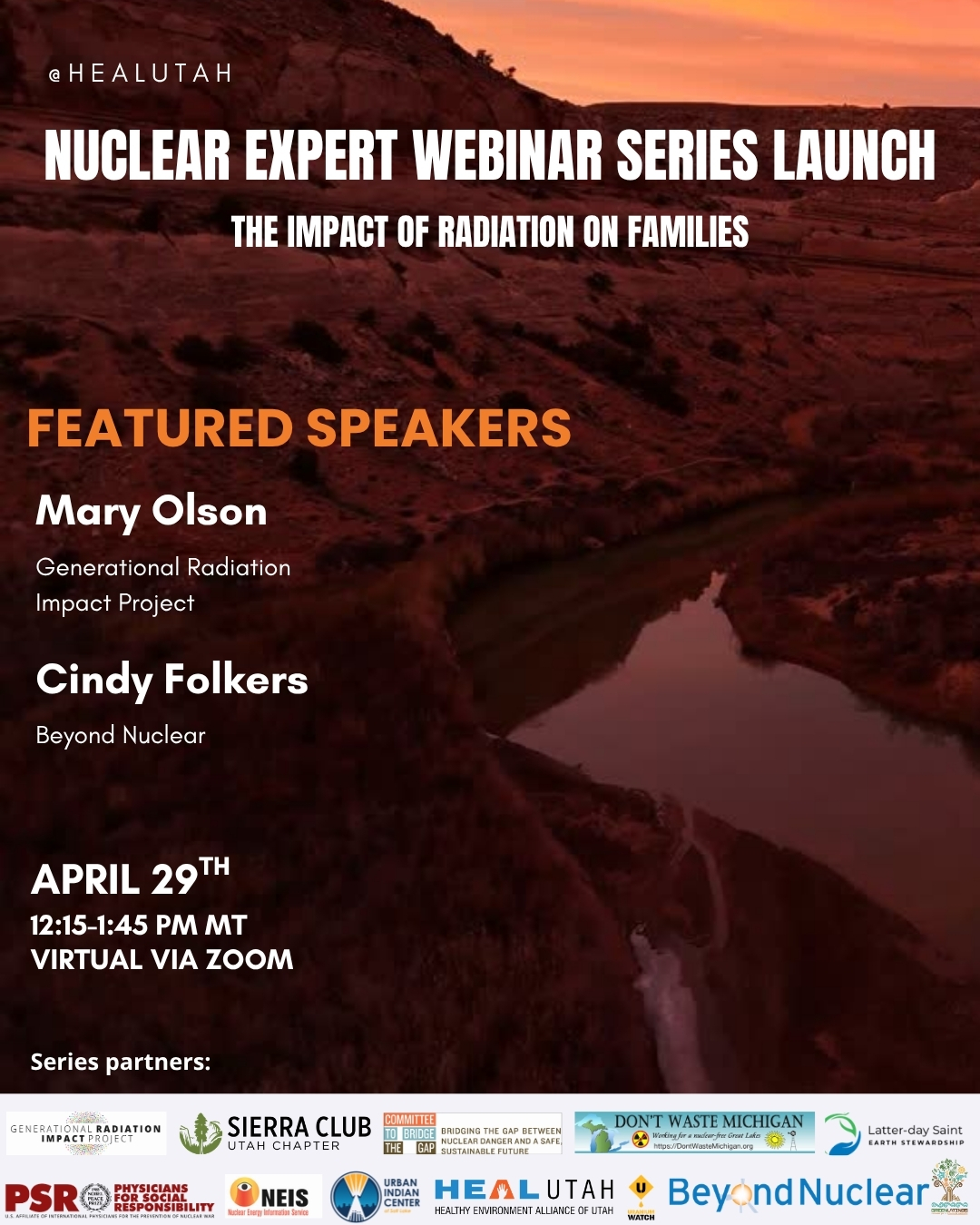
29 April – Nuclear Expert Webinar #1 – Radiation Impacts on Families with Mary Olson and Cindy Folkers
- 12:15 PM MT – 1:45 PM MT
- Location: Virtual – REGISTER TODAY

4 May -West Suburban Peace Coalition to discuss Iran war at May Educational Forum
Monday, May 4, 7:00 – 8:00 PM Central Standard Time
Title: : How Trump’s Narrative Tries to Shape the Reality of the War on Iran.
Contact Walt Zlotow, zlotow@hotmail.com 630 442 3045 for further information
14 May – online event From Bombs to Data Centres: the Face of Nuclear Colonialism

Pine Ridge Uranium is the real threat, not Tehran- Tell Burgum: Stop the Extraction.
Chernobyl: The Lost Tapes – A good documentary on Chernobyl on SBS available On Demand for the next 3 weeks– https://www.sbs.com.au/ondemand/tv-program/chernobyl-the-lost-tapes/2352741955560
To see nuclear-related stories in greater depth and intensity – go to https://nuclearinformation.wordpress.com
-
Archives
- April 2026 (300)
- March 2026 (251)
- February 2026 (268)
- January 2026 (308)
- December 2025 (358)
- November 2025 (359)
- October 2025 (376)
- September 2025 (257)
- August 2025 (319)
- July 2025 (230)
- June 2025 (348)
- May 2025 (261)
-
Categories
- 1
- 1 NUCLEAR ISSUES
- business and costs
- climate change
- culture and arts
- ENERGY
- environment
- health
- history
- indigenous issues
- Legal
- marketing of nuclear
- media
- opposition to nuclear
- PERSONAL STORIES
- politics
- politics international
- Religion and ethics
- safety
- secrets,lies and civil liberties
- spinbuster
- technology
- Uranium
- wastes
- weapons and war
- Women
- 2 WORLD
- ACTION
- AFRICA
- Atrocities
- AUSTRALIA
- Christina's notes
- Christina's themes
- culture and arts
- Events
- Fuk 2022
- Fuk 2023
- Fukushima 2017
- Fukushima 2018
- fukushima 2019
- Fukushima 2020
- Fukushima 2021
- general
- global warming
- Humour (God we need it)
- Nuclear
- RARE EARTHS
- Reference
- resources – print
- Resources -audiovicual
- Weekly Newsletter
- World
- World Nuclear
- YouTube
-
RSS
Entries RSS
Comments RSS
 nuclear-news