Sister Megan Rice – The Nun Behind Bars in Brooklyn

Sister Megan Rice
Courtesy:Megan Finnerty
Posted: 05/27/2014
Helen Young
You could call it a homecoming of sorts, but without the welcome home party. After growing up in the shadow of Columbia University in Manhattan’s Morningside Heights, serving the Catholic Church as a biology teacher in Africa for more than 40 years, and a peace activist in Nevada, 84-year-old Sister Megan Rice has landed back in New York City. She’s at the Metropolitan Detention Center (MDC) in Brooklyn. It’s Sunset Park, but without the grass and trees.
According to the Federal Bureau of Prisons, Sister Megan in all probability would have served her 35-month prison sentence at Connecticut ‘s Danbury Federal Prison. But female inmates are no longer being housed in that institution. So, Danbury’s loss is Brooklyn’s gain. Sister Megan is one of 78 low security female inmates known as “cadres”. They’re not awaiting trial or transfer. They’ve been convicted and, it appears, will serve their sentences at MDC. Although the prison system classifies this kindly, grandmotherly nun as “low security”, prosecutors described her as a danger to the community during her recent Knoxville trial, and won a conviction for sabotage, which the law defines as a “federal crime of terrorism”.
In July 2012, Sister Megan, along with two fellow peace activists, carried a Bible, candles, bread and bolt cutters into the Y-12 National Security Complex in Oak Ridge, Tennessee. Y-12 processes and stores America’s highly enriched uranium, the material terrorists could use to make a dirty bomb. The facility has enough highly enriched uranium to make 10,000 nuclear bombs. Using bolt cutters the trio sliced through four chain link fences, reaching all the way to the outside walls of the building where the bomb making material is stored, before they were accosted by a single security guard. The guard took one look at Sister Megan, Michael Walli and Greg Boertje-Obed and knew immediately they were peace protesters… and it wasn’t just because they offered him bread, instead of brandishing weapons.
Japan: The new Uzbekistan of press freedom in Asia – At the bottom of the slippery slope!
Paper trail: Guards at the Diet building restrain a man who opposes the ruling coalition’s moves to force its contentious state secrets bill through the Lower House on Tuesday. | KYODO

http://www.japantimes.co.jp/news/2013/11/30/national/japan-the-new-uzbekistan-of-press-freedom-in-asia/#.U4j_34aycUT
by Jake Adelstein
Special To The Japan Times
If you’re living in Japan, you may be surprised to know that your right to know has been replaced by the right to remain silent. Shhh … don’t protest. It’s practically a done deal.
The first rule of the pending state secrets bill is that a secret is a secret. The second rule is that anyone who leaks a secret and/or a reporter who makes it public via a published report or broadcast can face up to 10 years in prison. The third rule is that there are no rules as to which government agencies can declare information to be a state secret and no checks on them to determine that they don’t abuse the privilege; even defunct agencies can rule their information to be secret. The fourth rule is that anything pertaining to nuclear energy is a state secret, which means there will no longer be any problems with nuclear power in this country because we won’t know anything about it. And what we don’t know can’t hurt us.
The right to know has now officially been superseded by the right of the government to make sure you don’t know what they don’t want you to know.
Welcome to the new Dark Ages of Japan, brought to you by Prime Minister Shinzo Abe’s Liberal Democratic Party, Komeito and Your Party. If the economy and the actions of the government and its politicians seemed opaque up to now, the ruling bloc is making sure that it’s very solid obsidian. Every major news organization in Japan opposes the bill. Last week, thousands of ordinary citizens took to the street to protest the proposed legislation.
The LDP — ever sensitive to the will of the people — took decisive action to address the issue last Tuesday. A debate was held in the morning and televised by state broadcaster NHK. As soon as NHK cut off the broadcast, the LDP ended the debate and rammed the bill through the Lower House. Democracy in action. Only the Upper House remains.
The law has been compared to the pre-World War II Peace Preservation Law, which was used to arrest and jail any individual who opposed the government party line. “Japan already has a very weak freedom of information act which this will cripple,” said Yutaka Saito, a member of the Japan In-House Lawyers Association task force. “The bill takes everything bad about national security laws in the U.S. and then removes all the safeguards and checks.”
According to one survey, more than 80 percent of the public feels that the new law will be misused by the government to coverup scandals, corruption and troubling information. That mistrust in the government is well founded: the Minamata disease coverup on behalf of corporate interests in the ’60s; the HIV-tainted blood scandal in the ’90s; Ministry of Economy, Trade and Industry’s moves to bury a whistle-blower report on nuclear safety problems at Fukushima No. 1 and No. 2 nuclear power plants in 2000.
Abe has assured us that the regulations for the bill clearly state that a third party organization should be put in place to keep checks on the system.
Should.
Should is an interesting word. You should brush your teeth. You should pay your taxes.
You should believe Prime Minister Abe when he tells that he doesn’t know notorious yakuza financier Icchu Nagamoto — even though he had his photo taken with him in 2008.
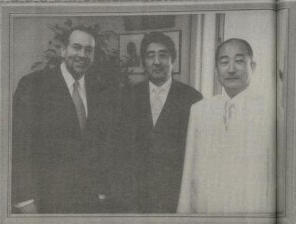
From left to right ; Arkansas governor Mike Huckabee , Shinzo Abe and Icchu Nagamoto, whom the Tokyo Reporter describes as “a financial broker for the Yamaguchi-gumi, who was arrested earlier this year for violating money-lending laws.” OCTOBER 17, 2012
We should believe Abe and yet I don’t. Japan should have a society where people have a right to know what their government is doing and where freedom of the press is guaranteed.
Abe’s suggestion that there should be oversight does not mean that there will be. And judging by recent history, even if a token oversight committee is created, it will be about as effective as protecting the public’s right to know as the Nuclear Industrial Safety Agency was in preventing a triple nuclear meltdown at the Fukushima No. 1 nuclear plant.
On Nov. 27, Reporters Without Borders condemned the legislation cogently. “How can the government respond to growing demands for transparency from a public outraged by the consequences of the Fukushima nuclear accident if it enacts a law that gives it a free hand to classify any information considered too sensitive as a ‘state secret’?” the organization said. “By imposing heavy penalties on those who obtain classified information . . . and then publish it, Parliament is making investigative journalism illegal, and is trampling on the fundamental principles of the confidentiality of journalists’ sources and ‘public interest.’ ”
Reporters Without Borders also noted that Japan’s ranking in the press freedom index had taken a record fall of 31 places from its position in 2012 to a new low of 53 out of 179 countries.
If the state secrets law is passed, Japan’s press freedom ranking next year is expected to sink to nearly Uzbekistan or China levels. Welcome to the land of the setting sun. Let’s see how much darker it will get.
Ontario’s politicians coy about their $25 billion plans for nuclear power expansion

 Why no one is talking nuclear on the election trail Despite tens of billions of dollars of nuclear projects in the pipeline, nuclear policy is a no-go area in the Ontario election The Star, By: John Spears Business reporter, on Fri May 30 2014 Nuclear energy policy has been almost a no-go area in Ontario’s election campaign.
The sector is on the verge of spending $25 billion or more on two massive projects, and constructing a nuclear-waste site that must last for millennia to come.
But while voters will ultimately pay for the projects through their hydro bills, the nuclear issue has barely raised a ripple in the current election campaign. In fact, it doesn’t even rate a mention in the New Democratic Party’s election platform.
Mid-life overhauls of two nuclear stations – Bruce and Darlington – are on the table. The price tag for Darlington’s four reactors alone is currently estimated at $10 billion in 2013 dollars – or $12.9 billion if interest and contingencies are included.
The price tag at privately operated Bruce Power – where six reactors will undergo mid-life refits – comes in at $2 billion per reactor, but with associated work over the next 15 years, spending will total $15 billion, company officials said earlier this year.
In addition to the nuclear overhauls, Ontario Power Generation proposes to construct a permanent disposal site for low and intermediate level nuclear waste at the Bruce.
But the mega-projects have raised scarcely a ripple on the hustings……..
it’s a lot of money – even if the projects stay within budget.
And staying within budget is not something that nuclear projects have been prone to in Ontario. The unpopular debt retirement charge – an extra 0.7 cents a kwh that’s finally due to expire at the end of 2015 – was levied to pay for past nuclear project cost over-runs.
The Liberal and Conservative platforms clearly support the nuclear overhauls.
“We will invest in the refurbishment of 10 nuclear units and Darlington and Bruce over 16 years, creating and sustaining 25,000 high-wage jobs,” the Liberal platform pledges.
The Conservatives go even further.
They note that Pickering with its eight reactors is due to close.
“We must build new ones and refurbish others,” they say in their Paths to Prosperitypolicy paper, released prior to the election.
The price tag on new reactors of unknown size and design is unclear, but would be multiple billions. Building them would be further complicated by a federal court ruling that told OPG it can’t build new reactors, in part because there are no firm plans for handling waste that will remain dangerously radioactive for hundreds of thousand of years.
The same environmental groups who won that decision are seeking a similar ruling on the Darlington refurbishment.
The New Democratic Party is more skeptical of the nuclear overhauls, according to energy critic Peter Tabuns.
“We haven’t seen a business case that supports refurbishment and we won’t make a decision on this until we do see a business case,” he said in an interview.
The NDP unequivocally opposes building new reactors, he said.
The Liberals have suspended any consideration of new reactors, declaring last December that they are “not needed at this time,” though keeping the option open for the future.
The one issue none of the parties address in their formal platforms is OPG’s proposal to entomb low- and intermediate-level radioactive waste in a limestone formation 680 metres below ground on the shore of Lake Huron.
A federal review panel is currently examining the proposal, but since OPG is owned by the province, the ultimate decision to proceed with the billion-dollar-plus proposal will lie at Queen’s Park.
The proposal took a new twist in February when a similar waste storage facility in Carlsbad, New Mexico leaked radiation……..
Various local, state and federal politicians in Michigan have expressed alarm at OPG’s proposed nuclear waste site.
The latest is Michigan state senator Phil Pavlov, who has called the waste site a “critical threat to the health of the Great Lakes.”
(Michigan’s federal senators Debbie Stabenow and Carl Levin have also expressed stiff opposition to the site.)
Pavlov has introduced resolutions calling on the president or Congress to submit the project to the International Joint Commission, which deals with cross-border issues on the lakes.
“I talk to people every day that can’t understand the rationale behind this,” Pavlov said in an interview.
“The fact that we’re even considering something this close to the lake needs to be challenged,” he said……..
The Liberals say they’re waiting on the federal panel to report before taking a final position on the waste site.
The panel has extended its hearings to gather information on the New Mexico incident, but no dates have been announced……. http://www.thestar.com/business/economy/2014/05/30/why_no_one_is_talking_nuclear_on_the_election_trail.html
With Allison MacFarlane and Gregory Jaczko. USA’s nuclear power plans could be very different
 NRC rejects effort to move radwaste from pools; Macfarlane issues strong dissent Michael Mariotte, Green World, 30 May 14,
“……….Back to the composition of the NRC. If Greg Jaczko, who  voted against licenses for the Vogtle and Summer reactors and since leaving the Commission has recommended phase-out of U.S. reactors, were still chair, Allison Macfarlane would almost certainly have still been President Obama’s next Democratic nominee (the NRC is required to have no more than three of its five members from the same political party). And there are two Democratic seats up this year: Commissioner Magwood is leaving the agency soon to head up Europe’s Nuclear Energy Agency, which exists not to regulate, but promote nuclear power (a position that raises the issue of whether it was a conflict-of-interest for Magwood to have taken this vote, and for that matter any other vote at this point) and Commissioner Apostolakis’ five-year term ends next month. He has not announced publicly whether he wants a second term, but the President is certainly under no obligation to re-appoint him even if he does.
We would have a very different Commission then. But we still could. Now, President Obama is in a position to act to fundamentally change the NRC and support his chosen chair. And, as this vote makes clear, to support his chosen NRC chair Macfarlane, he mustuse this opportunity to appoint such advocates to the NRC. Otherwise, he will be simply hanging her out to dry.
For that reason, NIRS has begun an e-mail campaign to urge the President to appoint such people to the Commission now. You can make your voice heard here. And NIRS and other groups will be making this point as forcefully as possible in other venues in the coming weeks as well. http://safeenergy.org/2014/05/29/nrc-rejects-effort-to-move-radwaste-from-pools/
Fairewinds – New Japanese Documentary Featuring Arnie Gundersen To Be Broadcast on NHK Sunday, June 1 at 10pm
 |
|||
|

 The full testimony of the manager of the Fukushima No. 1 nuclear power plant at the time of the March 2011 disaster is being published. Masao Yoshida is a hero who stayed at the reactor when 90% of his workers had fled to safety. Mr. Yoshida died last summer of esophageal cancer.
Ontario Liberal and PC parties not winning hearts, minds or judges with their pro nuclear agenda
 Anti-nuclear advocates, Federal Court trouble Ontario Liberal and PC energy plans rabble.ca BY STEVE CORNWELL
MAY 30, 2014 Falling demand for electricity, sky-high cost projections, a catastrophic meltdown in Japan and a dedicated resistance to nuclear expansion have contributed to tough times for advocates of new and rebuilt nuclear reactors in Ontario.
 The latest punch in the gut for nuclear proponents in the province comes from a May 14 Federal Court decision to nullify the approval of up to four new reactors at Darlington Station, about 60km east of Toronto.
Among other issues, the presiding Justice James Russell cited inadequate planning for both nuclear waste storage and a catastrophic accident as reasons to revoke the project’s license, which was originally secured following a multi-year environmental assessment (EA). Justice Russell found that the EA failed to adhere to the Canadian Environmental Assessment Act.
The Federal Court review of the EA was initiated by environmental groups Canadian Environmental Law Association (CELA), Greenpeace Canada, Lake Ontario Waterkeeper (LOW) and Northwatch with lawyers from Ecojustice and CELA representing the application in court.
In a press release following the decision, the environmental groups called the Federal Court’s ruling “common sense.”
Justin Duncan, Staff Lawyer for Ecojustice and co-counsel for groups, said “the court’s ruling means that federal authorities can no longer take shortcuts when assessing nuclear projects.” “The federal government must protect Canadians from energy projects that may harm the health of the environment. Because the panel failed to assess certain environmental effects, the court revoked the project’s licence.”
Ontario Power Generation (OPG), who was ordered by the McGuinty Liberals in 2006 to start the process for new reactors at Darlington, still has options towards building the new reactors.
Rick Lindgren of CELA, who presented the case alongside Duncan said, “we do not yet know if the decision will be appealed, or if the EA process will be restarted to address the various deficiencies identified by the Federal Court.”
While Lindgren strikes a cautious note regarding OPG’s intentions going forward, he’s much more optimistic about the message that the decision sends.
“The decision sends a strong signal to other proponents and federal authorities that environmentally significant projects must be subject to a robust EA process that satisfies the legal requirements of the Canadian Environmental Assessment Act.”
And it seems the call for more robust environmental regulation is gaining traction in the host community. In an editorial following the decision, a local paper called on OPG to “accept the ruling and work quickly to address the gaps Justice Russell has identified in the existing environmental assessment.”
Greenpeace’s Nuclear Analyst, Shawn-Patrick Stensil thinks that receiving an endorsement from media around Darlington Station is telling.
“Durham Region is always being portrayed as uniformly supportive [of nuclear] by OPG. But many locals seem to think it’s fair for OPG to not to have a blank cheque, and do due diligence. But will OPG be willing to openly discuss the risks its reactors pose?”
Nukes on the campaign trail…… http://rabble.ca/news/2014/05/anti-nuclear-advocates-federal-court-trouble-ontario-liberal-and-pc-energy-plans
Nuclear and coal get twice the subsidies that wind and solar power get
 Wind Subsidies & Solar Subsidies ~50% Nuclear & CCS Subsidies (Charts) Clean Technica 30 May 14, After a week which saw the use of renewable energy support schemes in Australia described as “plain crazy”, it seems like a good time to take another look at the study published last month by Agora Energiewend that shows European subsidies for solar and wind essentially come at half the price of those for nuclear or CCS.
The analysis – based on a comparison of European subsidies for low-carbon energy systems – found that new wind and solar PV could generate energy for an overall cost of up to 50 per cent less than new nuclear or coal or gas with (as yet unavailable) carbon capture and storage technology.
“Today’s feed-in tariffs for wind and PV in Germany are up to 50 per cent lower than those offered for new nuclear in the UK according to the Hinkley Point C agreement,” the report says, noting that for CCS, with the technology still in demonstration phase, estimates suggest it would cost about as much as new nuclear power or more.
“Even today and under conservative assumptions, a generation mix consisting of PV, onshore wind and gas is approximately 20 percent less expensive than a mix consisting of new nuclear power (based on the Hinkley Point C agreement) and gas,” the report says.
Overall, it says, “onshore wind at sites with a good resource potential and utility-scale PV represent the low-carbon technologies with the lowest cost,” while power from nuclear, as well as gas and coal plants with CCS represent the low-carbon technologies with the highest cost.
But we’ll let the charts do the talking…http://cleantechnica.com/2014/05/30/wind-subsidies-solar-subsidies/
Barack Obama takes action on climate change
 Obama to unveil historic climate change plan to cut US carbon pollution
• Proposed regulations could cut carbon pollution by up to 25%
• President still faces potential opposition from Republicans
• Q&A: why the carbon proposal could make climate history
Suzanne Goldenberg, US environment correspondent theguardian.com, Friday 30 May 2014 President Barack Obama will unveil a plan on Monday that will cut carbon pollution from power plants and promote cap-and-trade, undertaking the most significant action on climate change in American history.
The proposed regulations Obama will launch at the White House on Monday could cut carbon pollution by as much as 25% from about 1,600 power plants in operation today, according to those claiming familiarity with the plan.
Power plants are the country’s single biggest source of carbon pollution – responsible for up to 40% of the country’s emissions.
The rules, which were drafted by the Environmental Protection Agency and are under review by the White House, are expected to do more than Obama, or any other president, has done so far to reduce the carbon dioxide emissions responsible for climate change.
They will put America on course to meet its international climate goal, and put US diplomats in a better position to leverage climate commitments from big polluters such as China and India, Obama said in a speech to West Point graduates this week.
“I intend to make sure America is out front in a global framework to preserve our planet,” he said. “American influence is always stronger when we lead by example. We can not exempt ourselves from the rules that apply to everyone else.”
It won’t be without a fight. Obama went on in his remarks at West Point to take a shot at Republicans who deny climate change is occurring, and the White House press secretary, Jay Carney, on Thursday accused critics of making “doomsday claims” about the costs of cutting carbon…….
Obama had originally hoped to cut carbon pollution by moving a bill through Congress. Four years after that effort fell apart, campaigners say the EPA rules could deliver significant emissions cuts – near the 17% Obama proposed at the Copenhagen climate summit – and the cap-and-trade programmes that were so reviled by Republicans.
The EPA, using its authority under the Clean Air Act, proposed the first rule phase, covering future power plants, last September.
In this the more politically contentious phase of the plan, it is widely believed the EPA will depart from the “inside the fence-line” convention of earlier environmental regulations for mercury and other pollutants, which focused on emissions-scrubbing on specific power plants.
The EPA administrator, Gina McCarthy, is seeking steep reductions – as much as 25% – but she has hinted repeatedly that she will allow states latitude in how they reach those targets.
The plan would allow electricity companies to reduce pollution by shutting down the oldest and most polluting coal plants. They can install carbon-sucking retrofits. They can expand wind and solar energy, upgrade the electrical grid, encourage customers to update to more efficient heating and cooling systems, or more efficient appliances and lightbulbs.
“They have recognised huge emissions reductions opportunities are often cheaper than trying to do it all inside the plant,” said David Doniger, who heads the climate programme at the NRDC. “If you want to get substantial reductions and you want to get it economically, you have to take into account a system-wide approach.”…….http://www.theguardian.com/environment/2014/may/29/obama-unveil-historic-climate-plan-carbon-pollution
Shortcomings in doctors’ understanding of ionising radiation in medicine
 Residents lack knowledge of radiation safety By Eric Barnes, AuntMinnie.com staff writer May 30, 2014 — Medical residents have limited knowledge of radiation safety, with just over half knowing that fluoroscopy could produce radiation-induced skin burns, for example. Radiology residents were only marginally more informed, according to survey results published inAcademic Radiology.
To their credit, 95% of residents, regardless of specialty, reported a link between ionizing radiation and the future development of cancer, the authors wrote. For radiology residents, 98% said they believe in such a link. Continue reading
Breaking – Greenpeace Turkey – Flying the flags at nuclear summit – Activists arrested!!


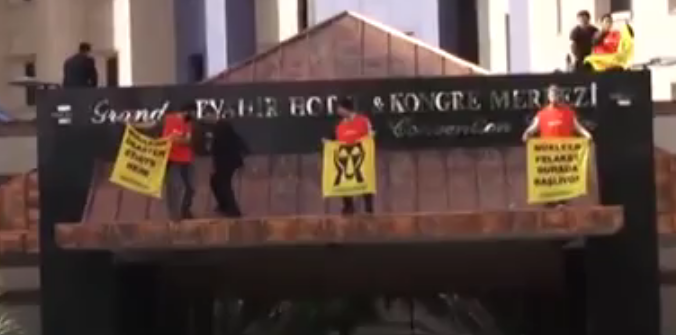
From this source- Video on link ; https://www.facebook.com/photo.php?v=578041112308901&fref=nf
GREENPEACE (@Greenpeace_Med) “Nükleer Zirve” denilen ZIRVALIĞA daha fazla dayanamadı ve Cevahir’de harika bir protesto yaptı…
Umarız arkadaşlarımızın kılına bile zarar gelmez…
Tepkimiz çok basit ve insani, 52 Nükleer Santrali de kapalı olan Japonya, #FUKUSHIMA‘yı çözememiş bir #JAPONYA örneği varken ve #TÜRKİYE‘de GÜNEŞ batmaz RÜZGAR dinmez iken ve yine aynı Türkiye’nin enerji elde etmede pekçok öz kaynağı, YENİLENEBİLİR Kaynağı varken, HEM #SİNOP‘a hem de #MERSİN‘e NÜKLEER denilen ÇÖP teknolojiyi getirmek ÖLÜMDÜR, KAOSTUR, CEHENNMEDİR!!
The Mine disaster at Soma has highlighted the issues in Turkey regarding corruption and corporate cost cutting causing health and safety issues . The Turkish government, just two weeks ago, denied an opposition party investigation into ongoing accidents and lax safety procedures ever since the privatisation of the industry in the 1990`s.

A connection between Soma Holdings and the Turkish government was deemed to be a contributing factor…..
Radiation – cancer link near Oyster Creek Nuclear Power Plant?
Is there a radiation-cancer link? Asbury Park Press, Janet Tauro May 29, 2014 Ever since the switch was turned on at the Oyster Creek Nuclear Generating Station in Lacey in 1969, the public has received exposure to radiological releases.
Most often the releases have been extremely small, fractions of what is allowed by federal standards. But, there have been times when releases were high, according to statistics compiled by the Brookhaven National Laboratory. The public has been largely unaware of these releases, which are odorless, colorless and tasteless. And that leads to the obvious and monumental question: Have 45 years worth of radiation exposure negatively impacted public health in Ocean County?
At 6:30 p.m. Wednesday, experts from the National Academies of Science will hold a forum on an upcoming cancer study in communities around Oyster Creek at the Toms River Ramada Inn on Route 9.
Inquiries are regularly received at the Clean Water Action NJ office from citizens seeking answers on a possible link between living near a nuclear plant and health risks. We hope that the NAS study will adequately address these questions.
However, there is cause for concern about the study’s scope. Continual exposure to low-level radiation can affect human DNA and damage cells. Is there a link between radiation exposure and Ocean County’s high autism rate? Will the study look at the rates of miscarriage and birth defects? Will those who sought cancer treatment, or died, out of state be included in statistics? Will the study examine cancer incidence, as well as cancer fatalities?
Scientific studies can be frustratingly difficult in proving cause and effect. One only needs to read Dan Fagin’s Pulitzer Prize-winning “Toms River, A Story of Science and Salvation” to realize what might seem obviously apparent is often difficult to prove. Fagin showed that years of research that cost millions of dollars still left many with unanswered questions about Ciba-Geigy’s role in cancer clusters found in neighborhoods where the company discharged thousands of gallons of toxic chemicals into the groundwater.
And now a similar investigation will take place around Oyster Creek, where reports on emissions tend to be spotty and difficult to find. And sometimes, they are simply wrong. An NRC document shows that a disconnected joint in the emissions stack went undetected for four years, meaning emissions data between 2006 and 2010 was inaccurate………
A previous NAS study, commonly referred to as the Bier VII report, concluded that no amount of exposure to continuous radiological releases can be considered safe.
Researchers in France, Germany, Sweden and the United Kingdom have found increased pediatric cancer rates in communities surrounding nuclear plants. The research helped prompt Germany to abandon its nuclear program, and today, about 74 percent of the country’s power supply is generated by renewable energy sources, namely solar and wind. Germany is a shining example of what political will can achieve when public health and safety take precedent over industry profits.
It is imperative that the NAS researchers take a close look at the 1993 Brookhaven National Laboratory report that charted radiological releases at Oyster Creek, one of which was measured at more than 1 million curies in 1979.
Given that statistics by the state Department of Health and Senior Serviceshave indicated Ocean County has the highest pediatric cancer rate statewide and the third-highest autism rate, it is crucial that the NAS compile a fair, accurate, and easily accessible assessment of Oyster Creek’s impact on our health and the health of future generations.
Then, elected officials and regulators might finally realize it is time to turn the switch to the OFF position at Oyster Creek.
Janet Tauro is board chair of Clean Water Action NJ and founding member of GRAMMES (Grandmothers, Mothers, and More for Energy Safety).http://www.app.com/story/opinion/columnists/2014/05/29/editorial-radiation-cancer-link/9739433/
I am Mordechai – Buried Alive (Lyric Video) with links
Published on 29 May 2014
I am Mordechai – ‘Buried Alive’ (Lyric Video).
From the EP ‘Revelations: Part 1’.
Footage from the film; ‘Barefoot Gen’ via youtube.
‘Buried Alive’ written and produced by Denning Isles, based on the poem ‘Buried Alive’ by Mordechai Vanunu.
https://nuclear-news.net/2014/05/29/protecting-whistleblowers-free-mordechi-vanunu-and-others/
Barefoot Gen full film
Published on 13 Mar 2012
Barefoot Gen (はだしのゲン Hadashi no Gen?) is a Japanese manga series by Keiji Nakazawa. Loosely based on Nakazawa’s own experiences as a Hiroshima survivor, the series begins in 1945 in and around Hiroshima, Japan, where the six-year-old boy Gen lives with his family. After Hiroshima is destroyed by atomic bombing, Gen and other survivors are left to deal with the aftermath.
Barefoot Gen is a war drama anime based on the Japanese manga series by Keiji Nakazawa. Directed by Mori Masaki and released in 1983, it depicts World War II in Japan from a child’s point of view revolving around the events surrounding the bombing of Hiroshima and the main character’s first hand experience of the bomb.
Liberal and PC parties in Ontario have expensive expansive nuclear power plans
 Anti-nuclear advocates, Federal Court trouble Ontario Liberal and PC energy plans rabble.ca BY STEVE CORNWELLMAY 30, 2014 “……..the court’s decision does seem to enhance the credibility of the Ontario New Democrats’ (ONDP) energy platform, while troubling those of the Liberals and Conservatives.
Dating back to Howard Hampton’s leadership, the ONDP has remained opposed to building new reactors in Ontario. The ONDP’s election platform highlights a pledge for a solar panel and energy efficiency fund to help homeowners produce clean electricity and consume less power.
In response to a recent Ontario Clean Air Alliance questionnaire, the ONDP was very critical of the Liberals’ plan to rebuild nuclear units in the province. The ONDP indicated that they would support cost-effective conservation and efficiency measures before spending tax and rate-payer dollars on rebuilding reactors.
They added, “hundreds of millions of dollars have been wasted through the cancellation of gas and nuclear plants…Signing contracts for nuclear refurbishment without knowing the final price tag or seeing the business case will only push costs even higher for consumers. That’s just not acceptable.”
Both the Liberals and PCs have placed nuclear expansion and or revitalization as large tenants of their projected energy plans.
The Liberal spokesperson interviewed for this piece condemned the PCs plan, saying “Tim Hudak wants to build $15 billion worth of new nuclear we don’t need and cancel existing clean energy contracts, putting ratepayers on the hook for up to $20 billion.”
While Liberals did not include new nuclear in their Long Term Energy Plan, Energy Minister Bob Chiarelli also suggested that “sometime in the future, we might be looking at it.”
Lefty voters being wooed by the latest Liberal attempt to position themselves as the more progressive and reasonable choice to slay the Conservatives should note that the Grits and PCs are mostly identical on nuclear power.
In addition to both the PCs and Liberals openness to spending billions and testing the risks of new nuclear in the province, each party’s energy stance includes a commitment to rebuilding existing reactors at Darlington and Bruce Stations.
Following the ruling striping approval of new reactors at Darlington, a decision Greenpeace’s Stensil called “a firewall from a really bad political decision,” he wants the debate during the rest of the election to focus on plans to rebuild existing nuclear units. “I’d hope that it allows us to focus on the current plan to spend billions of dollars rebuilding Ontario’s ten remaining reactors.”
Plans to rebuild reactors at Darlington have already passed through an expedited assessment.
Cost analyses on rebuilding the reactors vary wildly, but if the difficulties of refurbishing units in Pickering and other Canadian jurisdictions are any indication, Ontarians might be in for some pocketbook punishment if the Liberal or PCs implement their plans.
“The Liberal government has given the ok to rebuild reactors at the Darlington and Bruce nuclear stations without a cost estimate or a public review. The gas plant scandal has gotten lots of attention since the last election, but it’ll end up being small change compared to the nuclear fiascos coming our way.”
Steve Cornwell is an MA candidate at York University. He is interested in the interactions of social movements, science and technology. Steve has worked on energy issues with Greenpeace Canada, Environmental Defense, and Safe and Green Energy Peterborough. Follow Steve Cornwell on Twitter @steve_cornwell http://rabble.ca/news/2014/05/anti-nuclear-advocates-federal-court-trouble-ontario-liberal-and-pc-energy-plans
Urge Obama to support his NRC chair, appoint strong safety advocates to NRC.
 The Nuclear Regulatory Commission has again sided with the nuclear power industry (where have you heard that one before?) and rejected efforts by environmental/clean energy groups and five U.S. Senators to move high-level
 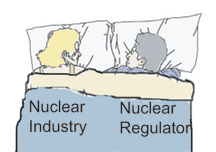 radioactive waste out of overcrowded, dangerous and poorly-protected fuel pools as soon as it is cool enough to be placed in dry casks.
Not only did the NRC Commissioners take this unconscionable vote, they said this was their last word on the subject and they would refuse to ever again consider the issue.
But the vote wasn’t unanimous: NRC Chair Allison Macfarlane, who has spent her career studying radioactive waste issues, issued a strong dissent to the decision, essentially arguing that the NRC staff hasn’t done its homework.
Japan about to extract the teeth from its Nuclear safety Watchdog?
 The government should not be allowed to make the nuclear watchdog toothless by nominating experts who are convenient to it and the industry.
EDITORIAL: Nuclear watchdog must not be made toothless –The Asahi Shimbun, May 29 Prime Minister Shinzo Abe has a habit of trying to promote policy changes through political appointments. His administration seems to have employed this political ploy to achieve its goals in the area of nuclear safety inspections.
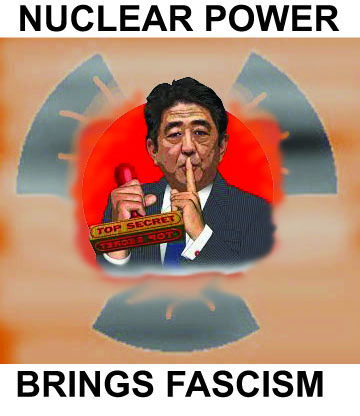
This is the only possible way to put proposed replacements for two outgoing commissioners of the Nuclear Regulation Authority (NRA) into perspective. Continue reading
1 This Month

of the week – Shut Down Drone Warfare!


Tell the Ukrainian Government to Drop Prosecution of Peace Activist Yurii Sheliazhenko

Petition to revoke the licensing of the Near Surface Nuclear Disposal Facility (NSDF) at Chalk River. https://www.ourcommons.ca/petitions/en/Petition/Details?Petition=e-7247
To see nuclear-related stories in greater depth and intensity – go to https://nuclearinformation.wordpress.com
-
Archives
- March 2026 (237)
- February 2026 (268)
- January 2026 (308)
- December 2025 (358)
- November 2025 (359)
- October 2025 (376)
- September 2025 (257)
- August 2025 (319)
- July 2025 (230)
- June 2025 (348)
- May 2025 (261)
- April 2025 (305)
-
Categories
- 1
- 1 NUCLEAR ISSUES
- business and costs
- climate change
- culture and arts
- ENERGY
- environment
- health
- history
- indigenous issues
- Legal
- marketing of nuclear
- media
- opposition to nuclear
- PERSONAL STORIES
- politics
- politics international
- Religion and ethics
- safety
- secrets,lies and civil liberties
- spinbuster
- technology
- Uranium
- wastes
- weapons and war
- Women
- 2 WORLD
- ACTION
- AFRICA
- Atrocities
- AUSTRALIA
- Christina's notes
- Christina's themes
- culture and arts
- Events
- Fuk 2022
- Fuk 2023
- Fukushima 2017
- Fukushima 2018
- fukushima 2019
- Fukushima 2020
- Fukushima 2021
- general
- global warming
- Humour (God we need it)
- Nuclear
- RARE EARTHS
- Reference
- resources – print
- Resources -audiovicual
- Weekly Newsletter
- World
- World Nuclear
- YouTube
-
RSS
Entries RSS
Comments RSS
 nuclear-news