Ukraine – Journalists under attack – Graham Phillips, Oleg Sidyakin and Marat Saichenko
….On Sunday, two Russian LifeNews journalists, Oleg Sidyakin and Marat Saichenko, were captured by Ukrainian troops, presumably near Kramatorsk in the self-proclaimed Donetsk People’s Republic. The journalists were being investigated on the charges of “aiding the terrorist groups,”…….

Video and images on RT link;
http://rt.com/news/160188-rt-journalist-detain-army/
RT contributing journalist Graham Phillips said he has been detained by the National Guard at a check point in Mariupol, eastern Ukraine. Following his phone call RT lost connection with the British journalist while UK said ready to provide assistance.
RT has lost connection with the it’s contributing journalist Graham Phillips who was detained at a check point in Mariupol earlier on Tuesday.
“Our stringer Graham Phillips was arrested at a checkpoint by people who, according to him, when we last spoke, introduced themselves as the National Guard and asked for his papers. After this, the connection with the journalist was lost, we still cannot get in touch with Graham, we are extremely worried what could happen to him. It is even more worrying after the events, which, as we all saw happened to the LifeNews TV correspondents” said Alexey Kuznetsov, deputy head of RT’s English department.
“I’m sitting at a blockade post in a portacabin. The dialogue is quite interrogation oriented,” Phillips earlier told RT in a phone call.
He added that he was asked if he is a spy, while his car was searched and his laptop confiscated. However, he noted that he is being treated well.
“At the moment I’m with the Ukrainian forces … near Mariupol. I’ve been here for over two hours and I’ve been described, my status, as being detained in terms of I can’t leave. I would also say I’m being treated OK by them. I believe that someone is coming. They’ve done checks on my documentation. They found my reports and clips I’ve done and they’re now looking through them asking me my position on things, asking if I’m a spy, and asking me quite thorough questions. They’ve checked all my documentation and photos, my laptop and the car – so that’s who I’m with at the moment.”
He also said he has been asked about separatism and his working arrangement with RT.
“I’ve been describing my position on Crimea. I did believe – and I did say and I did state and I stand by position – that the Crimea referendum was legitimate. I do believe referendums held here have a legitimacy, and I had an exchange one day that I do believe the Kiev government isn’t legal and isn’t democratic. I don’t support this current situation in the east of Ukraine or the Donetsk Republic, as it’s now been named. I believe the position of President Turchinov and [PM] Yatsenyuk – not coming here to speak to people, but using military forces to launch assaults against them – is completely wrong.”
During the phone conversation Phillips said he had explained to his captives that while working for RT he “maintains complete objectivity and neutrality as a correspondent.”
“I present the facts as I see them and exactly as today, which is to say they’re treating me OK. They’ve taken my bulletproof jacket and my helmet, but on the other hand they haven’t in any way inflicted any form of injury or any actions on my person.”
UK Foreign Office ready to provide consular assistance
The UK Foreign Office, upon being contacted by RT, said it is looking into Phillip’s detention and “stand ready to provide consular assistance.”
The British national’s previous record of reporting for RT has already backfired on him. Two weeks ago Ukrainian radicals put a bounty out on Phillips. The Right Sector reportedly offered $10,000 for the capture of “the Russian spy.”
On Monday, pro-Kiev activists again called to “immediately detain and deport” Phillips, whom they believe is “cooperating with terrorists,” according to a message posted on EuroMaidan Kharkov’s Facebook page.
Ecumenical delegates at the UN pursue alternatives to an unhealthy nuclear regime
14 May 2014
Reflections by Jonathan Frerichs (*)
Like an annual check-up where the patient disputes the diagnosis and refuses treatment, five states out of nearly 200 governments who met at the United Nations, New York, from 28 April to 9 May, continue to hang onto an “illness” the international community has long agreed is unhealthy and catastrophic – their nuclear arsenals.
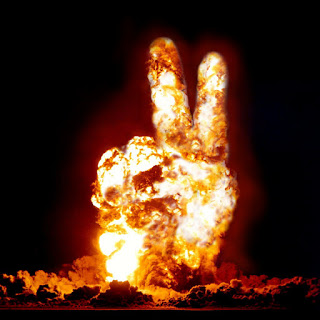
Image source ; http://internetsveryown.blogspot.ie/2013/06/nuclear-weapons-peace-keepers.html
An ecumenical delegation was present to advocate for a strong humanitarian remedy, one that has wide international support and that World Council of Churches (WCC) member churches on five continents brought to governments in advance of this 2014 meeting on the Non-Proliferation Treaty (NPT).
The nuclear powers could not block the careful diagnoses of the global nuclear malaise offered by the conference chair Ambassador Roman-Morey of Peru and by many of the 184 countries without nuclear weapons. Yet representatives of nuclear powers, such as the United States, Russia, the United Kingdom, France, and China and their allies were at pains to show that the real problem does not lie with them.
The real problem, they said, is with states that do not have nuclear weapons and might acquire them. This is similar to someone with an infectious disease refusing treatment while insisting that everyone else must be quarantined. NPT resolutions have foundered repeatedly on the same argument.
Alternative, energizing approaches were rife in the conference chamber and in dozens of side events. Chief among them is the need to deal with “the devastation that would be visited upon all humankind by any use of nuclear weapons and since there is no competent international capacity to address the resulting catastrophic humanitarian consequences,” as the chair’s final recommendations put it.
Ecumenical delegates met with representatives of governments on all sides of the issue—some with nuclear weapons, some without, and some dependent on the US nuclear arsenal. The meetings discussed national action called for by the recent WCC Assembly; namely, for all states to address conclusively the humanitarian impact of nuclear weapons of mass destruction. Assembly policy and church actions for peace on the Korean peninsula were explained in a panel proposing a nuclear-weapon-free zone in Northeast Asia. The WCC took part in a meeting of Christian, Buddhist, Muslim and Jewish leaders exploring new multi-religious initiatives for nuclear abolition. Dr Emily Welty, a Pace University professor from the Presbyterian Church (USA) and former international affairs commissioner of the WCC, and Mr Steve Hucklesby, policy advisor to the Methodist, United Reformed and Baptist churches in the United Kingdom, were ecumenical delegates at the NPT.
Nuclear testing in the Pacific made unexpected headlines at the conference. The Marshall Islands announced at the outset that it was taking each of the nine nuclear-armed states to the International Court of Justice for their failure to comply with the disarmament obligations in the NPT. Radiation from tests carried out in the 1950s and 60s still affect Pacific islanders’, including member churches there.
“It is hardly possible to have a smaller David and a bigger Goliath,” one ambassador said of the Marshall Islands’ lawsuit against the USA, Russia, China, France, United Kingdom, India, Pakistan, Israel and North Korea. The only recourse being sought by the small island nation is that nuclear disarmament be completed within a short, specified timeframe.
“The real question is this: Can the current dynamics of the global nuclear disarmament and non-proliferation regime deliver on the promise of nuclear abolition?” a representative of Project Ploughshares of the Canadian Conference of Churches said of the conference. “With poor prospects for a ‘yes,’ an increasing number of non-nuclear-weapons states are openly challenging the status quo.”
(*) A reflection on the news, by Jonathan Frerichs, WCC programme executive for peace building and disarmament, is a member of the Evangelical Lutheran Church in America.
WCC statement on the Way of Just Peace
WCC statement on Peace and Reunification of the Korean Peninsula
BREAKING – “World Without War” in South Korea – Reverend Bora Im, Yang and Choi imprisoned for peaceful demonstration
We just received news that our friend from World Without War in South Korean were imprisoned today for taking action against the construction of the naval base on Jeju Island. Below you find information where you can send letter of support.

Image source ; http://www.space4peace.org/articles/jeju_and_a_naval_arms_race_in_asia.htm
Posted by Javier http://www.wri-irg.org/node/23124
20 May 2014
Why South Korean peace activists walked into a prison on their own feet
Yeo-ok Yang and Jungmin Choi, activists of World Without War, and Reverend Bora Im of Hyanglin Church were put into prison on May 20.
They were sentenced to pay a fine of two million won each (approximately 2,000 USD) for taking a direct action to block the construction of Jeju Naval Base, which had been illegally undertaken without an agreement with local residents.
Instead of paying the fine, they chose to be imprisoned in a workhouse. Two million won is a large amount money for an activist. But that is not the main reason of their choices. They thought it is a violation of the constitutional rights to the freedom of assembly and association to impose heavy fines on activists taking a thoroughly nonviolent way of resistance against wrongful state policies.
Thus, it is an active civil disobedience that these peace activist refused to pay the fine and walked into a prison on their own feet. Being punished instead of obeying an unjust law, they are actively revealing the unjustness of law. They are showing that the construction of Jeju Naval Base is wrong and that it is unjust to violate the constitutional rights to the freedom of assembly of association by imposing heavy fines.
We respect their choices to be imprisoned. But we cannot let our friends stay in the prison for too long. There are several ways you can help them:
1. Fund-raising for the fine
(1) Himneyo >> http://himneyo.com/story/story_detail.jsp?sid=1000334
You can donate a thousand won just by logging in with a Facebook account and a few clicks. The contribution comes from a number of committed donators. (Refer to the attached images for instructions.)
(2) SocialFunch >> http://www.socialfunch.org/peacefund
SocialFunch is a crowdfunding site for social movements. You can donate any amount of money in several payment methods. (Only available in South Korea.)
2. Letters of support
Send your letters of support to these activists.
(1) Send an email to: peace@withoutwar.org
(2) You can also write online messages on a Facebook page:
http://www.facebook.com/wearenotguilty
3. Petition
Send Twitter messages to South Korean authorities:
(1) Ministry of Justice: @happymoj
(Sample message: Release all peace activists of Gangjeong. Nonviolent direct action is not a crime! #wearenotguilty)
(2) Ministry of National Defense: @ROK_MND
(Sample message: Stop the construction of Jeju Naval Base! #wearenotguilty)
(3) Samsung C&T: @Samsungcnt
(Sample message: Stop the construction of Jeju Naval Base! #wearenotguilty)
SURGEONS LAND IN EASTERN UKRAINE TO CARRY OUT LIFE-SAVING OPERATIONS DESPITE THE BACKGROUND OF THE CRISIS
h/t https://www.facebook.com/ChernobylChildrenInternational?fref=nf
20 May 2014

Against all the odds, an Irish funded international surgical team has got through the strife-torn Ukraine and landed in Kharkiv today to provide life-saving cardiac operations for more than 60 critically ill children. The mission has been organised by Irish humanitarian aid agency Adi Roche’s Chernobyl Children International.
The team of internationally renowned specialists – from the US, Canada and Nicaragua – will begin carrying out the urgently needed operations, funded by Irish donors, on children suffering from genetic heart defects in the eastern city of Kharkiv today (Tuesday).
The volunteer multi-national team of surgeons will be led by the renowned US surgeon, Dr. William Novick, Founder and Medical Director of the International Children’s Heart Foundation (ICHF) who pioneered the ‘mercy missions’ to Ukraine where 6,000 babies are born with heart defects each year.
The surgical team of 7 includes Frank Molloy, a specialist cardiac nurse with English roots now working in the US and Dr. Kathleen Fenton, originally of Washington DC, now living in Nicaragua.
Dr. Novick, Adi Roche, CEO, Chernobyl Children International and Dr. Igor Polivenok, Head of the Cardiac Unit at Kharkiv Hospital, are delighted that the operations will go ahead today.
Dr. Novick said “It has been a difficult decision to go ahead with the mission and there are risks involved but we could not put the operations off any longer. We have to keep these children alive”.
Adi Roche, said “We are so grateful to the surgical team for taking a personal risk travelling to Kharkiv to save the lives of children who, without surgical intervention, would not survive. We are hoping for a successful outcome to this mission”.
“We were so disappointed when the operations had to be twice cancelled because of the volatility and instability in Eastern Ukraine but it is such a relief that the team has arrived safely in Kharkiv and can now begin saving lives”.
Dr. Igor Polivenok of Kharkiv Hospital has expressed his joy at the team’s return. “This is something magical and unbelievable! These children are our treasures and now there is hope that they will live. The restoration of these life-saving missions’ gives us all hope for life”, Dr Polivenok said.
In April, the rapidly deteriorating situation in Ukraine forced the suspension of the life-saving cardiac surgery programme for a second time this year. Of the 6,000 babies born with heart defects in Ukraine each year, 50 per cent are not operated on because of lack of facilities and qualified medical teams in Ukraine. Without cardiac surgery the children, who need complex open heart operations, have little hope of living beyond 5 years. Since 2004 more than €3 million has been raised in Ireland to fund the programme organised by Chernobyl Children International.
USA’s Westinghouse taking over nuclear fuel supplies to Ukraine, despite problems in those fuel assemblies
 Chernobyl memories faded? Kiev turns blind eye to disaster risk in nuclear deal with US http://rt.com/news/159848-ukraine-nuclear-deal-westinghouse/ May 19, 2014 In order to alleviate energy dependence on Moscow, the coup-imposed government in Kiev has resurrected a contract
  with a US company to supply fuel to Ukraine’s nuclear power plants. Using US fuel rods was banned in 2012 due to dangerous incompatibility.
The rivalry for nuclear fuel supply to Ukraine between Russia’s nuclear fuel cycle company TVEL and America’s Westinghouse took a twist when in April 2014, shortly after the armed coup, Kiev signed a new deal with America’s leading nuclear fuel producer, Westinghouse Electric Company, instead of the Russian TVEL company that has been supplying fuel rods to Ukraine for years.
 Ukraine’s 4 nuclear power plants constitute a huge part of the country’s energy system. The country’s 15 nuclear reactors produce at least 50 percent (over 13 megawatt) of all electric power generation in Ukraine. All nuclear fuel for Ukrainian reactors (worth hundreds of millions of dollars a year) has been produced in Russia, which also recycles Ukraine’s nuclear waste.
Moreover, Russia’s Rosatom state-owned nuclear monopoly is currently constructing a nuclear fuel fabrication plant in Ukraine, where nuclear fuel rods will be assembled using uranium enriched in Russia.
All in all, Ukraine has relied on Russia in all atomic matters – but the West has muscled in on the relationship.
The Westinghouse Electric Company has been trying to ‘ease’ the former Soviet-bloc countries energy reliance on Russia and enter the market in Eastern Europe for over a decade. For that purpose the company was also using political leverage. Back in 2012, the then US Secretary of State Hillary Clinton attempted to convince Czech leaders to pick up America’s Westinghouse as a primary nuclear fuel supply partner instead of Russia, which would create thousands of new jobs in the US.
Actually, Westinghouse has already supplied nuclear fuel to Ukraine’s Energoatom nuclear power generator company. In 2005, six experimental Westinghouse fuel assemblies, adopted for use in USSR-developed reactors, were tried at the South Ukraine plant in one reactor together with Russian fuel rods.
Though nuclear engineers were skeptical of the pilot probe, the government of former president Viktor Yushchenko signed a deal in 2008 with Westinghouse on fuel rod supply, despite the fact that American nuclear fuel is significantly more expensive and technologically different: Russian nuclear fuel rods are hexagonal in section, while Americans produce fuel assemblies of square section
This time a batch of 42 fuel assemblies was loaded into three reactors at the South Ukraine nuclear power plant for a standard three-year period of commercial operation.
When in 2012 the time came to replace the fuel assemblies, Ukrainian nuclear engineers found that Westinghouse assemblies deformed during exploitation and got stuck in the core.
Energoatom accused Westinghouse of producing poorly engineered assemblies, whereas Westinghouse countered, accusing the Ukrainian engineers of installing the rods badly.
After the incident the use of American nuclear fuel was banned in Ukraine fuel rods were returned to the producer ‘to get fixed’ and Russian experts were summoned to help with the repair of the equipment produced in the USSR. The Energoatom Company lost an estimated $175 million.
Similar problems with Westinghouse fuel assemblies occurred at a number of other USSR-constructed nuclear power plants: NPP Krško in Slovenia, NPP Loviisa in Finland and NPP Temelin in the Czech Republic. All these countries opted to return to time-proved fuel assemblies produced by Russia’s TVEL Company.
Now Ukraine appears to be ready to fall into the same trap twice. The coup-imposed Kiev regime has renewed the 2008 nuclear fuel deal till 2020, to replace 25 percent of the Russian-made fuel rods with an option to “provide more if needed,” reported the Associated Press in April – all this for the sole purpose of ‘diversifying’ supply.
Kiev’s interim authorities may be not familiar with nuclear energy technologies, but they surely have a clue about theconsequences of a Chernobyl-like tragedy.
What happened back in 2012 at Zaporozhskaya NPP could have potentially ended with another Chernobyl, because having unextractable fuel assemblies loaded means a potential loss of control over the fission processes inside the reactor.
But the new Kiev authorities, supported by Washington, are making every effort to cut Ukraine’s economic ties with Russia, so crossing over from Russian nuclear fuel to American sounds attractive to Arseny Yatsenyuk’s government despite the 2012 incident.
Furthermore, Westinghouse won’t recycle its fuel rods when they ‘burn out’, so Ukraine will be spending even more budget money to prepare special storage facilities for nuclear waste. Also, the company may have its sights set on a much-hotter prize.
“This move by Westinghouse is really to secure not just a fuel contract, which will go on for many years, but to put its foot in the door to build a fuel fabrication plant in eastern Ukraine. And that’s what’s most important and that’s what they’re after,” John Large, an independent nuclear analyst from London, told RT.
Experts generally agree that nuclear power plants are constructions that should not undergo drastic transitions. A nuclear reactor demands a coherent structure of operations. The active reactor core is the most dangerous when it comes to the impact it may have on people and the environment. All reactors differ in smallest details, and toying around with them leads to no good,” Evgeny Akimov of the International Union of Nuclear Energy Veterans told RT.
And if something goes wrong, Kiev may find that they are lonely in facing the consequences.
“As far as I know, Westinghouse signs contracts in which the company bears no responsibility, so the burden will lie with Ukraine,” said Rafael Arutyunyan, a nuclear security expert and professor at the Moscow Institute of Physics and Technology.
With Chernobyl and Fukushima being the prime examples, nuclear power is a force to be handled with great care. Yet, Kiev’s actions seem to be dictated by politics rather than risks, even when the consequences may affect not just Ukraine, but the entire European continent.
When the Chernobyl tragedy occurred back in 1986, it was a pure coincidence that Ukraine’s wind direction, usually directed into Europe, changed, sending radioactive fallout in the direction of Russia and Belarus.
In this over-politicized case, European capitals would do well to learn how the wind blows beforehand.
UK peace activists make a daring blockade against construction of nuclear weapons
 Britain: Activists Disrupt Construction of New Nuclear Weapons Factory http://www.globalresearch.ca/britain-activists-disrupt-construction-of-new-nuclear-weapons-factory/5382852 By Global Research News May 19, 2014by Action AWE (Atomic Weapons Eradication)
 £2 billion project going ahead, but Parliament has not yet voted on further nuke development.
That’s what you call “democracy”. But it is all for a good cause. Nuclear weapons are an “instrument of peace”.
Daring dawn blockade of Berkshire’s nuclear weapons factory
This morning at 7.20, a group of people began blockading the Atomic Weapons Establishment (AWE) site at Burghfield, near Reading. The protesters, acting as part of ActionAWE [1], a campaign of nonviolent direct action, are trying to disrupt construction of a new nuclear warhead factory on the site.
The new development at AWE Burghfield is being built at a cost to the tax payer of almost £2 billion, despite the fact that parliament has yet to vote on replacing the current generation of nuclear warheads that the site would build.
The eight protesters, aged between 19 and 40, are locked together using handcuffs inside ‘lock-on’ devices – made from drainpipes, and vegetable oil drums filled with concrete in order to block the gate to the construction site to prevent further work on the site. Traffic is now queued up, unable to enter the facility. The Christians amongst the protesters are singing hymns.
Catherine Bann, 40, mother of two from Todmorden, said: “The money we would spend renewing Trident could pay for all A & E hospital departments in the country for the next 40 years! It’s a huge waste of public money to be investing in nuclear weapons, and people like us must make a stand now, so that future generations do not have to bear the cost.”
Joanna Frew, 35, a member of the United Reformed Church living in London but originally from Scotland, said
“Trident is illegal, immoral and a waste of money. It is the opposite of everything that Jesus teaches us about being co-creators of life and loving your enemies. Political and religious leaders in Scotland are opposed to retaining Trident at Faslane. We have a real opportunity over the next year to say that it is no longer acceptable , and that we don’t want an illegal renewal.”
Phil Wood, 20, a student at Bradford University added
“To be spending millions of pounds and planning to spend billions more on nuclear weapons while cutting back on essential public services that people rely on is unforgivable”.
Matt Fawcett, 39, from Yorkshire CND said Continue reading
USA East Coast nuclear power plants set to sink under rising seas
 How Rising Seas Could Sink Nuclear Plants On The East Coast Shane Shifflett Kate Sheppard, HUFFINGTON POST, 19 May 14 In 2011, a tsunami sent waves as high as 49 feet crashing over the seawalls surrounding the Fukushima Daiichi Nuclear Power Plant in Japan, causing meltdowns at three of the plant’s reactors. After that incident, the United States Nuclear Regulatory Commission (NRC) ordered nuclear facilities in the U.S. to review and update their plans for addressing extreme seismic activity and potential flooding from other events, such as sea level rise and storm surges. Those plans aren’t due until March 2015, which means that many plants have yet to even lay out their their potential vulnerabilities, let alone address them.
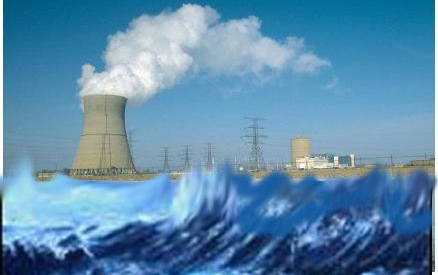
During the 1970s and 1980s, when many nuclear reactors were first built, most operators estimated that seas would rise at a slow, constant rate. That is, if the oceans rose a fraction of an inch one year, they could be expected to rise by the same amount the next year and every year in the future.
But the seas are now rising much faster than they did in the past, largely due to climate change, which accelerates thermal expansion and melts glaciers and ice caps. Sea levels rose an average of 8 inches between 1880 and 2009, or about 0.06 inches per year. But in the last 20 years, sea levels have risen an average of 0.13 inches per year – about twice as fast.
And it’s only getting worse. The National Oceanic and Atmospheric Administration (NOAA) has laid out four different projections for estimated sea level rise by 2100. Even the agency’s best-case scenario assumes that sea levels will rise at least 8.4 inches by the end of this century. NOAA’s worst-case scenario, meanwhile, predicts that the oceans will rise nearly 7 feet in the next 86 years.
But most nuclear power facilities were built well before scientists understood just how high sea levels might rise in the future. And for power plants, the most serious threat is likely to come from surges during storms. Higher sea levels mean that flooding will travel farther inland, creating potential hazards in areas that may have previously been considered safe. During Superstorm Sandy, for example, flooding threatened the water intake systems at the Oyster Creek and Salem nuclear power plants in New Jersey. As a safety precaution, both plants were powered down. But even when a plant is not operating, the spent fuel stored on-site, typically uranium, will continue to emit heat and must be cooled using equipment that relies on the plant’s own power. Flooding can cause a loss of power, and in serious conditions it can damage backup generators. Without a cooling system, reactors can overheat and damage the facility to the point of releasing radioactive material.
Salem and Hope Creek Nuclear Generating Stations Operated by PSEG Nuclear, LLC.……..
Turkey Point Nuclear Generating Station Operated by Florida Power & Light Co……..
America agonises over what to do with nuclear radioactive trash

that they should stop making this toxic stuff
LEGACY OF AMERICA’S NUCLEAR POWER PLANTS — SPENT FUEL AND NO PLACE TO PUT IT BRATTLEBORO REFORMER BY BOB AUDETTE MAY 19, 2014. BRATTLEBORO — After Vermont Yankee nuclear power plant is closed and when the site is finally cleaned up — perhaps before the end of the next decade — there will still be a lingering reminder of what existed there since 1972.
As at other nuclear power plant sites around the country, spent nuclear fuel — or nuclear waste, as it used to be called prior to a successful rebranding campaign waged by the nuclear industry — might remain in Vernon long after all other reminders of Yankee are gone.
In fact, the Nuclear Regulatory Commission released last year a revised waste confidence rule that stated impacts would be small if spent fuel had to be stored at nuclear sites “indefinitely.”
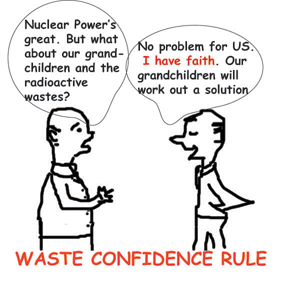
Ernest Moniz, the secretary of the U.S. Department of Energy, was in Vermont last week. During a phone interview with the Reformer, Moniz said his department is focused on developing a way to take care of the nation’s nuclear waste. However, noted Moniz, DOE needs the go-ahead from Congress. Continue reading
Manga artist not prepared to toe the reassuring official line on radiation and health
 Manga depiction of nosebleed spurs debate on radiation health risks CTV News, Yuri Kageyama, The Associated Press May 19, 2014 TOKYO — A journalist finds his nose doesn’t stop bleeding after visiting the meltdown-stricken Fukushima nuclear plant. He also learns others suffer similar symptoms.
The scene from popular manga comic “Oishinbo,” published last month, has set off a hot public debate in Japan — a nation still traumatized by the world’s worst nuclear disaster since Chornobyl.
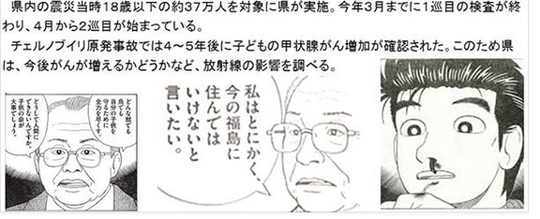
Local governments immediately protested the comic, saying it fosters unfounded fears of radiation.
Prime Minister Shinzo Abe chimed in over the weekend, reassuring the public there was no proof of a link between radiation and such illnesses. “The government will make the best effort to take action against baseless rumours,” he said.
Undeterred by the ruckus, Tokyo-based publisher Shogakukan added a special 10-page segment to weekly Big Comic Spirits magazine, published Monday, featuring criticism it had received as well as opinion from radiation experts.
Editor Hiroshi Murayama acknowledged he had been unsure about publishing the manga, subtitled “The Truth of Fukushima,” because he anticipated people would be offended. But he had decided that voice needed to be heard, he said.
“We hope the various views on the latest ‘Oishinbo’ will lead to a constructive debate into assessing our future,” he said in the special segment.
“Oishinbo,” a hit series usually about gourmet food, which began in the 1980s, will be discontinued temporarily in the magazine. But the publisher said that had been the plan even before the controversy. It is not clear when it will run again………..
Scientists say there is no exact safe limit to low dose radiation. A causal link to any individual’s disease is hard to prove, given the varieties of carcinogens and other risks in the environment.
Fukushima is monitoring the health of its residents, and carrying out thyroid checks on those ages 18 and under.
Seventy-five confirmed and suspected cases of thyroid cancer have been found in those tests, but it is unclear whether they are linked to radiation.
A group of Fukushima residents, who say they have suffered dizzy spells and nosebleeds since the disaster, came out last week in defence of “Oishinbo.” They said through their lawyer that they will speak out in Tokyo, but on condition of anonymity, perhaps wearing a traditional demon’s mask to protect themselves against ostracism and other social backlash over going public with fears about radiation.
In the final scenes of the Fukushima episodes of “Oishinbo,” the characters — drawn in trademark manga style with big eyes — talk about how they must save Fukushima. But they decide that the best way is to urge people living with radiation to have the courage to get out, with the help of the government.
Tetsu Kariya, the writer of “Oishinbo,” did not immediately respond to requests for an interview. But he said on his blog earlier this month that the intensity of the outrage set off by the nosebleed scene was unexpected.
Having researched Fukushima for two years, he was not about to write that Fukushima was safe and all was well — even if that may be what people wanted to hear.
“I can only write the truth,” he said. http://www.ctvnews.ca/health/manga-depiction-of-nosebleed-spurs-debate-on-radiation-health-risks-1.1828017#ixzz32JOTbOhy
USA charges Chinese officials with nuclear cyberspying
 Chinese officials indicted in nuclear cyberspying case, By Eric Tucker, The Times of Israel, 19 May 14 US announces unprecedented charges against military hackers who targeted big-name firms, stole trade secrets WASHINGTON (AP) — The United States announced on Monday unprecedented cyber espionage charges against five Chinese military officials accused of hacking into US companies to gain trade secrets The hackers targeted big-name makers of nuclear and solar technology, stealing confidential business information, sensitive trade secrets and internal communications for competitive advantage, according to a grand jury indictment……..
The indictment says that five hackers — members of the People’s Liberation Army — worked from a building in Shanghai to steal proprietary information from the companies and the labor union, including communications that could have helped Chinese firms learn strategies and weaknesses of American companies involved in litigation with the Chinese government or Chinese firms.
The defendants are all believed to be in China and it was unclear whether they would ever be turned over to the US for prosecution. But the Justice Department, publicizing the charges, identified all five by name and issued “wanted” posters………
The indictment will put a greater strain on the US-China relationship and could provoke retaliatory acts in China or elsewhere.
“What we can expect to happen is for the Chinese government to indict individuals in the United States who they will accuse of hacking into computers there,” said Mark Rasch, a former US cybercrimes prosecutor. “Everybody now is going to jump into the act, using their own criminal laws to go after what other countries are doing.”
Rasch said the indictments attempt to distinguish spying for national security purposes — which the US admits doing — from economic espionage intended to gain commercial advantage for private companies or industries, which the US denies it does. Classified documents disclosed by former National Security Agency analyst Edward Snowden described aggressive US efforts to eavesdrop on foreign communications that would be illegal in those countries.
“These five people were just doing their jobs. It’s just that we object to what their jobs are,” Rasch said. “We have tens of thousands of dedicated, hard-working Americans who are just doing their jobs, too.”
Unlike in some countries, there are no nationalized US industries. American officials have flatly denied that the government spies on foreign companies and then hands over commercially valuable information to American companies. http://www.timesofisrael.com/chinese-officials-indicted-in-nuclear-cyberspying-case/#ixzz32JH7SA85
Poverty-stricken African nations exploited by mining companies, especially Australian uranium miners
THE SCRAMBLE FOR URANIUM IN AFRICA http://www.phantomreport.com/the-scramble-for-uranium-in-africa 19 May 14, Africa’s resources are extracted by outsiders, with benefits only reaching the involved non-African mining companies and non-African end-users of the commodity. Africa is the next frontier to meet energy needs. Oil and gas are being exploited as never before, exacerbating conflict in Darfur and Nigeria, social inequality in Angola, and environmental damage in Chad.
At the same time, renewed demand for uranium is being explored on the continent more than at any other time in history.
Yet the continent’s huge potential for renewable energy is not fully being realised. The government of Malawi granted a uranium mining licence to an Australian uranium mining company without having any legislation on the mining, handling and transportation of radioactive materials. Malawi is now home to twelve potential uranium mines.
In Niger mining companies from Australia, Canada, France and other parts of the world are scrambling for licences to explore uranium in a country which is already the world’s sixth producer of uranium. In the Central African Republic (CAR) there is a scramble amongst Chinese, American and French companies which are all interested in mining the Bakouma region.
In Tanzania the Australian Omega Corp obtained the Mkuju River concessions through its subsidiary, Mantra Resources. Other Australian juniors are represented in Tanzania, including Sabre Resources, Goldstream Mining, Uranex and Deep Yellow.
In Zambia, the Australian Energy Ventures through its subsidiary Africa Energy Resources started drilling the Kariba Valley in May 2008. Another Australian enterprise, Albion Ltd,, is also undertaking exploration.
Bad omens for uranium mining expansion
By Dave Forest | Mon, 19 May 2014 Uranium prices took another slump the last several weeks. Spot prices for uranium oxide have now fallen below $30 per pound for the first time since 2005. Even long-term prices sagged, falling below $50–to a current $45 per pound.
That’s stopped the wave of optimism that had been running through uranium stocks earlier this year.
Cameco..told regulators in Canada that it is shelving one of its biggest development projects in the uranium-rich province of Saskatchewan.The Canadian Nuclear Safety Commission (CNSC) said in a press release Friday that Cameco is not proceeding with permitting for the company’s Millennium project. The up-and-coming mine had been scheduled for public hearings in June, to consider the grant of a 10-year operating license.
……… Cameco is concerned about low uranium prices. And how they will affect the potential economics of a start-up at Millennium.The company has now reportedly withdrawn its application to construct and operate the mine………
Simply put, Millennium was one of the world’s premier uranium development projects. Hosting an indicated mineral resource of 46.8 million pounds uranium oxide–grading a league-leading 4.53% U3O8. The proposed mine here would have been one of the world’s largest producers. Slated to put out up to 7 million pounds of uranium oxide yearly.
But all of that supply is now lost to the market. Just another sign that current prices are too low to support much of the existing uranium mining industry. Let alone necessary expansion projects.
This is not a sustainable situation. With supply also falling in major producing centre like Kazakhstan and Africa, something will have to give…..http://oilprice.com/Finance/investing-and-trading-reports/This-Is-A-Major-Loss-For-Uranium-Supply.html
North Korea warned by China against conducting 4th nuclear test
China warns North Korea against fourth nuclear test, Australia Network News, 20 May 14 China has used diplomatic channels to warn North Korea against conducting a fourth nuclear test after the reclusive state renewed its threat of “counter-measures” against perceived US hostility.
North Korea, which regularly threatens the South and the United States with destruction, is already under heavy sanctions imposed by several UN resolutions beginning in 2006 but has defied pressure to abandon its missile and nuclear programs.
It last conducted a nuclear test in February 2013.
“China has told North Korea that there is no justification for a new nuclear test and that they should not do it,” a Western diplomat who was briefed by Chinese officials said.
The sources said China had used diplomatic channels in Beijing and Pyongyang to convey its anxiety about the possibility of a fourth test to the North……http://www.abc.net.au/news/2014-05-20/an-china-warns-nkorea/5463466
Insider threats biggest challenge to nuclear security
http://cisac.stanford.edu/news/insider_threats_biggest_challenge_to_nuclear_security_20140409/
By Clifton Parker
April 9, 2014 – CISAC, FSI Stanford In the News
The greatest dangers to nuclear facilities are sabotage and theft from insiders, according to political scientist Scott Sagan. Analysis of past incidents can help boost safeguards at these sites.
A diesel generator at the San Onofre Nuclear Generating Station in Southern California was possibly sabotaged, likely by an insider, in 2012.
Insider threats are the most serious challenge confronting nuclear facilities in today’s world, a Stanford political scientist says.
In every case of theft of nuclear materials where the circumstances of the theft are known, the perpetrators were either insiders or had help from insiders, according to Scott Sagan and his co-author, Matthew Bunn of Harvard University, in a research paper published this month by the American Academy of Arts and Sciences.
“Given that the other cases involve bulk material stolen covertly without anyone being aware the material was missing, there is every reason to believe that they were perpetrated by insiders as well,” they wrote.
And theft is not the only danger facing facility operators; sabotage is a risk as well, said Sagan, who is a CISAC senior fellow and professor of political science.
While there have been sabotage attempts in the United States and elsewhere against nuclear facilities conducted by insiders, the truth may be hard to decipher in an industry shrouded in security, he said.
“We usually lack good and unclassified information about the details of such nuclear incidents,” Sagan said.
The children of Japan’s Fukushima battle an invisible enemy
Hiraguri said that stress was showing up in an increase of scuffles, arguments and even sudden nosebleeds among the children, as well as more subtle effects.
“There’s a lot more children who aren’t all that alert in their response to things. They aren’t motivated to do anything,” he said.
http://news.msn.com/world/the-children-of-japans-fukushima-battle-an-invisible-enemy

3/10/14 By Toru Hanai and Elaine Lies of Reuters
KORIYAMA, Japan (Reuters) – Some of the smallest children in Koriyama, a short drive from the crippled Fukushima nuclear plant, barely know what it’s like to play outside – fear of radiation has kept them indoors for much of their short lives.
Though the strict safety limits for outdoor activity set after multiple meltdowns at the Fukushima Dai-ichi nuclear plant in 2011 have now been eased, parental worries and ingrained habit mean many children still stay inside.
And the impact, three years on, is now starting to show, with children experiencing falling strength, lack of coordination – some cannot even ride a bicycle – and emotional issues like shorter tempers, officials and educators say.
“There are children who are very fearful. They ask before they eat anything, ‘does this have radiation in it?’ and we have to tell them it’s okay to eat,” said Mitsuhiro Hiraguri, director of the Emporium Kindergarten in Koriyama, some 55 km (35 miles) west of the Fukushima nuclear plant.
“But some really, really want to play outside. They say they want to play in the sandbox and make mud pies. We have to tell them no, I’m sorry. Play in the sandbox inside instead.”
Following the March 11, 2011, quake and tsunami, a series of explosions and meltdowns caused the world’s worst nuclear accident for 25 years, spewing radiation over a swathe of Fukushima, an agricultural area long known for its rice, beef and peaches.
A 30-km radius around the plant was declared a no-go zone, forcing 160,000 people from homes where some had lived for generations. Other areas, where the radiation was not so critically high, took steps such as replacing the earth in parks and school playgrounds, decontaminating public spaces like sidewalks, and limiting children’s outdoor play time.
“There are children in the disaster-stricken areas who are going to turn three tomorrow,” Prime Minister Shinzo Abe said on Monday. He told a nationally televised news conference he wanted to invite as many of them as possible to the 2020 Olympics, when they will be fourth-graders, as a “symbol of reconstruction.”
Any such revival looks a long way off.
“AVOID TOUCHING THE OUTSIDE AIR”
Koriyama recommended shortly after the disaster that children up to two years old not spend more than 15 minutes outside each day. Those aged 3 to 5 should limit their outdoor time to 30 minutes or less.
These limits were lifted last October, but many kindergartens and nursery schools continue to adhere to the limits, in line with the wishes of worried parents.
One mother at an indoor Koriyama playground was overheard telling her child: “Try to avoid touching the outside air”.
Even three-year-olds know the word “radiation”.
Though thyroid cancer in children was linked to the 1986 Chernobyl nuclear accident, the United Nations said last May that cancer rates were not expected to rise after Fukushima.
Radiation levels around the Emporium Kindergarten in Koriyama were now down around 0.12-0.14 microsieverts per hour, from 3.1 to 3.7 right after the quake, said Hiraguri.
This works out to be lower than Japan’s safety level of 1,000 microsieverts a year, but levels can vary widely and at random, keeping many parents nervous about any outdoor play.
1 This Month


Tell the Ukrainian Government to Drop Prosecution of Peace Activist Yurii Sheliazhenko

Petition to revoke the licensing of the Near Surface Nuclear Disposal Facility (NSDF) at Chalk River. https://www.ourcommons.ca/petitions/en/Petition/Details?Petition=e-7247


of the week – STOP SMALL MODULAR REACTORS IN CANADA
To see nuclear-related stories in greater depth and intensity – go to https://nuclearinformation.wordpress.com
-
Archives
- March 2026 (204)
- February 2026 (268)
- January 2026 (308)
- December 2025 (358)
- November 2025 (359)
- October 2025 (376)
- September 2025 (258)
- August 2025 (319)
- July 2025 (230)
- June 2025 (348)
- May 2025 (261)
- April 2025 (305)
-
Categories
- 1
- 1 NUCLEAR ISSUES
- business and costs
- climate change
- culture and arts
- ENERGY
- environment
- health
- history
- indigenous issues
- Legal
- marketing of nuclear
- media
- opposition to nuclear
- PERSONAL STORIES
- politics
- politics international
- Religion and ethics
- safety
- secrets,lies and civil liberties
- spinbuster
- technology
- Uranium
- wastes
- weapons and war
- Women
- 2 WORLD
- ACTION
- AFRICA
- Atrocities
- AUSTRALIA
- Christina's notes
- Christina's themes
- culture and arts
- Events
- Fuk 2022
- Fuk 2023
- Fukushima 2017
- Fukushima 2018
- fukushima 2019
- Fukushima 2020
- Fukushima 2021
- general
- global warming
- Humour (God we need it)
- Nuclear
- RARE EARTHS
- Reference
- resources – print
- Resources -audiovicual
- Weekly Newsletter
- World
- World Nuclear
- YouTube
-
RSS
Entries RSS
Comments RSS
 nuclear-news