“Nuclear fuel fragments” from Fukushima found in Europe — 10,000+ kilometers from reactors — Study: Plume “directly from N. America” — Hot particles a “significant part” radioactive releases — Quickly spread over entire hemisphere — Film shows core material on Norway air filter (PHOTO)
Published: May 6th, 2014 at 11:31 am ET
By ENENews
From the comments
Nick
“Consequently, there was a rapid melt-down of the reactor cores and
a massive injection of radionuclides into the atmosphere.
During the accident, the whole inventory of the noble gas 133Xe was set free from
the reactors.”
http://www.atmos-chem-phys-discuss.net/12/12331/2012/acpd-12-12331-2012.pdf
ENENews Admin
May 6, 2014 at 12:48 pm
From 5 months ago:
Report reveals highest level of radioactive xenon-133 to hit Canada after Fukushima over 6,000% more than gov’t website claims
http://enenews.com/report-reveals-highest-level-of-radioactive-xenon-133-to-hit-canada-after-fukushima-was-over-6000-more-than-govt-website-claims
Canadian Study: Those lacking wisdom expected Fukushima plume to disperse before hitting West Coast — In reality “sharp features” were detected even after several days travel (PHOTO)
http://enenews.com/study-uninformed-people-thought-fukushima-plume-would-dilute-before-hitting-west-coast-in-reality-sharp-features-were-detected-even-after-several-days-travel-photo
Atmospheric Chemistry and Physics Discussions, Atmospheric removal times of aerosol-bound radionuclides, May 2012: Hot particles (e.g., fragments of the nuclear fuel) were present in the FD-NPP plume.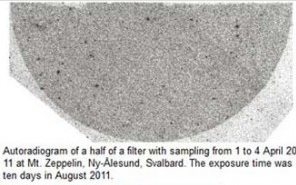
Elsevier (academic publisher) — Fukushima Accident: Radioactivity Impact on the Environment, 2013: Paatero et al. (2012) estimated that a significant part of the Fukushima-derived radioactivity is in hot particles from autoradiogram of a filter sample from 1 to 4 April 2011 at Mt. Zeppelin, Ny-Alesund, Svalbard.
Poster for Alaska Marine Science Symposium (Arctic Ocean and Bering Sea/Aleutian Islands), Jan. 20, 2014: Exposure to fallout while on ice in 2011 […] Models suggest pinnipeds may have been exposed while on ice to the following: […] Hot particles, nuclear fuel fragments, were detected in air samples taken in Svalbard, Norway (Paatero et al. 2012).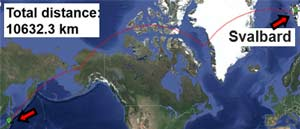
(Paatero et al. 2012) Airborne fission products in the High Arctic after the Fukushima nuclear accident: The plume arriving in Svalbard did not come from Europe but directly from North America […] [Hot particles are] either fragments of the nuclear fuel or particles formed by the interactions between condensed radionuclides, nuclear fuel, and structural materials of the reactor […] a significant part of the activity related to Fukushima was in hot particles. So far the authors are not aware of any other reports concerning hot particles from the Fukushima accident. […] radionuclides emitted into the atmosphere were quickly dispersed around practically the whole northern hemisphere within a couple of weeks.
2 Comments »
Leave a reply to Governmental Deception Cancel reply
1 This Month
26 April – Chernobyl: Inside the Meltdown airs on National Geographic on Sunday 26th April from 4pm

29 April – Nuclear Expert Webinar #1 – Radiation Impacts on Families with Mary Olson and Cindy Folkers
- 12:15 PM MT – 1:45 PM MT
- Location: Virtual – REGISTER TODAY

4 May -West Suburban Peace Coalition to discuss Iran war at May Educational Forum
Monday, May 4, 7:00 – 8:00 PM Central Standard Time
Title: : How Trump’s Narrative Tries to Shape the Reality of the War on Iran.
Contact Walt Zlotow, zlotow@hotmail.com 630 442 3045 for further information
14 May – online event From Bombs to Data Centres: the Face of Nuclear Colonialism

Pine Ridge Uranium is the real threat, not Tehran- Tell Burgum: Stop the Extraction.
Chernobyl: The Lost Tapes – A good documentary on Chernobyl on SBS available On Demand for the next 3 weeks– https://www.sbs.com.au/ondemand/tv-program/chernobyl-the-lost-tapes/2352741955560
To see nuclear-related stories in greater depth and intensity – go to https://nuclearinformation.wordpress.com
-
Archives
- May 2026 (12)
- April 2026 (356)
- March 2026 (251)
- February 2026 (268)
- January 2026 (308)
- December 2025 (358)
- November 2025 (359)
- October 2025 (376)
- September 2025 (257)
- August 2025 (319)
- July 2025 (230)
- June 2025 (348)
-
Categories
- 1
- 1 NUCLEAR ISSUES
- business and costs
- climate change
- culture and arts
- ENERGY
- environment
- health
- history
- indigenous issues
- Legal
- marketing of nuclear
- media
- opposition to nuclear
- PERSONAL STORIES
- politics
- politics international
- Religion and ethics
- safety
- secrets,lies and civil liberties
- spinbuster
- technology
- Uranium
- wastes
- weapons and war
- Women
- 2 WORLD
- ACTION
- AFRICA
- Atrocities
- AUSTRALIA
- Christina's notes
- Christina's themes
- culture and arts
- Events
- Fuk 2022
- Fuk 2023
- Fukushima 2017
- Fukushima 2018
- fukushima 2019
- Fukushima 2020
- Fukushima 2021
- general
- global warming
- Humour (God we need it)
- Nuclear
- RARE EARTHS
- Reference
- resources – print
- Resources -audiovicual
- Weekly Newsletter
- World
- World Nuclear
- YouTube
-
RSS
Entries RSS
Comments RSS
 nuclear-news
Reblogged this on Governmental deception.
Normally, even if a reactor’s core comes into contact with water and vapor or hydrogen explosions ensue, the debris is ejected close to the ground. Hence they usually are not transported over tens of miles in either direction. That particles from the cores now seem to be found in Tokyo is already strange, but that they now arrive in America and Europe speaks for a far more powerful explosion than was ever reported or admitted.