A highly radioactive particle of suspected Fukushima core material was found in house dust in Nagoya, Japan. This home is 460 kilometers (300 miles) from the accident site. This one microscopic dust particle has enough radioactivity to be a real health hazard.
Synopsis:“Radiophobia” examines the Chernobyl disaster and its consequences 20 years later. The film is told from the perspective of a group of survivors, and people who were on duty at the reactor during that fateful night. This is the first time that these people have returned to the “Zone”, to reconcile their past within the ruins of the present….
Chernobyl London meeting (27 April 2013) Speech by Tamara Krasitskava from Zemlyaki
On Sunday the 27 April 2013 in a little room somewhere off Grays Inn road London, a meeting took place. In this meeting was Ms Tamara Krasitskava of the Ukrainian NGO “Zemlyaki”.
In this meeting she quoted that only 40 percent of the evacuees that moved to Kiev after the disaster are alive today! And lets leave the statistics out of it for a moment and we find out of 44,000 evacuated to Kiev only 19,000 are left alive. None made it much passed 40 years old
…..3.2 million with health effects and this includes 1 million children…
T .Kraisitskava
“….I was told to not talk of the results from Belarus as the UK public were not allowed to know the results we were finding!….”
* A draft movie report from Chernobyl Day meeting is now ready. It’s a speech by Tamara Krasitskava from Ukraine. She is a chairperson of Zemlyaki, Ukraine NGO in Kiev to represent evacuees from Pripyat city.
Uploaded on 1 May 2013
* Tamara Krasitskava is a chairperson of Zemlyaki, Ukraine NGO in Kiev to represent those who had to collectively evacuate from Pripyat
* Speech was done by Russian, and interpreted into English.
* Chernobyl Day London Public Meeting was organized by “JAN UK” on Sat 27 April 2013. http://www.JANUK.org http://twitter.com/JAgainstNukesUK http://www.facebook.com/JapaneseAgain…
* The nuclear accident happened on Saturday 26 April 1986, 1:23am. It was, for the most of he residents, midnight of Friday 25 April.
Slight change of plan on this article (see the comments)
Extract from article (full article to be posted later in the month)
“Yes, dose is very important. Very often the initial dose measurements are totally inadequate and must be reconstructed years later. Usually these dose reconstructions under value the contribution of internalised radioactive dust. [49] The dual concepts and labels of “non-stochastic” and “Stochastic” under the broad headings encompass the Western view of the health effects of radiation exposure. The headings themselves give no hint of the existence of a health syndrome caused by chronic exposure to environmental radiological contamination.”
Victors write the history books. The thrust of the official view washes over individual experience and memory, threatening to submerge it. The vitality of insight memory brings is lost if one stops swimming against the tide. The counter current of the official view bends the wind and it whips the face of the solitary witness with the cold cutting chill of denial.
He had seen the Black Rain. Living in Hiroshima he suffered as many did in those suburbs, washed by the tar like liquid that fell from the bomb cloud in 1945. That Black Rain fell far more widely than admitted at that time or since. Now even his own government doubted that his suffering was real. Bent and weakened, often bed ridden, the years had been an ordeal. Bura Bura disease. Ha. Too much worrying about nothing, the nations’ experts had said recently. His skin had borne witness to the truth.
The day the smoke went up at Fukushima Diiachi, the old man’s children remembered, and knew that their own “Black Rain” was on it’s way. They knew what they had to do, for it would last a long time. First: Remember. Don’t let there be forgetfulness. Build a living library of facts sufficient to silence the voices of denial. The nation’s memory extends beyond the horizon. It will always be August 1945. It will always be March 2011. Few remain with recollection of the Black Rain as we watch Fukushima unfold.
The children stood ready to demolish the cruel official claim that they were nothing but fearful worriers. They held their courage high. With calm resolution they formed a blockade against the official attempt to impose old lies onto the latest disaster.
………………………………………………………………………………………………
On the 15th of March 2011, the words of the Chief Scientist of Britain, Lord Beddington, were transmitted and streamed around the world by the BBC. I watched him speak on local TV in Adelaide. If there were a meltdown, he said, “you would get an explosion and radioactive material would be emitted. But it would be emitted to about 500 meters and it would be a relatively short duration of the order of an hour or so. Compare that with Chernobyl…” [1]
Not long after Beddington spoke, the Prime Minister of Japan, dressed in his blue overalls, appeared at the rostrum in Japan. He pleaded for calm. The situation was urgent. He and his Cabinet Secretary, Mr. Edano, told Japan and the world that radiation from the reactor plant was “now high enough to endanger health”. People up to 10km outside of the 20km evacuation zone were told to stay indoors with doors and windows shut. Their homes became their “containment domes”. 250km to the south, Tokyo was receiving far higher levels of radiation than normal. The people there were told they were perfectly safe. China responded by evacuating its citizens from Japan. [2]
[…]
I have reason to think that the threat to the ocean and to the fisheries off the Japanese coast has long been known to the nuclear industry in the event of major accident occur at any Japanese reactor site. I also wonder whether Mr. Ergen and his consulting companies, General Electric and Westinghouse, considered wet sand advantageous in the attempt to mitigate meltdown consequences.
[…]
The venting into air and emissions into water lasted longer than Beddington’s magic hour. It is still going on, and will continue for more years to come. Ergen, 1967, study shows that at 100,000 hours after meltdown, the fuel is still molten. [3]
[…]
Above: “The frantically scribbled log the engineers kept on a whiteboard in the control room as the nuclear plant slid towards disaster. “15:42, nuclear emergency declared. 15:50, loss of water level readings. 16:36, emergency core cooling system malfunction. No water can be injected.” [9]
[…]
One of the failures of the nuclear industry and mass media narrative since the March 2011 disaster has been its enforced amnesia in regard to the warnings the industry and regulators have had since the probability of core melt in the event of cooling system and emergency cooling system failure was first recognised in the 1960s. It has been over 40 years since these warnings were issued and ignored. Nothing has changed. The fact is the enormity of the natural disaster did not cause the inadequacy of the Fukushima Diiachi emergency cooling systems. The designed in inadequacy of reactor ECCS have been known by many industry experts for decades. While these issues do relate specifically to the Fukushima Diiachi General Electric type reactors in this instance, they also relate to ALL types of commercial power reactors designed and produced by the United States at that time and since.
[…]
Whatever the actual motivation for placing the Fukushima Diiachi over such an aquifer, Tepco and the rest of the Japanese and world nuclear industry has had since 1967 to consider and design a system for catching, holding and decontaminating the contaminated water caused by melt downs at the plant. The Ergen Report of 1967 shows that nuclear authorities have considered meltdown a possibility, from whatever cause, in any multi megawatt reactor built since that time.
The constant denials by nuclear authorities in regard to the constant emissions by the failed Fukushima reactors came in spite of the routine findings to the contrary by those independent researchers who persisted despite the flood of industry propaganda. Ken Buesseler, a senior scientist with the Woods Hole Oceanographic Institution, has monitored thousands of fish taken from the ocean off Fukushima and has found continuing highly levels of short lived Cesium 134 in the ocean life. Buesseler stated “It’s getting into the ocean, no doubt about it,” he said. “The only news was that they finally admitted to this.” [17]
[..]
In those early days, the world was awash with the voices of an army of nuclear King Canutes, attempting, it seems, to hold back the flood of nuclear pollution from the public awareness. They failed to hold back the tide of truth as experienced by the people of Japan. It is no longer 1945, there is no legitimate basis for censorship, the people will be heard.
Hiroshi Sano spoke of his family’s ordeal in Iitate village, 20kms outside of the evacuation zone. The village was subject to heavy fallout from the reactors, but for an entire month no official told the village. The farmland lies ruined by fallout from the nuclear plant. The people have become scattered nuclear refugees: “I remember a stream of evacuees coming from the direction of the disaster. I never imagined that I myself would have to evacuate.” Sano says Iitate’s residents were becoming more fearful even before the evacuation order, as bulletins from the International Atomic Energy Agency and rumours on the Internet (which turned out to be correct) suggested the town had been showered with wind borne fallout.” [22] The withholding of computer generated fallout prediction information from the nation’s “SPEEDI” system is now infamous world wide. Japan gave the US military the data, and with held it from its own embattled and struggling people. Major newspapers in Japan describe the details of the “SPEEDI Deception”. The instruments of government are so controlled by the vested interests of nuclear industry that a public fallout prediction system is now known around the world by name as one of means by the people who paid for it were deceived. Nuclear authorities are not the only ones with a right to know. [23]
Greenpeace Map of Japan showing location of Iitate village in relation to the nuclear fallout of March 2011. [24]
In the end, the IAEA heard the month long pleadings from the independent monitors from Greenpeace. The Japanese government was forced, by international pressure, into evacuating a village it knew all along to be dangerously contaminated by nuclear fallout. [25] [26]
Christina Macpherson, 3 April 14, I have not yet read the latest report. But I have seen many headlines – telling us that there will be few or no health effects from Fukushima radiation.
Here are a few of the points that I noticed in the news reports.
It talks about cancer predictions for the whole of Japan with “ low impact” – rather than focussing on the Fukushima exposed population
It finds that there will be no discernable change in cancer rates for the whole of Japan, nor of birth defects.
It finds that any effects on terrestrial and marine ecosystems would be “transient”
effects on flora and fauna of marine ecosywas limited to the shoreline area adjacent to the power station
the potential for marine effects over the long term was considered insignificant
If you bother to analyse all this – it really means nothing. The report admits to a few thyroid cancers amongst children. But that doesn’t seem to matter!
As to mixing up the exposed population with the whole Japanese population – then the cancer incidence increase would look negligible. But it mentions “low impact” – So there IS some impact!
There’s no “discernable ” change – there could be a change but they won’t be able to pin[point it, therefore it doesn’t exist?
As no-one really registers birth defects – there is no baseline to compare whether or not birth defects will increase. (also stillbirths, spontaneous abortions – all not measured)
Effects on ecosystems are “transient”. That’s not what the studies by Dr Timothy Mousseau are finding. but then UNSCEAR hasn’t done any ecological studies, as far as I can find out
Marine effects are limited to the shoreline – so where did the newly arrived radioactive Cesium in Pacific fish come from? (Radioactive cesium is unknown except from nuclear industry sources – does not exist in nature)
Secret talks on future of Britain’s nuclear arsenal, Guardian UK, Richard Norton Taylor and Ewen Macaskill, 3 April 14,
• UK’s nuclear arsenal relies on US components • Nature, cost, and timing, of new warheads will also depend on US.
While the Nato allies are collectively preoccupied by Vladimir Putin’s intentions in eastern Europe, Britain and the US are secretly renegotiating a pact which is a bedrock of their very special bilateral relationship.
Their Mutual Defence Agreement (MDA), first signed in 1958, is due for renewal this year. Britain relies on it to secure, maintain, and upgrade, its nuclear warheads.
“The UK regards safety, security and reliability as central to the maintenance of its nuclear warheads”, the Foreign Office stated in an “explanatory memorandum” on an amendment to the MDA ten years ago. It added: “The programme benefits from long-standing collaboration with US scientists, including the sharing of data and test results and the use of US test facilities”.
The extent to which Britain’s nuclear arsenal is dependent on American help, through the MDA, is clearly set out in The Bang Behind The Buck, a paper just published by the Royal United Services Institute.
It warns that the future shape of the US nuclear arsenal is uncertain and it is unlikely Britain will be able to decide the future of its own arsenal until the US has agreed on the future of its own arsenal, whatever condition the UK’s warheads are in………
The government should not get away with renewing in secret an agreeement that has serious implications for the non-proliferation treaty (NPT), the nature of Britain’s “independent deterrent”, and its relationship with the US.
As one commentator has remarked: “On past performance, most MPs will need some considerable external encouragement before accepting that the renewal of the MDA is a subject that ought to be debated openly and democratically, both within and without Westminster.
“At the moment, it rather looks as if the Conservative government of prime minister Cameron is intent on following in the footsteps of the Labour government of Tony Blair by ensuring that the US-UK Mutual Defence Agreement is in the bag for a further ten years before the parliamentary summer recess, and quite possibly before the Easter recess.” http://www.theguardian.com/world/defence-and-security-blog/2014/apr/02/nuclear-weapons-warheads-trident
Joseph Lopez, reporter: In the Vancouver area, as of June last year […] there are increasing levels of cesium-134, the same isotope released from Fukushima. […]
Irene Querubin, host: I hope we’re not slowly dying by that.
At 7:00 in
Lopez: There’s a strong current called the Kuroshio current […] these are highways in the ocean […] it’s one of the strongest water currents […] and this current passes through Fukushima but it is so strong it helps keep the radiation levels in the Fukushima area lower, it blows it away. […] These radioactive isotopes, in a slower speed — because they’re slowing down in these areas like Vancouver […] where the water is not as fast as in the ocean, there’s a chance for the radioactive isotopes to settle down and be in the water and possibly be absorbed by bottom feeders. […] The radioactive isotopes [are] not observed much in Japan, in the Fukushima area, surprisingly […] but the current pulls it away and acts as a boundary because it’s so fast. Once the speed slows down in our area, the chances are high for the marine life to absorb it.
At 11:00 in
Lopez: They’re not doing any testing right now, that’s why the public should be concerned […] We don’t know why they’re not doing it. They should be doing it. […] It is true that the Pacific Ocean will dilute the radiation, but what they found is there might be hotspots where this radiation might be concentrated. And surprisingly the high concentrations have been found in the Vancouver area because in these waters there’s less movement, less speed. […] I’m surprised that Dr. Smith of the Department of Fisheries and Oceans would categorically state that there’s a zero chance of starfish die-off [being related to radioactive contamination]. It’s like saying the Titanic will never sink. […] I would be concerned about mussels as well […] and clams and oysters, because they are filters. […] Remember no level of radiation is ever safe.Full broadcast available here
Vermont Nuclear Plant Seeks Decommission But Lacks Funds, Clean Technica 3 April 14,On Friday, the Vermont Public Service Board voted to authorize Entergy Nuclear Operations, Inc., the operators of the Vermont Yankee electricity generating station at 546 Governor Hunt Rd. in Vernon, to close down their nuclear power plant by the end of this year. Because Entergy planned to shut the Vermont nuclear plant down prior to its licensed end-term, the board was required to approve the shutdown……..
The Vermont nuclear plant is similar to those at TEPCO’s ruined Fukushima Daiichi site………
Vermont Yankee has had detractors for almost all of its 42-year history. Anti-nuclear protests clouded the plant in its first decades of operation. A cooling tower cell collapsed there in 2007, and tritium leaks as high as 2.5 million picocuries (125 times the EPA drinking-water standard) also occurred. Nonetheless, the Nuclear Regulatory Commission renewed the license for the Vermont nuclear plant on March 21 three years ago for operation at 1,912 MWe until 2032.
Entergy announced last August that it intended to shut down the reactor late this year for economic reasons. As has happened elsewhere, declining natural gas prices and low wind power prices are making nuclear-generated power too expensive. Coal-fired plants in the region are also at risk of closure…….
Another remaining issue is a 12-year-old National Pollutant Discharge Elimination Systempermit that has been under review by the Vermont Agency of Natural Resources for the past eight years. Continued discharges of warm water into the Connecticut River appear to have adversely affected water quality downstream and altered ecological systems in the watershed.
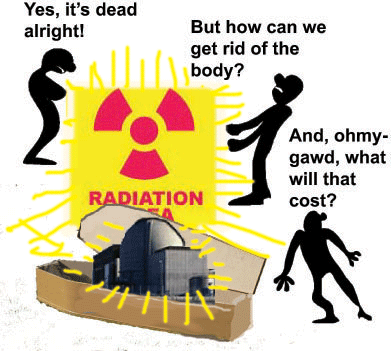
Entergy has reserved just over $600 million to date for decommissioning the Vermont nuclear plant, according to the Department of Public Service. This amount will not be adequate to meet the costs of full deconstruction, estimated at more than $1 billion according to the company’s 2012 Decommissioning Cost Analysis report.
The company has pledged to put $25 million toward site restoration after decommissioning the plant. However, presumably, the pledge would be moot if Entergy cannot totally decommission the plant.
Of course we know better. We humans won’t jump into a pot of boiling water. We’re not happy when members of our species start dying around us. But frightening new scientific findings have forced us to look at a larger reality: the bottom-up damage that radioactive fallout may do to the entire global ecosystem.
When it comes to our broader support systems, the corporate energy industry counts on us to tolerate the irradiation of our fellow creatures, those on whom we depend, and for us to sleep through the point of no return.
Case in point is a new Smithsonian report on Chernobyl, one of the most terrifying documents of the atomic age.
Written by Rachel Nuwer, “Forests Around Chernobyl Aren’t Decaying Properly,” cites recent field studies in which the normal cycle of dead vegetation rotting into the soil has been disrupted by the exploded reactor’s radioactive fallout. “Decomposers — organisms such as microbes, fungi and some types of insects that drive the process of decay — have also suffered from the contamination,” Nuwer writes. “These creatures are responsible for an essential component of any ecosystem: recycling organic matter back into the soil.”
Put simply: The micro-organisms that form the active core of our ecological bio-cycle have apparently been zapped, leaving tree trunks, leaves, ferns and other vegetation to sit eerily on the ground whole, essentially in a mummified state.
Reports also indicate a significant shrinkage of the brains of birds in the region and negative impacts on the insect and wildlife populations.
Similar findings surrounded the accident at Three Mile Island. Within a year, a three-reporter team from the Baltimore News-American cataloged massive radiation impacts on both wild and farm animals in the area. The reporters and the Pennsylvania Department of Health confirmed widespread damage to birds, bees and large kept animals such as horses, whose reproductive rate collapsed in the year after the accident.
Other reports also documented deformed vegetation and domestic animals being born with major mutations, including a dog born with no eyes and cats with no sense of balance.
To this day, Three Mile Island’s owners claim no humans were killed by radiation there, an assertion hotly disputed by local downwinders.
Indeed, Dr. Alice Stewart established in 1956 that a single X-ray to a pregnant woman doubles the chance that her offspring will get leukemia. During the accident at Three Mile Island, the owners crowed that the meltdown’s radiation was equivalent “only” to a single X-ray administered to all area residents.
Meanwhile, if the airborne fallout from Three Mile Island and Chernobyl could do that kind of damage to both infants and the non-human population on land, how is Fukushima’s continuous gusher of radioactive water affecting the life support systems of our oceans?
In fact, samplings of 15 tuna caught off the coast of California indicate all were contaminated with fallout from Fukushima.
Instant as always, the industry deems such levels harmless. The obligatory comparisons to living in Denver, flying cross country and eating bananas automatically follow.
But what’s that radiation doing to the tuna themselves? And to the krill, the phytoplankton, the algae, amoeba and all the other microorganisms on which the ocean ecology depends?
Cesium and its Fukushima siblings are already measurable in Alaska and northwestern Canada. They’ll hit California this summer. The corporate media will mock those parents who are certain to show up at the beaches with radiation detectors. Concerns about the effect on children will be jovially dismissed. The doses will be deemed, as always, “too small to have any impact on humans.” Harvey Wasserman edits www.nukefree.org . His SOLARTOPIA! OUR GREEN-POWERED EARTH is at www.solartopia.org . The Solartopia Green Power & Wellness Show airs at www.progressiveradionetwork.com .
The EU consultation on state aid for the proposed new nuclear power plant, Hinkley Point C. Quick copy and paste submission. It Happens 1 April 14
This is the submission done by Global 2000 ,which they say you are welcome to copy and paste – Just add your name, email address and the date at the end. Send to stateaidgreffe@ec.europa.eu
You don’t have to send it all and if there are any other points you want to raise, the scruffily put together facts in my last blog might be useful. There are some good links there too.
I am very concerned about the current plans of the UK government to make a new nuclear power plant possible by granting enormous support for it. We would like to encourage the EU Commission to stick to its clear analysis, because we as CITIZENS/ NGOS/ BUSINESS in the UK do not want to be forced into paying a fixed high electricity price to EDF for several decades, with no chance of the possibly of making use of lower electricity prices…….. http://dandelionithappens-dendelion.blogspot.co.uk/2014/04/the-eu-consultation-on-state-aid-for.html
IRENA: Making A Business Case for Renewable Energy , WSJ By ASA FITCH, 3 April 14 Solid progress has been made in the past three years promoting renewable energy as a policy choice, especially in parts of the developing world where demand is expected to grow rapidly, although more must be done to make clean energy a significant share of the global mix, according to the director general of the International Renewable Energy Agency.
Renewable technologies are quickly becoming cheaper, IRENA director general Adnan Amin said this week, which is making things like solar, wind and geothermal power increasingly practical.
IRENA, an organization established by international treaty and based in Abu Dhabi, has grown its membership from 70 countries when it started operations three years ago this month to more than 130 today, which Mr. Amin said was another way to measure how interest in renewables has grown.
“The secret to renewables is going to be how fast we can get to scale, draw down the costs of the technology, create business models that can work in different environments, and utilize the fast-moving innovation processes for renewables,” Mr. Amin said. “All of that is coming together, and what we are seeing is remarkable progress has already been made, but the rate of change is accelerating.” Continue reading →
The Guardians Of the U.S. Nuclear Arsenal Don’t Keep Very Good Records http://io9.com/the-guardians-of-the-u-s-nuclear-arsenal-dont-keep-ve-1557024074 3 April 14,The scathing 19-page report, available on the website of Energy Department’s Office of Inspector General, warns that the range of problems “may ultimately increase costs and could negatively impact the reliability and safety” of the U.S. nuclear arsenal.
As the Global Security Newswire notes: In one case, officials incorrectly approved two components to be added to a variant of the W-76 nuclear warhead. The error, they said, cost between $20 million and $25 million, and held up preparation of new parts by an extra 12 months.
The United States never “treated the maintenance of original nuclear weapons [records] as a priority” during or after the Cold War…The auditors argued, though, that “recapturing the department’s original nuclear weapons data in a configurable format can potentially save tens of millions of dollars.”
Even worse—yes, there’s a “worse”—the investigation found that lax security at the Los Alamos National Laboratory “had given system access to approximately 30 nuclear weapons designers regardless of whether they were assigned to a nuclear weapon project.” Translation: Saboteurs could potentially tamper with existing weapons designs.
Mars health risks exceed NASA limits Sky News 3 April 14, Efforts to send humans to Mars would likely expose them to health risks beyond the limits of what NASA currently allows, an independent panel of medical experts said Wednesday.
Therefore, any long-term or deep space missions — which are still decades off — need a special level of ethical scrutiny, said the report by the Institute of Medicine.
‘These types of missions will likely expose crews to levels of known risk that are beyond those allowed by current health standards, as well as to a range of risks that are poorly characterised, uncertain and perhaps unforeseeable,’ said the IOM report.
Currently, astronauts are launched into low-Earth orbit, where they spend three to six months at a time aboard the International Space Station (ISS), but journeys to Mars could take up to 18 months.
NASA has said it aims to send people to the Red Planet by the 2030s and is working on building a heavy duty launcher and spacecraft for this purpose.
Health risks from short-term missions in space can include nausea, weakness and blurred vision, while long-term risks include radiation-induced cancer and the loss of bone mass……..http://www.skynews.com.au/tech/article.aspx?id=963933
Woes continue to mount around the construction of Finland’s Olkiluoto 3, the new generation European Pressurized Reactor (EPR), as new cost estimates for its completion have reached new heights, hitting the $11 billion dollar mark, Hesingen Sanomat reported, outpacing expenditures on ultra-luxury hotels and paying for the reconstruction of the World Trade Center three times over.
Woes continue to mount around the construction of Finland’s Olkiluoto 3, the new generation European Pressurized Reactor (EPR), as new cost estimates for its completion have reached new heights, hitting the $11 billion dollar mark, Hesingen Sanomat reported, outpacing expenditures on ultra-luxury hotels and paying for the reconstruction of the World Trade Center three times over.
The project, which as of last year this time was already running $7 billion, or €5 billion, over its originally estimated price tag of €3 billion, sheds a dim light on the practicality and expense of the first-of-its kind reactor, which has been touted as a revolution in nuclear power production.
Nils Bøhmer, Bellona’s general director and nuclear physicist called the new round of cost overruns “absolutely insane” and questioned why such lavish sums could not be expended in the field of far cheaper renewable and alternative energy sources.
The coverage of the newly announced bill for the reactor in Helsingen Sanomat, Finland’s usually staid and respected daily paper of record, took a positively jeering parry at the cost overrun, and summoned comparisons to the world’s most expensive casinos, luxury hotels and even the Pyramids and the Taj Mahal to make its point.
The paper drew on the cost of Singapore’s ultra-luxury Marina Bay Sands Hotel and casino, the world’s most expensive building, which, on its completion, weighed in at €5.2 billion.
But as time has shown, the building of any nuclear power plant is always a gamble, making the newspaper’s comparison quite apt.
The original contract between Finland’s Teollisuuden Voima (TVO) and Areva-Siemens signed in 2003 envisioned the plant would cost € 3.2 billion, with a completion date of 2009. TVO announced in December 2011 that it anticipated the 1600 MWe plant to begin commercial operation in August 2014, some five years later than originally planned. By that same year, the ancitipated costs of the plant had balloned to €8.5 billion, according to data released by Areva.
The giant facility, which is under construction on an island in the Baltic Sea, is forecasted to be large enough to supply 10 percent of Finland’s electricity needs.
Though Hesingen Sanomat’s Tuesday report did not report any further delays to the beginning of commercial operation of Olkiluoto 3, it was quick to point out that the reactor’s cost would equal that of three new skyscrapers of the type that are being reconstructed at New York City’s World Trade Center One.
In fairness, the paper pointed out that Canada’s Darlington Nuclear Generating Station located on the northern shore of Lake Ontario and running 4 CANDU reactors, similarly ran into insatiable cost overruns. By its completion the plant had cost €13.8 billion do built.
But this is arguably a slightly better deal: Darlington kicks out 3,512 MWe of energy to Olkiluoto 3’s projected 1600 MWe. Roughly, each of Darlington’s reactors cost some €3.5 billion and produce 878 MWe of energy a piece, according to Ontario Power Generation, the plant’s owner.
This means they two reactors at Darlington can produce the slightly more power than Olkiluoto 3 for a discount of a billion Euro.
Furthermore, Darlington only blew its original budget parameters by twice its initially announced cost, according to the March 4, 1993 edition of The Toronto Star, where Olkiluoto 3 has surpassed that to almost three times its originally planned cost.
Bøhmer said the tremendous skyrocketing of building nuclear reactors was attributable to the fact that reactors require tons and tons of concrete. But even so, he said, the experience of some 60 years of building nuclear power plants worldwide should lead to more accurate cost estimates than the nuclear industry can produce.
What becomes especially troublesome, he added – especially with all that concrete involved – is how much it will cost to dismantle these nuclear facilities, including Olkiluoto 3.
“This is math no one does at the beginning,” he said. “This leads to further uncertainty about the growing costs of the nuclear industry, because there are no cost analyses for dismantlement and safe storage of the resulting nuclear waste.”
For the accountants running the book on Olkiluoto 3, there is bound to be hell to pay eventually. In that case, they can always slip the country to Hong Kong and ease their conscience a bit in the knowledge that the airport there cost a cool $21 billion.













 nuclear-news