Mikhail Golovko, Svoboda MP, Ukraine -” We made a very grave mistake when we gave up our nuclear arsenal”
-
- Video Id:
- 20140304-048
- Title
- Ukraine: Country could restore its nuclear arsenal – Svoboda MP
- Category
- Politics
- Location
- Kiev, Ukraine
- Region
- Europe
- Duration
- 0:43
- Published
- March 4, 2014, 21:31 (GMT)
- Aspect Ratio
- 16:9
- Keywords
- Ukraine, Kiev, nuclear, Maidan, Svoboda
- Video here;
- http://ruptly.tv/vod/view/10216/ukraine-country-could-restore-its-nuclear-arsenal-svoboda-mp
M/S Mikhail Golovko, Svoboda MP [cutaway]
Ukraine: Country could restore its nuclear arsenal – Svoboda MP
Svoboda MP Mikhail Golovko spoke in Kiev Tuesday, about the need to defend Ukraine’s sovereignty, even if that would mean restoring its nuclear arsenal. He admitted that this would not be easy since world powers would have to agree to it.
Golovko also said that Ukraine could consider becoming a member of NATO.
Setsuko Kuroda: Talks about Women from Fukushima
“There is an invisible pressure and is an oppressive atmosphere which encroaching on freedom of speech. We hardly say here is a very dangerous situation or it is good for children to evacuate. People like me are really the minority.”

Text and Photo by Yoshihiro Kaneda
In June, 2012, I went to the Fukushima Forum at the Iwaki City in Fukushima, Japan where I was born in. I heard victims’ voices which were facing against the power and they were very smart and new. They accumulated their knowledge and experiences from the past experiences of Minamata disease and Hiroshima and Nagasaki. In the forum, one guy who had lived near Fukushima Daiichi insisted on the importance of self-decision among people’s distrust of everything including the government, the congress, bureaucrats, industries, and the media.
In late September of 2013, I interviewed Setsuko Kuroda who was a member of Women from Fukushima Against Nukes and appears on the documentary “Women of Fukushima.” I am sorry for a late report and my English skill.
Q: Please tell me about the beginning of the Women from Fukushima Against Nukes?
A: After the accident, everybody evacuated here and there and I also evacuated once. Then, I returned here (the Koriyama City in Fukushima). We wanted something to do by those who lived here. I called Ruiko Mutoh (the representative of The Complainants for Criminal Prosecution of the Fukushima Nuclear Disaster) and Seiichi Nakate (the representative and mediator of Citizen’s Conference of the Support Child and Victims Law in The Nuclear Accident) to organize the meeting. At that time, radiation level in front of the Koriyama station was very high. It was the beginning that various movements were starting rapidly. So we did a protest meeting but there were sparse audiences in late April, 2011.
Q: What was the policy of the protest meeting?
A: We were not in dead silence.
Q: Did you already know people were in initial radiation exposure including iodine?
A: Yes. There were no big movement yet so we were in gloom. We wanted to express our anger and sorrow in the appreciable way. We were discussing about a sit-in in front of the prefectural office or Tokyo where more people would see us all over the country. While doing this, members were increasing. At the time, the youth gathered and started the No Nukes Tent in front of the Ministry of Economy, Trade and Industry. Then, we decided the Three Days Sit-In there. Women who were good at the Internet mailed to spread our event information, women who were good at designing handouts created a handout, and we were discussing what we would do. Women from Fukushima exceeded over a hundred in a twinkling. It was our passionate debut on 28 to 30th October, 2011.
Q: I watched the closed meeting of the Women from Fukushima on YouTube. One member reported the situation of Chernobyl, one member reported the law of compensation for damaged assets, and other members also reported other issues. It looked very meaningful meeting. In the negotiation with bureaucrats of the Ministry of Economy, Trade and Industry on YouTube, I was so impressed by and understood clearly Ms. Kazue Morizono’s words “We, Women from Fukushima, have studied entire human history during a year.” I was surprised at the tremendous efforts how your group have accumulated knowledge, information, and experiences.
A: I had a chance to go to Chernobyl and reported it in the meeting. We have two regular meetings in a month. One is for decision making and one is for just a chat which we have known it is rather important. Facing each other with tea is very significant.

Q: How is recent situation?
A: After the event above, Women from Fukushima became famous abruptly among the antinuclear movements in Japan. Each splendid woman has innovated herself promptly. There are many problems such as the Fukushima Collective Evacuation Trial, the Complainants for Criminal Prosecution of the Fukushima Nuclear Disaster, Fukushima Network for Saving Children from Radiation, information for evacuation, safe food, and so on. So each woman has her own ground to act. It looks a little vague but it is good. Women from Fukushima should be humans to connect each movement like an ameba. The important is women’s flexibility, in other words, sloppiness which connects various movements against nukes. We have a huge annual event on March. Various people, citizens’ groups, and individuals come to the event from throughout the country and bring their plans to act and we organize workshops in two big venues. It will take hold. Women from Fukushima rent venues and schedule the event. It is a hard work for us.
Japanese Prosecutors Refuse to Hit TEPCO With Criminal Charges Over Fukushima
Published on 4 Mar 2014
Over 15,000 people whose lives here totally destroyed due to the meltdowns at Fukushima caused by TEPCO but in the opinion of the Japanese prosecutors no one is at fault.
References:
Hundreds protest dropped charges over Fukushima crisis
http://www.google.com/hostednews/afp/…
Japan Power Company Admits Failings on Plant Precautions
http://www.nytimes.com/2012/10/13/wor…
TEPCO: Not all pumped-in water reached overheating Fukushima reactors
http://ajw.asahi.com/article/0311disa…
The 1995 System(The method of `legal` systematic corruption which still exist today just in a slightly different form)
http://www.jpri.org/publications/work…
ETHOS, Ethics and Lies – Chernobyl to Fukushima, Nesterenko to Takenouchi and beyond?
Mari is facing charges stemming from speaking out on radiation in Japan and advocacy for families relocating children out of the areas contaminated by radioactivity from the damaged Fukushima Daiichi reactor site, operated by TEPCO.
The group ETHOS in Japan supports the decision by some to stay and live in contaminated areas. Sadly, some of these families feel they have no choice due to economics and other factors. Certainly young children have no choice. ETHOS advocates monitoring radioactivity, but well established science supports Mari’s views that there is no safe dose of radiation and that children need to be protected. We support open discussion, access to information and free choice. We ask the Prosecutor to agree that writing and speaking about these issues are not a crime.
Please Stand With Mari as she stands for precaution, protection and the rights of children to a healthy future. THANK YOU.
The late nuclear physicist Vassili B. Nesterenko (2 December 1934–25 August 2008) was hounded and persecuted by the KGB because he published inconvenient truths: research about the consequences of Chernobyl. Here is a short article about his achievements and here is his Wikipedia entry.
Alternate link to his achievements ; http://legendofpineridge.blogspot.co.uk/2010/05/death-of-exceptional-resister-vassili-b.html
“….At a lower level, but also dangerous, there is the CEPN with Lochard. His project ETHOS has failed in Chernobyl : the children became more and more ill, and more severely ill. In the final report, they censured the medical report of the paediatrician, because the project was accompanied with the deterioration of health of the children….” (Full article below)
More on ETHOS radiation project here;
This is the official informationICRP Tsusin: http://icrp-tsushin.jp/Ethos in Fukushima: http://ethos-fukushima.blogspot.jp/Report on Childrens radiation education structure : http://www.icrp.org/docs/dialogue-4E.pdfTHIS INFO IS NEARER THE TRUTH OF THE MATTER INFORMATION“…..In effect, ETHOS had learned everything from Nesterenko and had collected his data in order to now supplant him. A real case of plagiarism but with one fundamental flaw: the ETHOS mission, as conceived by the French nuclear lobby had an insurmountable statutory limitation, that prevented it from taking any action in the area of health: ETHOS was not qualified to treat the population medically: (4) What was it doing, in that case, at Chernobyl?I began to understand more when a friend, a sociologist, who had some involvement with ETHOS, told me that Jacques Lochard, leader of the ETHOS project, was employed by the CEA and had defined its task in this astonishing phrase. “We need to occupy the territory…”http://independentwho.org/en/2014/02/05/chernobyl-model-fukushima/


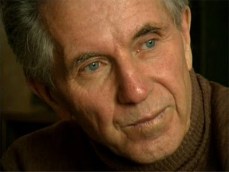

Pr. Michel Fernex is a Swiss medical doctor from the Medical Faculty University of Basel. Born in Geneva in 1929. Member of Physicians for Social Responsibility and International Physicians for the Prevention of Nuclear War (IPPNW). He worked at the World Health Organization (WHO) as member of the Steering Committee on Tropical Diseases Research for 15 years. In 1986, facing the reality of the WHO which attempted to downplay the consequences of the Chernobyl accident instead of helping the population, it compeled him to demand the independence of the WHO from the International Atomic Energy Agency (IAEA). Since 2007 he has been a leading campaigner of Independent WHO. With Solange Fernex, his wife and member of the French Green Party, Vassily Nesterenko, founder of the Institut Belrad, and film director Wladimir Tchertkoff, he also founded in 2001 the NPO Children of Chernobyl Belarus (Les Enfants de Tchernobyl-Belarus) to support the Institute Belrad as well as the independent recherches of the consequences of Chernobyl accident.
Q1. What were the policy measures undertaken by the IAEA in Chernobyl after the nuclear disaster in 1986?
In Chernobyl, the IAEA arrived soon. Together with Prof Pellerin, delegate from the WHO, they proposed to change the established limits of protection for external irradiation for professional workers in atomic industries and apply them for the population, ignoring that families living in contaminated areas were soon to suffer more from internal irradiation than external. The Soviet Union refused to increase the limits of 5 to 10 or even 20 mSv/year, which would delay the evacuations and would have increased risks for radio-induced diseases. The risks of cancers are only a small part of pathologies occurring, as we learned from Chernobyl.
They did not encourage the distribution of stable iodine to the children, which was recommend by Baverstock, doctor at the WHO. They did not accelerate the evacuation of populations at risk, but waited until the irradiation reached higher doses. They minimized the risk for the population. They financed the Ministry of Health to discourage independent research.
The French lobby arrived later than in Fukushima, with an NGO, the CEPN with M. Lochard, representing Electricité de France with 56 atomic reactors, the CEA which developed the French Bomb, and Areva which builds atomic power plants, stores atomic waste in La Hague, and sells uranium, plutonium and MOX. In the UN hierarchy, the IAEA remains on the top, other agencies have to follow. Even the FAO has to agree, when limits have to be imposed for food.
Their goal is to reduce the costs of the catastrophe and to reduce the impact of Chernobyl on the further sale of atomic power plants.
Governments, media. corporations in denial about Fukushima nuclear catastrophe
the desperate drive—in which a largely compliant mainstream media have been complicit—to deny the Fukushima catastrophe, a disaster deeply affecting life on Earth.
 Nuclear Denial: The Giant Lie About Fukushima,CounterPunch, MARCH 03, 2014 by KARL GROSSMAN With the third anniversary of the start of the Fukushima Daiichi nuclear catastrophe coming next week, the attempted Giant Lie about the disaster continues—a suppression of information, an effort at dishonesty of historical dimensions.
It involves international entities, especially the International Atomic Energy Agency, national governmental bodies—led in Japan by its current prime minister, the powerful nuclear industry and a “nuclear establishment” of scientists and others with a vested interest in atomic energy.
Deception was integral to the push for nuclear power from its start. Continue reading
Very high levels of cesium in Fukushima, and far beyond
Asahi: ‘Mind-boggling’ cesium levels far from Fukushima plant — Japan Times: “Health ministry in denial” — Interview: “They force us to forget everything”; Gov’t radiation levels http://enenews.com/asahi-mind-boggling-radioactivity-levels-fukushima-evacuation-zone-resident-unable-hide-anger-japan-times-health-ministry-denial-interview-force-forget-everything-govt-radiation-levels-complete
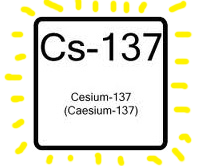 Asahi Shimbun, Feb. 25, 2014: CAPTION: Radioactive cesium of mind-boggling 370,000 becquerels per kilogram of soil has been detected in the mud of the Myotoishi reservoir in Motomiya, Fukushima Prefecture [55 km from Fukushima Daiichi]. The reservoir is ringed by homes and a community center. – Very high levels of accumulated radioactive cesium have been detected in the mud of hundreds of reservoirs used to irrigate farmland in Fukushima Prefecture […] 576 reservoirs [of 1,939 surveyed]. […] many of which are located in residential areas […] and still supplying water to rice paddies and other farmland. […] Environment Ministry says it has no plans to dredge the reservoirs to remove the contaminated mud. […] Kiyoshi Ishii, 71 […] was unable to hide his anger.
Full interview with Kuroda here Full interview with Kuroda here
Deceptive fog in information about Fukushima radiation
To stem any such public anxiety, TEPCO and Japanese government officials minimized the damage at Dai-ichi and assured its population that the situation was certainly not another Chernobyl. Untrue. In important ways, the Japan situation is worse: …
The good news is that there is some movement as citizens, news media and public officials are starting to demand answers about Fukushima radiation. The bad news is that it’s difficult to pry out documented facts from TEPCO and/or the Japanese government as both continue to stonewall requests for information.
it’s way beyond time for a full-court-press approach by the U.S. and global community to challenge what may be a whitewashed cover-up, and with intensified scientific research and accurate figures and diagnosis, to get to the bottom of what’s happening at the Fukushima Dai-ichi power plant. Doing nothing is not an option.
 Cutting through Fukushima Fog: Radiation in U.S. Bernard Weiner, Dissident Voice March 3rd, 2014 Governments cite “national security” concerns and “official secrets” as their justification for withholding information from the public. Corporations rationalize their secrecy behind concerns about “patent infringement,” shielding their trademarked “proprietary” secrets from competitors. But most of the time, such obfuscation is really derived from the time-honored villains of systemic corruption and what is politely known as CYA in military and bureaucratic slang.
Which brings us to Fukushima.
From the very beginning of this catastrophic emergency — the earthquake/tsunami off the Japanese coast in March of 2011, when nuclear reactors at a power plant were flooded and then exploded and began their meltdowns — the public in Japan and around the world have not been told the full story of what’s been happening at the Dai-ichi nuclear-power plant in Fukushima province.
The utility that runs the plant, TEPCO (Tokyo Electric Power Company), is notoriously close-mouthed about its operation. To this day, aided by a recently passed “government secrets” act in Japan, we have no confirmable idea of the extent of the damage: how much radiation is really leaking out into the Pacific Ocean and where the currents are taking it, the density and direction of the radioactive plumes carried by the wind, the radioactive effects up and down the marine food-chain. Not only is there precious little data-reporting released to the public — journalists who violate the “state secrets” law can be thrown into prison for 10 years — but what little information that does appear, both in Japan and in the U.S., seems to be hidden inside a different language, with a vocabulary(“bequerelles,” “millisieverts,” “millirems,” the difference between “radiation,” “radioactive” and “radiation dose,” and so on) that is utterly confusing to most non-nuclear scientists. Continue reading
South Carolina stuck with a load of nuclear radioactive trash
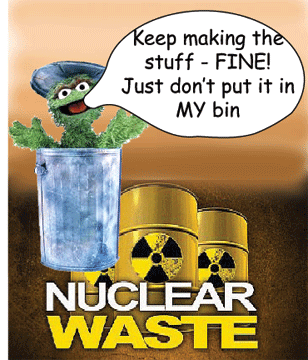
 they should stop making the stuff
SC Left Holding The Nuclear Waste Eric Connor, The Greenville News: March 3, 2014 A radioactive leak that has indefinitely shut down a New Mexico nuclear waste dump has left South Carolina holding a stockpile of weapons waste that had been scheduled to be shipped westward for disposa49 a.m. ESTl by the end of next year.
The plans to ship waste stored at the Savannah River Site are in limbo – and the government isn’t prepared yet to talk about what will happen next if the New Mexico underground dump no longer is an option. The U.S. Department of Energy said Friday it is “evaluating its options” after a mysterious leak two weeks ago at New Mexico’s federal Waste Is olation Pilot Plant exposed workers to radiation and shut down operations.
The department said more information will be presented next week.
Nuclear watchdogs say the government should be prompt in sharing information on the future of SRS waste slated for transport and should heed the unexpected leak as evidence not to allow further storage of nuclear spent fuel at SRS.
“Nuclear waste dumps leak — and they leak sooner than the experts predict,” said Tom Clements, Columbia-based nuclear adviser to the Sierra Club’s chapter in South Carolina. “Obviously this is going to have an impact on operations at Savannah River Site, and they should talk about it.”………
So far, about 12,000 cubic meters from SRS have disposed in the WIPP facility since 2001, according to a DOE report last May. About 700 cubic meters remain to be disposed, the report said.
The report said that the last transuranic waste shipment would occur by the end of 2015 if enough funds were allocated.
The DOE has raised the possibility, also, that New Mexico facility could be a permanent home for higher-level liquid waste from generating sites that have stockpiled since Cold War-era weapons production ceased years ago.
The Waste Isolation Pilot Plant outside of Carlsbad, N.M., accepted its first shipment of waste in 1999 after decades of planning. The plant hosts waste half a mile beneath the surface in salt beds formed by an ancient sea……..http://www.wltx.com/story/news/2014/03/03/nm-nuclear-waste-dump-leak-leaves-sc-holding-nuclear-waste/5967663/
Global renewable energy market heating up
T he global outlook for renewable energy , The Interpreter, 3 March 14, My previous article showed that there has been an unprecedented level of investment in renewable energy over the last decade. Let’s consider the drivers for this in more detail and look to the future.
Policy measures introduced in Europe and North America kick-started the market for wind turbines and solar photovoltaic (PV) cells and helped build what are now multi-billion dollar global industries. More recently, China has taken over as the main destination for investment and has also become a major manufacturer.
Policies are often categorised as either ‘push’ or ‘pull’ measures. The former include incentives such as R&D funding and tax breaks, while the latter provide a price signal for deployment via feed-in tariffs (FITs), for example.
It is unclear how long it would have taken the industry to reach critical mass without such policy measures. In the last two and a half years, the global solar PV industry, for example, jumped from 50 gigawatts (GW) of installed capacity to just over 100 GW, yet it took decades to add the first 50 GW. Continue reading
Britain’s nuclear industry – an expensive folly?

 Where next for the UK nuclear industry? Duncan Jefferies theguardian.com, 3 March 14. Nuclear power is the most controversial source of energy, but government claims an expansion of the sector is essential Few subjects are as polarising as nuclear power. Supporters claim a new generation of nuclear plants is the most effective means of helping to reduce the UK’s greenhouse gas emissions by 80% by 2050, while filling the ‘energy gap’ that will result from the decommissioning of old fossil fuel and nuclear power facilities in the 2020s.
But opponents believe it is an expensive folly, replete with ethical and environmental effects that have repercussions for generations to come, siphoning money and attention away from renewables……….
Hinkley Point C is projected to provide electricity for 6m homes, meeting approximately 7% of the UK’s demand when running at full capacity. But the proposals are controversial, not least due to the cost involved.
All new nuclear builds involve high capital expenditures. However, many opponents of the Hinkley plan claim the £92.5/MWh strike price, the loan guarantee promised by the Treasury, liability issuance provided to EDFby the Government, and other financial measures actually amount to subsidies by another name – transferring liability onto British electricity customers and taxpayers for at least 35 years…….
n addition, the coalition agreement promised that new nuclear sites would not receive state financial aid. The European Commission has doubts that the estimated £17.6 bn in financial aid for the Hinkley deal can be justified.
Many environmentalists have expressed concerns over how the nuclear waste from these new reactors will be dealt with. Cumbria recently rejected government plans for an underground nuclear waste disposal facility, and the costs of cleaning up the Sellafield nuclear reprocessing site in the region have rocketed past £70bn.
“That site is so polluted and so nasty, and they just don’t know what to do with it,” claimed Catherine Mitchell, professor of energy policy at the University of Exeter, “so every time a new government comes in they just keep it going, they don’t deal with it.”…..
Many people still believe the UK is heading down the wrong electricity track, and should emulate Germany and Denmark and invest much more heavily in renewable sources of electricity. The potential for smart meters, increased energy efficiency measures, carbon capture technologies, distributed grids and community energy projects could change the way we consume electricity – and put the nuclear industry out of step with reality. “The whole energy system is changing,” added Mitchell, “and that’s really one of the big issues for nuclear power.”… http://www.theguardian.com/big-energy-debate/uk-nuclear-industry-where-now
Stop assassinating Iran’s nuclear scientists, Obama tells Israel
Obama pushes Israel to stop assassinations of Iran nuclear scientists – report RT.com March 02, 2014 President Barack Obama is pressuring Israel to stop carrying out assassinations of top nuclear scientists in Iran as the Islamic Republic continues its negotiations with world powers over its uranium enrichment program, according to a new book.
Apart from pressure from Washington that Israel give up the assassination program, sources close to Israel’s intelligence agencies told CBS News’s Dan Raviv that Mossad itself viewed the campaign as too dangerous to continue. Raviv, who was updating a book he co-wrote about the history of Israel’s intelligence agencies, said the pressure form the Obama administration was “more than a hint.”
Mossad itself was apparently undergoing a sea change regarding the program. Fearing their ‘best combatants’ – Israel’s term for its most accomplished spies – could be captured and hanged, the agency is reportedly set to shift its focus to other activities. According to security sources, Netanyahu ordered the intelligence agency to focus its efforts on proving the Islamic Republic is cheating on a landmark preliminary agreement made with six world powers in November to curtail its uranium enrichment program in return for limited sanctions relief.
At least five Iranian nuclear scientists have been killed since 2007, with men on motorcycles sticking magnetically attachable bombs to their victims’ cars. The head of the country’s ballistic missile program was also killed, while in October Mojtaba Ahmadi, who served as commander of the Cyber War Headquarters, was found shot dead. No Israeli national has ever been arrested in collusion with the targeted assassination program, which is reportedly intended to thwart advances in Iran’s nuclear program and dissuade Iran’s best and brightest from working in the sphere.
The killing of Ahmadi was widely viewed as an attempt to derail nuclear negotiations between Tehran and the P5+1 – the five permanent members of the UN Security Council plus Germany.
Israel has never publically claimed responsibility for the attacks… http://iranian.com/posts/view/post/29170
Third year of losses for French nuclear power company, AREVA
 France’s Areva posts 3rd straight annual loss Digital Journal 28 Feb 14 France’s state-controlled nuclear energy conglomerate Areva on Wednesday posted 2013 results showing its third consecutive annual loss and forecast lower revenues this year because of persistent problems in the market.
The company made a net loss of 494 million euros ($675 million). It said that result was worse than the 99-million-euro loss for 2012 because of 425 million euros it had to set aside last year to cover overruns and delays with a European Pressurised Reactor (EPR) it has been building in Olkiluoto, Finland for the past nine years…..http://www.digitaljournal.com/biz/business/france-s-areva-posts-3rd-straight-annual-loss/article/373230
.
Safety vulnerabilities i Russia’s nuclear power plants
Working Document: Bellona’s Analysis of Post-Fukushima Stress Tests on Russian Nuclear Power Plants March 3, 2014 by Bellona ST. PETERSBURG – After the disaster at Japan’s Fukushima-Daiichi nuclear power plant in 2011, nuclear experts worldwide agreed to stress-test their own reactors and called for the evaluation of European nuclear power plants in terms of their capability to withstand natural disasters and technical and human-error snafus. Russian nuclear power stations were also subjected to safety assessments, the results of which Bellona’s Russian offices have analyzed in a working document devoted to the subject……..Bellona’s analysis shows that Russia has formally followed the international community’s recommendations on re-assessing safety issues surrounding atomic energy. However, the report does not include enough expert information about all possible nuclear safety risks. For example, the report states that Russian nuclear power plants are, on the whole, earthquake resistant, but additional measures must be taken in order to improve some components of auxiliary equipment safety.
At the same time, the report fails to outline any plans for investigating the earthquake resistance of the buildings, structures, and equipment of spent fuel storage pools. Moreover, the report does not provide any test results on the potential effects of earthquakes paired simultaneously with other natural disasters, such as severe flooding…….
Stress tests on Russian atomic power plants also showed that all units under operation need to be equipped with additional emergency water delivery systems; these systems are essential in the case of interrupted cooling to the reactor core, storage pools, and nuclear waste depositories. The bottom line is that before the Fukushima accident Russian power plants were often not equipped with such systems, or they were absent entirely.
Serious questions remain as to whether or not the vulnerabilities in nuclear power plant safety exposed by experts will be corrected in practice, and only time will tell whether or not the world will come to completely grasp Fukushima’s lessons. For more detailed information on the Russian atomic power plant stress tests, you can read Bellona’s working document (in Russian). http://bellona.org/news/nuclear-issues/nuclear-meltdown-in-japan/2014-03-working-document-bellonas-analysis-post-fukushima-stress-tests-russian-nuclear-power-plants
Meagan Dunham translated this article from Russian.
No sign of nuclear weapons preparation found by UN search in Iran
| UN finds no evidence that Iran seeks nuclear weapons Iran (The Daily Star :: Lebanon News :: http://www.dailystar.com.lb) TEHRAN: President Hassan Rouhani said Sunday that despite “thousands of hours” of inspection, the UN’s atomic watchdog has found no evidence of military objectives in Iran’s nuclear drive. |
His remarks came on the eve of an International Atomic Energy Agency board of governors meeting in Vienna, on the sidelines of which Iran will hold expert-level talks with world powers.
Western powers “all know that nuclear science in Iran follows a peaceful path”, Rouhani said in a speech broadcast on state television.
“The agency has conducted thousands of hours of inspection, and announced it has not found any diversion from the peaceful use (of nuclear technology) to military purposes.” http://www.dailystar.com.lb/News/Middle-East/2014/Mar-02/248964-un-finds-no-evidence-iran-seeks-nuclear-arms-rouhani.ashx#ixzz2uvimr9bB
Religious principles would stop Iran from getting nuclear weapons – Rouhani
Rouhani says Iran will not acquire nuclear weapons ‘on principle’ Guardian 2 Mar 14 President says religion forbids pursuit of WMDs• Generals told to let diplomacy do its work ran’s president said on Saturday the Islamic Republic has decided not to develop nuclear weapons out of principle, not only because it is prevented from doing so by treaties.
President Hassan Rouhani also urged Iran’s military leaders to let diplomacy prevail in dealing with potential foreign threats, in a clear reference to efforts to end the nuclear dispute and decades of hostile relations with the west. ……http://www.theguardian.com/world/2014/mar/01/rouhani-iran-nuclear-weapons-principle
-
Archives
- February 2026 (233)
- January 2026 (308)
- December 2025 (358)
- November 2025 (359)
- October 2025 (376)
- September 2025 (258)
- August 2025 (319)
- July 2025 (230)
- June 2025 (348)
- May 2025 (261)
- April 2025 (305)
- March 2025 (319)
-
Categories
- 1
- 1 NUCLEAR ISSUES
- business and costs
- climate change
- culture and arts
- ENERGY
- environment
- health
- history
- indigenous issues
- Legal
- marketing of nuclear
- media
- opposition to nuclear
- PERSONAL STORIES
- politics
- politics international
- Religion and ethics
- safety
- secrets,lies and civil liberties
- spinbuster
- technology
- Uranium
- wastes
- weapons and war
- Women
- 2 WORLD
- ACTION
- AFRICA
- Atrocities
- AUSTRALIA
- Christina's notes
- Christina's themes
- culture and arts
- Events
- Fuk 2022
- Fuk 2023
- Fukushima 2017
- Fukushima 2018
- fukushima 2019
- Fukushima 2020
- Fukushima 2021
- general
- global warming
- Humour (God we need it)
- Nuclear
- RARE EARTHS
- Reference
- resources – print
- Resources -audiovicual
- Weekly Newsletter
- World
- World Nuclear
- YouTube
-
RSS
Entries RSS
Comments RSS
 nuclear-news