Thyroid cancer incidence rising in Fukushima children
Fukushima Children Show Rise in Thyroid Cancer, Liberty Voice by April Littleton on March 9, 2014. Three years after the Fukshima Daiichi nuclear Three years after the Fukshima Daiichi nuclear power plant suffered a triple meltdown, doctors are seeing a significant rise of thyroid cancer in children and young adults. Last month, cases of thyroid cancer in individuals between the ages of 18 and below increased to 75. Out of those patients, 33 cases were confirmed to have cancer.
So far, doctors have tested 254,000 out of 375,000 Fukushima children. They will continue to be screened throughout their lives. Thyroid cancer usually affects one to two people per million. The individuals who develop the illness are within the age range of 10 to 14 years old.
According to the UN Committee on the Effects of Atomic Radiation, more than 6,000 cases of thyroid cancer in children live in Russia, Ukraine and Belarus. Emeritus professor of Pathology at Cambridge University Dillwyn Williams noted that most of the radiation blew over the Pacific Ocean. The thyroid doses were low compared to Chernobyl………..
While the U.S. prepares for the radiation to drift in, Fukushima is still dealing with the aftermath. The rise in thyroid cancer in children is not only affecting the citizens physically, but mentally as well. Parents are dealing with mistrust and anxiety toward government officials. ….http://guardianlv.com/2014/03/fukushima-children-show-rise-in-thyroid-cancer/
Opposition to uranium mining regroups
Uranium foes regroup: strategy is to attack mine at August hearing on water and tribal issues Rapid City Journal, 9 Mar 14 I n the wake of a recent setback for their cause, opponents of a proposed uranium mine near Edgemont are planning their strategy and gearing up for an August federal hearing, where they will attack the methods used by federal nuclear regulatory officials who have given initial approval to the mining plan………
Tribes raising concerns
The project, which would be about 15 miles northwest of Edgemont, would employ scores of in-situ mines — underground sites where the company would inject oxygenated water into the ground to absorb uranium. The water would then be pumped back to the surface, where uranium would be extracted and processed.
Mining opponents have a host of objections to the mine, but two main ones that will be heard in August deal with old Indian burial grounds and whether water polluted during the mining could spread through the region’s aquifers……..
Tribes raising concerns
The project, which would be about 15 miles northwest of Edgemont, would employ scores of in-situ mines — underground sites where the company would inject oxygenated water into the ground to absorb uranium. The water would then be pumped back to the surface, where uranium would be extracted and processed.
Mining opponents have a host of objections to the mine, but two main ones that will be heard in August deal with old Indian burial grounds and whether water polluted during the mining could spread through the region’s aquifers…….Aquifer questions
Parsons, the tribal attorney, said the project site also contains thousands of improperly closed boreholes from uranium exploration in the 1970s. He says that means the aquifers may not have “confined” the heavy metals activated by the mining so they do not stay within in a specific area……..http://rapidcityjournal.com/news/local/uranium-foes-regroup-strategy-is-to-attack-mine-at-august/article_55a915f5-893b-5041-abb3-ccf70d1b012d.html
Pressure from residents to shut down Pilgrim Nuclear Plant.
Cape Cod Activists To Lobby Governor For Shutdown Of Pilgrim Nuclear Plant.CBS BostonMarch 9, 2014 BOSTON (AP) — Residents from across Cape Cod are planning to converge on the State House to call on Gov. Deval Patrick to help shut down the Pilgrim nuclear power plant in Plymouth.
Activists are tying their visit Monday to the eve of the third anniversary of the meltdowns at the Fukushima nuclear power plants in Japan.
Residents say they want Patrick to press the Nuclear Regulatory Commission to shutter the plant. The commission voted in 2012 to relicense Pilgrim through 2032……..Patrick said last year that it was not clear to him that Massachusetts needs Pilgrim to meet all of the state’s electricity need…….http://boston.cbslocal.com/2014/03/09/cape-cod-activists-to-lobby-governor-for-shutdown-of-pilgrim-nuclear-plant/
Warren Buffett sees renewable energy as a sound investment
 Here’s Why Warren Buffett Is Betting Big on Renewable Energy The Motley Fool, 9 Mar 14 Berkshire Hathaway’s MidAmerican Energy’s deals with SunPower and Siemens offer a look into a big renewable future. Vestas shouldn’t be ignored, either.
“Someone’s sitting in the shade today because someone planted a tree a long time ago.” – Warren Buffett……..Buffett’s success is also his ability to acknowledge that sometimes things dochange and that new competitive advantages can and must be built. MidAmerican Energy has been doing just that for the past nine years, working with companies like Siemens (NYSE: SI), SunPower (NASDAQ: SPWR), and Vestas (NASDAQOTH:VWDRY) to add renewable energy to its mix in a big way. Renewables are becoming a huge — and growing — part of Berkshire’s competitive advantage at MidAmerican. Let’s take a closer look at how these companies are all expanding in the surge of demand for renewable energy with Berkshire and beyond.
Nine years in and just getting started
Buffett had this to say about renewables in his latest annual letter to shareholders:
From a standing start nine years ago, MidAmerican now accounts for 7% of the country’s wind generation capacity, with more on the way. Our share in solar — most of which is still in construction — is even larger… When our current projects are completed, MidAmerican’s renewables portfolio will have cost $15 billion. We relish making such commitments as long as they promise reasonable returns. And, on that front, we put a large amount of trust in future regulation.
Buffett’s team at MidAmerican aren’t making these investments in renewables just because they are good for the planet — though I’m sure that does play some role — these investments are being made because they are profitable, and offer durable advantages and reasonable returns. MidAmerican’s contribution to Berkshire’s 2013 earnings was $1.47 billion, up 11% from 2012.
SunPower’s deal with MidAmerican just one of many globally
SunPower’s big 2012 deal with MidAmerican — valued at between $2 billion and $2.5 billion — to construct two co-located solar farms in the California desert north of Los Angeles is well under way, having been recently synchronized to the grid and already producing 10% of the planned output. Not only will SunPower build the 579 MW facility, but it will also maintain it after completion.
SunPower has since signed a number of agreements to build solar farms around the world, including an 86 MW plant in South Africa it will build with majority shareholder Total; supplying the panels for a combined 96MWs at two plants in Japan — 69 MWs of which will be a single installation, and the country’s largest to date; and another deal with Total for a 70 MW plant in Chile. The company also recently completed a 250 MW facility in California for NRG Energy……….http://www.fool.com/investing/general/2014/03/09/heres-why-warren-buffett-is-betting-big-on-renewab.aspx
Renewable energy revolution coming, with cheap battery storage
Disruptive change is a constant feature of capitalism. Railways ran coaching inns out of business. Electricity did for gas lighting, which had replaced oil lights, which replaced whale oil. The economistJoseph Schumpeter called it “creative destruction”. We are on the crest of another technological tsunami.
The good news is that this wave will make the planet safer, and our children’s future more secure
Cheap batteries will revolutionise the renewable energy market Chris Huhne The Guardian, Monday 10 March 2014 The big power companies will struggle to keep up as a solution emerges to the problem of storing wind and solar power News this week, from opposite ends of the planet, that points to the convulsion of change about to hit the global economy.
The first report came from Palo Alto, California, headquarters of the Tesla electric car company. Tesla’s car produces no carbon emissions (so long as the electricity that charges its batteries is also low carbon). Tesla’s chief executive, Elon Musk, announced it would invest in a $4bn-$5bn “gigafactory” doubling the world’sproduction of lithium-ion batteries. These power your mobile phone, but also Tesla’s high-end luxury electric cars. The objective is to cut battery prices by 30% in three years, and to halve them by 2020.
Since battery cost is the main obstacle to electric cars, this is potentially game-changing. It would allow electric cars with a 200-mile range to compete with the Ford Mondeo and not just the BMW 5-series (Tesla has already spurred the Bavarian luxury car-maker into an electric response)………..
Most fundamentally, it will make the transition to low-carbon electricity far easier. Renewables like solar and onshore wind are coming down dramatically in price – the industry forecasts they will be cheaper than grid electricity in most of the world by 2025 – but they have a key disadvantage: they do not produce electricity when people want it.
This matters. The UK is typical in having an enormous variation in electricity use through the day……..
Because solar and wind have no fuel costs, and you pay for the capital cost up front, their electricity is pumped into the grid regardless of price. With nearly a quarter of German electricity coming from renewables last year, the wholesale price of electricity can collapse on sunny, windy days. Sometimes power companies have to pay to deliver electricity to the grid. Since you cannot quickly shut down power stations this has cost the German utilities dear…………
Disruptive change is a constant feature of capitalism. Railways ran coaching inns out of business. Electricity did for gas lighting, which had replaced oil lights, which replaced whale oil. The economistJoseph Schumpeter called it “creative destruction”. We are on the crest of another technological tsunami.
The good news is that this wave will make the planet safer, and our children’s future more secure.http://www.theguardian.com/commentisfree/2014/mar/09/cheap-batteries-renewable-energy-market-big-power-companies-wind-solar-power
Illinois’impressive achievements in renewable energy
Established in the state in 2009, CCA works a little like some of the recent electricity switching initiatives in Australia; helping local communities to pool their electricity purchasing power. This allows areas to then choose an electricity supplier; not only driving down the price of power, but also the type of energy supplied.
The Illinois experience has seen demand for energy sources such as wind and solar increase by over 6 terawatt hours (TWh) – enough to take 250,000 homes entirely off fossil fuel generated electricity.
According to a new report released by WWF and partners; cities in five other states – California, Massachusetts, New Jersey, Ohio and Rhode Island – are also using this tool to boost renewable energy use.
“Without fanfare, 91 local governments in Illinois have decided that renewable electricity is the best option,” said WWF’s Keya Chatterjee. “No one knew this was happening, and I doubt anyone would have guessed. America’s green energy revolution is here; and it starts in Illinois.”
CCA’s also leverage the power of Renewable Energy Credits (RECs), very similar to Australia’s renewable energy certificate system.
The report shows how communities can use CCAs to not only purchase RECs, but also invest in new renewable energy projects that create jobs and focus the social and environmental benefits in the local community.
Renewable energy sectoe a big employer for women
More women employed in renewables than other energy sectors’ Energy Live News Mar 09, 2014 Priyanka Shrestha More than a quarter of employees in the renewable energy sector are women – a larger proportion than in the oil and gas or nuclear sectors, a new survey claims.
It suggests 28% of the workforce in the renewable energy industry in Scotland are female compared to 21% in the UK oil and gas sector and 18% in nuclear.
Jenny Hogan, Director of Policy for Scottish Renewables, which commissioned the survey said: “These findings would seem to suggest that renewable energy is attracting more women than other more established energy sectors.
“Having 28% of women working in renewables in Scotland is a good starting point for what we hope to be an increasing figure as the industry expands into emerging sectors such as wave, tidal and offshore wind.”
More than 540 companies were surveyed, with a total of 11,695 people employed in the Scottish renewables industry overall……http://www.energylivenews.com/2014/03/09/more-women-employed-in-renewables-than-other-energy-sectors/
Kazakhstan to seal international nuclear fuel bank when nuclear reactor fuel rods are having problems?
Business News Europe
Cached version only available as it was quickly pulled.. “Management perception” in light of all the nuclear fuel rod incidents occurring in France, UK and the USA. Japans Daichi unit 3 exploded in a different way to the other units and contained some MOX plutonium and nuclear waste fuel rods, did this aggravate the explosion? or were the fuel claddings worn or damaged from running too hot for too long?

bne
February 18, 2014
Kazakhstan is in the final stages of talks with the International Atomic Energy Agency (IAEA) on plans to host an international nuclear fuel bank.
As the range of countries investing into nuclear power plants grows, the bank will make it possible for them to buy fuel rather than setting up their own enrichment plants. The launch of the international bank then is designed to help prevent the proliferation of nuclear weapons.
“Kazakhstan is to host the international bank for low-enriched uranium and the IAEA is currently finalizing negotiations on an agreement,” says a statement from the Kazakh ministry of foreign affairs. “We believe that the development of multilateral approaches to the nuclear fuel , including the creation of guaranteed nuclear fuel reserves will promote the peaceful use of nuclear energy.”
A final decision on the bank was expected in 2013, but talks are still ongoing, the statement added. Kazakhstan is the world’s leading uranium producer, and turned out 38% of global production last year. Seventeen uranium mining projects run in the country, 12 of them joint ventures with foreign partners.
Astana has offered the Soviet-built Ulba Metallurgical Plant in Ust-Kamenogorsk, at the very eastern end of the country, as the site for the fuel bank, which will store and distribute low-enriched uranium internationally. In 2012, the head of state nuclear agency Kazatomprom claimed the plant is one of the safest places in the world for uranium storage.
More here;
UK nuclear submarine fleet increases its costs with an undecided future after “high fuel burn up” test of prototype reactor at Dounreay – UK stakeholders ignored again!
…The big nuclear companies threatened DECC from withdrawing all co-operation concerning nuclear matters if they insisted on asking for information that was needed for the stakeholders to argue their points. So, DECC (And NDA) was actually blackmailed (By the “individual and other companies”)….
European Parliament asking akward questions concerning the fuel cladding on nuclear fuel rods
| Parliamentary questions | ||
| 28 February 2014 |
|
|
| Question for written answer to the Commission Rule 117 Werner Langen (PPE)http://www.europarl.europa.eu/sides/getDoc.do?type=WQ&reference=P-2014-002367&format=XML&language=EN |
||
 Subject: Fuel element cladding at the Cattenom nuclear power plant Subject: Fuel element cladding at the Cattenom nuclear power plant |
|
| In its issue of 14 February 2014 the Trierischer Volksfreund newspaper reported that the fuel element cladding at the Cattenom nuclear power plant had been examined and found to be actually or possibly damaged. If the cladding material were, say, severely corroded, fuel elements might need to be replaced ahead of time, and other problems could arise.1. Is the Commission aware that, according to French media reports, 25 out of the 58 French nuclear power plants have corroded fuel element cladding?
2. Has corrosion of fuel element cladding been known to occur at nuclear power plants, and have there been any proven cases at Cattenom? 3. Has risk analysis ever been brought to bear on what is one of the largest and most efficient, but also one of the oldest, nuclear power plants in France? 4. In the light of the stress testing of nuclear installations in Europe, how does the Commission view the safety implications of this type of corrosion? 5. Does corrosion damage of the kind described have to be reported to the International Energy Agency or neighbouring countries?
|
|
AUDIO: The Role Of 1994 Nuclear AgreemAent In Ukraine’s Current Stat
e http://www.npr.org/2014/03/09/288298641/the-role-of-1994-nuclear-agreement-in-ukraines-current-stateMarch 09, 2014 In 1994, Ukraine signed an agreement with the U.S., the UK and Russia under which it gave up its nuclear arsenal in return for certain assurances. NPR’s Arun Rath speaks with Steven Pifer, former U.S. ambassador to Ukraine, about the agreement.
Singh’s nuclear deal attacked in India’s parliament
“You are head of a lame duck government. General elections are round the corner. We are likely to have a new government and new prime minister in less than three months from now. …….
He went on to ask the PM, “Is this conference another ploy to take India further along that dangerous path in the dying days if the UPA government?”
Sinha requested the PM to ask IDSA to “postpone this expensive seminar which is ill-designed and ill timed.”http://timesofindia.indiatimes.com/india/Yashwant-Sinha-questions-nuclear-seminar-by-lame-duck-govt/articleshow/31757771.cms
Tokyo – 0309 NO NUKES DAY 原発ゼロ★大統一行動 ~福島を忘れるな!再稼働を許すな!~
Over 30,000 marched in central Tokyo.

More pics here
Published on 9 Mar 2014
2014年3月9日(日) 福島第一原子力発電所の事故から丸3年。
国会周辺において、首都圏反原発連合、さよなら原発1000万人アクション、原発をなくす全国連絡会の呼びかけによる大集会、請願デモと国会包囲、大抗議が行われた。
参加者は、主催者側の発表によると3万2000人。
字幕に一部間違いがありました。
7:24 あたり、「ジンらムータwithリクルマイ」とあるのを「ジンタらムータwithリクルマイ」と訂正します。
Hundreds gather for anti-fracking march in Manchester (PHOTOS, VIDEO)
http://www.shatteringnews.com/hundreds-gather-for-anti-fracking-march-in-manchester-photos-video/

A recent survey carried out by the Manchester Evening News found that 73 percent of Greater Manchester residents are opposed to the controversial gas extraction technique – so on Sunday at noon, up to 1,000 demonstrators gathered in downtown to march from Piccadilly Gardens to Cathedral Gardens.
Many of the speakers and demonstrators included members of the long-standing Barton Moss protest camp in neighboring Irlam, just south of Manchester. There, energy firm IGas is carrying out test drilling to explore potential shale gas reserves beneath the green belt site at Barton Moss.
[PHOTO 7] #Salford Says… Anti #fracking demo #Manchester 09/03/14 pic.twitter.com/sbQzT1sknb
— Sara Firth (@SaraFirth_RT) March 9, 2014
The purpose of the march in Manchester was to send a clear message to the government and energy companies that the vast majority of Britons oppose fracking, Martin Porter, a spokesman for the Barton Moss camp and a member of Frack Free Greater Manchester, told the Manchester Evening News.
“The purpose of the day is to send a message out that we don’t want fracking in Manchester or anywhere else. At the moment, Barton Moss is at the center of attention across the country but before long two thirds of people in England and Wales might find a fracking rig on their doorstep,” Porter said.
[PHOTO 5] ‘Water is Life’. Anti #fracking demo #Manchester 09/03/14 pic.twitter.com/G2vkLZBtQl
— Sara Firth (@SaraFirth_RT) March 9, 2014
A number of campaign groups were represented at the demonstration, including Friends of the Earth, the Green Party, and the Campaign Against Climate Change.
RT reporter Sarah Firth says people at the march complained that there is not enough awareness on fracking and therefore it is dangerous to pursue.
“Clever” Abe sees nothing wrong in Miyakoji district

Anne
Published on 8 Mar 2014
Abe visits Fukushima ahead of March 11 anniversary
Prime Minister Shinzo Abe visited Fukushima Prefecture on Saturday, 3 days before the 3rd anniversary of the earthquake, tsunami and nuclear disasters.
In Tamura City, he met with residents of Miyakoji District. They’ll be allowed to return to their homes on April 1st when an evacuation order for the district is expected to be lifted. It will be the first evacuation order lifted since the nuclear accident.
Remember Fukushima – No to Nuclear Power Mon 10th, Tue 11th & Sat 15th March 2014
Japanese and British citizens join together in London
to mark 3rd anniversary of the Fukushima nuclear disaster
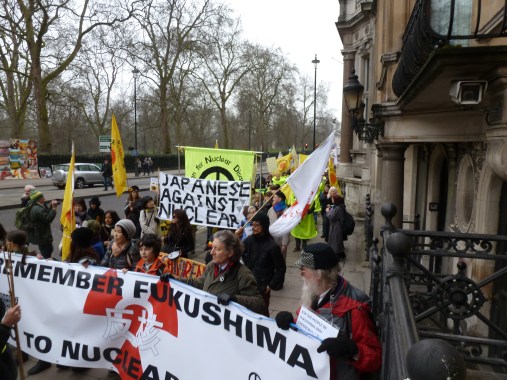
Japanese and UK citizens groups are jointly hosting a series of events in London to mark the third anniversary of the Fukushima nuclear disaster during a week when many similar events are taking place throughout the world. See below for the events details.
Fukushima is an ongoing catastrophe. On 11th March 2011, a massive earthquake triggered the triple melt-down of the Fukushima Daiichi nuclear reactors. 160,000 people were forced to leave their homes. Many are still living in temporary accommodation with little compensation or support. They face a terrible choice between returning to their heavily contaminated homes and villages or abandoning them in order to stay away from contamination. Radiation has entered the biosphere, which directly affects the food chain. A high incidence rate of thyroid cancer has been identified in Fukushima children.
The stricken reactors continue to pour 400 tons a day of highly radioactive water into the Pacific, with no end in sight. Many parts of the reactor buildings are impossible for humans to enter, due to lethal doses of radioactivity. Already weakened, they are in danger of collapse in any further earthquake. This could cause the spent fuels pool to drain and the fuel rods to catch fire. In the worst case scenario, this would lead to the evacuation of half of Japan.
The vast majority of people in Japan now want nuclear power to be abolished. Despite the strength of anti-nuclear sentiment and the high risk of a further apocalypse, the Japanese government is planning to revive nuclear industry, by restarting several nuclear reactors in Japan and exporting nuclear technology to many countries including the UK.
Remember Fukushima! No to nuclear power! The events will send a clear message to governments and people throughout the world that our future must be sustainable.
Further information on the current state of the Fukushima Daiichi can be found here: ENE NEWS or Simply Info
Events details
Public Meeting
7-9pm, Monday 10th March
Committee Room 10, House of Commons
What lessons should we learn from Fukushima?
Expert speakers: Dr Paul Dorfman, Dr David Lowry, Dr Chantal Galhinger.
Citizen speakers: Rik (Kick Nuclear), Geoff Read (Strong Children Japan), nuclear evacuee.
There will be Q&A to and discussion after the speeches.
Candle-lit Vigil
6-8pm, Tuesday 11th March (3rd Fukushima anniversary)
Outside Japanese Embassy, 101 Piccadilly, near Green Park tube station
We will be thinking of people, families and communities affected by the triple disaster.
Programme includes: Fukushima evacuee’s experience, 2 minutes silence, speeches on effects of Fukushima on people and society, songs, Buddhist chanting and open-microphone.
March to the Parliament & Rally
12:30pm, Saturday 15th March Hyde Park Corner to Parliament
Meet: 12:30pm by Hyde Park Corner tube station, near the “Hyde Park” exit for 1pm start. March via Japanese Embassy and offices of Tokyo Electric Power Company (TEPCO – the operator of Fukushima Daiichi), Piccadilly Circus, Trafalgar Square to Parliament.
Rally: 3:00–4:30pm at Old Palace Yard, opposite House of Lords.
Speakers include: fashion designer Katharine Hamnett, Samarendra Das from India’s anti-nuclear power campaign, Fukushima evacuees, campaigners from South West Against Nuclear, Nuclear Free Lakeland & Green Party, letter to Japanese government.
Programme also includes: music, singing, a human chain, a die-in and a minute silence, and open microphone.
Events are jointly organised by
Himawari JAN UK
Kick Nuclear
CND
For further information
In English, contact David Polden (London Region CND) on 0207-607 2302 or david.lrcnd@cnduk.org
In Japanese, contact through website
– ends –
Nevada’s renewable energy boom
Johnson and Salerno: Nevada is cashing in on renewable energy Ken Johnson and Eliza.beth Salerno RGJ.com 9 Mar 14,While Americans know wind and solar energy are clean, they often aren’t aware of the economic success story behind these renewable-energy technologies.
Wind and solar power have economic benefits that reach far and wide. They have become increasingly affordable, attracting billions in private development, and today are both mainstream and reliable energy sources across America.
Nevadans in the eastern part of the state often see something that may at first look to be a mirage: sleek, powerful wind turbines towering over what was once only barren, untapped desert. But the Spring Valley wind farm is as real as the increased revenue to small businesses during the project’s development, the $500,000 in property taxes Spring Valley paid to White Pine County last year and the $275 million in capital investment wind power has attracted to the state so far.
Just west of Las Vegas, the almost 400-megawatt Ivanpah plant is now the world’s largest concentrating solar power plant — and a great example of how smart public policies create new energy infrastructure. The solar Investment Tax Credit, the 1603 Treasury Program and the Bureau of Land Management’s streamlined permitting processes all worked so that 140,000 more homes can use reliable, sustainable and economical solar energy.
There’s more to wind and solar power than the economic and environmental benefits they create for Nevada. These renewable energy sources foster economic benefits across America……….http://www.rgj.com/article/20140309/OPED04/303090007/Johnson-Salerno-Nevada-cashing-renewable-energy
-
Archives
- February 2026 (233)
- January 2026 (308)
- December 2025 (358)
- November 2025 (359)
- October 2025 (376)
- September 2025 (258)
- August 2025 (319)
- July 2025 (230)
- June 2025 (348)
- May 2025 (261)
- April 2025 (305)
- March 2025 (319)
-
Categories
- 1
- 1 NUCLEAR ISSUES
- business and costs
- climate change
- culture and arts
- ENERGY
- environment
- health
- history
- indigenous issues
- Legal
- marketing of nuclear
- media
- opposition to nuclear
- PERSONAL STORIES
- politics
- politics international
- Religion and ethics
- safety
- secrets,lies and civil liberties
- spinbuster
- technology
- Uranium
- wastes
- weapons and war
- Women
- 2 WORLD
- ACTION
- AFRICA
- Atrocities
- AUSTRALIA
- Christina's notes
- Christina's themes
- culture and arts
- Events
- Fuk 2022
- Fuk 2023
- Fukushima 2017
- Fukushima 2018
- fukushima 2019
- Fukushima 2020
- Fukushima 2021
- general
- global warming
- Humour (God we need it)
- Nuclear
- RARE EARTHS
- Reference
- resources – print
- Resources -audiovicual
- Weekly Newsletter
- World
- World Nuclear
- YouTube
-
RSS
Entries RSS
Comments RSS
 nuclear-news