The world won’t survive a nuclear W.W.III.
 A Nuclear War Would Be Insane, OpEdNews 3/18/2014 By Dave Lefcourt Let’s get to the point fundamentally and unmistakably, a nuclear war would be insane.
Ever since the Cuban missile crisis in 1962, President Kennedy knew it and so did his counterpart Nikita Khrushchev in the Soviet Union. Even Stalin, probably the most brutal man ever never considered it.
That’s why in the cold war between the U.S. and the USSR, MAD, mutually assured destruction were the operative words and the primary reason a nuclear conflagration never occurred because such a war was unwinnable and to contemplate winning such a war was insane.
Yes tough guy Donald Rumsfeld as secretary of defense talked of using tactical bunker busting nuclear weapons but the use of any nuclear weapons began and ended with the U.S. dropping two atomic bombs on Japan in August 1945. Continue reading
The need for the West and Iran to negotiate in good faith
 Iran keeps its word – the west should do the same Ft.com By Javad Zarif, 18 Mar 14, Pursuing atomic weapons would put the country’s national security in jeopardy, writes Javad Zarif A
At last it seems realistic to hope for a resolution to the unnecessary crisis surrounding Iran’s peaceful nuclear programme. In large part that is because attitudes towards my country are changing. It is now recognised that Iranian scientists have mastered nuclear technology – and it is widely accepted that the knowledge we have attained cannot be wished away.
There is also a growing appreciation that Iran does not have any interest in nuclear weapons. True, we live in a volatile neighbourhood. Yet we have always been clear that pursuing nuclear weapons – or even being wrongly suspected of doing so – would put our national security in jeopardy. A
t last it seems realistic to hope for a resolution to the unnecessary crisis surrounding Iran’s peaceful nuclear programme. In large part that is because attitudes towards my country are changing. It is now recognised that Iranian scientists have mastered nuclear technology – and it is widely accepted that the knowledge we have attained cannot be wished away.
There is also a growing appreciation that Iran does not have any interest in nuclear weapons. True, we live in a volatile neighbourhood. Yet we have always been clear that pursuing nuclear weapons – or even being wrongly suspected of doing so – would put our national security in jeopardy…….http://www.ft.com/intl/cms/s/0/3c53cf60-ae8e-11e3-8e41-00144feab7de.html
China’s concern over Japan’s plutonium and enriched uranium

 Japan and China’s Dispute Goes Nuclear, The Diplomat, Japan and China’s bitter PR campaign has now entered the nuclear realm. By Zachary Keck March 18, 2014 Japan and China appear to be trading nuclear barbs with one another.
For some weeks now, China has been raising concerns about the amount of enriched uranium and weapons-grade plutonium Japan currently stockpiles. “We continue to urge the Japanese government to take a responsible attitude and explain itself to international community,” a Chinese Foreign Ministry spokesperson said at the end of last month.
The following week, the same spokesperson asked: “Has Japan kept an excessive amount of sensitive nuclear material that is beyond its actual needs? Does one need so much sensitive nuclear material for peaceful use? Should one keep excessive weapons-grade nuclear material?” He added: “More importantly, does Japan have higher-enriched and weapons-grade uranium, and how much does it have? What are those used for? How can Japan ensure a balance between the demand and supply of nuclear materials? These are the real concerns and questions of the international community.”
Japan has one of the most advanced civilian nuclear programs of any country without nuclear weapons.According to NBC News, Tokyo has 9 tons of plutonium stockpiled in different places throughout Japan, while 35 tons of Japanese plutonium is stockpiled in different countries in Europe. Only about 5 to 10 kilograms is needed to produce a nuclear weapon. Japan also has an additional 1.2 tons of enriched uranium. It is also building a fast-breeder plutonium reactor in Rokkasho that will produce 8 tons of plutonium annually.
Many experts believe that Japan could produce nuclear weapons within 6 months of deciding to do so, and some believe that Tokyo is pursuing a “nuclear hedging” strategy. Japan has done little to mollify these concerns. In fact, it has often encouraged them, with a Japanese official recently saying off the record that “Japan already has the technical capability [to build a nuclear bomb], and has had it since the 1980s.”
Having a “bomb in the basement” largely suits Japan’s interests in its competition with China. …….http://thediplomat.com/2014/03/japan-and-chinas-dispute-goes-nuclear/
Asia could become the epicentre of another nuclear catastrophe
 A need to address nuclear dangers, The Star, BY NOBUMASA AKIYAMA, SHAHRIMAN LOCKMAN, TANYA OGILVIE-WHITE, MANPREET SETHI, AND CHAN-HOON SHIN 19 March 14, There is no option but to cooperate, to prevent Asia from becoming an epicentre of another nuclear catastrophe.
IT’S no secret that nuclear dangers are mounting in Asia. Nuclear weapons arsenals are growing, nuclear power programmes are expanding, and fissile and radioactive materials – which could be used to target innocents anywhere – are used, stored and transported throughout our region, sometimes in insecure conditions.
It’s a discomfiting picture, and contrary to what sceptics would have us believe, it’s not an exaggerated one. We should be putting pressure on our political leaders to accept their responsibility to address our concerns before a nuclear catastrophe happens.
Next week, an opportunity exists for them to be pro-active in the face of nuclear dangers as leaders from around the world gather in the Netherlands at the world’s third Nuclear Security Summit to discuss and agree on actions that should be taken to reduce nuclear risks across the globe. What are these risks?
Let’s travel across the Asian nuclear landscape with our eyes wide open.
First stop: Pakistan, a nuclear-armed state with the world’s fastest growing nuclear arsenal and military stockpile of highly enriched uranium (HEU) and plutonium (Pu).
It is believed that there are sympathisers of extremist groups amongst its military, and a number of terrorist organisations operating from its soil.
The risks of nuclear sabotage and theft at Pakistan’s military and civilian sites must not be underestimated.
Heading south to India, the nuclear landscape is marginally better. New Delhi too is in the process of building its credible deterrence and the stockpile of weapons-usable HEU and Pu is growing.
India also has an ambitious nuclear power programme with twenty-one nuclear power reactors already operational, more being built, and also a new reprocessing facility at Kalpakkam……Onward to China…….the Korean peninsula……, Japan…. Despite the difficult political climate, there is no option but to cooperate, to prevent Asia from becoming an epicentre of another nuclear catastrophe.
Each state, whether it is a nuclear weapon state or not, should make extraordinary efforts to increase national accountability for their nuclear programmes according to accepted international benchmarks. http://www.thestar.com.my/News/Nation/2014/03/19/A-need-to-address-nuclear-dangers/
European Union working through the costs associated with renewable energy introduction
EU mulls aid to industries to cope with cost of renewable energy SMH, March 18, 2014 The European Union is considering allowing state aid to 62 energy-intensive industries including aluminium- and petroleum-product manufacturers to help with the cost of boosting renewable energy, a draft EU document showed.
The European Commission, the EU regulatory arm, will approve support in the form of reductions in environmental taxes if the beneficiaries cover at least 20 per cent of the additional costs, according to state-aid guidelines for 2014-2020 obtained by Bloomberg News. Continue reading
NRC Defines Risk Terms in a New Glossary
My new comments have been added, enjoy!

As with many subjects, when you’re talking about Probabilistic Risk Assessment (PRA) terms, it can get confusing when the same terms mean different things. To reduce this confusion, the NRC’s Office of Nuclear Regulatory Research decided to produce a glossary of risk-related terms.
 In November 2013, we published NUREG-2122, “Glossary of Risk-Related Terms in Support of Risk-Informed Decisionmaking.” This glossary provides a single source for definitions of terms used in risk-informed activities. This document clarifies the terms and provides the proper context for using them. For example, the glossary defines the word “assumption” as “a decision or judgment that is made in the development of a model or analysis.” It then describes how “assumption” is used within the context of a PRA.
We developed the list of terms by first reviewing documents used to support risk-informed activities…
View original post 277 more words
Censorship of scientific findings on Fukushima radiation
 NYTimes: Gov’t scientist not allowed to publish findings that Fukushima cesium-137 levels could be 10,000 times higher than after Chernobyl in Pacific surface waters — Japan researchers pressured to downplay disaster’s impact — Professors obstructed when data might cause public concern http://enenews.com/nytimes-govt-scientist-allowed-publish-findings-fukushima-cesium-137-could-be-10000-times-higher-pacific-surface-waters-after-chernobyl-japan-researchers-pressure-downplay-disasters-impact-profe?utm_source=feedburner&utm_medium=email&utm_campaign=Feed%3A+ENENews+%28Energy+News%29
New York Times,, Mar. 16, 2014: […] As a senior scientist at the Japanese government’s Meteorological Research Institute, [Michio Aoyama] said levels of radioactive cesium 137 in the surface water of the Pacific Ocean could be 10,000 times as high as contamination after Chernobyl […] as Mr. Aoyama prepared to publish his findings […] the director general of the institute called with an unusual demand — that Mr. Aoyama remove his own name from the paper. Continue reading
Careful plan to replace San Onofre Nuclear Plant with Renewables and Efficiency
 How California Will Use Renewables to Replace Massive Nuclear Plant, Eco Watch Natural Resources Defense Council | March 17, 2014 By Sierra Martinez California took another major and symbolic step this month with its decision to rely significantly on energy efficiency and other clean energy resources to help replace electricity once generated by the San Onofre Nuclear Generation Station (SONGS) serving San Diego and the greater Los Angeles area.
The California Public Utilities Commission (CPUC) made official its strategy to address the loss of the huge nuclear plant, which had been offline since January 2012 and was officially retired last year. Fortunately, it closely resembles its proposal released last month.
The final plan uses efficiency and other “preferred resources”—those resources with lower environmental impacts—like demand response (ways customers can consume less energy at key times during the day) and renewable energy such as wind and solar, as well as some upgrades to the electric system, to replace the vast majority of the lost SONGS generation. Instead of turning directly to dirty gas-fired power to replace SONGS, this decision fills the gap left by SONGS with at least two-thirds of clean energy resources, and up to 100 percent clean energy. That means that dirty gas-fired power is limited to contributing, at most, one-third of the replacement energy and at best, zero. Continue reading
Radiation exposure to US sailors far greater than Japan estimated
 US sailors exposed to Fukushima radiation levels beyond Japan’s estimates Aljazeera 17 March 14, Crew members of the USS Ronald Reagan’s March 2011 Fukushima relief mission encountered radiation levels that far exceeded the Japanese government’s estimates, according to a report in the Asia-Pacific Journal.
The revelations contained in the report could have a bearing on the lawsuit against Tokyo Electric Power Company by more than 70 U.S. service members who say they suffer from long-term health effects from their participation in the U.S. navy’s response to the nuclear disaster. Continue reading
Ukraine crisis could lead to a ‘nuclear impasse’
“It is extraordinarily irresponsible to jump on the bandwagon of this dangerous regional crisis and make Ukrainians feel that they were wrong to rid their newly independent country of nuclear weapons in 1992 and join the NPT as non-nuclear-weapon states,”
 US -Russia standoff over Ukraine may trigger nuclear attack UNITED NATIONS: The US-Russian confrontation over Ukraine, which is threatening to undermine current bilateral talks on North Korea, Iran, Syria and Palestine, is also in danger of triggering a nuclear fallout., The International News, 17 MAr 14,
Secretary of State John Kerry told US legislators early this week that if the dispute results in punitive sanctions against Russia, things could “get ugly fast” and go “in multiple directions. ”Perhaps one such direction could lead to a nuclear impasse between the two big powers. Continue reading
VIDEO: Thom Hartmann on cover-up of nuclear dangers
 Video: On the News With Thom Hartmann: US Nuclear Regulators Are Hiding the Risk of a Fukushima-Style Incident, and More TruthOut , 17 March 2014 15:21By Thom Hartmann, The Thom Hartmann Program | Video Report In today’s On the News segment: Recently released documents show that since Fukushima, our nuclear regulators have been playing down the risk of a similar incident happening in the US; homeowners want energy choices – and for once, that’s not just a Republican talking point; four new man-made gases are destroying our ozone layer and intensifying the effects of climate change; and more.
TRANSCRIPT:
Thom Hartmann here – on the best of the rest of….science & green news…..
You need to know this. Last week marked the third anniversary of the earthquake and tsunami that devastated the Fukushima Nuclear Power Plant in Japan. And, recently released documents show that since then, our nuclear regulators have been playing down the risk of a similar incident happening in the U.S. Emails obtained via a Freedom of Information Request show that the higher-ups at the Nuclear Regulatory Agency told staff to hide information from reporters, to keep quiet about NRC scientists studying risk at US plants, and to change the subject when media asked what a worst-case scenario in our country could look like. ……http://truth-out.org/news/item/22526-on-the-news-with-thom-hartmann-us-nuclear-regulators-are-hiding-the-risk-of-a-fukushima-style-incident-and-more
TruthOut reports on just one month’s environmental catastrophes
Fukushima remains on the forefront of many folks’ minds because it is an ongoing disaster, and its direct impact on our health is obvious. However, we tend to forget how much radiation has already been bombed into the oceans.
Those who have been bombed, however, haven’t forgotten.
Reporting on a World of Environmental Catastrophes – All in Just One Month
TruthOut, 17 March 2014 09:40By Dahr Jamail, Truthout | News Analysis March 2014
When all the trees have been cut down,
when all the animals have been hunted,
when all the waters are polluted,
when all the air is unsafe to breathe,
only then will you discover you cannot eat money.
– Cree Prophecy……..
A new study has confirmed that a magnitude 5.7 earthquake in Oklahoma – one of the state’s biggest man-made quakes – was caused by fracking-linked wastewater injections.
Water
Even the depths of the oceans are now at risk……… Continue reading
Launch of Africa’s Renewable Energy Fund
African Renewable Energy Fund launches with $100MM in committed capital http://www.pennenergy.com/articles/pennenergy/2014/03/african-renewable-energy-fund-launches-with-100mm-in-committed-capital.html March 17, 2014 By Dorothy Davis Ballard Content Director Source: African Development Bank The African Renewable Energy Fund (AREF), a dedicated renewable energy fund focused on Sub-Saharan Africa closed last week with US $100 million of committed capital to support small- to medium-scale independent power producers (IPPs).
The fund, which will be headquartered in Nairobi, is targeting a final close of US $200 million within the next 12 months to be invested in grid-connected development stage renewable energy projects including small hydro, wind, geothermal,solar, biomass and waste gas.
Initially promoted in a joint initiative by the African Biofuel and Renewable Energy Company (ABREC) and the African Development Bank (AfDB), AREF will be managed by Berkeley Energy Africa Limited (Berkeley Energy), a fund manager focused on developing and investing in renewable energy projects in emerging markets. The fund will target IPPs with an ideal size of between 5 and 50 MW and a commitment per project of between US $10 million and US $30 million, with the capacity to source further funding from co-investors where necessary for a larger investment.
Africa Development Bank is the fund’s lead sponsor, bringing US $65 million in an equity investment package from its statutory resources as well as climate finance instruments such as Sustainable Energy for Africa (SEFA) and the Global Environment Facility (GEF) to leverage commercial and institutional investment. SEFA will additionally fund a Project Support Facility (PSF), which will provide resources to be deployed at an early stage to structure bankable deals.
“Over the past decade, the AfDB has established itself as a prime catalyst for renewable energy investment on the continent and is currently hosting the Africa Hub for the Sustainable Energy for All (SE4All) initiative. As Africa’s largest infrastructure finance partner, we understand the value of supporting both large-scale and small-scale projects as part of our strategy for Africa to promote inclusive and sustainable growth,” said Gabriel Negatu, AfDB Regional Director for the East Africa Regional Resource Center.
The investor group also includes West African Development Bank (BOAD), Ecowas Bank for Investment and Development (EBID), Nederlandse Financierings-Maatschappij voor Ontwikkelingslanden N.V. (FMO), Calvert Foundation, Berkeley Energy and ABREC, who are the vision-bearers of the fund.
Owned by 15 African Nations and five financial institutions, ABREC is a company specialized in developing, managing and advising public and private sector renewable energy and energy efficiency initiatives and projects.
AfDB selected Berkeley Energy as the fund manager of AREF following a competitive procedure. Berkeley Energy, based in Mauritius, will have operational headquarters in Nairobi and a further office to be situated in West Africa. The Berkeley Energy team and investment committee comprises Managing Partner TC Kundi; Partner Alastair Vere Nicoll; Chairman Andrew Reicher; Investment Director and AREF lead Luka Buljan; and Investment Committee members Thierno Bocar Tall, Chief Executive Officer of ABREC; and Eddie Njoroge, former Chief Executive Officer of Kenya Electricity Generating Company (Kengen).
Marking Three Years of Post-Fukushima Progress
Many good comments here worth reading if you are interested in reactor “safety”.
The approach to the Fukushima Dai-ichi reactor complex winds through empty villages where weeds grow in silent communities, storefronts are shattered and advertising signs entice a population that may be years in returning.
A year ago I visited the site of the devastating March 11, 2011, accident triggered by a massive 9.0 earthquake and subsequent 46-foot tsunami.
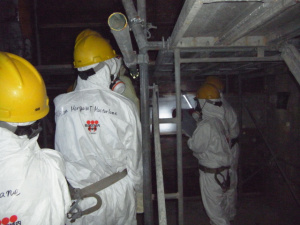 Chairman Allison Macfarlane and other NRC officials stand in the darkened interior of Reactor 4 at the Fukushima Dai-ichi nuclear complex northeast of Tokyo Dec. 13, 2012. Photo courtesy of TEPCO
The site where four of six reactors were inundated bears testament not only to the power of the natural forces but also to the huge hydrogen explosions that rocked three of the reactors. Rusting trucks lay about the property. And thousands of workers in protective gear and full-face respirators scramble over the shattered industrial complex.
It is…
View original post 550 more words
UN nuclear chief – ‘we can only try to prevent’ a nuclear accident
 UN nuclear watchdog chief says atomic plants never ‘100%’ safe, 7 News, March 17, 2014 Tokyo (AFP) – The head of the UN nuclear watchdog said Monday his agency would keep working to improve safety after the Fukushima crisis, but no atomic plant could be “100 percent” safe from natural disasters.
Yukiya Amano, director general of the International Atomic Energy Agency (IAEA), made the comments before he meets Prime Minister Shinzo Abe later Monday, as Japan moves closer to restarting two reactors despite objections from a nuclear-wary public……..Amano added that “what we can do is to prevent an accident (as much) as humanly possible, and to get prepared for the mitigation of the consequences” of one………http://au.news.yahoo.com/world/a/22027660/un-nuclear-watchdog-chief-says-atomic-plants-never-100-safe/
-
Archives
- February 2026 (233)
- January 2026 (308)
- December 2025 (358)
- November 2025 (359)
- October 2025 (376)
- September 2025 (258)
- August 2025 (319)
- July 2025 (230)
- June 2025 (348)
- May 2025 (261)
- April 2025 (305)
- March 2025 (319)
-
Categories
- 1
- 1 NUCLEAR ISSUES
- business and costs
- climate change
- culture and arts
- ENERGY
- environment
- health
- history
- indigenous issues
- Legal
- marketing of nuclear
- media
- opposition to nuclear
- PERSONAL STORIES
- politics
- politics international
- Religion and ethics
- safety
- secrets,lies and civil liberties
- spinbuster
- technology
- Uranium
- wastes
- weapons and war
- Women
- 2 WORLD
- ACTION
- AFRICA
- Atrocities
- AUSTRALIA
- Christina's notes
- Christina's themes
- culture and arts
- Events
- Fuk 2022
- Fuk 2023
- Fukushima 2017
- Fukushima 2018
- fukushima 2019
- Fukushima 2020
- Fukushima 2021
- general
- global warming
- Humour (God we need it)
- Nuclear
- RARE EARTHS
- Reference
- resources – print
- Resources -audiovicual
- Weekly Newsletter
- World
- World Nuclear
- YouTube
-
RSS
Entries RSS
Comments RSS
 nuclear-news