Study Gives Wind Turbines a ‘Thumbs Up’ http://www.usnews.com/news/articles/2014/02/20/study-gives-wind-turbines-a-thumbs-up Researchers in the U.K. found wind turbines put out nearly twice the power in the long term than some critics have claimed. By Alan Neuhauser Feb. 20, 2014 A new study from the United Kingdom has found wind turbines generate more power in the long term than some critics have claimed. Some have argued turbines lose a third of their electrical output after just 10 years of operation, the paper said. Researchers from the Imperial College Business School, however, determined that turbines still churn out about three-quarters of their original capacity for 19 years – nearly twice as long.
“There have been concerns about the costs of maintaining aging wind farms and whether they are worth investing in,” professor Richard Green, a co-author of the study, said in a statement. “This study gives a ‘thumbs up’ to the technology and shows that renewable energy is an asset for the long term.”
The team used wind-speed data from NASA from the past 20 years and compared it with the actual recorded output from each wind farm. They then developed a formula to calculate how wear-and-tear affected the turbine’s performance, finding that the wind farms were putting out more power than had been previously thought. A key reason: the high-end engineering of the turbines.
“They’re designed to be as light and as strong as possible, and to be able to survive and withstand and use really powerful winds,” explains Dan Kammen, professor of energy at the University of California, Berkeley. “Anything that’s designed in that way, kind of optimizing lightness, strength and performance, it’s not surprising they’d really outperform what you’d expect, because that’s a really tough environment.”
Wind farms generate about 7.5 percent of the energy in the U.K. In the United States, wind power makes up slightly more than 4 percent of all generated energy, according to the Department of Energy.
“Our study provides some certainty,” said research fellow and co-author Iain Staffell, “helping investors to see that wind farms are an effective long-term investment.”
The findings were published in the journal Renewable Energy on Thursday.
February 23, 2014
Posted by Christina Macpherson |
Uncategorized |
Leave a comment
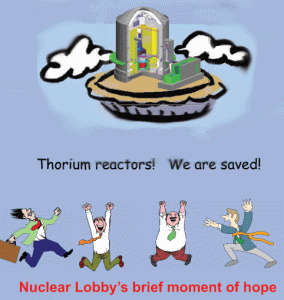 Will Thorium Save Us? David Suzuki February 20,
As knowledge about climate change increases, so does demand for clean energy. Technologies like solar, wind, hydro, geothermal, tidal and biofuels, along with eb energy-grid designs that will help us take advantage of renewables, are part of the equation, as is conservation.
But many argue that, despite Fukushima and other disasters, nuclear is the best option to reduce carbon emissions quickly enough to avoid catastrophic climate change. Because of problems with radioactive waste, meltdown risks and weapons proliferation, some say we must develop safer nuclear technologies…….
What are “safer nuclear power systems”? And are they the answer?
Proposed technologies include smaller modular reactors, reactors that shut down automatically after an accident, and molten salt reactors. Some would use fuels and coolants deemed safer. (Industry proponents argue the low incidence of nuclear accidents means current technology is safe enough. But the costs and consequences of an accident, as well as problems such as containing highly radioactive wastes, provide strong arguments against building new reactors with current technology.)
One idea is to use thorium instead of uranium for reactor fuel. Thorium is more abundant than uranium. And unlike uranium, it’s not fissile; that is, it can’t be split to create a nuclear chain reaction, so it must be bred through nuclear reactors to produce fissile uranium.
Thorium-fuelled reactors produce less waste, and while some trace elements in spent uranium fuels remain radioactive for many thousands of years, levels in spent thorium fuels drop off much faster. China and Canada are working on a modified Canadian design that includes thorium, along with recycled uranium, fuels. With the right type of reactor, such as this design or the integral fast reactor, meltdown risks are reduced or eliminated.
Thorium can be employed in a variety of reactor types, some of which currently use uranium — including heavy water reactors like Canada’s CANDU. But some experts say new technologies, such as molten salt reactors (including liquid fluoride thorium reactors), are much safer and more efficient than today’s conventional reactors.
So why aren’t we using them?
Although they may be better than today’s reactors, LFTRs still produce radioactive and corrosive materials, they can be used to produce weapons and we don’t know enough about the impacts of using fluoride salts. Fluoride will contain a nuclear reaction, but it can be highly toxic — and it’s deadly as fluorine gas. And though the technology’s been around since the 1950s, it hasn’t been proven on a commercial scale. Countries including the U.S., China, France and Russia are pursuing it, but in 2010 the U.K.’s National Nuclear Laboratory reported that thorium claims are “overstated.”
It will also take a lot of time and money to get a large number of reactors on-stream — some say from 30 to 50 years. Given the urgent challenge of global warming, we don’t have that much time. Many argue that if renewables received the same level of government subsidies as the nuclear industry, we’d be ahead at lower costs. Thorium essentially just adds another fuel option to the nuclear mix and isn’t a significant departure from conventional nuclear. All nuclear power remains expensive, unwieldy and difficult to integrate with intermittent renewables — and carries risks for weapons proliferation.
If the choice is between keeping nuclear power facilities running, or shutting them down and replacing them with coal-fired power plants, the nuclear option is best for the climate. But, for now, investing in renewable energy and smart-grid technologies is a faster, more cost-effective and safer option than building new nuclear facilities, regardless of type……http://www.planetsmag.com/story.php?id=1496
February 23, 2014
Posted by Christina Macpherson |
Uncategorized |
Leave a comment
As Coal Ash Investigation Continues, Anti-Uranium Groups Draw Disaster Comparisons ABC 13 Virginia Feb 21, 2014 By Whitney Delbridge – Danville, VA – As the investigation into the Duke Energy coal ash spill continues, environmental agencies are still trying to determine the potential long term effects. The Virginia Department of Environmental Quality has turned its attention to the fish.
Thursday, biologists caught 175 fish to test their tissue and determine how they may be affected by the ash. They plan to expedite the process of receiving the results.
Anti-uranium groups say this accident is an example of what could happen if the ban on uranium mining is lifted.
The proposed mine in Pittsylvania County would sit less than 10 miles from the Banister River.
The groups say they want it to be a wake up call for those who support uranium mining in Pittsylvania County.Throughout the uranium debate on the Southside, people have been concerned about potential effects of mining on water quality.
Anti-uranium advocate Sarah Dunavant says a uranium-related accident like this would take years to fix, if it could be fixed at all….Dunavant says many questions about the long term effects this spill may have on the area went unanswered.Dunavant says many questions about the long term effects this spill may have on the area went unanswered.
February 23, 2014
Posted by Christina Macpherson |
Uncategorized |
Leave a comment
Op Ed Posted by arclight2011
Nuclear-news.net
22 February 2014
Nuclear news had been promoting Riseup.net as an encrypted service suitable for activists. However, recent information given to this blogger has thrown doubt on the ability of riseup and other “encrypted” online services to be able to deliver a secure service.
I contacted them via email and have not received a reply after about 2 weeks. The delay in reporting this was because i had to interview my sources at Japanese Against Nuclear UK to confirm the situation and give riseup staff a chance to reply. It might be that riseup never received the email and so i am posting this article to catch their attention and give them a chance to respond.
The scenario
I have been working with many bloggers from Japan and Japanese in the UK to get, what is now, censored information direct from Japanese sources. To try to protect my sources i can not be more specific in some details of internet restrictions, hacking and general harassment but for those that remember tokyobrowntabby (who worked with EXSKF amongst others) had her original youtube channels deleted and videos constantly challenged for copyright even though she was using them for educational purposes only. She retired after such harassment unfortunately but understandably as did the UK based bloggers on YouTube with Japanese contacts.
Other UK bloggers in the early days of Fukushima were also working with Japanese contacts that were able to do the hard work in translating Japanese to English and vise-versa were also targeted and after some months, stopped blogging because of the stresses involved.
3 years later and just after Japans new secrecy law was posited now the Japanese in the UK are being targeted by persons unknown.
I have been targeted myself on multiple occasions by “unknown” assailants but have carried on regardless (I have been made jobless, homeless and have been attacked using financial strategies) [I have taken out some bits of this article as it doesnt reflect the content of the email correctly. I took the description of the content of the email seriously out of context. Sorry about the delay in correcting the article -Arclight2011]
An email was sent to the subscription list recently. JANUK use riseup.net emails and use the subscribers service offered by riseup.net as well. However, a member that uses riseup.net got the initial email but certain words had been deleted, making the email mostly unreadable.
A second attempt at informing the members was blocked and the sender of the email was further harassed via the internet to make sure this point was driven home.
It was very effective at frightening and discouraging all activists concerned (including me)
I will carry on blogging anyway and am adjusting my life style accordingly to cope with this ever changing situation. My autobiography will be interesting i suspect (not planned yet)!
The main points are that JANUK and other UK based activists are constantly being manipulated and divided (ref George Monbiot splitting the anti nuclear movement in the UK that STRATFOR was VERY concerned about, and the results speak for themselves unfortunately! George helped destroy the movement that STRATFOR and the UK nuclear lobby were previously so concerned about). 
Anyone involved in translation and dissemination of Fukushima information is under severe restrictions or suffers punitive actions.
[Nuclear power in Britain is, in effect, finished: on Saturday, the EU revealed that it had prohibited the government’s latest desperate attempt to keep it afloat with massive subsidies. G Monbiot 2002]
…Despite the strong interparty consensus on the issue, therefore, the United Kingdom remains a country where public opinion – and anti-nuclear energy activists – will have to be “monitored” carefully to gauge which way the country will go following the Fukushima incident….. STRATFOR REPORT
I await a response from riseup.net on the hacking issue to support the above anecdotal evidence or to clarify that there was no hacking. I will update this article and post a new one to clarify the situation.
response email for riseup staff AND George Monbiot if he wants.
arclight2011@riseup.net (likely not secured 😦 )
February 22, 2014
Posted by arclight2011part2 |
Uncategorized |
3 Comments
“Mari is facing charges stemming from speaking out on radiation in Japan and advocacy for families relocating children out of the areas contaminated by radioactivity from the damaged Fukushima Daiichi reactor site, operated by TEPCO. Radioactivity continues to leave that site. It is well established that while lower levels of exposure to radioactivity lowers risk, the greatest hazard from radiation comes when children are exposed, raising the risk of cancer manifold over their entire lives…..”
 nuclear-news
“Perhaps because everyone believes people telling them on television that everything is fine, they don’t seem so worried,” 281 Antinuke told Reuters.“I hope by leaving my art I can remind people that we’re not safe at all … and that they will do something to protect themselves.”
“We don’t know what will happen in the future, whether children will get cancer or leukemia,” he said. “So I want to keep making noise and making a fuss.”
“The nuclear accident allowed us to realize that Japan had hidden a lot of things,” he said. “I want to make images that express doubts about what’s going on in politics – like a label that says ‘This is happening, pay attention’!” http://www.dailykos.com/story/2013/11/30/1259294/-Masked-Artist-Forces-Japanese-to-Think-About-Fukushima

Why this is important!!

Mari is facing charges stemming from speaking out on radiation in Japan and advocacy for families relocating children out of the areas contaminated by radioactivity from…
View original post 167 more words
February 22, 2014
Posted by arclight2011part2 |
Uncategorized |
Leave a comment
nuclear-news
 http://www.januk.org/event.html
Monday March 10th 2014
19.00 – 21.00
Meeting in Committee Room 10 in The House of Commons
Speeches and discussion about the situation in Japan three years on since Fukushima and the lessons we can learn for a nuclear-free world.
Enter Parliament by public entrance by central St. Stephen’s Tower.
Arrive half an hour early to get through security.
The vigil
11th March 2014
outside Japanese Embassy
101 Piccadilly, W1J 7JT
18.00 – 20.00pm
Candle-Lit vigil in support of families and people of all ages continuing to suffer the affects of Fukushima.
Please bring torch & wrap up warm.
15th March 2014
The March to Parliament
Hyde Park Corner – London
Assemble 12.30pm, Start 13.00
Assemble at Hyde Park Corner at 12.30 to start the march at 13.00
Route: Hyde Park Corner, Japanese Embassy, TEPCO London Office, Piccadilly Circus, Japan Centre, Trafalgar Square, Parliament
Themes:. Colour yellow & sunflower…
View original post 25 more words
February 22, 2014
Posted by arclight2011part2 |
Uncategorized |
Leave a comment
nuclear-news
“There is no consistent signal of change in either storms or blocking near the UK in either ensemble of Met Office models or the ensemble of alternative models. Such changes as are seen are relatively modest, and the potential for substantial changes appears to be small.“

Posted to nuclear-news.net
Posted by Arclight2011
18 February 2014
A new report out today gives justification for a new generation ABWR reactor to be built in the UK. It comes with pretty pictures and a biased view of radiological damage.
https://www.gov.uk/government/uploads/system/uploads/attachment_data/file/280857/abwr_justification_volume_2_application.pdf
The report states that there are no issues with this plan and that even in the event of a major incident that there would be no insignificant health effects on humans. The effects on birds and animals are presumed to be negligable if there are no effects on humans.
The basis for this feel good factor is the WHO health report on…
View original post 1,473 more words
February 22, 2014
Posted by arclight2011part2 |
Uncategorized |
Leave a comment
nuclear-news
NATS is the UK’s leading provider of air traffic control services. Each year we handle 2.2 million flights and 220 million passengers in UK airspace.
http://www.nats.aero/about-us/what-we-do/our-control-centres/
OpEd
Arclight2011
20 February 2014
This post attempts to answer the question of what mechanism is causing the large amounts of record breaking levels of rainfall in Norway and the UK over recent years. Whilst global warming is an obvious answer as clouds hold more water if the atmosphere is warmer but the facts remain that increased flights across the Atlantic and increased particulates from various sources are responsible for this.
This dimming effect has repercussion concerning reports that use data that expects no quick changes to the earths climate (ref MET Office UK). In planning large projects such as nuclear power plants, waste/fuel processing work and storage sites, I have noticed that they refer to the incorrect information on the MET Office site…
View original post 1,825 more words
February 22, 2014
Posted by arclight2011part2 |
Uncategorized |
Leave a comment
Posted by Angela Glienicke – 21 February 2014 at 12:46pm

Hiroshi Kanno, a vegetable farmer evacuated from Iitate village harvests carrots at his new farm
I can’t believe it’s already three years since the Fukushima disaster struck. Thousands of people were forced to flee their homes and had to rebuild their lives elsewhere, because of the high levels of radiaition. Japanese photographer Noriko Hayashi documents the struggle of some of the victims, who feel the government has abandoned them.We don’t want their stories to be forgotten, so have sent six activists to Japan to meet the victims and spread their stories. Here is just a glimpse of their life after Fukushima.

Bags of decontaminated soil and grass are left near farmer’s Hiroshi Kanno’s original house in Iitate village.

Hiroshi Kanno checks radiation level near his new farm in Fukushima city. He used to grow 35 different kind of vegetables on 2.5 hectares of land. He and his family live now in a temporary house and can’t settle down.

Katsutaka Idogawa, former mayor of Futaba town, Fukushima prefecture, collects and checks materials about the Fukushima Daiichi nuclear disaster at his house office where he evacuated in Kazo city, Saitama Prefecture, 70 km north from Tokyo central.

Pictures of victims of the accident of nuclear power plant which a former mayor of Futaba town, which Katsutaka Idokawa collected.

Kenichi Hasegawa, a dairy farmer evacuated from Iitate village, Fukushima prefecture. He lives in a temporary house in Date city, 15 km away from Fukushima city central.

Kenichi Hasegawa’s empty cowshed in Iitate village, Fukushima prefecture. Before Fukushima Daiichi nuclear disaster, he owned 50 dairy cattle but he had to put all of his cows down before his evacuation. Mr. Hasegawa now lives in a small temporary house in Date city, 15 km away from Fukushima city central.

Minako Sugano, a mother of three children and former kindergarten teacher in Date city talks about her concerns about vegetables harvested in Fukushima in school lunches.

Minako Sugano hangs children’s clothes inside her apartment room. “I don’t want to hang our clothes outside because of concern of contamination.”

Kenji Fukuda, an attorney at law with Waseda Legal Commons. He has been working for victims of Fukushima Daiichi nuclear disaster. He maintains the current compensation system helps the nuclear industry and not the victims.

Tatsuko Okawara, an organic farmer performs a puppet show at her organic and fair trade shop, one story is a about a couple affected by a nuclear disaster.

Tatsuko Okawara at her organic and fair trade shop named “Esperi” , meaning “Hope” in Miharu Town.

Greenpeace Poland Nuclear Campaigner, Iwo Los buys produce from Tatsuko Okawara (left) and her husband Shin at their organic and fair trade shop in Miharu Town. © Alex Yallop/Greenpeace
February 22, 2014
Posted by arclight2011part2 |
Uncategorized |
Leave a comment

Image source ; http://articles.software.informer.com/prism-tempora-xkeyscore-what-is-it.html
“The two sides also set forth a strategic vision that, reflecting our shared values of democracy, the rule of law, free and open markets, and respect for human rights, will effectively promote peace, security, stability, and economic prosperity in the Asia-Pacific region. At the SCC meeting, the Ministers exchanged views on the evolving security environment in the Asia-Pacific region and decided upon several steps to upgrade significantly the capability of the U.S.-Japan Alliance” http://www.state.gov/r/pa/prs/ps/2013/10/215070.htm
http://mainichi.jp/english/english/newsselect/news/20140222p2a00m0na009000c.html
February 22, 2014(Mainichi Japan)
A Justice Ministry sectional committee has proposed that the scope of crimes subject to wiretapping in Japan be greatly expanded, dividing opinions among members of a committee debating the issue.
The proposal, made by a subgroup of the “Special Committee on New-age Criminal Justice System” that was established by the Justice Ministry’s Legislative Council, was presented during a committee meeting held on Feb. 21.
Under current laws, wiretapping by investigative authorities is limited to four categories: crimes involving drugs, crimes involving weapons, group smuggling, and organized murder. A police representative on the committee criticized the current system as difficult to use, and said that the number of wiretapping investigations was low compared with those overseas. The sectional committee’s proposal suggests that nine types of crimes be added to the list, including general cases of murder, infliction of injury, blackmail or fraud, abduction, theft or robbery, arson of inhabited structures, use of explosives, and hiding criminal proceeds.
Under a basic interim framework compiled by the committee in January last year, bank-transfer fraud and organized theft — including cases involving foreign nationals — were cited as examples of an expanded scope of wiretapping. The latest proposal widens this scope even further.
Continue reading →
February 22, 2014
Posted by arclight2011part2 |
Uncategorized |
Leave a comment
“It’s unfair for TEPCO to discontinue what is only a small amount of damages after a short period. With the petition, we’d also like to prevent people’s memory of the nuclear disaster from fading.”
http://fukushima-diary.com/2014/02/why-doesnt-tepco-analyze-fishery-products-for-strontium-90-%E2%86%92-tepco-because-its-how-its-supposed-to-be/?utm_source=feedburner&utm_medium=feed&utm_campaign=Feed%3A+FukushimaDiary+%28Fukushima+Diary%29
Tepco – “Because it’s how it’s supposed to be”
http://mainichi.jp/english/english/newsselect/news/20140222p2a00m0na011000c.html
Some 5,000 residents from areas outside evacuation zones near the crippled nuclear plant in Fukushima Prefecture are preparing to use an alternative dispute resolution (ADR) system to demand Tokyo Electric Power Co. (TEPCO) pay them more damages in connection with the nuclear crisis.
A local citizens’ organization will file a petition on behalf of the residents, who live in the cities of Fukushima, Koriyama and Iwaki, with the Nuclear Damage Claim Dispute Resolution Center, an ADR entity, on March 5. Such a large-scale petition for nuclear accident compensation being launched by residents outside evacuation zones is unprecedented.
The citizens’ organization, which involves the Social Democratic Party’s local chapter and other entities, will encourage all Fukushima Prefecture residents to join in the petition.
Continue reading →
February 22, 2014
Posted by arclight2011part2 |
Uncategorized |
Leave a comment
http://enenews.com/nuclear-professor-fish-on-west-coast-found-with-fukushima-radioactive-material-were-testing-fish-that-are-sold-at-markets-to-u-s-consumers-audio
Published: February 22nd, 2014 at 9:30 am ET
By ENENews
Radio VR – US Edition, Feb. 22, 2014 (at 6:15 in):
By Molly Seder
WASHINGTON (VR)– It seems that Japan’s 2011 Fukushima nuclear power plant disaster will never end. A report out Thursday found more radioactive nuclear was spilling out of a storage vault. The good news: the spill probably won’t reach the Pacific Ocean. But still, might the implications of this toxic waste entering the environment be dire? And how is the Japanese public reacting to more bad news?
For an assessment of what is happening on the ground now at Fukushima and discussion of the wider context, VR’s Molly Seder spoke with Catherine Higley, Professor and Head of the Department of Nuclear Engineering & Radiation Health Physics at Oregon State University. Higley specializes in radio-ecology.
See also: More US tuna contaminated — Study: Entire food web “including humans” may be affected as Fukushima radionuclides spread to West Coast
Full broadcast available here
February 22, 2014
Posted by arclight2011part2 |
Uncategorized |
Leave a comment
http://fukushima-diary.com/2014/02/why-doesnt-tepco-analyze-fishery-products-for-strontium-90-%E2%86%92-tepco-because-its-how-its-supposed-to-be/?utm_source=feedburner&utm_medium=feed&utm_campaign=Feed%3A+FukushimaDiary+%28Fukushima+Diary%29
Tepco – “Because it’s how it’s supposed to be”
Posted by Mochizuki on February 19th, 2014
The reason why Tepco doesn’t analyze fishery products for Strontium-90 is only because it’s the rule. Tepco stated in the press conference of 2/19/2014.
Having highly contaminated water leaking to the sea, the biological concentration of marine products is one of the most important issues.
However, they don’t analyze the samples for Strontium-90, which is accumulated in bone to cause human consumers leukemia. Like ordinary food test of the government, they only analyze them for Cesium-134/137.
Among tens of the test results, they release Strontium-90 data only about a couple of the samples, once in a few months.
Tepco doesn’t have the plan to analyze the samples for Strontium-90 and other nuclides more frequently, and the reason to refuse the proposal wasn’t announced either.
http://www.tepco.co.jp/tepconews/library/movie-01j.html
Iori Mochizuki
Downplay it in the beginning, and quietly add more information so nobody notices it. All for not letting the cattle escape. This is their strategy.
Strontium 89 in Fukushima Fallout – references
http://nuclearhistory.wordpress.com/2011/04/20/strontium-89-in-fukushima-fallout-references/
“The ministry announced Tuesday that strontium-89 and strontium-90 were found in its analyses of soil samples collected during the two days from March 16 from two locations in Namie of Fukushima Prefecture, where the plant is located, and one place in Iitate in the same prefecture.
The three locations are outside but close to the 30-kilometer zone around the stricken plant of Tokyo Electric Power Co. .
The analyses showed that the soil samples contained up to 260 becquerels of strontium-89 per kilogram and 32 becquerels of strontium-90, the ministry said.
The ministry also said it found plant samples collected on March 19 in the Fukushima Prefecture municipalities of Otama, Motomiya, Ono and Nishigo had up to 61 becquerels of strontium-89 per kilogram and 5.9 becquerels of strontium-90. The sampled plants are not edible vegetables.”
Maximum detected strontium-89 in Namie or Iitate’s soil in March 2011: 260 becquerels/kilogram = 7.02 picocuries of Sr89 per gram of soil
Maximum detected strontium-90 in Namie or Iitate’s soil in March 2011: 32 becquerels/kilogram = 0.8 picocuries of Sr90 per gram of soil
[…]
MEXT reported on measurements of strontium-89 (half-life: 50.5 days) and strontium-90(half-life: 28.8 years) in three samples taken in one village in the Fukushima prefecture on 16 March. The activities in soil for Sr-89 ranged from 13 and 260 Bq/kg and for Sr-90 between 3.3 and 32 Bq/kg. Sr-90 was also distributed globally during nuclear weapons’ testing in the atmosphere, typical global levels of Sr-90 in surface soils are in the order of one to a few becquerel per kg. Strontium was also measured in plant samples in four others villages, with values ranging from 12 to 61 Bq/kg for Sr-89 and 1.8 to 5.9 Bq/kg for Sr-90.
[…]
____
Thu, 2011-04-14 13:23
It has been reported that Strontium has been detected in other countries as well but this is the first confirmation that it has been found that I could find outside the grounds of the Daichi plant (meaning it must have been in the initial blasts and/or gas vented)
Once again the failure of ANYONE to be testing for this is really troubling.
http://www.nuc.berkeley.edu/node/3007
_
Français :
Pourquoi Tepco ne recherche pas le strontium 90 dans les produits de la mer ? → Tepco : “Parce que c’est supposé être comme ça”
Continue reading →
February 22, 2014
Posted by arclight2011part2 |
Uncategorized |
1 Comment
http://the-japan-news.com/news/article/0001055481
11:08 pm, February 22, 2014
Jiji Press BRUSSELS (Jiji Press)—The European Commission will relax the European Union’s restrictions on food imports from Japan, which were introduced after the Fukushima nuclear accident in March 2011, the commission said Friday.
The decision is based on examinations of more than 85,000 items, the EU’s policy-steering body said.
The EU plans to accept from April 1 foods produced in Tokyo and Kanagawa Prefecture and green tea leaves harvested in Shizuoka Prefecture without checking their radiation levels.
Radiation checks are currently required on food imports from 15 prefectures, including Fukushima, home to the disaster-crippled Fukushima No. 1 nuclear power station of Tokyo Electric Power Co.
The commission also said radiation checks will be conducted on fewer products from Gunma, Ibaraki, Tochigi, Miyagi, Saitama, Iwate and Chiba prefectures.
February 22, 2014
Posted by arclight2011part2 |
Uncategorized |
2 Comments
Having failed miserably a second time, the industry is demanding another round of massive subsidies, relaxed oversight, and pampered treatment for a third bite at the apple.
The biggest mistake policy makers could make is to allow the search for yet another nuclear holy grail to delay the transition to a 21st century electricity grid.
Why The Economics Don’t Favor Nuclear Power In America Forbes Staff, Contributor by Mark Cooper, senior fellow for economic analysis at Vermont Law School’s Institute for Energy and the Environment. 20 Feb 14, From 2011 through 2013, as the overwhelming majority of the new reactors that had been proposed as part of the “Nuclear Renaissance” were abandoned or delayed, the industry blamed low natural gas prices. In 2013, when five old reactors were retired early, and today with many old reactors being considered for early retirement, the industry blames low wholesale prices that result from a market that is distorted by the entry of subsidized wind power.
The irony in these complaints is that for fifty years the selection of generating capacity has been rigged in favor of nuclear power with socialized accident insurance and waste management costs, forced purchase of overpriced power, and advanced recovery of construction costs. Nuclear advocates complaining about policies that balance things out a bit to give other generation resources a decent chance of delivering electricity would be laughably hypocritical, if it weren’t so important. In fact, if the playing field were actually level, nuclear would be in even more trouble than it is.

The nuclear hypocrisy does not stop with complaints about subsidies. The nuclear utilities continue to complain about the challenges of the safety and licensing requirements imposed by the Nuclear Regulatory Commission, even after they convinced Congress to streamline and reform the process in the 2005. Yet, these challenges are matched by the obstacles utilities put in the path of alternatives at the public utility commissions, with hostile interconnection requirements, unfair contract conditions and uneconomic tariffs
The fifty year failure of nuclear power to be economically competitive compels nuclear advocates to label every pro-consumer analysis as anti-nuclear. The anti-nuclear label is used to avoid the inconvenient truth about nuclear: it is and has been unable to compete economically with the alternatives available. More importantly, it is not likely to be able to compete for the foreseeable future.
The economic reality is that efficiency and natural gas can keep the lights on and computers running at a fraction of the cost of nuclear power and the cost of wind and solar have been declining dramatically. Utility scale solar with storage is entering the market, as is utility scale battery storage. The decision to give them a boost, is paying off. These alternatives have exhibited the one characteristic that has always eluded nuclear, declining costs driven by innovation, learning, and economies of scale.
In contrast to the success of the alternatives, the projected cost of nuclear power has increased five-fold since technology vendors and academic boosters declared the “Nuclear Renaissance” in the mid-2000s. If the industry had been able to deliver on the hype of a decade ago, it would not be in such dire straits. Continue reading →
February 21, 2014
Posted by Christina Macpherson |
Uncategorized |
1 Comment






 nuclear-news