OT? The Day We Fought Back – Did you miss it?

https://www.eff.org/deeplinks/2014/02/day-we-fought-back
The late Internet activist Aaron Swartz famously said, when describing how the Internet defeated the SOPA blacklist bill, that: “We won this fight because everyone made themselves the hero of their own story. Everyone took it as their job to save this crucial freedom.”
February 11, 2014—The Day We Fought Back. We started something.
Of course, the battle didn’t begin today. The groups that organized this action have long been pushing hard for real surveillance reform. But we knew that the time was ripe—that the Snowden leaks, unrelenting media pressure, grassroots activism, and even pressure from within Congress—were creating a once-in-a-lifetime opportunity to give the public—worldwide—the chance to voice its opposition to mass spying. We knew that 6,000+ websites were committing to stand with us in a global day of action, that dozens of advocacy organizations worldwide would fight with us. What we didn’t know was how big today’s stand against mass spying would be.
In one day, over 71,000 concerned Americans picked up the phone and told their Congress to rein in the NSA. Far more sent emails to their members of Congress. Around the world over 200,000 put their name to a set of founding principles against suspicionless surveillance: by the NSA, by their own governments, by anyone who dares to violate our human rights.
We’ve done more in this single day to pressure the U.S. Congress to reform surveillance law than what months or even years of lobbying to date have accomplished.
We’ve demonstrated our strength. We’ve shown those who want to watch us that the whole world is watching them.
 This was a community-driven protest created by advocacy groups and everyday Internet users who wanted to defend the Internet from the creeping shadow of surveillance. Tech companies helped amplify their voices. Users worldwide were bolstered by the support of giants like Google, Facebook, Twitter, Tumblr, reddit, Automattic, Thoughtworks, Namecheap, Hover and many others. In dozens of countries, activists united their forces, forming new powerful coalitions and new legal campaigns.
This day of action tapped into the creativity and diversity of the Internet. Advocates for press freedom described how surveillance chills freedom of expression. International human rights organizations articulated how unrestrained, illegal surveillance violates human rights. Tech companies demanded privacy rights for their users. Lawmakers stood with their constituents in demanding an end to mass surveillance. And worldwide, there were people holding events large and small to show that they would no longer tolerate suspicionless surveillance.
We also saw great news coverage of our protests, from The Guardian to the Washington Post to PBS and many others, ensuring people around the world learned about the protests.
Of course, the battle isn’t over. In some ways it’s just beginning. We’ve proven to lawmakers that we are powerful, united yet diverse, and that we are going to use everything within our means to combat surveillance abuses. But defending freedom online is a marathon, not a sprint. We’ll need to show them, day after day, that we won’t compromise or accept reforms that fall short. And we’ll continue to make every day a day we fight back against mass surveillance—in the courts, in the legislature, and on the Internet.
The late Internet activist Aaron Swartz famously said, when describing how the Internet defeated the SOPA blacklist bill, that: “We won this fight because everyone made themselves the hero of their own story. Everyone took it as their job to save this crucial freedom.”
Aaron’s legacy of fighting for a technological world that supports, rather than undermines, human rights inspired us today. Together, the hundreds of thousands of us that took action in the last twenty four hours, can live up to that legacy. Today, we began to win.
12m and 8m long cracks on concrete base of 2 tank areas / Tepco doesn’t mention the possibility of land subsidence
Posted by Mochizuki on February 12th, 2014

2 of the long cracks were found on the base concrete of the tank areas.
Those cracks are 12m and 8m long, found in 2 tank areas. Those tank areas are next to each other.
The concrete base is to stop leaked contaminated water leak to the ground. Tepco removed the soil around the tank areas for the possible past leakage of contaminated water.
There is a possibility that land subsidence caused the long cracks, but Tepco didn’t mention the possibility and only announced they will cover the concrete base with urethane coating.
http://www.tepco.co.jp/nu/fukushima-np/handouts/2014/images/handouts_140212_05-j.pdf
http://www.tepco.co.jp/tepconews/library/movie-01j.html
http://photo.tepco.co.jp/date/2014/201402-j/140212-01j.html
Iori Mochizuki
#Nuclear Japan: Nuclear Regulation Authority Agrees That Ooi Nuclear Power Plant Does Not Have Active Faults
11 February 2014
http://ex-skf.blogspot.co.uk/2014/02/nuclear-japan-nuclear-regulation.html
It’s Nuclear Regulation Authority’s turn to be bullish on nuclear power plants in Japan awaiting NRA’s approval to restart, now that the Tokyo gubernatorial election ended with the result interpreted as great endorsement of Prime Minister Abe’s policies across the board.
NRA accepted the conclusion of the experts that the fractured zones inside the Ooi Nuclear Power Plant compound are not active faults.
All set to restart, then.
From Jiji Tsushin (2/12/2014):
「活動せず」報告書を了承=大飯原発の敷地内断層-規制委
NRA accepted the report that fractured zones at Ooi Nuclear Power Plant are not “active faults”
関西電力大飯原発(福井県おおい町)敷地内の破砕帯(断層)が活断層である疑いを指摘されていた問題で、原子力規制委員会は12日、「将来活動する可能性のある断層などには該当しない」とする専門家調査団の報告書を了承した。
Fractured zones inside KEPCO’s Ooi Nuclear Power Plant (Ooi-cho, Fukui Prefecture) compound have been suspected to be active faults. However, on February 12, 2014, Nuclear Regulation Authority accepted the report by a group of experts whose conclusion is that “they are not faults that may become active in the future”.
Ooi Nuclear Power Plant in Fukui Prefecture is accessible through a tunnel. In a severe accident after a big earthquake and tsunami, the only way to access the plant is by boat, if the tunnel collapses. Even then, if the plant harbor is destroyed by tsunami, oh well. It is not supposed to happen, and therefore it won’t happen.
The experts investigating on behalf of NRA did two surveys of the site to determine whether the fractured zones were active faults. The first survey was inconclusive, with most experts saying they were active faults. Clearly that changed in the second survey.
In case of a severe accident, the emergency response headquarters at Ooi Nuclear Power Plant will be a small spare room next to the central control room. There was no objection at all from NRA to this arrangement.
Again, the Tokyo gubernatorial election was supposed to be a mere provincial election (which was not, as revealed after the election by the compliant media), and the nuclear issues were supposed to be of little significance (which were total opposite, as revealed after the election by the compliant media).
There’s no stopping the Abe administration now.
(… unless another swarm of jellyfish clogs water intakes…)
‘Wading Through The Waters Of Fukushima Daiichi
- uploaded: Feb 12, 2014
To learn more about Fukushima from James Corbett visit:
http://www.corbettreport.com/
http://fukushimaupdate.com/
Foreigners afraid of living near Fukushima after crisis
A non-profit group’s interviews with expats who lived in Fukushima Prefecture at the time the nuclear catastrophe broke out in March 2011 determined that over two-thirds of them have left for their home countries or moved elsewhere in Japan.
http://voiceofrussia.com/2014_02_13/Foreigners-afraid-of-living-near-Fukushima-after-crisis-9548/
13 February 2014
The Fukushima International Association’s survey also showed that foreigners were worried by differences in domestic and foreign media coverage and that most of them relied on TV more than radio because of language barriers.
According to the prefectural authorities, up to 164,200 people had moved by May 2012, which accounts for 8% of the overall population of 2mln.
Of the 100 foreigners who took part in the survey, 53 knew that the prefecture hosted nuclear power plants before the earthquake on 11 March 2011 and tsunami that triggered the disaster.
At the end of 2010, 11,190 foreigners lived in the prefecture. Over 60% of them were either Chinese or Filipino. The number had dropped to 9,489 by the end of June 2013.
Foreigners who were given survey questionnaires pointed out that Japanese newspapers were slower in providing information than the foreign media.
Many foreigners had problems with understanding the situation even when they watched TV. They were at a loss why Japanese politicians appeared on the screen on a daily basis with a serious look in the faces. They were worried because they did not know where the nuclear plant was located and how dangerous radiation was.
Voice of Russia
Blast ruined the inside of containment vessel at Fukushima Daichi 4
http://the-japan-news.com/news/article/0001027724

The Yomiuri Shimbun
Yomiuri Shimbun reporters look at the inside of the Fukushima No. 1 nuclear power plant’s No. 4 reactor building on Wednesday.
6:11 am, February 13, 2014
The Yomiuri Shimbun Almost three years after the outbreak of the nuclear crisis following the Great East Japan Earthquake, debris and wreckage remain scattered at Tokyo Electric Power Co.’s Fukushima No. 1 nuclear power plant.
Reporters from The Yomiuri Shimbun visited the crippled plant Wednesday, accompanied by TEPCO employees.
On the top floor of the plant’s No. 4 reactor building, a crane was moving to remove spent nuclear fuel from a storage pool. On the lower floors, debris and wreckage were scattered.
A hydrogen explosion, which is believed to have taken place outside the reactor, destroyed a door attached to the containment vessel as well as walls and pipes inside the vessel.
UNSCEARが被曝による健康被害はなかったという報告を出そうとしている! UNSCEAR is going to publish a report that says there is no health hazards after the Fukushima disaster!


拡散してください!(特に国連の方と日本の憂慮する市民の方々)
Please dissemiante!
ベルギー代表も怒った9月発表のUNSCEAR報告 Even Belgian delegates got mad at the upcoming UNSCEAR report http://vogelgarten.blogspot.de/2013/08/unscear.html(Japanese)
The UNSCEAR Report downplays the Effects of radiation after the Fukushima accident, which infuriated even the Belgian government delegate.
このままでは、日本では事故直後から出ている健康被害、そして先日発表された44人の甲状腺と疑いのことも、なかったことにされてしまいます。
If nothing done, all the health hazards observed since the onset of the Fukushima accident and the recent news of 44 thyroid cancers and suspected cases would be totally ignored.
これを訴えられるのは、日本人しかいません。
Only Japanese can respond to this!
英語ができない?
You say you cannot write English?
関係ありません!今はグーグル翻訳だってあるのです。
Nonsense! You can use google translation!
グーグル翻訳でいいからメールを、以下のUNSCEAR担当者に!Please write a mail to UNSCEAR person below,
We need to tell the UN many Japanese are watching!!!
Contact address: Ms. Jaya…
View original post 158 more words
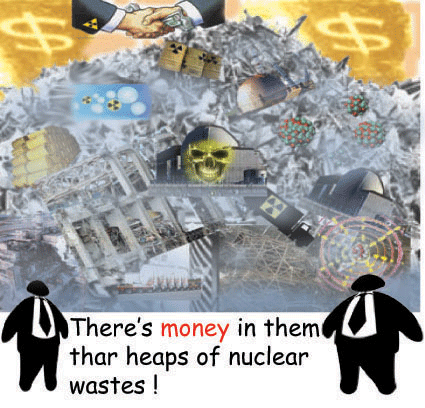
Costs of cleanup of Sellafield radioactive wastes getting out of control
Sellafield: MPs warn US-led consortium over escalating cost of clean-up Margaret Hodge says Nuclear Management Partners’ contract should be terminated if performance does not improve The Guardian, Rajeev Syal The Guardian, Tuesday 11 February 2014 The American-led consortium presiding over the clean-up of hazardous nuclear waste at Sellafield must be stripped of its contract if it does not improve a performance that has seen the bill rise to more than £70bn, according to a committee of MPs.
A report from the public accounts committee said progress at the nuclear complex in Cumbria had been poor, with missed targets, escalating costs, slipping deadlines and weak leadership.
The MPs made a series of recommendations focusing on the role of the private consortium, Nuclear Management Partners (NMP), which was brought in by the Nuclear Decommissioning Authority (NDA) six years ago to help improve the plant’s performance.
The report concluded that the consortium was to blame for many of the escalating costs and the MPs said they could not understand why the NDA extended the consortium’s contract last October.
Margaret Hodge, who chairs the committee, said costs were rising to “astonishing” levels, such as the doubling to £729m million on a storage silo project, while another task had been put back six years to 2023. Hodge said the authority should monitor progress and terminate NMP’s contract if performance does not improve quickly……..
Timescales have slipped and reprocessing targets have been missed. NMP has failed to provide the clear leadership, strong management and improved capabilities for the job.”
Hodge added: “There has been a high turnover of executives, and NMP has failed to train staff with the right skills and experience. Instead it used expensive NMP staff – at an average cost of £300,000 per expert in 2012-2013.”
 One of the members of the NMP consortium is Areva, the French engineering firm that is also working on the new power station at Hinkley Point in Somerset. The group also includes URS of the US and Amec of the UK……..
Sources close to the authority claimed that the consortium’s contract was extended by the government because of a “lack of faith” in its ability to attract another consortium to take over the job at the same rates.,,,,,,,,,http://www.theguardian.com/environment/2014/feb/11/sellafield-consortium-cost-clean-up
We greatly under=reported level of Fushima radiation, admits Tepco
Fukushima radiation data is wildly wrong, management apologizes Subodh Varma,TNN | Feb 10, 2014, NEW DELHI: Tepco, the utility company that is managing the destroyed Fukushima nuclear power plant in Japan said that there were mistakes in the radiation levels they recorded last year. According to Japanese media,
Tepco announced last week that what was recorded as 900,000 becquerels per liter of deadly beta radiation from a test-well last July was wrong and the actual level should read 5 million becq per liter. That’s five times more than what they announced previously, and nearly 170,000 times more than the permissible level. ……………http://timesofindia.indiatimes.com/world/rest-of-world/Fukushima-radiation-data-is-wildly-wrong-management-apologizes/articleshow/30163944.cms
Good progress in Iran – UN nuclear talks
U.N. nuclear watchdog sees ‘good’ progress with Iran, much work remains BY FREDRIK DAHL VIENNA Mon Feb 10, 2014 Reuters) – The U.N. nuclear watchdog signaled its determination on Monday to get to the bottom of suspicions that Iran may have worked on designing an atomic bomb, a day after Tehran agreed to start addressing the sensitive issue.
Chief U.N. nuclear inspector Tero Varjoranta said his team made good progress during February 8-9 talks in Tehran but that much work remained to clarify concerns about Iran’s nuclear program in an investigation that Western diplomats say the Islamic state has long stonewalled……
n Tehran, Rouhani told a gathering of foreign diplomats that Iran’s doors “are open to the IAEA within international regulations”, the official news agency IRNA reported.
“We have never sought weapons of mass destruction. We don’t want nuclear know-how for war, as some countries do,” he said…….Varjoranta said Iran had implemented six previously agreed steps under the November framework accord, including providing inspectors access to two-nuclear related sites.
“Since November everything has gone as planned,” he said, and more steps would follow. “These things take time.”http://www.reuters.com/article/2014/02/10/us-iran-nuclear-iaea-idUSBREA1907820140210
Not gjvjng up on fight to stop uranium mining
WHS Founder Vows To Fight Uranium Mining SDPB, 10 Feb 14 The Nuclear Regulatory Commission’s recent report on a request to mine uranium in the Black Hills isn’t going over well with Native Americans and non-Natives alike. The report concludes there are no environmental concerns, but possible water contamination remains an issue for many……………
Dayton Hyde founded the Black Hills Wild Horse Sanctuary. He worries that the mining will contaminate the area’s ground water.
Hyde is also concerned about the estimated 9000 gallons of water per minute that’s required for the mining process……Despite the NRC’s decision, Dayton Hyde says he’s determined to stop Powertech from mining uranium in the Black Hills.http://listen.sdpb.org/post/whs-founder-vows-fight-uranium-mining
Grim uranium market forces Cameco to dump expansion plans
Weak Uranium Outlook Causes Cameco Corporation to Scrap Its Aggressive Guidance Continued weakness in the uranium market has Cameco Corporation seeing lower sales and scrapping its 2018 production target…..http://www.fool.com/investing/general/2014/02/10/weak-uranium-outlook-causes-cameco-corporation-to.aspx
Cameco (T.CCO) says 2018 uranium production goals no longer likely Stockhouse, 10 Feb 14 Cameco (TSX:T.CCO, Stock Forum) chief executive Tim Gitzel says it no longer makes sense for the company to keep to its goal of producing 36 million pounds of uranium a year by 2018……”There has been little to no improvement on the issues needed to help clear the oversupply and uncertainty the industry continues to face,” Gitzel told a conference call with financial analysts Monday.
“We don’t believe the answer is to sit idle and wait for improvement, which is why you see us moving away from our target.”
………The company had been optimistic about the restart of the industry, but Gitzel conceded Monday that it has been wrong about how quickly it expected the Japanese reactors to restart.
“We’ve quit predicting on that because we just don’t know,” he said.
The uranium market has also seen unexpected reactor shutdowns in the U.S. and utilities have been well covered under long-term contracts.
The new production guidance by Cameco came as the company reported the average spot price for uranium was US$35.03 per pound in the fourth quarter, down from US$42.46 a year ago……
Scotiabank analyst Ben Isaacson said Cameco’s earnings were lower than expected, due mostly to the higher costs.”While shareholders should be pleased to hear management is showing capital discipline and not empire building, the decision reconfirms that uranium supply-demand tightness will likely occur later, and not sooner,” Isaacson wrote in a report to clients.
Read more at http://www.stockhouse.com/news/natural-resources/2014/02/10/cameco-t-cco-says-2018-uranium-production-goals-no-longer-likely#pA7Lgw4k2co9YYxU.99
Some pro-nuclear twitter-trolls might be counter productive?
John Randall @thjr19 You can scream and shout as much as you like I will expose the hypocrisy of @ChristinaMac1
US officials destroyed Fukushima documents. Secrecy over nuclear crisis
Professor: U.S. personnel destroyed thousands of documents to prepare for evacuation of Japan after 3/11 — Bloomberg: “Near-Chernobyl experience” for Tokyo even though 200+ kilometers from Fukushima http://enenews.com/professor-u-s-personnel-destroyed-thousands-of-documents-to-prepare-for-japan-evacuation-bloomberg-tokyo-faced-a-near-chernobyl-experience-while-over-200-kilometers-from-f
Bloomberg, , Willianm Pesek in Japan, Feb. 6, 2014: […] Anyone who lived through Tokyo’s near-Chernobyl experience in 2011 may recall how poorly NHK performed even then. The network downplayed risks at every turn to avoid panic. Many of us learned about explosions at Fukushima from CNN, BBC and U.S. military news conferences, not Japan’s most trusted news source. Just imagine the next time disaster strikes. Abe’s secrecy law means journalists and whistle-blowers can go to jail for reporting what the government doesn’t want the public to know. It’s nice to know that during the next crisis, when we’re desperate for news, NHK will be ready to distract us with cheerful PR puff pieces. It’s now official policy.
Number 1 Shimbun, Foreign Correspondents Club of Japan, Feb. 4, 2014: Paul Blustein, former Washington Post [and Wall Street Journal reporter who is now affiliated with the Brookings Institution] […] accuses some present members [of the FCCJ] of propagating misinformation — even of “journalistic malpractice.” […] “I’m referring to the oft-repeated claim that the accident came perilously close to irradiating the Tokyo metropolitan area. […] it is massively at odds with the facts. Propagating it is not just misinformation; it can now be fairly deemed an act of journalistic malpractice […] It pains me to level such accusations at fellow journalists […] Leading the pack was the New York Times, which carried a front-page story on Feb. 27, 2012 asserting that Kan and his fellow Japanese leaders “secretly considered the possibility of evacuating Tokyo” […] Jeffrey Bader, who had served on President Obama’s National Security Council, explained that modeling of radiation plumes and weather patterns by Lawrence Livermore National Laboratory – one of the government’s premier scientific facilities – had shown there was no need to consider evacuating Americans from the Tokyo metropolitan area.” […]
Rebuttal from David McNeillThe Economist, Feb. 4, 2014: […] I’m puzzled by this criticism. It seems to suggest that we should outweigh or dismiss the views of Japan’s sitting prime minister at the time of the disaster in favor of those of some U.S. officials in Washington. It also seems to ignore the growing body of evidence to the contrary. To cite only the latest intervention into this debate that I know of, Kyle Cleveland of Temple University Japan has written a well-sourced essay this year revealing that U.S. officials in Japan were concerned enough in March 2011 about the possibility of evacuation to have destroyed thousands of documents at military and diplomatic facilities. Mr. Blustein may also be aware that Kevin Maher, former director of the Office of Japan Affairs also said in his 2011 (Japanese) book, The Japan That Can’t Decide, that U.S. officials in Japan planned to evacuate 90,000 citizens from Tokyo during the disaster. […]
Tepco unable to stop leakage of radioactive cesium
Japan Nuclear Experts: Footage shows ‘major problem’ at Fukushima Unit 1; Cesium release to continue for next 5 decades — Tepco: Even if we knew where it’s broken, how can we stop it? — “Still in the dark” about other 2 units (VIDEO) http://enenews.com/japan-nuclear-experts-footage-major-problem-fukushima-unit-1-cesium-release-continue-next-5-decades-tepco-knew-broken-stop-dark-about-other-2-units-video 9 Feb 14
NHK Documentary, ‘Radioactive Water: Fukushima Daiichi’s Hidden Crisis‘ — Feb. 1, 2014:
Zengo Aizawa, Tepco VP: “Even if we found out where the water is coming from the question is how to stop it. I think it will be difficult but we have no other choice and if we fail that would be miserable. We just have to succeed somehow.”
More from Aizawa: Tepco VP not optimistic: “I have concerns” for long-term plan — Location of melted fuel a mystery (VIDEO)
1 This Month
26 April – Chernobyl: Inside the Meltdown airs on National Geographic on Sunday 26th April from 4pm

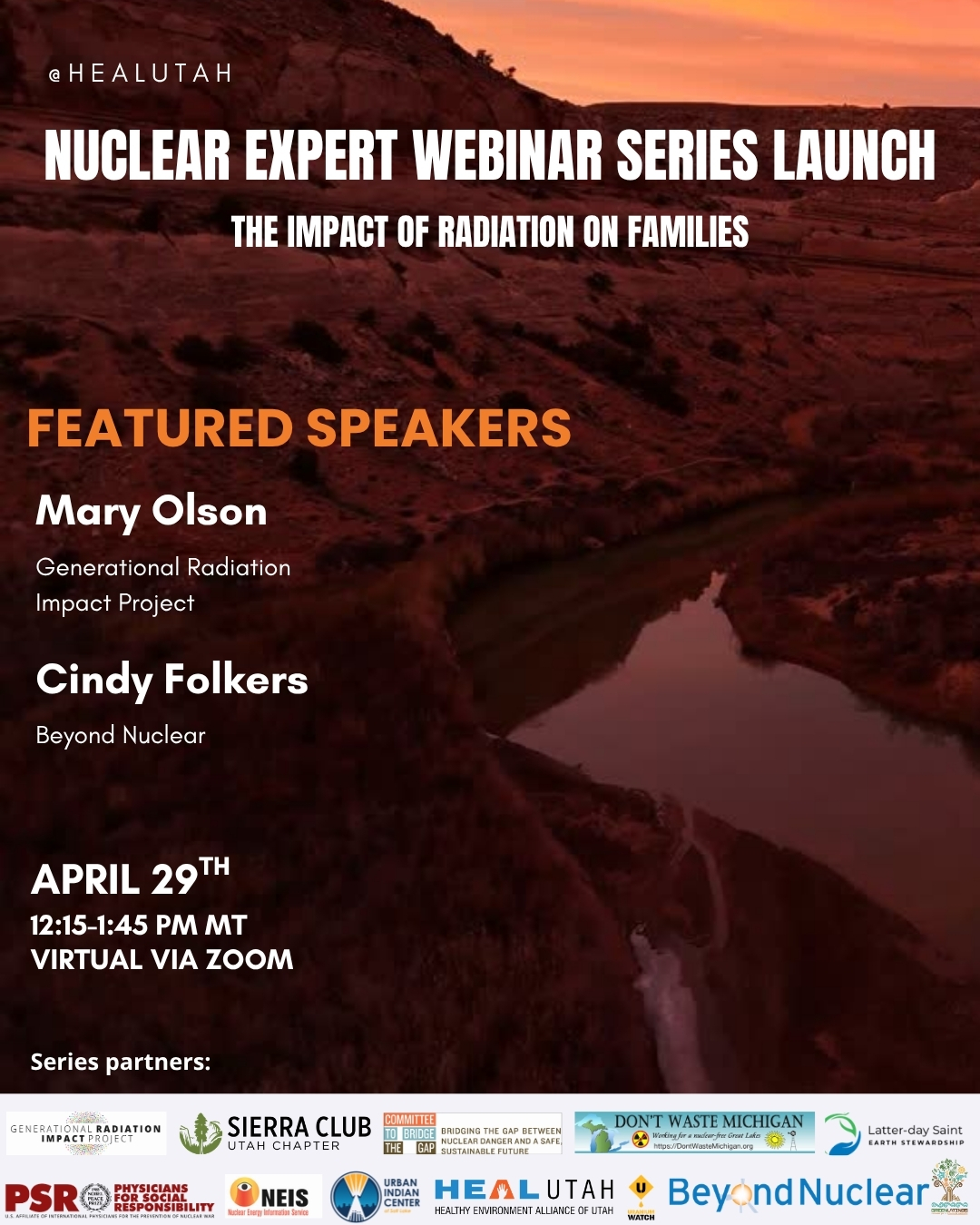
29 April – Nuclear Expert Webinar #1 – Radiation Impacts on Families with Mary Olson and Cindy Folkers
- 12:15 PM MT – 1:45 PM MT
- Location: Virtual – REGISTER TODAY

4 May -West Suburban Peace Coalition to discuss Iran war at May Educational Forum
Monday, May 4, 7:00 – 8:00 PM Central Standard Time
Title: : How Trump’s Narrative Tries to Shape the Reality of the War on Iran.
Contact Walt Zlotow, zlotow@hotmail.com 630 442 3045 for further information
14 May – online event From Bombs to Data Centres: the Face of Nuclear Colonialism

Pine Ridge Uranium is the real threat, not Tehran- Tell Burgum: Stop the Extraction.
Chernobyl: The Lost Tapes – A good documentary on Chernobyl on SBS available On Demand for the next 3 weeks– https://www.sbs.com.au/ondemand/tv-program/chernobyl-the-lost-tapes/2352741955560
To see nuclear-related stories in greater depth and intensity – go to https://nuclearinformation.wordpress.com
-
Archives
- April 2026 (317)
- March 2026 (251)
- February 2026 (268)
- January 2026 (308)
- December 2025 (358)
- November 2025 (359)
- October 2025 (376)
- September 2025 (257)
- August 2025 (319)
- July 2025 (230)
- June 2025 (348)
- May 2025 (261)
-
Categories
- 1
- 1 NUCLEAR ISSUES
- business and costs
- climate change
- culture and arts
- ENERGY
- environment
- health
- history
- indigenous issues
- Legal
- marketing of nuclear
- media
- opposition to nuclear
- PERSONAL STORIES
- politics
- politics international
- Religion and ethics
- safety
- secrets,lies and civil liberties
- spinbuster
- technology
- Uranium
- wastes
- weapons and war
- Women
- 2 WORLD
- ACTION
- AFRICA
- Atrocities
- AUSTRALIA
- Christina's notes
- Christina's themes
- culture and arts
- Events
- Fuk 2022
- Fuk 2023
- Fukushima 2017
- Fukushima 2018
- fukushima 2019
- Fukushima 2020
- Fukushima 2021
- general
- global warming
- Humour (God we need it)
- Nuclear
- RARE EARTHS
- Reference
- resources – print
- Resources -audiovicual
- Weekly Newsletter
- World
- World Nuclear
- YouTube
-
RSS
Entries RSS
Comments RSS
 nuclear-news