London gets world’s largest solar-powered bridge
World’s largest solar-powered bridge opens in London, Guardian, 24 Jan 14 Blackfriars rail station secures half its power from 4,400 roof-mounted solar panels, reports BusinessGreenAfter nearly five years in the making, Network Rail has today cut the ribbon on the world’s largest solar-powered bridge at Blackfriars Bridge across the River Thames.
As part of a project with solar installation firm Solarcentury, the roof of the bridge has been covered with 4,400 photovoltaic panels, providing up to half of the energy for London Blackfriars station.
First Capital Connect, which runs Blackfriars, expects the panels to cut the stations’ carbon emissions by an estimated 511 tonnes a year, further reducing the carbon footprint of its train routes to the south east of England.
“Electric trains are already the greenest form of public transport – this roof gives our passengers an even more sustainable journey,” said David Statham, managing director of First Capital Connect. “The distinctive roof has also turned our station into an iconic landmark visible for miles along the River Thames.”
The bridge will also act as a major advertisement for London’s efforts to become a sustainable city, with tourists and workers viewing the panels as they enter the capital……http://www.theguardian.com/environment/2014/jan/22/worlds-largest-solar-powered-bridge-opens-in-london
Solar PV installation at record high in China
China’s solar PV installations soared to record in 2013 http://www.smh.com.au/business/carbon-economy/chinas-solar-pv-installations-soared-to-record-in-2013-20140124-31cck.html Developers in China installed a record 12 gigawatts of solar panels last year, almost matching the total amount of solar power in operation in the U.S., and may exceed that this year, according to Bloomberg New Energy Finance.
The power plants were built mostly in the sunny, western provinces of Gansu, Xinjiang and Qinghai and make China’s state-owned power companies the world’s biggest owners of solar assets, the London-based research company said today in a statement.
China was the biggest solar market last year, surpassing longtime leader Germany. Chinese installation more than tripled from 3.6 gigawatts in 2012, and the nation expects to add 14 gigawatts of solar capacity this year, according to New Energy Finance.
China led a 28 per cent increase in global solar installations last year of 39 gigawatts, and total installation may increase another 20 per cent this year, according to the statement. Before 2013, no nation had ever installed more than 8 gigawatts of solar power in a year.
China blocking “inconvenient” foreign news sites
 China blocks foreign news sites that revealed elite’s offshore holdings Guardian among sites blocked over reports • China Digital Times publishes details of directive Tania Branigan in Beijing and James Ball in New York theguardian.com, Thursday 23 January 2014
The blocking of foreign news sites that revealed details of offshore holdings by the relatives of senior leaders has continued in China as reports emerged of a propaganda directive ordering websites and services to target users posting on the subject.
Details of the order were published by China Digital Times, a website that monitors censorship instructions.
“Immediately find and remove the foreign media report “China’s Secret Offshore Tax Havens” and related content. Interactive platforms must strictly check [users]. Related images and accusatory comments about leaders and the system [of government] must be deleted without exception,” said the instructions, according to CDT.
“Block the [user] IDs of those who have an evil influence and coordinate on-the-ground investigations with the relevant departments.”…http://engineeringevil.com/2014/01/23/china-blocks-foreign-news-sites-that-revealed-elites-offshore-holdings/
Youth urged to take up the anti nuclear cause
Bryana Malloy: Young people must tackle today’s issues, like nuclear plant safetyhttp://www.gazettenet.com/home/10303496-95/bryana-malloy-young-people-must-tackle-todays-issues-like-nuclear-plant-safety January 24, 2014 As part of my internship with the American Friends Service Committee, I began to attend monthly meetings held by the Nuclear Free Future coalition. I learned a great deal about the issue of nuclear power and weapons, and after attending a December panel discussion in Northampton on decommissioning the Vermont Yankee plant in Vernon, Vt., the urgency of this issue became more apparent.
Some believe the energy produced at nuclear power plants is the cleanest and safest form available. But if you look into the steps taken to produce this energy, you will find it can be extremely dangerous. The possibility of large amounts of radioactive material leaking into the environment is a reality. The decommissioning process, if not done sensibly, will increase the likelihood that radioactive material will be released into the environment.
This integrity of this process is perhaps more important than nuclear power plant operation as a whole. The placement of spent fuel rods is a decision that must be made with long-term consequences in mind. Materials used in the nuclear power plant will be radioactive for years to come.
Terrorism, natural disasters, leaks and accidents can lead to disasters that affect our communities. The thought of what may happen is frightening, but is something that we should all be aware of. With the busy lives we all lead, it is easy to fall prey to ignorance. As a third-year college student, I admit there are many issues to which I should pay more attention. It is our civic duty to take action on these issues. I am working to become an active citizen and wish that more citizens, especially young people, would do the same.
If we do not take the time to get involved now, there is no guarantee that life will be the same in the future. These are issues relevant to our lives and the lives of generations to come. No matter the differences we see when we look at each other on the outside, we must remember that we are all humans —every person matters when it comes to the fight for life.
IRENA and ADFD join in funding renewable energy in several countries
IRENA and ADFD announce joint renewable energy financing programme 24 January 2014 http://www.renewableenergyfocus.com/view/36581/irena-and-adfd-announce-joint-renewable-energy-financing-programme/ Organizations commit $41 million in concessional loans for renewable energy projects in developing countries.
According to the International Renewable Energy Agency and the Abu Dhabi Fund for Development, the financed projects have a combined total capacity of 35 MW. More importantly, the funding aims to bring reliable and sustainable power to rural communities that are currently lacking access to modern energy services.
“IRENA and ADFD selected projects bring power to isolated off-grid populations, in some cases for the first time,” said Adnan Z. Amin, IRENA’s director-general. “This will stimulate local economic development and raise living standards.”
The loans go to a geographically diverse set of countries, including the Republic of Ecuador, Sierra Leone, the Maldives, Mauritania, Samoa, and Mali. IRENA is assessing the socio-economic impact and technical merit of the projects, and ADFD is making its selection based on the Agency’s recommendation. Projects selected need to be transformative, innovative and replicable.
The UAE government has committed a total of $350 million in concessional loans through ADFD to support the deployment and sustainable use of all forms
Security violations at the Pilgrim Nuclear Power Station
Mass. nuclear plant faulted on security issues Security Info Watch, BY CHRISTINE LEGERE CAPE COD TIMES, HYANNIS, MASS. JANUARY 24, 2014 NRC found five security-related violations during recent inspection Jan. 24–PLYMOUTH — Federal nuclear regulators found five security-related violations at the Pilgrim Nuclear Power Station during a routine inspection last month.
Two of those had been spotted by inspectors as long ago as 2012 but the shortcomings had yet to be addressed.
On Thursday, Nuclear Regulatory Commission spokesman Neil Sheehan characterized the number of infractions found in this latest inspection as high.
It isn’t uncommon for plants to receive multiple “green” or “low security significance” inspection findings, “but five is above the normal average,” Sheehan said.
For two of the violations, the NRC issued written notices to Entergy Nuclear Operations, the plant’s owner and operator, for failing “to correct long-standing equipment deficiencies important to station security defense … within a reasonable amount of time,” according to the NRC letter.
The deficiencies dated back to November 2012……http://www.securityinfowatch.com/news/11299738/regulators-find-security-issues-at-pilgrim-nuclear-power-station
PSR Mourns Loss Of Dr. Jeff Patterson

Former head of Physicians For Social Responsibility, Dr. Jeff Patterson unexpectedly died of a heart attack earlier this week.
Dr. Patterson was a long time member of PSR, starting the chapter in Madison WI and working at the national level. He also worked extensively with the Hackett Hemwall Foundation to bring medical care to people in Mexico and the Phillipines.
PSR has an extensive write up of Dr. Patterson’s work through his life.
http://www.psr.org/news-events/press-releases/dr-jeff-patterson.html
Dr. Patterson will be greatly missed. He dedicated his life to making the world a better place.
This article would not be possible without the extensive efforts of the SimplyInfo research team
Russia – Largest icebreaker construction now underway
 Rendering of the new LK-70 icebreaker, for which the keel has been laid at the Baltic Shipyard in St Petersburg
Work has begun in Russia on a new nuclear-powered icebreaker, considerably larger and more powerful than any existing vessel, while a smaller Russian icebreaker soon to be completed in Finland, offers a novel approach to clearing wide channels, writes Dag Pike.
As part of the Russian programme to open up the Northern Sea route across the Arctic and to assist with the exploitation of the natural resources in the region, a Russian shipyard has started construction of the world’s largest icebreaker. Russia already has the world’s only fleet of very powerful nuclear powered icebreakers, but the new vessel will be by far the largest and most powerful ever built.
The keel of the new vessel has been laid at Baltiysky Zavod (Baltic Shipyard) in St.Petersburg and completion of this major newbuilding project is scheduled for 2017. The new icebreaker is codenamed LK60. The length of the vessel will be 173.3m on a 34m beam. The wide beam will allow the vessel to cut a channel through ice which will be sufficient in width for tankers up to 70,000dwt. Previously two icebreakers working together were necessary to cut a wide enough channel for these larger ships.
The LK-60 has been designed with a variable draught. In open waters the vessel would operate at a minimum draft of 10.5m but this measurement can be reduced to 8.55m when the icebreaker is operating in inshore waters and in rivers. The difference in draught is achieved through a specially-designed ballasting system.
The design of this icebreaker was originally developed by CDB Aisberg back in 2009. LK-60 will be the first such ship with the capability of creating a channel through ice up to 3m thick, which will allow shipping routes in the Arctic to stay operational through longer winter periods.
The nuclear power unit for LK-60 will be a new design of liquid cooled pressurised water reactor developed by Rosatom’s Nizhniy Novagorod located OKBM Afrikantov. This is claimed to be half the size of existing reactors and to be more reliable and economical, with the core needing refuelling every seven years. The lifespan of this icebreaker is expected to be around 40 years. This reactor is said to have a capacity of 170MW, and this will be applied with a total propulsion power of 60MW divided between three shafts.
Reports say that the ship will be named Arktika as a tribute to a former prominent Soviet nuclear-powered icebreaker of the same name, which was the first surface ship to reach the North Pole. Russia is due to build three such icebreakers in the next decade, which are expected to replace four smaller ships. An even more powerful vessel, codenamed LK-110yA, is said to be at the design stage. This will be able to negotiate ice up to 3.5m in thickness, which should allow Arctic navigation through the entire winter period in most years.
American hurried Japan to return plutonium
Plutonium is a radioactive transuranic elements of American Scientists first discovered the element in 1940 and it is currently being used in nuclear weapons and nuclear reactors. Compared to other radioactive elements, the greater the risk of plutonium, once into the human body, plutonium will be lurking in the lungs, bones and other tissue cells, genetic damage cells, raising the risk of cancer, according to Xinhua News Agency
http://www.readdailynews.com/news-6307368-American-hurried-Japan-also-plutonium.html
Published: 7:46:28 January 27,2014
During the Cold War the United States had
AC 331 kilograms of plutonium in Japan
American hurried Japan to rteurn plutonium
Japanese media quoted the 26th in Japan and the United States government news sources reported that the United States is urging Japan returned more than 300 kilograms of plutonium radioactive substances. Reported that the United States during the Cold War put these radioactive substances to Japan for study, most of them weapons-grade plutonium.
This exclusive Kyodo news release on the 26th. Reported that during the Cold War the United States had handed over 331 kilograms of plutonium in Japan, most of the abundance of weapons-grade plutonium for nuclear research. Kyodo said these plutonium present in Naka-gun, Ibaraki Prefecture, Japan Tokai-mura used for fast reactor fuel.
China’s photovoltaic solar power industry rebounds
Shunfeng Photovoltaic, which is buying the main unit of bankrupt former top solar panel maker Suntech Power Holdings, this month vowed to invest 80 billion yuan ($13 billion) to develop 10-GW projects – nearly 30 percent of Germany’s solar installed capacity – over the next three years.
“We want to develop 3 GWs a year so we need more panel capacity,” said Shunfeng chairman Zhang Yi.
26/01/2014
http://www.evwind.es/2014/01/26/chinas-photovoltaic-solar-power-industry-rebounds/42382
China’s solar panel industry is showing signs of booming again after a prolonged downturn – raising fears of another bust when the splurge of public money that is driving a spike in demand dries up.
Lured by generous power tariffs and financing support to promote renewable energy, Chinese firms are racing to develop multi-billion dollar solar generating projects in the Gobi desert and barren hills of China’s vast north and northwest.
The sweeteners have not only lured traditional energy investors like China Power Investment Corp, but also a host of solar panel makers and even companies such as toll road operator Huabei Express and Jiangsu Kuangda Auto Textile Group.
Some solar panel manufacturers, encouraged by a recovery in sales in the last two quarters – largely on surging demand from China and Japan – are expanding production capacity, even though the overall sector remains mired in a severe glut.
But industry officials worry fast-growing generation capacity will increase fiscal pressures on China and Japan and force them to cut subsidies which will then hit demand, just as happened with previous big solar users Germany, Spain and Italy.
“The key is whether the Chinese government is determined enough to boost solar generation,” Sun Haiyan, senior executive at Trina Solar, said when asked if the current solar expansion in China was sustainable.
China already boasts solar manufacturing capacity of about 45 gigawatts (GW), enough to meet global demand this year.
US Physicians Claim Radiation Risks Due to the Fukushima Nuclear Accident
Wednesday, January 22, 2014
http://fukushimavoice-eng2.blogspot.co.uk/2014/01/us-physicians-claim-radiation-risks-due.html
The following is the English translation of the The Wall Street Journal Japan Online article posted on November 13, 2013. Permission for translation was obtained from the author, Misako Hida.
Disclaimer: Wall Street Journal Japan Online is not responsible for the translation.
Note: Although most of the links were not part of the original article, they were provided within the translation for easy accessibility to appropriate information at the discretion of the translator.
******
NY Report by Misako Hida
November 13, 2013
US physicians claim radiation risks due to the Fukushima nuclear accident
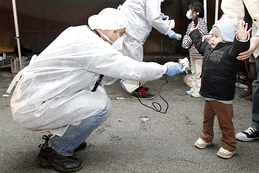
Intake of radioactively contaminated air, water and food brings radioactive material inside the body, causing internal radiation contamination. It is a critical responsibility of adults to protect lives and health of children, who will carry on the future, from radiation exposure.
Last month, there was a symposium held in New York City to discuss the “Fukushima Report” by United Nations Scientific Committee on the Effect of Atomic Radiation (UNSCEAR). A former president of a non-governmental organization (NGO) “Physicians for Social Responsibility (PSR)” and Assistant Clinical Professor in Department of Medicine at University of Iowa, John W. Rachow, M.D., urged not to underestimate the risks of health effects on Fukushima children, by excerpting the following quote by President Kennedy.
“The number of children and grandchildren with cancer in their bones, with leukemia in their blood, or with poison in their lungs might seem statistically small to some, in comparison with natural health hazards. But this is not a natural health hazard-and it is not a statistical issue. The loss of even one human life, or the malformation of even one baby-who may be born long after all of us have gone-should be of concern to us all. Our children and grandchildren are not merely statistics towards which we can be indifferent.”
This was part of the July 27th Radio and Television Address to the American People by President Kennedy, the day after the United States and the former USSR reached an agreement to sign the Partial Test Ban Treaty in 1963, in the midst of Cold War when the United States and the former USSR were engaged in the arms race.
A Fukushima child being tested for radiation exposure (March 13, 2013). (Photo courtesy of Reuters)
“A 50-year-old speech by President Kennedy fits the UNSCEAR report just right,” says Rachow.
Japans Cancer cover up law – Quietly enacted and now in place?
Arclight2011
Nuclear-news.net
Op-Ed
26 January 2014
Whilst Japans new secrecy law was being unveiled, under the noses of the big international NGO`s and Global press scrutiny (sort of), a little known Cancer Registration Law was quietly brought into being.

This registry law comes with teeth – up to a 2 year prison sentence for doctors or other health staff with the option for a huge fine (For the doctors). The law and its threatening posture means that the Law has really now begun and few if any cancer statistics will be released. Apart from coourageous japanese whistleblowers. We bloggers should all support their efforts to get the hidden truth out there to the masses.
Some debate on this is floating around the Japanese Blog scene. And I will attempt to recreate some of the comments here. I will also leave links and comments in Japanese for our Japanese viewers for further investigation;
The Cancer registration Law (がん登録法 ) had passed the lower house (It passed the Upper house sometime before) recently (6/12/13) along with the new secrets law. Doctors are complied with registering this information on their patients who have developed cancer.
They get of up to 1,000,000 yen fine or 2 years in the jail if they leak the data of their cancer patients. They said it’s going to take an effect from January in 2016 at the earliest.
The In this law all the hospitals in Japan are required to notify the specific “cancer registry “ department;
The details that will be passed exclusively to the secretive cancer registry are the ;
Names, birth dates, type of cancer , grade, treatment, and other valuable epidemiological research data.
Data in Japanese language..
http://saigaijyouhou.com/blog-entry-1385.html
http://www.mhlw.go.jp/file.jsp?id=148306&name=2r985200000352di.pdf
医療機関に患者の情報提供を義務づけ、がんに関する全国規模のデータベースを整備するなどとした「がん登録推進法」が、衆議院本会議で、可決され、成立しました。
「がん登録推進法」は、参議院ですでに可決されており、6日の衆議院本会議で可決され、成立しました。
特定秘密保護法案ばかりに抗議が集中していますが、特定秘密保護法案と同時期に可決された「がん登録法案」も非常に危険な内容となっています。「がん登録法案」という法案は癌患者の登録を定めた法案ですが、実はこの癌患者に関する情報を漏洩した方に対して、「2年以下の懲役又は100万円以下の罰金」という罰則が設けられているのです。
がん登録法では全ての病院にがん患者の氏名、生年月日、がんの種類・進行度、発見の経緯や治療内容などを届けるように義務付けているので、確かに個人情報が漏洩しないようにすることは重要だと言えます。
しかしながら、福島原発事故で行政は多くの情報隠蔽や情報工作をしていることから、この制度が悪用される可能性も考えれ、状況次第では全国の癌患者に関する情報が隠蔽されるかもしれません。がん登録法で登録された癌の情報は政府や医療関係者しか閲覧することが出来ないため、ここから何も公表されないと、私達国民は癌の発生状況などを知ることは不可能になってしまいます。
Estimate of Consequences from the Fukushima Disaster
Estimate of Consequences from the Fukushima DisasterAbstractIn the immediate aftermath of the Fukushima disaster, the plants operator, the Japanese authority and the IAEA insisted for a month that the accident would pose no (immediate) health consequences. This work explores consequences that can be expected using the USNRC code MACCS2 in order to assess the validity of the statement.All the data and information used are from available sources published during the accident bythe Japanese authorities and internet sites.A range of possible atmospheric source terms is estimated, using three methods:dosimetric measurements at the plant, simplified accident progression, and aerial USDOE maps ofsurface contamination. Estimates from other sources are also included to arrive at the ranges.Detailed site population input for the code is constructed from current information on population around the plant, Japan, Korea, China and SiberiaEvacuation models are constructed to reflect the multi stage evacuation scheme adopted during the accident.Acute consequence models are then surrogated for in input to account for effects of Acute Radiation Syndrome, and chronic health effects are corrected for the lack of reciprocity at low and intermediate doses.For the range of source terms, acute consequences are calculated as best as the code allows, given the prolonged releases from the accident, together with chronic excess deaths and illnesses.Since much of the radioactive releases are deposited in the ocean some assessment is also given of the environmental damage to the sea life.Economic impact is assessed to some extent using simplified rough data just to show also this aspect of the accident.The authors thank Mr. Salih Güntay (Paul Scherrer Institut, Switzerland) for having reviewed this work and for his many useful suggestionsExtract
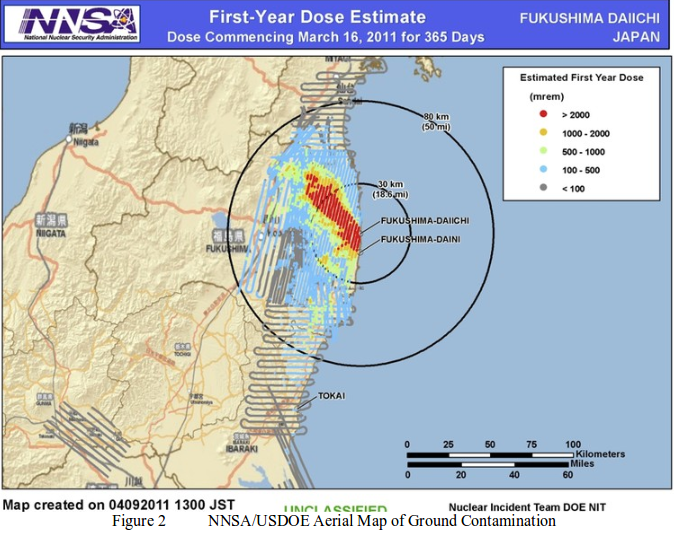
….It is obvious from all results that the IAEA, the Japanese authority and their experts were not telling the whole truth. The declarations, which, as noted, probably induced an unusually large part of the population (estimated 27%!) to remain in their homes, will probably result in an additional 200 cancer deaths or in a few months more than 20% of the total lifetime incurred dose for that population, even though they may have been forcibly removed at a later date.
The large number of cancer fatalities predicted for the City of Tokyo
results for a good part from ingestion of food and water contaminated up to the legal limits.
Individual lifetime (societal) risks of death are shown in Table 12.
Obviously the target of 1e4-year as “level of acceptable individual risk“
or “dose limited to 1 mSv per annum” regardless of frequency of occurrence [45] is well exceeded for an accident such as happened at Fukushima
for a very large number of people .Individual risk for the area almost promptly evacuated to 20 km is smaller because the 73% of the people who are removed disappear from the calculations for some time,
but they are still counted to arrive at the statistical averages….
Jiřina Vitázková, Errico Cazzoli
http://www.npsag.org/publications/download.aspx?id=1158&pid=89
| Report Title | Estimate of Consequences from the Fukushima Disaster |
|---|---|
| Reference NO | Cazzoli Consulting/Cazzoli paper 2011-09-05 |
| Project NO | 00-004 |
| Keywords | |
| Size | 1,23 MB |
| Publish Date | 2011-09-05 |
| Download |  click here to download click here to download |
Yes, things are very bad at Fukushima but it’s not the Apocalypse
Many people have been exposed to significantly elevated levels of radiation. Thousands of square kilometers have been contaminated and will be for many decades to come by radioactive fallout from the accident….
Blogpost by Jan Beránek – January 24, 2014
There have been a number of news stories recently about the radiation escaping into the ocean at the Fukushima Daiichi nuclear power plant that have raised great concern. Some are worried about how escaping radiation may or may not be affecting ocean eco-systems around the world.
Since Greenpeace has been working on the Fukushima nuclear crisis since it first began in March 2011, we can offer some thoughts on people’s concerns.
We have sampled sealife along the Japanese coastline, both from the Rainbow Warrior and in conjunction with local fishermen and Japan’s food cooperatives.
You can find some of the results of our independent measurements on our Radiation Surveys – Fukushima webpage.
While we don’t have a marine biologist on our team, we have a number of radiation specialists whose findings and assessments we share with scientists and academic researchers.
There are many reasons to be concerned about the continuing impacts of the disaster on people and the environment. These include the ongoing leaks of contaminated water from the damaged Fukushima reactors into the ground and ocean, the unresolved issue of how to reliably store huge volumes of contaminated water, as well as the massive amounts of radioactive material produced by the decontamination efforts in Fukushima Prefecture.
Then there is the plight of over 100,000 evacuees. Their lives are in limbo. After nearly three years, they still have not received proper compensation from either the government or the corporations responsible for the accident.
Nuclear firm aims to meet energy ambition
China contributes about 10 percent of AREVA global sales revenues.
[…]
China’s investment in Britain’s 16 billion pounds ($26 billion) Hinkley Point project was its first foray into Europe’s nuclear power market, according to media reports.
http://www.globaltimes.cn/NEWS/tabid/99/ID/839549/Nuclear-firm-aims-to-meet-energy-ambition.aspx
Global Times | January 27, 2014
China will become the world’s largest nuclear energy user by 2030, and more than half of the world’s new reactors will be built in China over the next 20 years, a senior executive of AREVA, a leading French nuclear technology provider, told the Global Times.
China is the fastest-growing energy market globally, said Rémy Autebert, senior executive vice president of AREVA Asia-Pacific.
The share of electricity from nuclear power projects in China can reach 10 percent or even more in 2030 from the current level of about 2 percent, he said.
The rapidly growing demand for electricity linked to economic growth, and air pollution caused in particular by traditional coal firing power generation will be the major motivators for China to develop clean and safe nuclear power plants, he noted.
-
Archives
- February 2026 (228)
- January 2026 (308)
- December 2025 (358)
- November 2025 (359)
- October 2025 (376)
- September 2025 (258)
- August 2025 (319)
- July 2025 (230)
- June 2025 (348)
- May 2025 (261)
- April 2025 (305)
- March 2025 (319)
-
Categories
- 1
- 1 NUCLEAR ISSUES
- business and costs
- climate change
- culture and arts
- ENERGY
- environment
- health
- history
- indigenous issues
- Legal
- marketing of nuclear
- media
- opposition to nuclear
- PERSONAL STORIES
- politics
- politics international
- Religion and ethics
- safety
- secrets,lies and civil liberties
- spinbuster
- technology
- Uranium
- wastes
- weapons and war
- Women
- 2 WORLD
- ACTION
- AFRICA
- Atrocities
- AUSTRALIA
- Christina's notes
- Christina's themes
- culture and arts
- Events
- Fuk 2022
- Fuk 2023
- Fukushima 2017
- Fukushima 2018
- fukushima 2019
- Fukushima 2020
- Fukushima 2021
- general
- global warming
- Humour (God we need it)
- Nuclear
- RARE EARTHS
- Reference
- resources – print
- Resources -audiovicual
- Weekly Newsletter
- World
- World Nuclear
- YouTube
-
RSS
Entries RSS
Comments RSS
 nuclear-news