Japans Cancer cover up law – Quietly enacted and now in place? – repost
Arclight2011
Nuclear-news.net
Op-Ed
26 January 2014
Whilst Japans new secrecy law was being unveiled, under the noses of the big international NGO`s and Global press scrutiny (sort of), a little known Cancer Registration Law was quietly brought into being.

This registry law comes with teeth – up to a 2 year prison sentence for doctors or other health staff with the option for a huge fine (For the doctors). The law and its threatening posture means that the Law has really now begun and few if any cancer statistics will be released. Apart from coourageous japanese whistleblowers. We bloggers should all support their efforts to get the hidden truth out there to the masses.
Some debate on this is floating around the Japanese Blog scene. And I will attempt to recreate some of the comments here. I will also leave links and comments in Japanese for our Japanese viewers for further investigation;
The Cancer registration Law (がん登録法 ) had passed the lower house (It passed the Upper house sometime before) recently (6/12/13) along with the new secrets law. Doctors are complied with registering this information on their patients who have developed cancer.
They get of up to 1,000,000 yen fine or 2 years in the jail if they leak the data of their cancer patients. They said it’s going to take an effect from January in 2016 at the earliest.
The In this law all the hospitals in Japan are required to notify the specific “cancer registry “ department;
The details that will be passed exclusively to the secretive cancer registry are the ;
Names, birth dates, type of cancer , grade, treatment, and other valuable epidemiological research data.
Data in Japanese language..
http://saigaijyouhou.com/blog-entry-1385.html
http://www.mhlw.go.jp/file.jsp?id=148306&name=2r985200000352di.pdf
医療機関に患者の情報提供を義務づけ、がんに関する全国規模のデータベースを整備するなどとした「がん登録推進法」が、衆議院本会議で、可決され、成立しました。
「がん登録推進法」は、参議院ですでに可決されており、6日の衆議院本会議で可決され、成立しました。
特 定秘密保護法案ばかりに抗議が集中していますが、特定秘密保護法案と同時期に可決された「がん登録法案」も非常に危険な内容となっています。「がん登録法 案」という法案は癌患者の登録を定めた法案ですが、実はこの癌患者に関する情報を漏洩した方に対して、「2年以下の懲役又は100万円以下の罰金」という罰則が設けられているのです。
がん登録法では全ての病院にがん患者の氏名、生年月日、がんの種類・進行度、発見の経緯や治療内容などを届けるように義務付けているので、確かに個人情報が漏洩しないようにすることは重要だと言えます。
し かしながら、福島原発事故で行政は多くの情報隠蔽や情報工作をしていることから、この制度が悪用される可能性も考えれ、状況次第では全国の癌患者に関する 情報が隠蔽されるかもしれません。がん登録法で登録された癌の情報は政府や医療関係者しか閲覧することが出来ないため、ここから何も公表されないと、私達 国民は癌の発生状況などを知ることは不可能になってしまいます。
Japan Approves Collecting All Personal Information On Muslims
Published on 26 Jan 2014
In a recent court case in Tokyo a judge decided that it is perfectly legal, without giving the legal justification, for the Japanese police to collect all personal information on Muslims for no other reason than the fact they are Muslims.
Reference:
Court: Police can gather personal information on Muslims
http://ajw.asahi.com/article/behind_n…
Just a
Japanese Universies Offer Halal Food
….Japan today is home to a thriving Muslim community of about 120,000, among nearly 127 million in the world’s tenth most populated country…..

random image source (I am not sure if this is relevant/sarc) 🙂 ; http://berliner-filmfestivals.de/2013/09/21-internationales-filmfestival-contravision-in-der-wabe
Sunday, 26 January 2014
CAIRO – A growing number of Japanese universities are offering halal meals in their menus to cater to the needs of the growing number of Muslim students.
“I’d been making my own meals until now, so this is helpful,” a 21-year-old student from Malaysia, eating a halal curry dish, told The Mainichi on Sunday, January 26.
The student was at the student cafeteria at the University of Yamanashi, where new items labeled with Halal stickers were added to the menu.
Japanese Senior Scientist Censored over Radiation Report
 Senior Scientist at MIT Event: Japanese scientists censored — Not allowed to publish research that compared Fukushima to Chernobyl — Fukushima ‘arguably’ bigger http://enenews.com/senior-scientist-at-mit-event-japanese-scientists-censored-not-allowed-to-publish-research-that-compared-fukushima-to-chernobyl-fukushima-arguably-bigger
 MIT Center for International Studies — Japan’s Continuing Nuclear Nightmare, Oct 24, 2013:
Ken Buesseler, Woods Hole Oceanographic Institution (at 31:00 in):
I kind of look at these [Chernobyl and Fukushima] and say these are similar in scale, we can argue about which one’s bigger.
 It was politically impossible, the first paper I wrote, for Japanese scientists to be co-author because I compared Fukushima to Chernobyl and that was considered not appropriate by his bosses at his institution.
Buesseler during a recent radio interview: Fukushima released “100, or 50 to 80 petabecquerels” of cesium-137 in 2011 — Chernobyl total was 70 petabecquerels Watch the presentations here
Record high radiation in 8 locations at at Fukushima Daiichi
 Jiji: Highly radioactive groundwater now flowing under Unit 1 — Levels skyrocket since last test, now 1,000s of times higher — 8 locations hit record in recent days at Fukushima Daiichi http://enenews.com/jiji-highly-radioactive-groundwater-now-flowing-under-fukushima-unit-1-levels-skyrocket-since-last-test-now-1000s-of-times-higher-8-locations-hit-record-in-recent-days
Jiji Press, Jan. 24, 2014: Tainted Water May Also Have Leaked from No. 1 Reactor at Fukushima N-Plant — Highly radioactive water accumulated in the basement of the turbine building of the No. 1 reactor […] may have contaminated groundwater, experts said Friday. […] TEPCO has explained that the groundwater may have been contaminated by highly radioactive water in underground cable tunnels of the No. 2 and 3 reactors […] however, 5,600 becquerels of radioactive tritium per liter was detected in groundwater taken on Sunday from an observation well near the turbine building of the No. 1 reactor. No radioactive tritium was detected in water collected in mid-November. […]
8 groundwater locations hit new highs for tritium since January 6 (Bq/liter):
0-2: 4,700 <1/12>
0-3-2: 73,000 <1/16>
0-4: 46,000 <1/12>
1-8: 12,000 <1/6>
1-17: 31,000 <1/16>
2-2: 660 <1/8>
2-7: 1,100 <1/17>
3-5: 170 <1/8>
Japan could restart nuclear reactors with no proper emergency plan
 Japanese nuclear power regulation does not require evacuation plan approval as a prerequisite for restarting nuclear power plants
No plan best plan in Kansai nuclear disaster Area leaders paralyzed by lack of answers, state guidance Japan Times, BY ERIC JOHNSTON 26 Jan 14 Ten months after regional governments were required to submit nuclear disaster evacuation plans, a lack of central government guidance and local-level cooperation is generating concern that Kansai will be ill-prepared to respond if any of Fukui Prefecture’s 13 commercial reactors suffers a meltdown.
Questions remain about how fleeing Fukui residents who pass through neighboring Kyoto would be stopped and screened for radiation, and how residents in the rural northern areas closest to the reactors would be gathered and evacuated in a timely manner. Evacuating the elderly, young mothers and the pregnant is also a serious concern.
There is also the question of what to do if Shiga’s Lake Biwa, which supplies drinking water to about 14.5 million people, gets contaminated with radiation.
Citizens’ groups have posed these and other detailed questions to prefectural officials in Kyoto and the Union of Kansai Governments, a loose federation of seven prefectures and four major cities in the region. But Kansai officials reply that, on many issues, there is little they can do because the central government hasn’t drafted specific guidelines…..
Kansai leaders recognize that more monitoring stations, particularly in northern Kyoto and Hyogo, are needed, but without guidance from the central government, as well as funding, there is little they can do.
Prime Minister Shinzo Abe’s government has made restarting the nation’s nuclear reactors a primary goal. The discussions have focused mostly on the technical issues related to the plants and whether the fault lines surrounding them, or in some cases under them, are active.
Given the widespread concerns, Smith says such thinking puts the cart before the horse. “It’s a very serious problem that Japanese nuclear power regulation does not require evacuation plan approval as a prerequisite for restarting nuclear power plants,” she said. http://www.japantimes.co.jp/news/2014/01/26/national/no-plan-best-plan-in-kansai-nuclear-disaster/
China’s repressive policies in Tibet
Human Rights Watch chides China for enforcing highly repressive policies in Tibet http://tibet.net/2014/01/23/human-rights-watch-chides-china-for-enforcing-highly-repressive-policies-in-tibet-2/ DHARAMSHALA: China’s policies in Tibet once again came under criticism from Human Rights Watch, which says in annual report released on Tuesday that the Chinese government systematically suppresses Tibetan political, cultural, religious and socio-economic rights.
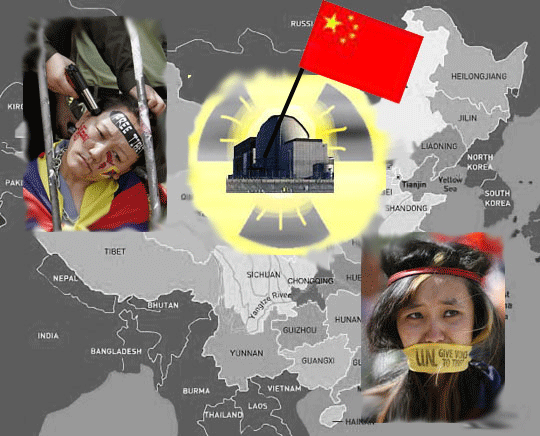 The Chinese government systematically suppresses Tibetan political, cultural, religious and socio-economic rights in the name of combating what it sees as separatist sentiment including non-violent advocacy for Tibetan independence, the Dalai Lama’s return, or opposition to government policy, the report said.
“Arbitrary arrest and imprisonment remains common, and torture and ill-treatment in detention is endemic. Fair trials are precluded by politicised judiciary overtly tasked with suppressing separatism,” it said.
“The Chinese government carries out involuntary population relocation and rehousing on a massive scale, and enforces highly repressive policies in ethnic minority areas in Tibet, Xinjiang, and Inner Mongolia,” Human Rights Watch said in its report.
“The government is also subjecting millions of Tibetans to a mass rehousing and relocation policy that radically changes their way of life and livelihoods, Continue reading
Thorium nuclear reactors (LFTRs) produce intensely radioactive wastes
 “……LFTRs are theoretically capable of a high fuel burn-up rate, but while this may indeed reduce the volume of waste, the waste is more radioactive due to the higher volume of radioactive fission products. The continuous fuel reprocessing that is characteristic of LFTRs will also produce hazardous chemical and radioactive waste streams, and releases to the environment will be unavoidable. Spent fuel from any LFTR will be intensely radioactive and constitute high level waste.
The reactor itself, at the end of its lifetime, will constitute high level waste.
The UK’s National Nuclear Laboratory (NNL) believes that considerable research, development and testing lies ahead before thorium fuels will be ready for operational use. As the NNL states, “Thorium reprocessing and waste management are poorly understood. The thorium fuel cycle cannot be considered to be mature in any area.” It estimates that 10-15 years work is required before thorium fuels will be ready for use in current reactor designs, and that their use in new types of reactor is at least 40 years away….”http://www.no2nuclearpower.org.uk/nuclearnews/NuClearNewsNo43.pdf
Renewable energy help to climate-change affected States – from UAE
“During the campaign we saw the impacts of climate change. We know those islands are among the most vulnerable to climate change.”The desire to more effectively conduct projects in the Pacific was also the reason the UAE signed the partnership arrangement with the New Zealand ministry of foreign affairs and trade.
Renewable energy projects key to UAE’s diplomatic efforts http://www.thenational.ae/uae/environment/renewable-energy-projects-key-to-uaes-diplomatic-efforts 26 Jan 14 ABU DHABI // Renewable-energy projects are now a mainstay of diplomatic efforts with developing nations, the Ministry of Foreign Affairs says.
At Abu Dhabi Sustainability Week last week, technology partnerships were signed with New Zealand and Denmark, and plans announced to give US$20 million (Dh73.4m) in aid to Pacific Island states.
Dr Thani Al Zeyoudi, director of energy and climate change at the ministry, said clean energy had been identified as a major area of focus for UAE diplomacy. Dr Al Zeyoudi said the money would go to Fiji, Kiribati, Samoa, Tuvalu and Vanuatu. Continue reading
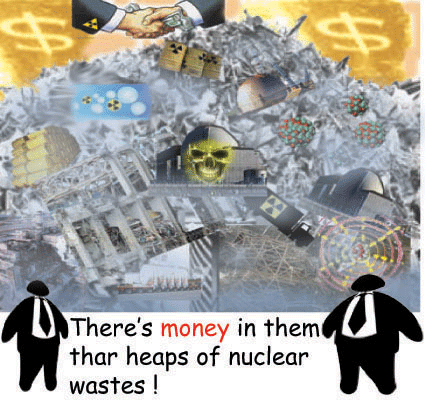
Nuclear Management Partners (NMP)’s expensive botch at Sellafield
Politicians and the deal’s numerous critics were shocked when the NDA awarded NMP the extension in October, despite a disastrous tenure during which Sellafield’s clean-up bill soared to over £70bn. The letters warn that a “re-baselining” of budgets will cause cost estimates to further spiral in April this year: “However presented, the extent of change was going to be extremely uncomfortable and difficult to sell.”
 Nuclear chief’s despair over Sellafield firm NMP revealed in letters written by UK nuclear decommissioning boss The Independent, 26 Jan 14, Damning criticism of the consortium overseeing the expensive clean-up of the Sellafield nuclear reprocessing plant has been revealed in a series of hostile letters written by John Clarke, head of the UK’s Nuclear Decommissioning Authority.
Mr Clarke accused Nuclear Management Partners (NMP) of undermining confidence and damaging the entire project’s reputation, as well as criticising Tom Zarges, the consortium chairman, of setting “unduly conservative” targets. In one letter, written in November 2012, Mr Clarke attached slides that outlined the NDA’s frustrations with NMP’s decontamination work at the Cumbrian facility, including concerns about the “quality of leadership” and the “pace of change”, which it said “feels too slow”.
The content of the letters has added to the confusion over why NMP was recently asked to continue overseeing the clean-up of one of the world’s most hazardous nuclear sites until 2019. The correspondence, which was obtained under a Freedom of Information request, covers a 21-month period to November 2013. During this time NMP and the NDA were locked in discussions over a five-year extension to a contract that was originally awarded in 2008.
Politicians and the deal’s numerous critics were shocked when the NDA awarded NMP the extension in October, despite a disastrous tenure during which Sellafield’s clean-up bill soared to over £70bn. The letters warn that a “re-baselining” of budgets will cause cost estimates to further spiral in April this year: “However presented, the extent of change was going to be extremely uncomfortable and difficult to sell.”
The harsh tenor of the letters – one of which demanded “improved performance in a number of key areas, including schedule delivery” – adds weight to suggestions that Mr Clarke did not want NMP to continue at Sellafield. The NDA looked at bringing the decontamination back under the management of the public sector.
A critical 292-page report by the accountancy firm KPMG last year showed that nine of the 11 biggest projects on the site, including the construction of a storage facility for radioactive sludge, were a combined £2bn overbudget.
Seven were also behind schedule, while KPMG argued that the structure of NMP’s contract was “inappropriate” and was designed in a way that sought to “maximise shareholder returns”. NMP is a consortium of California-based URS, France’s Areva and British engineer Amec.
Dr David Lowry, an independent environmental policy and research consultant and a member of Nuclear Waste Advisory Associates, obtained the letters. He said: “This is a massive indictment of NMP’s failure to deliver – and then to give them an extension is almost inexplicable…….http://www.independent.co.uk/news/uk/home-news/nuclear-chiefs-despair-over-sellafield-firm-nmp-revealed-in-letters-written-by-uk-nuclear-decommissioning-boss-9085512.html
Small Modular Nuclear Reactors – the $90 billion gamble
 Going nuclear-and small-with new type of reactor, 27 Jan 14 “……….recent report by the Institute for Energy and Environmental Research cast doubt on the idea that SMRs could help revive the nuclear industry.
The think tank said small reactors “still present enormous financial risks,” citing the sector’s tendency to overrun on costs. It said the four reactors under construction were in part subsidized by taxpayers. The report said the mass production of SMRs could require $90 billion, and migrating from reactors to smaller modules “is a financial risk shell game, not a reduction in risk.
THe Nuclear Medusa AREVA and its uranium mining harm to Niger
 No matter where Uranium is mined on this planet the story is the same. The marketeers operate without conscience. Uranium should not be a marketable commodity.
 World’s Poorest Suffer From Radioactive Sickness as Areva Mines for Uranium http://ecowatch.com/2014/01/24/worlds-poorest-radioactive-areva-uranium/Brandon Baker | January 24, 2014 More than 60 percent of Niger’s population lives on less than $1 per day, and even more have no electricity.
Still, French company Areva keeps contaminating those residents and their environment while mining away for uranium—one of the few resources the world’s poorest country still has. Continue reading
USA Veterans’ Affairs finally admit nuclear veteran’s radiation-caused cancer
WWII vet exposed to radiation wins fight with VA http://www.sfgate.com/bayarea/article/WWII-vet-exposed-to-radiation-wins-fight-with-VA-5173107.php Kevin Fagan , January 24, 2014 MILLBRAE – John Brenan rolled his Jeep into freshly bombed Hiroshima in 1945 on a reconnaissance mission to see if there was any enemy left to fight. The only enemy the Army sergeant found in the miles of rubble pulverized by America’s atomic attack was the one he couldn’t see – radiation.
The fallout surrounded his body, and that is almost surely why he got colon cancer four decades later, his doctors told him. Brenan managed to beat the disease, but then came the follow-up battle – filing a disability claim with the U.S. Department of Veterans Affairs.
It took until last week for him to win that battle. And victory only came with the help of a member of Congress. Continue reading
Nuclear power an election battle issue in Tokyo
 Tokyo governor race turns into battle over nuclear power, Ft.com, 24 Jan 14, By Jonathan Soble in Tokyo Fighting to be heard over the video screens that pummel Tokyo’s Shibuya district with adverts for pop bands and mobile-phone services, Morihiro Hosokawa, the 76-year-old former Japanese prime minister and anti-nuclear campaigner, launched his bid this week to be Tokyo’s next governor.
Mr Hosokawa has returned to politics after two decades of quiet retirement, a period in which he rarely spoke in public and, when he did, talked mostly about pottery, his late-life passion. His motives are reflected in his election strategy: to transform the February 9 vote from a contest for an important but limited municipal governorship to a referendum on Japan’s post-Fukushima energy policy.
This is more than just a Tokyo election,” he told a crowd of supporters and curious onlookers in Shibuya on Thursday, the first day of the formal campaign. “It’s going to decide the fate of Japan.”…….
To assuage voter concerns about the economy, Mr Hosokawa has enlisted Junichiro Koizumi, another former prime minister who is a recent convert to the anti-nuclear cause. Appearing alongside Mr Hosokawa on Thursday, Mr Koizumi, a member of the pro-business LDP, promised that Japan could have economic growth without atomic power, and pointed to the huge costs of the Fukushima clean-up to counter the view that nuclear plants provide low-cost energy.
“Nuclear power isn’t safe, and it isn’t cheap,” he said.
Such statements drew the most applause in Shibuya. “This Tokyo election is a big moment,” said Muko Muto, 49, an office worker who described herself as an opponent of atomic energy. “Pro-nuclear groups are trying to scare people by saying we can’t afford to give up nuclear power.”
Mr Hosokawa has other obstacles to overcome, however. The anti-nuclear vote is likely to be split between him and the Communist candidate, Kenji Utsunomiya, a human rights lawyer and former head of the Japan Bar Association……..
Mr Hoshi, the Asahi columnist, says Mr Hosokawa’s greatest electoral strength may be a growing sense among voters that Mr Abe’s conservative government is overreaching. The national opposition is in tatters and Mr Abe is pushing what many see as an increasingly rightwing social and security agenda, exemplified by his visit in December to the Yasukuni war shrine and the passage of an unpopular official secrets law.
“Hosokawa really has two goals,” Mr Hoshi says. “To end nuclear power and to create some kind of competition for the Abe government and its policies.”http://www.ft.com/intl/cms/s/0/1fab426c-84c7-11e3-8968-00144feab7de.html#slide0
Renewable energy is the future for Jordan, not nuclear energy
The cost issues of renewable energy are developing in such a way that are much cheaper than nuclear energy and safer, he said, indicating that there are many expenses associated with nuclear energy that are not applicable when utilising renewable resources, such as risks, insurance and development costs.
“Our belief is that renewable energy is the most viable approach for the future and much more environmentally safe,” Amin stressed.
Jordan’s future lies in renewable energy http://www.albawaba.com/business/jordan-renewable-energy-549840
 January 26th, 2014 Renewable energy is the most viable approach for the future of Jordan and regional countries, according to International Renewable Energy Agency (IRENA) Director General Adnan Amin.
“Jordan is a very interesting market because it has a very developed institutional structure in terms of government agencies dealing with energy issues,” Amin said in a recent interview with The Jordan Times on the sidelines of the Abu Dhabi Sustainability Week.
“Jordan is looking very positively at the future of renewable energy,” he added. Continue reading
Nuclear Iran less of a worry than nuclear India and Pakistan?
The evolution of South Asia’s nuclear powers, Journal Pioneer, Henry Srebrnik on January 26, 2014 While much of the world’s attention these days is focused on Iran’s nuclear program, it should not be forgotten that its eastern neighbours, Pakistan and India, South Asia’s two largest countries and long-time enemies, both are nuclear-armed states.
India is not a party to the 1968 Nuclear Non-Proliferation Treaty (NPT) and tested what it called a “peaceful nuclear explosive” in 1974. The test was the first after the creation of the NPT, and India’s secret development of nuclear weaponry, using civilian nuclear technology, caused great concern and anger from nations such as Canada, that had supplied its nuclear reactors for peaceful and power generating needs……..
India is also expanding its ability to produce highly enriched uranium for military purposes, including more powerful nuclear weapons, according to a U.S.-based think tank that cited satellite imagery taken last April of a gas centrifuge facility under construction at the Rare Materials Plant near Mysore in Karnataka.
The Institute for Science and International Security (ISIS) published a report in 2013 stating that this new facility “could significantly increase India’s ability to produce highly enriched uranium for military purposes, including more powerful nuclear weapons.”
Pakistan, too, is not a signatory to the Nuclear Non-Proliferation Treaty, and built its first nuclear power plant near Karachi with equipment and materials supplied mainly by western nations in the early 1970s. Pakistani Prime Minister Zulfiqar Ali Bhutto had promised in 1965 that if India built nuclear weapons then Pakistan would too, “even if we have to eat grass.”……http://www.journalpioneer.com/Opinion/Columnists/2014-01-26/article-3591613/The-evolution-of-South-Asia%26rsquo%3Bs-nuclear-powers/1
-
Archives
- February 2026 (228)
- January 2026 (308)
- December 2025 (358)
- November 2025 (359)
- October 2025 (376)
- September 2025 (258)
- August 2025 (319)
- July 2025 (230)
- June 2025 (348)
- May 2025 (261)
- April 2025 (305)
- March 2025 (319)
-
Categories
- 1
- 1 NUCLEAR ISSUES
- business and costs
- climate change
- culture and arts
- ENERGY
- environment
- health
- history
- indigenous issues
- Legal
- marketing of nuclear
- media
- opposition to nuclear
- PERSONAL STORIES
- politics
- politics international
- Religion and ethics
- safety
- secrets,lies and civil liberties
- spinbuster
- technology
- Uranium
- wastes
- weapons and war
- Women
- 2 WORLD
- ACTION
- AFRICA
- Atrocities
- AUSTRALIA
- Christina's notes
- Christina's themes
- culture and arts
- Events
- Fuk 2022
- Fuk 2023
- Fukushima 2017
- Fukushima 2018
- fukushima 2019
- Fukushima 2020
- Fukushima 2021
- general
- global warming
- Humour (God we need it)
- Nuclear
- RARE EARTHS
- Reference
- resources – print
- Resources -audiovicual
- Weekly Newsletter
- World
- World Nuclear
- YouTube
-
RSS
Entries RSS
Comments RSS
 nuclear-news