DEC to State Senate: Fukushima Radiation Not a Risk to Alaska’s Fish
Thursday, January 23 2014
The state Senate Resources Committee got an overview Wednesday of how Alaska is dealing with potential impacts of radiation from the 2011 Fukushima nuclear disaster and tsunami in Japan.
Environmental Conservation commissioner Larry Hartig told committee members that his department is monitoring marine debris washing ashore in Southeast Alaska and the Prince William Sound.
“For now, we have a lot more debris than we used to have that came in from Japan, and Alaska got more than its share of it,” he said. “Most of it’s been just solid waste — it hasn’t been anything that’s what we would deem as hazardous waste.”
He said the DEC doesn’t have a separate program to keep an eye out for radiation in the debris. Since it flows here via California and Washington, he said federal programs in those states have it covered.
“They have been monitoring for radiation, and they’re not seeing any kind of levels of human concern,” he said. “So when we look at this, there hasn’t been a driving need in Alaska to try to institute a program, particularly where we’d be starting it from scratch.”
Committee members wanted reassurance that Alaska’s fish stocks weren’t at risk, either. Hartig said the programs in the Lower 48 (?? – arclight2011) are testing fish that swim between the Gulf of Alaska, the West Coast and Japan, and they’re sure the fish are safe to eat.
“It worries me, frankly, when you see speculation, because we sell our fish in the international market, and there’s people that would love to discourage Alaska fish,” he said. “We’ve got to be careful when we throw things out there that we have an industry that’s dependent on the reputation of our fish.”
He said they’re working with other groups in the state to reassure buyers that Alaskan fish aren’t contaminated.
Hartig’s presentation was part of a committee overview of all of DEC’s programs. It was the committee’s first meeting of the new legislative session.
101 East : Japan: The next wave – What is the truth of the increase in childrens thyroid cancer?
Published on 23 Jan 2014
We investigate the long-term effects of the 2011 tsunami, including a potential cancer threat for Fukushima’s children.
Congenital Hypothyroidism and Fukushima Fallout in the US
http://southweb.org/lifewise/congenital-hypothyroidism-and-fukushima-fallout-in-the-us/
By Dr Mae-Wan Ho of the Institute of Science in Society:
Plume of airborne radioactive iodine arrival in the US correlates with increased rates of congenital hypothyroidism among the new born.
A new study finds congenital hypothyroidism in the US rising 28 % in the two and a half months after the arrival of the Fukushima fallout of radioactive iodine (I-131) [1]. Researchers and authors Joe Mangano and Janette Sherman from the Radiation and Public Health Project [2] have done a thorough job based on data from the US government
ExtractMangano and Sherman stress that the findings should be regarded as preliminary, and require confirmation and expansion, including long-term follow-up of infants and other children. CH is only one indicator for the health impacts of the Fukushima fallout. Other indicators of foetal/infant health include foetal deaths, premature births, low weight births, neonatal deaths, infant deaths and birth defects; and those should also be monitored. While any adverse impacts would be expected to affect first the most susceptible foetus and infant, changes in the health status of older children and adults may also occur.
Sure enough, thyroid cancer among the young has shot up in Fukushima, and scores of US sailors exposed while performing rescue work near Fukushima in March 2011 have been diagnosed with thyroid cancer, testicular cancer, leukaemia, and other illnesses…..
As I See It: Include risks of major volcanic eruptions in nuclear reactor safety assessment in Japan
Nuclear power plants and their surrounding areas would be buried under volcanic ash, making it impossible to control nuclear reactors for long periods of time. Even if radioactive materials were to leak from the reactors, we would not be able to reach the facilities to do anything about it. It would put the very survival of the country at risk.
h/t ; http://fukushima-is-still-news.over-blog.com/
http://mainichi.jp/english/english/perspectives/news/20140122p2a00m0na007000c.html
January 22, 2014
The risks of earthquakes and tsunami causing nuclear disasters have garnered much attention among experts and the public, but I feel a grave need to raise awareness on how much greater a risk a massive volcanic eruption poses on nuclear reactors in Japan.
Volcano experts surveyed for a Mainichi Shimbun article published last December said they were most concerned with the impact of a major volcanic eruption on Kyushu Electric Power Co.’s Sendai Nuclear Power Plant, located in Kagoshima Prefecture, followed by Hokkaido Electric Power Co.’s Tomari Nuclear Power Plant in Hokkaido.
Some 10 years ago, a volcanologist told me that pyroclastic sediment was commonly found in the surrounding areas of both Sendai and Tomari nuclear power stations. I was working at the Mainichi Shimbun’s Shimabara Local Bureau in Nagasaki Prefecture at the time, and had been learning about earthquakes and volcanoes through my coverage of the eruption of Mount Unzen-Fugendake that began in 1990.
Consisting of high-temperature substances such as lava and volcanic ash, pyroclastic flows spread at rapid speeds and are some of the most terrifying phenomena resulting from volcanic eruptions. In 1991, a Mainichi Shimbun photographer and 42 others were killed by pyroclastic currents from Mount Unzen-Fugendake.
In volcanology terms, however, the Mount Unzen-Fugendake eruptions are considered minor. Pyroclastic currents from a massive eruption would be beyond comparison.
Massive eruptions, which have occurred in Japan about once every 6,000 to 10,000 years, cause pyroclastic flows that can bury an area within several dozen to over 100 kilometers of the volcano, and create calderas measuring over 10 kilometers in diameter. Volcanic ash from a massive eruption can cover the entire Japanese archipelago, or even parts of the rest of the world.
TPP – Sacrificing the Environment for Corporate Interests – Wikileaks
http://wikileaks.org/tpp-sacrificing-the-environment.html
15 January 2014
The leaked secret draft of the TPP´s (Trans-Pacific Partnership) Environment Chapter, published today by WikiLeaks, underscores how multinational corporate interests rule the negotiating process of this important 12-nation treaty, representing more than 40 per cent of the world’s GDP and one-third of world trade.
On 13 November last year, WikiLeaks released the secret draft text of the Intellectual Property Rights Chapter, which showed how nations were forced to change laws and to prosecute in defence of the biggest corporate interests in the field of IP rights.
In sharp contrast, the Environment Chapter does not include enforcement mechanisms serving the defence of the environment; it is vague and weak, and adheres to the lowest common denominator of environmental interests.
The word “appropriate” is found in various forms in 43 places in the draft text, in such contexts as: “Where possible and appropriate, the Parties shall seek to complement and utilise their existing cooperation mechanisms and take into account relevant work of regional and international organizations.” The word “may” is also found 43 times in the 23-page draft.
In the draft Consolidated Text, governments are urged to “…make every effort to arrive at a mutually satisfactory resolution…”, “…by any technological means available agreed by the consulting Parties…”, “…on the basis of objectivity, reliability and sound judgment…”, “…provided that the disputed Parties so agree…”, “…take measures to prevent…”, “…shall make best efforts…”, “…exercise restraint in taking recourse…”, “…in recognition of the importance…”, “…each Party retains the right to make decisions…”, “…adopt or maintain appropriate measures…”.
A selection of other favourite words in the draft include: “enhance” (12), “consider” (12), “encourage” (11), “address” (10), “endeavour” (9) and “seek” (9).
The Environment Chapter clearly shows the intention to first and foremost protect trade, not the environment. The principle is spelled out in this draft that local environmental laws are not to obstruct trade or investment between the countries. Furthermore, there is great emphasis on the self-regulatory principle when it comes to environmental protection, and emphasis on “…flexible, voluntary mechanisms, such as voluntary auditing and reporting, market-based incentives, voluntary sharing of information and expertise and public-private partnership”. But even such measures should be designed in a manner that “…avoids the creation of unnecessary barriers to trade”.
The Consolidated Text of the Environment Chapter of the TPP Agreement was drafted by Canadian officials after bilateral consultations with other TPP Parties. It is dated November 24, 2013, the last day of the TPP Chief Negotiators’ summit in Salt Lake City, Utah. It outlines what the Chairs of the TPP Environment Working Group evaluate as a compromise of the Parties’ different positions across issues. In a separate four-page document the Chairs of the Environment Working Group outline the main obstacles to agreement between the negotiating countries.
It is noteworthy in the assessment by the Chairs that the US government is isolated in its interest in placing enforcing mechanisms into the treaty to protect the environment. Without access to the negotiating table, it is hard to assess if the US representatives fought for this principle with the same vigour as they did for policing and enforcement on behalf of intellectual property interests, as can be seen in the leaked IP Chapter.
The TPP negotiations have been shrouded in secrecy during the three years the treaty has been in the making. The United States, as the largest of the 12 economies party to the negotiations, had originally pushed for the closure of the agreement before the end of 2013. According to recent reports quoting Andrew Robb, the Australian trade minister, the negotiations are in the final stages and the treaty is “ready to be sealed”.
The Obama administration wants to fast-track the TPP treaty through the US Congress, preventing Congress from amending or discussing any part of it. A bill to this effect was released last Thursday, 9 January, by the leaders of the Congressional committees with jurisdiction over US free trade agreements.
With the WikiLeaks release of the drafts of two of the most controversial chapters of the TPP, the media has now an opportunity to critically dissect the issues with the public interest in mind.
The TPP negotiations have wider implications than for the 800 million people in the 12 negotiating countries because the US administration, the dominant Party at the table, has declared that the principles outlined in the TPP will be a benchmark in the equally secretive US-EU trade talks for the TTIP (Transatlantic Trade and Investment Partnership) initiated in January 2013.
Current TPP negotiation member states are the United States, Japan, Mexico, Canada, Australia, Malaysia, Chile, Singapore, Peru, Vietnam, New Zealand and Brunei.
by Kristinn Hrafnsson, WikiLeaks Spokesperson
Press release: Secret Trans-Pacific Partnership Agreement (TPP) – Environment Chapter
http://wikileaks.org/tpp-enviro/pressrelease.html
Today, 15 January 2014, WikiLeaks released the secret draft text for the entire TPP (Trans-Pacific Partnership) Environment Chapter and the corresponding Chairs’ Report. The TPP transnational legal regime would cover 12 countries initially and encompass 40 per cent of global GDP and one-third of world trade. The Environment Chapter has long been sought by journalists and environmental groups. The released text dates from the Chief Negotiators’ summit in Salt Lake City, Utah, on 19-24 November 2013.
The way towards Nuclear Fascism- the Price Anderson Act
Is Nuclear Experimentation Fascism? 1/22/2014 By Ethan Indigo Smith (about the author) opednews.com
“….Today, the United States of America is fascist. So is China, Japan, Russia, France, England, Japan and every single nuclear nation.
Australia is de facto fascist, being a major extractor of uranium for the nuclear fuel chain.
The United States of America is fascist by way of one single act: The Price Anderson Nuclear Industries Indemnity Act. There are many more acts and laws that strengthen nuclear fascism in the United States, but The Price Anderson Act seals the deal. Its main purpose is to indemnify the nuclear industry against liability claims arising from nuclear incidents. And other countries have their own nuclear deals which also guarantee that those who profit from the nuclear industry are not held accountable for their work.
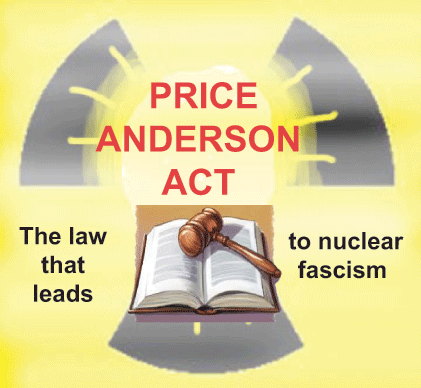
The Price Anderson Act illustrates the U.S.A.’s fascist trail, and that nuclear experiment cleared the way for it in the first place. The Act makes it so that nuclear power generation experiments can operate at all, otherwise no insurance corporation would insure them. The insurance companies that deal with nuclear experimentation only do so because the Act limits their responsibility in the event of an accident, such as the Fukushima meltdown. If there is an accident that costs more than the capped amount, insurance companies pay out up to and including their cap, and communities and governments foot the bill for the remaining clean up costs. Put simply”. they profit, you pay. Not to mention the non-financial costs of human and planetary health.
The Price Anderson Act endorses fascism in the United States, and in the bigger picture, nuclear experimentation guarantees fascism no matter what nation is doing the experimenting — whether Israel, China, Iran or the U.S. or Japan. The nuclear power industry could not survive without placing all the risk on the shoulders of taxpayers. And by doing so, the Price Anderson Act enables nuclear oligarchical fascists to make a fortune by endangering everyone and everything on the planet.
Even if nuclear facilities operated to their original design specifications rather than running components on extended operation (by years) and over-crammed fuel pools, as is the case today, the industry is still unworkable. But today, most if not all nuclear power generation experiments in the U.S.A. have fuel pools loaded with waste material beyond original design specifications, but the nuclear industry and its regulators seem content continuing down this path — and waiting for our grandchildren to figure out what to do with the mess they leave behind…. http://www.opednews.com/articles/Is-Nuclear-Experimentation-by-Ethan-Indigo-Smith-Fukushima_Nuclear-Cover-up_Nuclear-Meltdown_Nuclear-Waste-140122-627.html
Nuclear Hotseat #135: Fukushima – On the Ground in Japan with Beverly Findlay-Kaneko – Report
DOWNLOAD HERE:
http://lhalevy.audioacrobat.com/download/c3ca353a-7c23-a7e5-9138-3e36ea746626.mp3
INTERVIEW: Beverly Findlay-Kaneko of Families for Safe Energy reports on the deeply human side of Fukushima following her recent trip back home. Learn how nuclear refugees cope with radiation and catch up with the heartbreaking story of former Fukushima resident Setsuko Kida, previously interviewed on Nuclear Hotseat #127.
– See more at: http://www.nuclearhotseat.com/1679/#sthash.QPQt8Rkl.dpuf
Independent news website advises Japan to embrace citizen-based news
Jan 23, 2014

The head of an independent news website who went on a reporting tour of Japan has advised the local media to embrace citizen-based reporting as a way of helping improve society. Amy Goodman is the executive director of Democracy Now!, a Web-based site that advocates citizen journalism and airs in over 1,000 countries worldwide.
Goodman went around the country and interviewed evacuees from the Fukushima region, who were forced to leave their homes after the nuclear meltdown at the Fukushima Daiichi plant in 2011. She also met with residents of Okinawa who have been protesting the huge U.S. military presence, the largest in the region, in their prefecture. She said there is a different kind of power that comes from reading about the personal experiences of those who are in the thick of the situation.
She shared her thoughts and experiences with the Foreign Correspondents’ Club of Japan in Tokyo on Monday. She talked to them about the philosophy of Democracy Now! which is to bring a different perspective on news events that are independent from news outlets that may be profit or politics driven. They focus on such topics like climate change, national security, secrecy, racial discrimination and other similar issues. They believe that because the “common people” are given a voice through citizen journalism, there is a greater possibility to get actual action and results.
She used the example of how the public outcry over safety issues in nuclear plants has kept all of the plants closed and reactors offline, despite the current administration’s plans to still push nuclear power. “Imagine the possibilities for the rest of the world if more voices were heard,” she said.
[ via Wall Street Journal ]
U.S. Nuclear Waste Disposal — Only One Company Cashing In
….However Tom Smith, an environment specialist who leads Public Citizen Texas, noted his concern about the location of a local aquifer that had once been mapped to run under the site. A more recent map showed that the aquifer ended before the site began, but Smith called into the credentials of this map, based on the fact that the chancellor for the Texas Tech University System was once a lobbyist for WCS….
by
Jan 22nd 2014 1:09PM
Updated Jan 22nd 2014 1:10PM
http://www.dailyfinance.com/2014/01/22/us-nuclear-waste-disposal-only-one-company-cashing/
This article was written by Oilprice.com — the leading provider of energy news in the world
Each year the U.S. spends an estimated $30 billion on nuclear waste disposal, yet due to the incredibly high barriers to entry into the market there are almost no companies that offer disposal services. Many organizations over the years have tried to establish low-level waste disposal sites, but only one site has actually opened, giving the controlling company, Waste Control Specialists (WCS) a monopoly of the market and allowing it to earn a substantial portion of the $30 billion.
Rodney Baltzer, president of WCS, explained to The New York Times that the company has dug a huge pit in Andrews Country, Texas, with others planned to be dug over the next few years, into which a base layer of nearly waterproof clay has been set. Then a layer of concrete was poured on top, reinforced with steel, and then three layers of plastic. The low-level nuclear waste is loaded into large concrete containers and then placed in the pit, which once full will be covered by a 40-foot thick cap of concrete, clay, and finally a special cap to prevent prairie dogs from burrowing into the area.
All this allows the waste to be buried for thousands of years in a safe manner, and WCS benefits by being able to sell the space inside from anywhere from $1,000 up to $10,000 per cubic foot.

The pit where the waste is stored.
Low-level nuclear waste is a term that includes contaminated tools, protective clothing, used-up filters for radioactive water, hospital and laboratory wastes, and also all debris (radioactive steel and concrete) from demolished nuclear power plants. Demand is expected to start to grow as more nuclear reactors around the country approach the end of their lives and demolition crews move in.
Japan’s Hosokawa, With Fukushima in Mind, Wants To Close All Nuclear Sites in Japan — Sure To Clash With PM Shinzo Abe
By Isabel Reynolds and Takashi Hirokawa
Bloomberg
23 January 2014
Extract..
“The myth that nuclear power is clean and safe has collapsed,” Hosokawa told reporters in Tokyo today. “We don’t even have a place to store nuclear waste. Without that, restarting the plants would be a crime against future generations.”
The mothballing of the nation’s 48 reactors after the Fukushima accident in March 2011 forced Japan to step up fuel imports, widening the current account deficit and hampering efforts to contain the world’s biggest debt. A victory in Tokyo, which produces about a fifth of Japan’s economic output, would hand Hosokawa a platform to oppose Abe’s efforts to restart the plants.
Abe’s Support
“With Hosokawa running, it puts nuclear power back on the agenda in a way they can’t take off,” said Steven Reed, professor of political science at Chuo University in Tokyo. Abe’s coalition will suffer if the nuclear topic becomes a singular issue in the Tokyo race, he said. “They can’t win that one.”
Abe visit: Indo-Japan nuclear pact unlikely
Extract
Given this sticky issue between negotiators from both sides, no nuclear agreement is expected to be signed during Abe’s visit from January 25 to 27, sources said. Singh met Abe in Tokyo in May last year, and again in Brunei in October on the sidelines of East Asia summit.
However, sources said there will be a reference to the “progress” made during negotiations on the proposed nuclear deal. On civil nuclear cooperation, the two PMs had confirmed in May that the two countries would accelerate negotiations for the early conclusion of a bilateral agreement.
Dame Barbara Judge – Japan has no choice! Nuclear or nothing!
“It will be very difficult to convince the public that nuclear is the solution.” http://theunhivedmind.com/wordpress3/2013/07/06/lady-barbara-judge-hired-to-help-tepco-rebuild-its-reputation-after-fukushima/
…She added: “I was amazed at how much work had been done to clear up the site and the high aspiration to make the site the safest in the world.””’ http://enenews.com/cnn-american-fukushima-daiichi-fantastic-amazed
….”Yes.” The Japanese have no choice, really, because the alternative—importing liquefied natural gas (LNG)—is far too expensive….
HOT: Uranium
http://www.equities.com/editors-desk/stocks/energy/energy-outlook-what-s-hot-in-2014
During a recent trip to London, I spoke with Lady Barbara Judge, chairman emeritus of the UK Atomic Agency and an advisor to TEPCO on the Fukushima nuclear disaster in Japan. I asked her point-blank whether Japan was willing to bring any nuclear reactors back online in 2014.
Her answer was an unequivocal “Yes.” The Japanese have no choice, really, because the alternative—importing liquefied natural gas (LNG)—is far too expensive.
Japan is the world’s largest importer of LNG and has had to double its imports since the Fukushima incident. For that privilege, the country pays some of the highest rates on the planet—almost four times more than what we pay for natural gas in North America.
South Korea also shut down its nuclear plants post-Fukushima to do inspections and maintenance upgrades, and it, too, has had to import a lot of LNG. Both countries are looking to restart their nuclear reactors so they can stop paying a fortune to foreign energy suppliers. When these countries restart their reactors, they’ll also restart the uranium market, so we expect uranium prices to begin to shake loose of the doldrums this year.
Another driver will be throwing the switch at ConverDyn, the US uranium facility that is slated to start converting natural U3O8 to reactor-ready fuel in late 2014 or early 2015.
We currently hold two solid uranium companies in the portfolio—one is a US-based small-cap producer (one of the very few in America), the other is the lowest-risk way to play the uranium market that I know of. Both, we believe, will take off in 2014 on the renewed interest in uranium and the associated stocks.
By Marin Katusa, Chief Energy Investment Strategist
– See more at: http://www.equities.com/editors-desk/stocks/energy/energy-outlook-what-s-hot-in-2014#sthash.s4u3WDuO.dpuf
1 This Month
Chernobyl: The Lost Tapes – A good documentary on Chernobyl on SBS available On Demand for the next 3 weeks– https://www.sbs.com.au/ondemand/tv-program/chernobyl-the-lost-tapes/2352741955560

of the week–London Campaign for Nuclear Disarmament

Tell the Ukrainian Government to Drop Prosecution of Peace Activist Yurii Sheliazhenko
To see nuclear-related stories in greater depth and intensity – go to https://nuclearinformation.wordpress.com
-
Archives
- April 2026 (126)
- March 2026 (251)
- February 2026 (268)
- January 2026 (308)
- December 2025 (358)
- November 2025 (359)
- October 2025 (376)
- September 2025 (257)
- August 2025 (319)
- July 2025 (230)
- June 2025 (348)
- May 2025 (261)
-
Categories
- 1
- 1 NUCLEAR ISSUES
- business and costs
- climate change
- culture and arts
- ENERGY
- environment
- health
- history
- indigenous issues
- Legal
- marketing of nuclear
- media
- opposition to nuclear
- PERSONAL STORIES
- politics
- politics international
- Religion and ethics
- safety
- secrets,lies and civil liberties
- spinbuster
- technology
- Uranium
- wastes
- weapons and war
- Women
- 2 WORLD
- ACTION
- AFRICA
- Atrocities
- AUSTRALIA
- Christina's notes
- Christina's themes
- culture and arts
- Events
- Fuk 2022
- Fuk 2023
- Fukushima 2017
- Fukushima 2018
- fukushima 2019
- Fukushima 2020
- Fukushima 2021
- general
- global warming
- Humour (God we need it)
- Nuclear
- RARE EARTHS
- Reference
- resources – print
- Resources -audiovicual
- Weekly Newsletter
- World
- World Nuclear
- YouTube
-
RSS
Entries RSS
Comments RSS
 nuclear-news