Advice to cardiologists to reduce radiation exposure
Cardiologists urged to reduce inappropriate radiation exposure, Medical Press 8 Jan 14 Cardiologists are being urged to reduce patient radiation exposure in a European Society of Cardiology (ESC) position paper which outlines doses and risks of common cardiology examinations for the first time. The paper is published today in the European Heart Journal.
Lead author, Dr Eugenio Picano, FESC, said: “Cardiologists today, are the true contemporary radiologists. Cardiology accounts for 40% of patient radiology exposure and equals more than 50 chest X-rays per person per year.”
He added: “Unfortunately, radiation risks are not widely known to all cardiologistsand patients and this creates a potential for unwanted damage that will appear as cancers, decades down the line. We need the entire cardiology community to be proactive in minimising the radiological friendly fire in our imaging labs.”
The paper lists doses and risks of the most common cardiology examinations for the first time. Computed tomography (CT), percutaneous coronary intervention (PCI), cardiac electrophysiology and nuclear cardiology deliver a dose equivalent to 750 chest X-rays (with wide variation from 100 to 2,000 chest X-rays) per procedure. These procedures are performed daily in all cardiology in- and out-patient departments, usually more than one procedure per admission. They are used for all forms of cardiac disease, from congenital to heart failure, but more intensively and frequently for ischemic heart disease.
PCI for dilation of coronary artery stenosis totals almost 1 million procedures per year in Europe. The additional lifetime risk of fatal and non-fatal cancer for one PCI ranges from 1 in 1000, to 1 in 100 for a healthy 50 year old man. Risks are 1.38 times higher in women and 4 times higher in children. Children’s higher risk is because their cells divide more quickly and they have more years in which to develop cancer.
Dr Picano said: “Even in the best centres, and even when the income of doctors is not related to number of examinations performed, 30 to 50% of examinations are totally or partially inappropriate according to specialty recommendations. When examinations are appropriate, the dose is often not systematically audited and therefore not optimised, with values which are 2 to 10 times higher than the reference, expected dose.”
The paper aims to reduce the unacceptably high rate of inappropriate examinations and reduce excessive doses in appropriate examinations. Dr Picano said: “In these hard economic times, 50% of the costly and risky advanced imaging examinations we do are for inappropriate indications. Politicians’ top priority should be to audit and cut down on useless and dangerous examinations.”…….http://medicalxpress.com/news/2014-01-cardiologists-urged-inappropriate-exposure.html
Turkey gets its demand to enrich uranium into its nuclear agreement with Japan
 Ankara ‘adds’ uranium clause in nuclear deal with Tokyo, Hurriyet Daily News, 9 Jan 14 ISTANBUL/TOKYO Ankara demanded allowance for uranium enrichment and plutonium extraction in a nuclear export deal inked with Tokyo, a Japanese daily quoted as a Japanese Foreign Ministry official as saying.
A clause, which was added in the nuclear agreement signed by the two nations, upon Turkey’s demand prompted concerns over a possible proliferation of nuclear weapons.
The clause at issue allows Turkey to enrich uranium and extract plutonium, potentially creating nuclear material for weapons, Japanese daily Asahi Shimbun reported on Jan. 8…..http://www.hurriyetdailynews.com/nuclear-deal-with-turkey-stirs-concerns-in-japan.aspx?pageID=238&nID=60729&NewsCatID=34
USA poll shows concern about climate change, favouring green energy
Poll: Green power should replace nuclear,U-T San Diego By Morgan Lee9 A.M.JAN 8 A majority of utility customers in San Diego and Orange counties say climate change considerations should weigh in replacing power from the recently retired San Onofre nuclear plant, according to a survey released Wednesday by the Sierra Club.
The survey conducted by Raleigh, N.C.-based Public Policy Polling found 51 percent of utility customers believe the “potential impact on climate disruption” should be a major consideration in replacing San Onofre. An additional 25 percent said climate issues should be a minor consideration, 19 percent said climate should not be a consideration at all and 5 percent were not sure. …..http://www.utsandiego.com/news/2014/jan/08/survey-hightlights-green-energy/
Nuclear weapons now accessible to fewer countries
Number of Nuclear Capable Countries Drops, VOA January 08, 2014 The number of countries possessing the makings for a nuclear weapon has dropped by almost one-quarter during the past two years, according to a study by the U.S. based Nuclear Threat Initiative. But the study released Wednesday says there are “dangerous weak links” in nuclear materials security that could be exploited by terrorist groups.
The Nuclear Threat Initiative says Mexico, Sweden, Ukraine, Vietnam, Austria, the Czech Republic and Hungary have removed all or most of the weapons-usable nuclear materials from their territory since 2012. It says there are 25 countries with at least one kilogram of weapons-usable nuclear materials, down from 32 countries in 2012……http://www.voanews.com/content/number-of-nuclear-capable-countries-drops/1825957.html
UKIP go nuclear
I can’t help myself – my comment on the post below is going to have to appear here at the top
– Christina Macpherson
YOUR correspondent Mike Rath asks if UKIP is pro-nuclear, and whether he can expect a nuclear power station in Devon (Is UKIP keen on nuclear? Journal, December 19).
The answer is that UKIP favours proven, grown-up energy technologies like nuclear, coal and gas, rather than ineffective playground technologies like solar and wind ( and this? https://nuclear-news.net/2013/05/03/an-aluminium-fuel-cell-why-is-uk-government-blocking-it/ )
I daresay Mr Rath wants the lights to come on when he flicks the switch. So we need power stations, and they have to go somewhere. I daresay most people would prefer a single power plant to a thousand wind turbines.
And the curious thing is that people who live near nuclear power stations seem much more positive about them than those who don’t. Nearby residents see the benefits in terms of jobs and prosperity.
UKIP currently has no policy on where new nuclear capacity should be sited. The Government seems to favour putting new nuclear on the same sites as existing plants, and this seems a reasonable approach.
ROGER HELMER MEP,
UKIP Spokesman on Energy.
South Korea extends reactor shutdown after 2 workers drown in drain
Jan 9 (Reuters) – South Korea’s nuclear operator said on Thursday it had been told to extend the shutdown of a nuclear reactor to improve safety after two workers drowned this week when the water level in a drain rose.
http://uk.reuters.com/article/2014/01/09/nuclear-korea-idUKL3N0KJ0NU20140109
Korea Hydro & Nuclear Power Co Ltd was ordered by a local labour office to keep the plant closed until it had strengthened safety for workers after the deaths on Monday.
The 1,000-megawatt Hanbit No. 5 reactor had already closed for scheduled maintenance due to run from Dec. 12 to Jan. 19.
South Korea has been under pressure to ensure stable power supply due to a nuclear safety scandal which led to shutdowns of some nuclear reactors in a country where about a third of its electricity comes from nuclear power.
Ahead of peak winter demand this month, the nuclear regulator last week approved the restart of three reactors shut since last May to replace cables supplied with fake safety certificates.
Asia’s fourth-largest economy has 23 nuclear power plants. Of the 23, three are offline including the Hanbit No. 5.
A second is awaiting an extension of its licence after its 30-year lifespan expired in November 2012 and another is shut for scheduled maintenance extended to mid-January to repair cracks found on the reactor head. (Reporting By Jane Chung; Editing by Ed Davies)
Nuclear Hotseat #133 – Debunking Radioactive beaches Sean Bonner of Safecast – No Cesium!
Petition asking for leniency in the sentencing of peaceful anti-nuclear weapons protesters 84-year-old Sister Megan Rice – a Buddhist nun, Michael Walli and Gregory Boertje-Obed for their non-violent yet deeply embarrassing (to the government) protest at the Oak Ridge Site: http://act.rootsaction.org/p/dia/action3/common/public/?action_KEY=9007
http://www.nuclearhotseat.com/blog/
DOWNLOAD HERE:
http://lhalevy.audioacrobat.com/download/4ce1e3ca-cf08-a2d1-0e96-4cee50141e3c.mp3
INTERVIEWS: The holiday season saw rumors flying about Fukushima, radiation and elevated dangers in the U.S. Wildly exaggerated claims got picked up by mainstream media and had people panicking. Nuclear Hotseat gets to the root of the problems with Sean Bonner, one of the founders of Safecast. He talks about how a radiation reading can be misinterpreted in and directly addresses the Internet video claiming Fukushima radiation had risen to life-threatening levels at a California beach. Here’s a link to the report referenced in the interview: http://blog.safecast.org/2014/01/radiation-on-california-beaches/
Then Mimi German of RadCast talks about the psychology of the anti-nuclear echo chamber and what we need to do to stay centered, grounded and accurate in interpreting radiation numbers.
Image by 281_Antinuke
Image by 281
NUMNUTZ OF THE WEEK: Japan’s Monju nuclear breeder reactor picks up computer virus in control room. Oy!
PLUS:
Fukushima prefectural government and Fukushima Medical University sign secrecy pact with International Atomic Energy Agency (IAEA);
TEPCO restructures so it can still make money while continuing to fumble the Fukushima Daiichi clean-up;
Plutonium dump with levels 1,000 times normal found in Pacific Ocean 50 miles west of San Francisco;
Russia banned shipments of more than 130 radioactive cars from Japan in 2013;
Ireland’s government and citizens now able to sue the UK over nuclear contamination, damages.
LINKS:
Arnie Gundersen‘s report debunking rumors of new meltdown at Fukushima Unit 3: http://fairewinds.org/demystifying/fukushima-daiichi-unit-3-going-explode
Petition asking for leniency in the sentencing of peaceful anti-nuclear weapons protesters 84-year-old Sister Megan Rice – a Buddhist nun, Michael Walli and Gregory Boertje-Obed for their non-violent yet deeply embarrassing (to the government) protest at the Oak Ridge Site: http://act.rootsaction.org/p/dia/action3/common/public/?action_KEY=9007

Buesseler, K.O. 2014. – Fukushima and Ocean Radioactivity. Oceanography
…The Fukushima disaster provides a critical tool for the ocean science community to study fundamental physical, chemical, and biological processes in the Pacific Basin for as long as we can detect traces of the suite of long-lived radionuclides that originated there. It should serve as a call for ocean scientists to turn their attention to all aspects of this event, which continues to unfold and to present a plethora of new challenges, opportunities, and questions….
EARLY ONLINE RELEASE
Posted January 5, 2014

THE FUKUSHIMA DISASTER PROVIDES
A CRITICAL TOOL FOR THE OCEAN SCIENCE
COMMUNITY TO STUDY FUNDAMENTAL PHYSICAL,
CHEMICAL, AND BIOLOGICAL PROCESSES IN
THE PACIFIC BASIN FOR AS LONG AS WE CAN
DETECT TRACES OF THE SUITE OF LONG-LIVED
RADIONUCLIDES THAT ORIGINATED THERE.
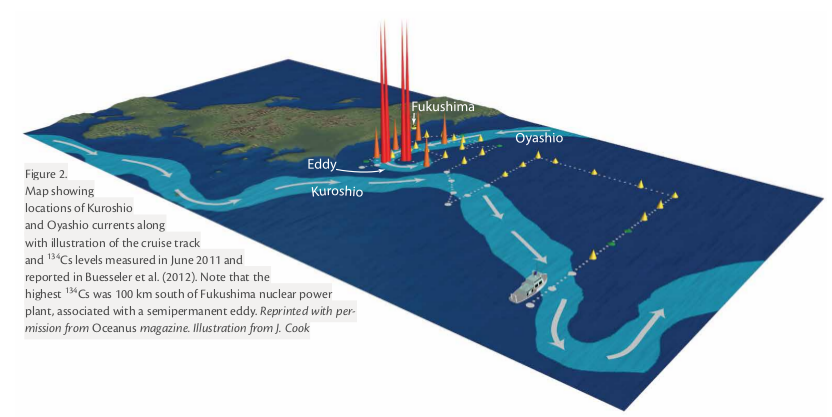
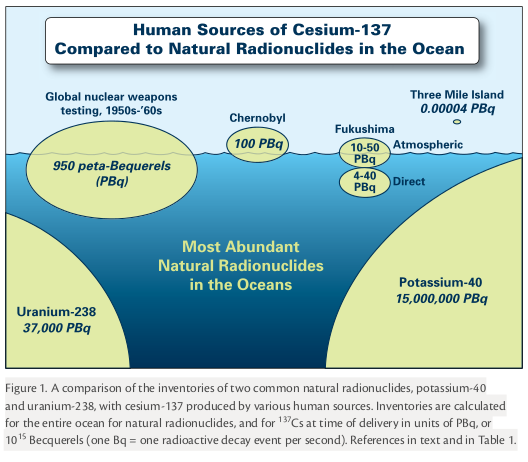
THE FACT THAT WE LIVE IN A RADIOACTIVE
WORLD AND THAT THE WORLD OCEAN ALREADY
CONTAINS A WIDE RANGE OF NATURAL AND
ANTHROPOGENIC RADIONUCLIDES IN NO
WAY DIMINISHES THE SCALE AND NATURE
OF EVENTS AT FUKUSHIMA .
Abstract
[…]
In Japan, seafood consumption rates are higher (57 kg yr –1), but even using the legal limit of 100 Bq kg –1 Cs in fish results in a dose of 75 μSv or more than 10 times lower than the international dose limit of 1 mSv yr –1 set for members of the public. At a Cs level of 100 Bq kg –1, the dose from 210Po is almost 20 times greater. As such, none of these potential doses from Cs would be expected to result in observable increases in cancer rates in the populations of Japan or the United States (Fisher et al., 2013).
Clearly, it is important to keep monitoring Cs in fish off Japan, espe- cially in bottom-feeding fish, but also in freshwater fish (which are higher in radioactive Cs due to lower stable Cs in fresh waters).
1 This Month

Petition to revoke the licensing of the Near Surface Nuclear Disposal Facility (NSDF) at Chalk River. https://www.ourcommons.ca/petitions/en/Petition/Details?Petition=e-7247


of the week – STOP SMALL MODULAR REACTORS IN CANADA
To see nuclear-related stories in greater depth and intensity – go to https://nuclearinformation.wordpress.com
-
Archives
- March 2026 (153)
- February 2026 (268)
- January 2026 (308)
- December 2025 (358)
- November 2025 (359)
- October 2025 (376)
- September 2025 (258)
- August 2025 (319)
- July 2025 (230)
- June 2025 (348)
- May 2025 (261)
- April 2025 (305)
-
Categories
- 1
- 1 NUCLEAR ISSUES
- business and costs
- climate change
- culture and arts
- ENERGY
- environment
- health
- history
- indigenous issues
- Legal
- marketing of nuclear
- media
- opposition to nuclear
- PERSONAL STORIES
- politics
- politics international
- Religion and ethics
- safety
- secrets,lies and civil liberties
- spinbuster
- technology
- Uranium
- wastes
- weapons and war
- Women
- 2 WORLD
- ACTION
- AFRICA
- Atrocities
- AUSTRALIA
- Christina's notes
- Christina's themes
- culture and arts
- Events
- Fuk 2022
- Fuk 2023
- Fukushima 2017
- Fukushima 2018
- fukushima 2019
- Fukushima 2020
- Fukushima 2021
- general
- global warming
- Humour (God we need it)
- Nuclear
- RARE EARTHS
- Reference
- resources – print
- Resources -audiovicual
- Weekly Newsletter
- World
- World Nuclear
- YouTube
-
RSS
Entries RSS
Comments RSS
 nuclear-news