Nuclear dose allowances to increase further?
While trawling the web i came upon this message on the RADSAFE comments.. No mention of Japans 100mSv/year dose allowance ..
However, there are moves to increase the dose allowance of gamma, Beta and Alpha energies even further, with no mention of internal dose allowances.. A figure mentioned in the message is O.2 Rontgen a day or 71 mSv/year.
I find it interesting that now the Nuclear Health Physicists are supporting the failed ICRP model so as to not make any bad publicity. At least that is the discussion.. Read on..
Arclight2011
Source of comment ; http://health.phys.iit.edu/archives/2013-December/039276.html
Dear RADSAFERS,

Let me at the very outset wish all of you a happy, healthy and productive New Year.

I thought it is time to discuss some of the developments in radiation risk assessment.
A  review  titled
"Evidence for beneficial low level
radiation effects and
radiation
hormesis"by Dr L E
FEINENDEGEN  published in the British
Medical Journal concluded :

"Thus, the
linear-no-threshold (LNT) hypothesis for cancer risk is scientifically
unfounded and appears to be invalid in favour of a threshold or hormesis. This
is consistent with data both from animal studies and human epidemiological
observations on low-dose induced cancer. The LNT hypothesis should be abandoned
and be replaced by a hypothesis that is scientifically justified and causes
less unreasonable fear and unnecessary expenditure". (BJR , 78 (2005), 3–7)

Shortly thereafter, The French
Academy of Sciences chaired by Prof.  Tubiana came to similar conclusions. Several
papers appeared since then. Many of them concluded that LNT theory is  not supported by scientific evidence.

The French report concluded that
on the basis of our present knowledge, it is not possible to define the
threshold level (between 5 and 50 mSv?) or to provide evidence for it.

A draft  summary of the DOE funded Low Dose Radiation Research
Programme  over 10 years from
1998-2008  concluded

"To date, these data have
had major impact on understanding the biological processes triggered by low
doses of radiation but require additional research, development of methods of
using the data, and communication before such data can impact radiation
standards"

The quest for a scientifically
supported model continues. Every one fervently hopes that the model may provide
evidence for a quantitative value for a threshold dose.

What is the  way forward.? Fukushima has added another
dimension to the discourse. Evacuation  caused over 1000 deaths

In his article titled "Commentary on Fukushima and Beneficial
Effects of Low Radiation" Dr Jerry Cuttler made a persuasive and
thought provoking  statement and a recommendation

. "The ICRP’s concept of
radiation risk is wrong. It should revert to its 1934 concept, which was a
tolerance dose of 0.2 roentgen (r) per day based on more than 35 years of
medical experience".

I
request  RADSAFERS to please respond to the following:

1) How many radsafers  are willing to accept Dr Cuttler's
recommendation?
2) My take is to keep the current
ICRP recommendations in tact. Fear of radiation arises from the improper and
incorrect use of  concepts. ICRP earlier
and UNSCEAR now  has cleared the air. A
well focused  public information
programme  must be tried to  allay radiation phobia.

We should unambiguously state
thus:

"There is substantial  and convincing evidence for health risks
following high dose exposures. However, below 5–10 rem (which includes
occupational and environmental exposures), risks of health effects are either
too small to be observed or are nonexistent." (Part of the position
statement by the US Health Physics Society)
Do you agree with this proposal?
3) Dose levels at which any emergency
has to be handled   should be decided in advance;  all stake-holders must participate in that
exercise.

Is that acceptable?
4 Comments »
Leave a reply to Guest Cancel reply
1 This Month
26 April – Chernobyl: Inside the Meltdown airs on National Geographic on Sunday 26th April from 4pm
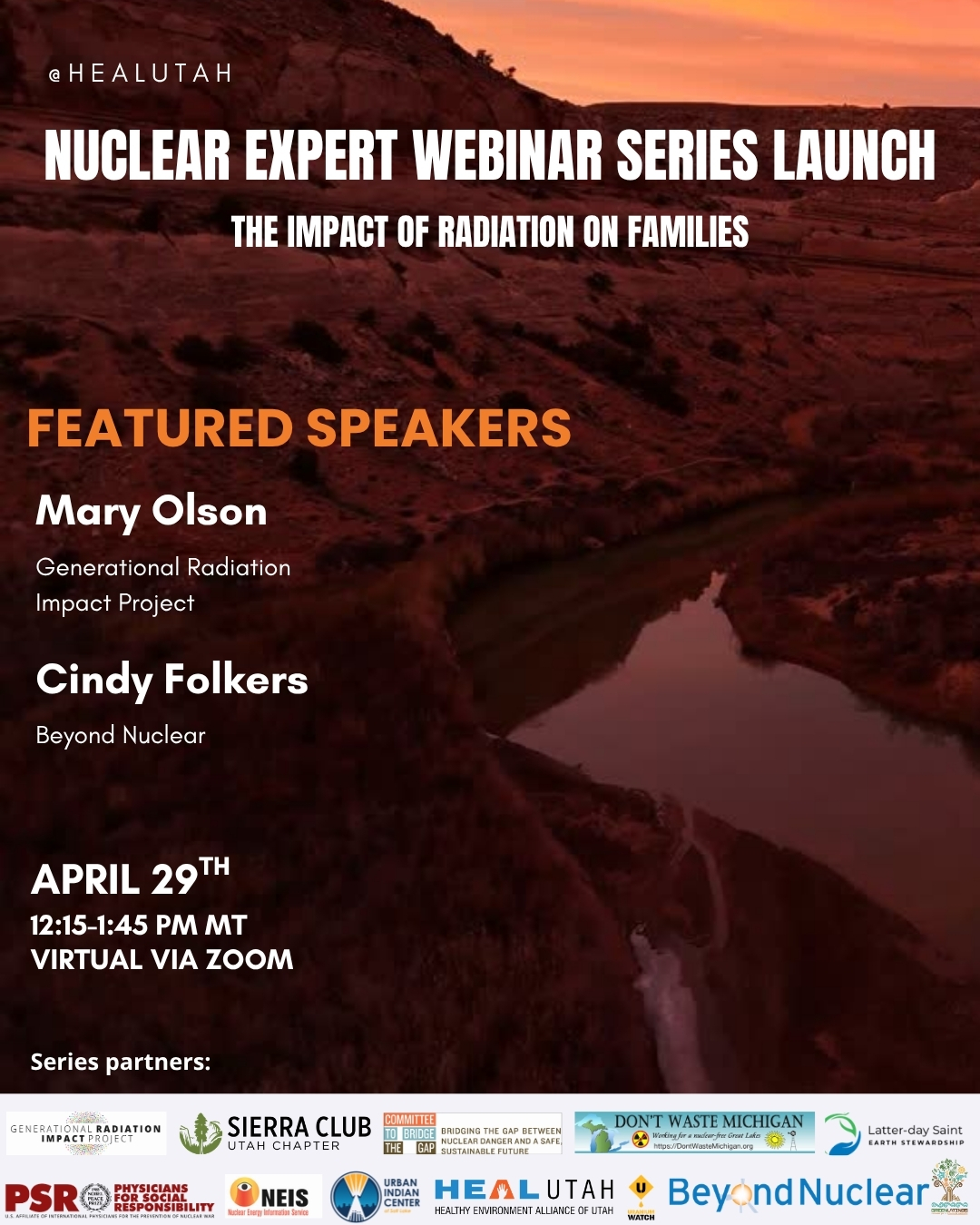
29 April – Nuclear Expert Webinar #1 – Radiation Impacts on Families with Mary Olson and Cindy Folkers
- 12:15 PM MT – 1:45 PM MT
- Location: Virtual – REGISTER TODAY

4 May -West Suburban Peace Coalition to discuss Iran war at May Educational Forum
Monday, May 4, 7:00 – 8:00 PM Central Standard Time
Title: : How Trump’s Narrative Tries to Shape the Reality of the War on Iran.
Contact Walt Zlotow, zlotow@hotmail.com 630 442 3045 for further information
14 May – online event From Bombs to Data Centres: the Face of Nuclear Colonialism

Pine Ridge Uranium is the real threat, not Tehran- Tell Burgum: Stop the Extraction.
Chernobyl: The Lost Tapes – A good documentary on Chernobyl on SBS available On Demand for the next 3 weeks– https://www.sbs.com.au/ondemand/tv-program/chernobyl-the-lost-tapes/2352741955560
To see nuclear-related stories in greater depth and intensity – go to https://nuclearinformation.wordpress.com
-
Archives
- May 2026 (12)
- April 2026 (356)
- March 2026 (251)
- February 2026 (268)
- January 2026 (308)
- December 2025 (358)
- November 2025 (359)
- October 2025 (376)
- September 2025 (257)
- August 2025 (319)
- July 2025 (230)
- June 2025 (348)
-
Categories
- 1
- 1 NUCLEAR ISSUES
- business and costs
- climate change
- culture and arts
- ENERGY
- environment
- health
- history
- indigenous issues
- Legal
- marketing of nuclear
- media
- opposition to nuclear
- PERSONAL STORIES
- politics
- politics international
- Religion and ethics
- safety
- secrets,lies and civil liberties
- spinbuster
- technology
- Uranium
- wastes
- weapons and war
- Women
- 2 WORLD
- ACTION
- AFRICA
- Atrocities
- AUSTRALIA
- Christina's notes
- Christina's themes
- culture and arts
- Events
- Fuk 2022
- Fuk 2023
- Fukushima 2017
- Fukushima 2018
- fukushima 2019
- Fukushima 2020
- Fukushima 2021
- general
- global warming
- Humour (God we need it)
- Nuclear
- RARE EARTHS
- Reference
- resources – print
- Resources -audiovicual
- Weekly Newsletter
- World
- World Nuclear
- YouTube
-
RSS
Entries RSS
Comments RSS
 nuclear-news
Dear arclight,
I find it ridiculous that they claim radiation effects at exposure of 5 to 10 rem are too small to measure/non-existent.
5 to 10 rem is equal to .05 to .1 sievert…or 50 to 100 millisieverts…or 50,000 to 100,000 microsieverts.
Detrimental health effects have been seen in radiation exposures MUCH lower than that, as shown in this National Academy of Sciences Abstract: http://www.pnas.org/content/100/24/13761.long
(1) Studies show increases in leukemia in children under 5 years of age who got 1.5 mSv (1,500 uSv) to bone marrow.
(2) A dose of 10 mSv (10,000 uSv) to the embryo and fetus causes “a significant and quantifiable increase in the risk of childhood cancer.”
(3) A Canadian study found a “statistically significant excess cancer incidence and mortality risks for solid cancers” at an average dose of 6.5 mSv (6,500 uSv)
(4) An average dose of 34 mSv (34,000 uSv) shows a significant “increase in solid-cancer-related mortality.”
(5) “a significant excess risk for acute leukemia was seen in individuals who died at younger than 20 years of age and who received bone-marrow doses from 6 to 30 mGy (6,000 to 30,000 uSv)
(6) At 40 to 70 mSv (40 to 70,000 uSv), a statistically significant increase in thyroid cancer risk was found.
By the way, it was “The American NUCLEAR Society” who first published the “position statement on the health effects of low-level radiation concurring with the Health Physics Statement that below 10 rem, risks of health effects are either too small to be observed or are non-existent.” http://lowdose.energy.gov/timeline.aspx
thats a great comment.. maybe an article??
🙂
Hi arclight – thanks for all of your good work.
Here are more studies showing radiation less than 100 mSv can be harmful:
>> 7.3-21.3 mSv
heart disease – increase in arterial hypertension risk
http://www.ncbi.nlm.nih.gov/pubmed/22647907
>> 8.6 mSv for men and 1.2 mSv for women
“The study has demonstrated a strong positive association between radiation dose and the risk of Cardiovascular Disease mortality.”
http://www.ncbi.nlm.nih.gov/pubmed/19329385
>> 10 mSv
“The excess relative risk for both sexes, estimated to be 3.0% per 10 mSv” “for all cancers combined”
http://www.ncbi.nlm.nih.gov/pubmed/9753011
>> 10 mSv
“All cancer mortality was estimated to increase 4.98%” “per 10-mSv cumulative dose received after age 45 under a 10-year lag, and 7.31%” “per 10-mSv cumulative dose received after age 45 under a 20-year lag”
http://www.ncbi.nlm.nih.gov/pubmed/10417363
>> 19 mSv
“The most comprehensive study of nuclear workers by the IARC, involving 600,000 workers exposed to an average cumulative dose of 19mSv, showed a cancer risk consistent with that of the A-bomb survivors.”
http://www.smh.com.au/federal-politics/society-and-culture/dont-be-fooled-by-the-spin-radiation-is-bad-20110407-1d63z.html#ixzz2pgYQAAh5
>> 22.5 mSv
“A mean cumulative dose of 22.5 mSv” = “A significant ERR/Sv was found for myeloid leukaemia.”
http://www.ncbi.nlm.nih.gov/pubmed/23716722
>> <100 mSv
“Protracted exposure to low-level radiation is associated with a significant increase in the risk of leukemia, according to a long-term study published Thursday in a U.S. research journal.”
“78 percent to below 100 millisieverts, indicating the impact on health of low-level exposure is not negligible.”
http://www.japantimes.co.jp/news/2012/11/09/news/exposure-to-low-level-radiation-can-cause-leukemia-u-s-ukraine-study-of-chernobyl-cleanup-workers-finds/#.UsuJ2Hso5yQ
thank you for the comment.. there is some interesting links there..
peace