JERUSALEM (JTA) – Israel’s Supreme Court dismissed a request by Mordechai Vanunu, who served 18 years in prison for leaking Israel’s nuclear secrets, to leave Israel.
Vanunu, who was released from prison in 2004, was jailed in Israel for discussing details of his work as a Dimona technician with the British newspaper the Sunday Times of London. He reportedly revealed Israeli nuclear secrets and gave the newspaper photographs of the plant’s operation.
Under the terms of his parole, Vanunu is prohibited from leaving the country, visiting the West Bank, or approaching foreign embassies and speaking with foreign nationals. He also is not permitted to have contact with others online.
Sunday’s decision by the Supreme Court is the seventh time since his release from prison that the restrictions have been extended.
Vanunu told the court he no longer wants to live in Israel. “I cannot live here as a convicted spy, a traitor, an enemy and a Christian,” he said, according to the Times of Israel. Vanunu converted to Christianity in the 1980s.
His attorney told the court that any information Vanunu has about Israel’s nuclear program is very outdated.
The three-judge panel ruled that the state had successfully proven that the restrictions should continue to remain in place, though that they should continue to be periodically reviewed.
Arnie Gundersen, Fairewinds chief engineer: (1:30 in) At Fukushima Daiichi, the nuclear fuel is in contact with the groundwater, because the groundwater has leaked into the bottom of the containment building and it’s gotten into other buildings that surround the containment. That makes Fukushima Daiichi much more expensive to solve and much more difficult to contain [compared to Chernobyl].
Gundersen: (2:15 in) We need an underground sarcophagus to prevent the groundwater from entering the Fukushima reactors. I think once that’s accomplished, there’s no need to decommission these power plants and turn them back to the ground they are in. The reason for that is the exposure to young brave Japanese workers is going to be way too high for almost 100 years. Because of the explosions and because of the fact that the groundwater has moved parts of the nuclear fuel out into surrounding buildings, the risk to the workers is way too high. It’s time to contain the groundwater, cover-up that site, and walk away for 100 years. The Japanese government doesn’t want that to happen because they want their population to think that this is a solvable problem. It isn’t. The best thing for the Japanese to do is to admit that they’re going to have to live with radioactive rubble at the Fukushima site for over 100 years.
FEATURING: Season’s greetings in the form of a trio of gifts: the chance to revisit three of the top, most respected voices within the anti-nuclear community, all of them presented during the past year of Nuclear Hotseat.
Dr. Helen Caldicott talks about how she became an activist and her then-upcoming Symposium on the Medical and Ecological Impact of the Fukushima Nuclear Disaster (NH #83 – 1/15/13).
In our most popular program ever, with 489,195 downloads in the first five days (and still getting play), nuclear engineer Arnie Gundersen of Fairewinds Energy Education explains what he would do with Fukushima if he were in charge. (NH #117 – 9/10/13).
And excerpts from a speech by Ralph Nader, who spoke at the east coast conference, Fukushima Nuclear Accident: Ongoing Lessons (NH #121 – 10/17/13).
Here are links to the websites mentioned during this program:
Fairewinds Energy Education’s Arnie Gundersen and Nuclear Hotseat’s Libbe HaLevy in front of the San Onofre Nuclear Reactor, four days before its closure was announced.
Ralph Nader – video of his full speech and all the other presenters from Fukushima Nuclear Accident: Ongoing Lessons: www.SamuelLawrenceFoundation.org
MOSCOW, December 27 (RIA Novosti) – The Russian Space Forces test-launched a Topol RS-12M intercontinental ballistic missile on Friday, a Russian Defense Ministry spokesman said.
The launch took place at 9:30 p.m. Moscow time (17:30 GMT) from the Kapustin Yar testing range in southern Russia’s Astrakhan Region.
The simulated warhead hit a designated target at a test range in Kazakhstan, spokesman Col. Igor Yegorov said.
The RS-12M Topol (NATO reporting name SS-25 Sickle), a single-warhead intercontinental ballistic missile, entered service in 1985.
It has a maximum range of 10,000 kilometers (6,125 miles) and can carry a nuclear warhead with a yield of up to 550 kilotons.
The Defense Ministry earlier announced plans to retire most of its outdated SS-18 Satan, SS-19 Stiletto and SS-25 Sickle (Topol) ICBMs and replace them with SS-27 Sickle-B (Topol-M) and RS-24 Yars missiles by 2021.
I got a copyright claim after a day of having this uploaded at MsMilkytheclown1 channel, so I edited the visuals to try and fly under the jibjab radar. http://youtu.be/e_a8tAy_b48 (video blocked worldwide)
I’m taking a little break from reporting on Fukushima. Please be sure you are subscribed to MissingSky101 and her new channel MissingSky102 for regular daily Fukushima updates as I enjoy a little R&R. https://www.youtube.com/user/MissingS…
and her backup channel https://www.youtube.com/user/MissingS…
and I’m still hanging out at MsMilkytheclown1 https://www.youtube.com/user/MsMilkyt…
I wanted to take the time to thank Everyone who has been trying to inform the public about the hazardous repercussions of nuclear energy, nuclear weapons, radioactive fallout, etc. Speaking out against the NRC, DOD, DOE, IAEA, and others to alert the public to the cover-up from the Fukushima Triple Plus Meltdowns in Japan on March 11, 2011. I’m going to take a little time off for R&R. Please see my YouTube page for other people who report on Fukushima (etc) to keep up to date. I used JibJab to make the video… LOL.
Great Song by:
Atomic Cockroach – God Damn Motherfucking Fukushima Zombie Criminals (demo) – EXPLICIT LYRICS http://youtu.be/6HULVkr_dkM
An internal memo from the Department of Foreign Affairs shows the government wanted to “cover themselves in the event of anything going wrong” at Windscale.
THE DEPARTMENT OF Industry and Energy was worried it had not done enough to deal with Britain’s nuclear power plans in the early 1980s.
In an internal memo released under the 30 Year Rule, an official recalled how the Industry and Energy department was “beginning to feel nervous about not having taken sufficient action vis-a-vis the British authorities on Windscale”.
“And want to cover themselves in the event of anything going wrong,” wrote an official.
First Secretary in the Department of Foreign Affairs, Joanna Betson, was writing an informal report of an interdepartmental meeting held on 17 November 1983 after media reports about the effects of levels of radioactivity in the Irish Sea.
She said there was a “general lack of knowledge on what level of radio activity we should agree to find acceptable at Windscale”.
The group, which included representatives from the Fisheries, Finance, Environment, Transport and Health departments and the Nuclear Energy Board (NEB), decided it was necessary to proceed with a bi-lateral agreement with the UK on the matter “as swiftly as possible”.
Earlier in the year, media reports suggested there were unacceptable levels of radioactivity in the Irish Sea.
One documentary linked the 1957 fire at Windscale (now Sellafield) to illnesses.
A junior minister in Ireland noted that these findings were limited to areas closer to the site than Ireland is.
According to the NEB’s independent tests, radioactivity levels reached their highest during 1974.
New Delhi: A nuclear power plant proposed to be set up in Haryana is one step short of getting the green clearance with a high-level panel of the Environment Ministry giving conditional nod.
The decision to recommend green clearance to the Nuclear Power Corporation of India Ltd (NPCIL) proposal for setting up a Rs 23,502 crore nuclear power plant in Fatehabad district was taken at a recent meeting of Expert Appraisal Committee on Environmental Appraisal of Nuclear Power Projects, official sources said.
Environment Minister is the final authority to grant the clearance to the project to be set up around 200 km away from the national capital. The NPCIL proposal seeks setting up a nuclear power park, known as Gorakhpur Haryana Anu Vidyut Pariyojna (4×700 MWe), at Fatehabad’s Gorakhpur village.
The project, for which the Ministry accorded Terms of References (ToR) three years ago, would be implemented in phases. The first phase would comprise two units of 700 MWe each.
The panel, which had sought details of the compensation paid and other measures as part of the project’s rehabilitation and resettlement (R&R) plan for those affected, has insisted that the project proponent should consider the newly enacted Land Acquisition Act for providing relief for project affected persons including landless labourers.
The proposal has been recommended for green clearance subject to several specific conditions. The eight-member committee, chaired by A R Reddy, has
asked the NPCIL to obtain the Atomic Energy Regulatory Board (AERB) clearance for the site for starting any construction work.
The panel has suggested that the project proponent should take necessary precautionary measures in and around the plant. It has recommended that regular monitoring of conventional gaseous pollutants, radioactive pollutants in the
air as well as in the discharged water should be monitored regularly as per the AERB standards and regular monitoring of ambient air quality should be carried out in and around the power plant and records maintained.
The high-level ministry panel has suggested that greenbelt should be developed in 35 per cent area around the project boundary with the native species of adequate density and width.
In addition, plantation should be raised in other vacant areas within the plant site, it said. According to it, water requirement for the project should
not exceed 320 cusecs as per the permission accorded by the state Irrigation Department and no groundwater should be used in the project either during construction phase or during operation phase.
The panel has also recommended testing of soil and groundwater samples to ascertain that there is no deterioration of groundwater quality by leaching heavy metals, radio nuclide and other toxic contaminants.
The non-radioactive waste water generated from the plant premises should be suitably treated in sewage treatment plant and the treated effluents should be recycled and reused within the plant premises for greenbelt and other things, it said.
The radioactive liquid waste emanating from the plant should be treated and managed as per the guidelines of AERB, it said.
The clearance is also subject to clearance from the wildlife authorities due to location of Schedule-I species of the animals in the vicinity. “As directed by the Ministry, conservation plan for Schedule-I species should be prepared in consultation with the State Chief Wildlife Warden, Wildlife Institute of India or Zoological Survey of India,” an official said.
In case the area is declared as wildlife park or sanctuary, necessary prior wildlife clearance should also be obtained from the Steering Committee of National Board of Wildlife, he said.
The proposal would be considered by the respective authorities on their merits and decision taken. The committee has also suggested that independent environment clearance should be sought for the township, if shifted from the present location due to change in surrounding environment.
…“They used us and threw us away,” he quoted an acquaintance as saying. The acquaintance could not return to the work site because he had been exposed to radiation above the limit immediately after the accident. He later quit his job at a TEPCO subcontractor….
As a former employee of Tokyo Electric Power Co., Akihiro Yoshikawa says he knows about the miserable conditions, declining morale and how workers are treated like garbage at the crippled Fukushima nuclear plant.
His mission now is to spread awareness of the circumstances surrounding those struggling to deal with the accident at the Fukushima No. 1 nuclear power plant and to help them get through the winter.
“I wanted to get people thinking about their working environment and do something to improve it,” Yoshikawa, 33, said.
Yoshikawa and his friends are now collecting donations to deliver heat packs and long underwear to the workers.
Born in Ibaraki Prefecture, Yoshikawa graduated from high school at Toden Gakuen, a now-defunct academy for training future workers of TEPCO, operator of the Fukushima No. 1 nuclear plant.
Yoshikawa’s work at TEPCO included supervising equipment inspections at the No. 1 plant.
After the tsunami caused the meltdowns at the plant in March 2011, Yoshikawa and his wife fled from the town of Namie. They now live in evacuee housing provided by the prefectural government in the nearby city of Iwaki.
Yoshikawa worked at the Fukushima No. 2 nuclear power plant, which was also hit by the tsunami but shut down properly.
Whenever he talked with workers toiling at the No. 1 nuclear plant, he heard about their fears of radiation contamination and low morale.
The world faces two potentially existential threats, according to the linguist and political philosopher Noam Chomsky.
“There are two major dark shadows that hover over everything, and they’re getting more and more serious,” Chomsky said. “The one is the continuing threat of nuclear war that has not ended. It’s very serious, and another is the crisis of ecological, environmental catastrophe, which is getting more and more serious.”
Chomsky appeared Friday on the last episode of NPR’s “Smiley and West” program to discuss his education, his views on current affairs and how he manages to spread his message without much help from the mainstream media.
He told the hosts that the world was racing toward an environmental disaster with potentially lethal consequence, which the world’s most developed nations were doing nothing to prevent – and in fact were speeding up the process.
“If there ever is future historians, they’re going to look back at this period of history with some astonishment,” Chomsky said. “The danger, the threat, is evident to anyone who has eyes open and pays attention at all to the scientific literature, and there are attempts to retard it, there are also at the other end attempts to accelerate the disaster, and if you look who’s involved it’s pretty shocking.”
Chomsky noted efforts to halt environmental damage by indigenous people in countries all over the world – from Canada’s First Nations to tribal people in Latin America and India to aboriginal people in Australia—but the nation’s richest, most advanced and most powerful countries, such as the United States, were doing nothing to forestall disaster.
“When people here talk enthusiastically about a hundred years of energy independence, what they’re saying is, ‘Let’s try to get every drop of fossil fuel out of the ground so as to accelerate the disaster that we’re racing towards,’” Chomsky said. “These are problems that overlie all of the domestic problems of oppression, of poverty, of attacks on the education system (and) massive inequality, huge unemployment.”
He blamed the “financialization” of the U.S. economy for income inequality and unemployment, saying that banks that were “too big to fail” skimmed enormous wealth from the market.
“In fact, there was a recent (International Monetary Fund) study that estimated that virtually all the profits of the big banks can be traced back to this government insurance policy, and in general they’re quite harmful, I think, quite harmful to the economy,” Chomsky said.
Those harmful effects can be easily observed by looking at unemployment numbers and stock market gains, he said.
“There are tens of millions of people unemployed, looking for work, wanting to work (and) there are huge resources available,” Chomsky said. “Corporate profits are going through the roof, there’s endless amounts of work to be done – just drive through a city and see all sorts of things that have to be done – infrastructure is collapsing, the schools have to be revived. We have a situation in which huge numbers of people want to work, there are plenty, huge resources available, an enormous amount to be done, and the system is so rotten they can’t put them together.”
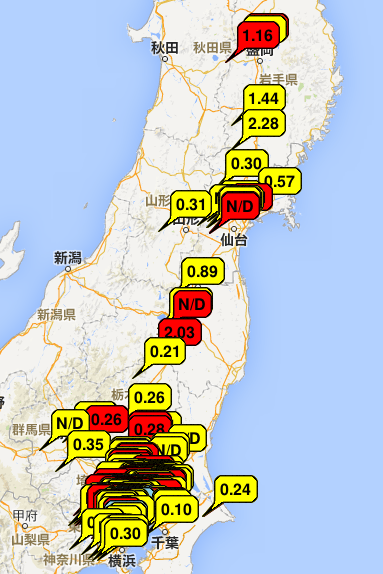
Epidemiologist Dr. Steve Wing, University of North Carolina — Chapel Hill, discusses the human impacts of the Fukushima nuclear disaster based on his visit to the area: This reading here, just to put it in perspective, the guard there if he stood there for a year, right where he is now in this picture, he would exceed the allowable radiation dose for a nuclear workers inside a plant. And this is 40 kilometers away. So we’re talking about a sacrifice zone, and millions of people live in this area.
So the guard — can you see on the ground behind the guard there’s a metal plate? He’s supposed to stand on that metal plate, and that’s his protection. And he’s wearing a surgical mask, and he has a helmet. It made me feel kind of bad, that here is someone that’s working in a radiation exposed job and he’s been issued a surgical mask and a helmet as though he’s supposed to feel protected.
And heres a link to some info from Chernobyl. Notice the levels of Cesium 137 do not reduce very much, in fact some breeds of tomatoes contamination seem to increase over the three years of the study.
….As in Chernobyl, the situation confirmed that nuclear industry is unable to deal with large scale accidents….
[…]
….In 1988 former director of the IAEA Dr. Hans Blix visited Chernobyl and met Spetsatom’s leaders. During the meeting he said that an organization like Spetsatom would have to be established in the structure of IAEA,
but it seems this idea was not supported by the staff of the Agency. Now it is easier to understand which arguments were at the base of the decision not to create an international nuclear emergency center…..
[…]
Nuclear Emergency Service
Why does this service not exist on the international scale?
Iouli Andreev Former Scientific Director of Soviet Nuclear Emergency Service “Spetsatom”
How frequently do they happen?
• 1 – Three Mile Island, 1979
• 2 – Chernobyl, 1986
• 3 – Fukushima, 2011
It is too early to produce statistics from several events, but we may predict that “beyond design accident” will inevitably happen in future.
Three Mile Island 1979
• Nuclear safety is too expensive to permit nuclear energy to be competitive, the USA decided after Three Mile Island accident.
• During more than 30 years no new nuclear power plants were built in America.
• This does not mean America has no risk from nuclear accidents.
• A TMI control room operator wrote a memo warning of “a very serious accident” if the condensate system problems were not properly addressed. He stated that “the resultant damage could be very significant.” Additionally, James Cresswell, an NRC inspector, warned for two years that a design flaw with U-shaped tubes could prevent coolant circulation and cause an accident like that which later occured at TMI. His warnings were ignored until the NRC met with him six days before the accident at TMI.
(Testimony of former NRC Commissioner Peter A. Bradford, Senate Committee on Environment and Public Works, Subcommittee on Clean Air and Nuclear Safety, March 24, 2009)
Chernobyl 1986
• Positive void coefficient, the main cause of nuclear explosion in reactor, is inversely to the grade of fuel enrichment. The wish of industry to use the cheap low enriched fuel was a cause of decreasing safety. After the accident enrichment of RBMK fuel was increased from 1,8 to 2,4%.
BOKU Wien 08.03.2012
• It was found immediately after the Chernobyl accident that nuclear industry and civil defense forces cannot deal with consequences of the reactor explosion. The Special Military Scientific Center was created in Moscow within two weeks and sent on the ChAES site. It had orders to develop methods for regular army formations to deal with the consequences of the accident.
• In 1988 the Russian Government decided to create the Nuclear Emergency Service (“SpetsAtom”) to deal with future large scale nuclear accidents.
• Nuclear Industry attempted to downplay the role of SpetsAtom, saying that accidents like Chernobyl would never happen again in the future.
….Zakharchev said that the epic tale of the Lepse would finally conclude when the ship and its spent nuclear fuel are sent in special packing to a uniquely conditioned facility at Sayda Bay, a former fishing village annexed by the Russian Navy in 1990 to store hulls and reactor compartments from nuclear submarines. He said the special storage facility for the Lepse parts was scheduled to open in 2015.
Zolotkov noted that, if all goes according to the new delayed schedule, the projected 2017 finishing date for the dismantlement effort will have taken 23 years….
Getting the ship out of water into dry dock will mark a significant milestone in reducing the overall radioactive threat posed by the vessel.
Officials told Russian media that this milestone, which will significantly reduce the overall radiation hazards posed by the ship, will happen in May 2014.
And though the ship has only be moved into position to be taken out of the water, Andrei Zolotkov, chairman of Bellona Murmansk said that “because the [Lepse dismantlement project] was Bellona’s idea,” he greets each new step toward the project’s completion as “positive.”
The Lepse has been laid up at Nerpa, a naval shipyard equipped to handle the ships dangerous nuclear cargo some 20 kilometers up Kola Bay from Murmansk, since September 2012.
That’s nothing compared to the 24 years it spent bobbing at dockside four kilometers north of central Murmansk and its population of 300,000 at the Atomflot nuclear icebreaker port, since its decommissioning in 1988.
The Lepse, which in its heyday had been used as a support vessel for Russia’s nuclear icebreaker fleet, now contains casks and caissons holding 639 spent nuclear fuel assemblies –equaling hundreds of tons of radioactive materials – some 300 of which have been damaged, including assemblies that were banged up during offloading from the nuclear icebreaker Lenin.
On top of that, the ship is old. Its keel was laid as a dry goods ship in 1934 and construction on it continued until World War II. It was eventually dumped in a river in the Ukraine. Its reactivation came about when the icebreaker Lenin was under construction and the Lepse’s durable hull saved it from mothballs in 1961.
That year, it was specially retrofitted to refuel the Lenin and the growing icebreaker fleet at sea, pulling spent nuclear fuel off, and refilling icebreakers’ reactors.
Between 1963 and 1981, the Lepse re-loaded nuclear fuel on the nuclear powered icebreakers Lenin, Arktika and Sibir 14 times. In 1981, it was again retrofitted to become a storage ship for irradiated parts and waste as well as spent nuclear fuel assemblies.
Submarine traffic jam
Progress toward getting the Lepse into dry dock at Nerpa, where the real dismantlement and spent nuclear fuel removal procedures can begin in earnest, however, have been thwarted ever since the vessel’s arrival at Nerpa in 2012.
Simply put, miscommunication between Russia’s Ministry of Defense, and Russian State nuclear corporation Rosatom, which is legally responsible for dispensing with the ship, steered the Lepse into a traffic jam at Nerpa with Russia’s oldest nuclear submarine, the Leninsky Komsomol.













 nuclear-news