Guardian editor, Alan Rusbridger, is having to defend his newspaper’s coverage of the Edward Snowden, NSA and GCHQ story in front of a committee of MPs. Snowden, a former Booz Allen Hamilton contractor, became a whistleblower on the extent to which intelligence agencies are able to spy on people around the world when he passed documents to Glenn Greenwald. Since then spy programmes like PRISM, TEMPORA and XKeyscore have been revealed in the Guardian and other publications.
…The UK is determined to belong to the nuclear power and weapons club as it thinks it will have more clout on the world stage and retain its privileged position as a member of the UN Security Council…
I would dispute the BNP MEP’s claim the NW “needs a nuclear power plant on the Cumbrian coast” to meet our energy needs.
The Government’s agreement to underwrite the £16 billion EDF Hinkley Point two nuclear reactors will prove to be economically insane and hugely costly to consumers.
It will be the most expensive power station in the world with the cost of energy twice the wholesale price in 2023 as it is now.
Taxpayers (consumers) will also be paying for some of the clear-up and decommissioning costs as well as any accident insurance.
The United Kingdom already faces a huge bill (£67.5 billion at Sellafield alone) to clean up its existing radioactive nuclear waste.
We certainly don’t need to add to that waste mountain with new nuclear reactors.
Nuclear power stations are almost never built on time and to budget with the Government paying an extra price, as evidence at the new EDF/Areva plants in Finland and France.
These plants also face technical difficulties which make them unsafe to operate.
It is highly unlikely Hinckley will come on stream in 2023 when the energy will be needed.
There is plenty of scope and expertise for the UK to generate sufficient energy from safe and renewable sources now without resorting to more dangerous nuclear or polluting fossil fuels.
The risks associated with nuclear power have been seen at Windscale, renamed Sellafield after the accident in 1957, Three Mile Island, USA (1979), Chernobyl (1986) and Fukushima (2011).
In the light of these disasters, the rest of the world is turning its back on nuclear power (Japan, Germany, Italy, Sweden, Spain) or gradually phasing it out, like France.
I believe the Government’s decision is not based on sound economic, environmental or ethical reasons but is primarily politically motivated.
The UK is determined to belong to the nuclear power and weapons club as it thinks it will have more clout on the world stage and retain its privileged position as a member of the UN Security Council.
We should be committed to phasing out nuclear power and weapons, including the renewal of Trident at £100 billion, to create a nuclear free and safer world.
….Oshima suggested the government would informally relax the long-term target, set by the previous government, to decontaminate an area the size of Connecticut around the Fukushima plant to levels of 1 millisievert of radiation or less…..
Dec 5 (Reuters) – Japan’s ruling party could set up a British-style agency to shut down the wrecked Fukushima nuclear plant, taking control of a project now managed by the station’s embattled operator, a senior party policymaker said on Thursday.
A huge earthquake and tsunami in March 2011 triggered three meltdowns at the Fukushima Daiichi nuclear station, the worst nuclear disaster since Chernobyl in 1986, and exposed a lack of preparation by Tokyo Electric Power Co, or Tepco.
The company has floundered for much of the last 2-1/2 years in dealing with several problems at the site, including a series of leaks of radioactive water into the Pacific Ocean.
Tepco has proceeded with initial decommissioning steps, including the tricky removal of spent fuel rod assemblies from a badly damaged reactor building. Dismantling the plant and decontaminating the nearby area is likely to take decades and cost ten of billions of dollars.
“It is likely that the government will eventually have to take responsibility” for the decommissioning, Tadamori Oshima, head of the Liberal Democratic Party’s task force on disaster reconstruction, told Reuters.
While immediate decommissioning steps should be taken by Tepco, a government oversight body should direct the utility, Oshima added, but gave no further details.
In Britain, the National Decommissioning Authority, a public body, is charged with managing the dismantling of the country’s atomic power and research stations.
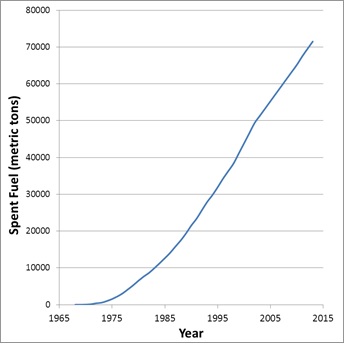
Because the U.S. has not opened a repository to store reactor waste, the government has not fulfilled its promise to take spent fuel from nuclear plants and dispose of it. As a result, spent nuclear fuel has accumulated at the reactor sites, reaching a level of 70,000 metric tons today. And over 70% of that waste is stored in increasingly crowded cooling pools that were originally intended to hold much less fuel.
A key step to increase the current safety of U.S. nuclear power is to transfer a large amount of the spent fuel from pools into concrete “dry casks” that would be stored temporarily at the plant. Since spent nuclear fuel is cool enough to transfer to dry casks after 5 years, more than 80% of spent fuel currently in pools could be moved to dry casks.
Fig. 1: Growth of spent fuel stored at reactor sites
Pool accidents could be disastrous
Nuclear fuel typically stays in the core of a reactor generating energy for several years. When they are taken out of the core the fuel rods are highly radioactive and continue to generate lots of heat. They are moved into a cooling pool at the reactor site, where the water acts as a radiation shield and carries the heat away from the rods. The water must be continuously cooled, which requires electric power.
If cooling is lost, the spent fuel can overheat, catch fire, and potentially release large clouds of radiation to the environment.
Cooling can be lost in a couple ways. If electric power to the plant is cut off, as it was following the earthquake and tsunami at Fukushima, the water can heat up and boil away. If water is not added fast enough (which it was at Fukushima) the fuel will overheat.
Tepco makes official announcements to deny “misinformation” by press, on both of their websites in English and Japanese occasionally.
In the press conference of 11/29/2013, Tepco’s spokesman stated they publish those announcements to deny “misinformation” when they think it may affect the company stock price.
The reason why they deny it when it may affect the stock price wasn’t explained.
On their English website, they recently made those announcements on Sep 21, Sep 24, Sep 26, Nov 8, and Nov 22.
This is the latest announcement below.
(Quote start)
<Title>
With Respect to ‘Another Moral Hazard of a Banking Organization Financing TEPCO Proceeding’ on the Page 28 of a Morning Issue on Tokyo Shimbun as of November 22, 2013
<Content>
On November 22, 2013, Tokyo Shimbun issued an article on the page 28 of its morning edition saying “A banking organization financing TEPCO has been switching its uncollateralized bonds to the collateralized utility bonds. The utility bonds have priority over the damage compensation for victims of Fukushima NPS accident, in case of TEPCO’s bankruptcy. Government of Japan expresses concern that the compensation might fall behind, in case it resolves and disposes of TEPCO. However, the government pretends not to see the act of the banking organization which could deteriorate the situation. A moral hazard (lack of a sense of morality) is proceeding, which is more vicious than the finance for gang groups.”
In order for TEPCO to steadily implement the longitudinal decontamination, or to fulfill our societal responsibility to supply with stable electricity, it is inevitable for us to receive loans from banking organizations. Comprehensive Special Business Plan approved in May 2012 includes such supportive measures as for all affiliated banking organizations to give TEPCO credit via refinancing etc. until TEPCO restores its independent funding such as rejoining a bond market etc., following the outcomes at the conference between Nuclear Damage Liability Facilitate Fund and us.
However, taking our current situation into consideration, it is very difficult for us to take a loan from a bank organization unconditionally, therefore, we try to obtain loans by issuing collateralized private-placement bonds, based on Electricity Business Act, Article 37.
The issue status for the private-placement bonds is released in handouts etc. intended for investors etc on our web-site.
Yesterday (on November 21), we gave these above circumstances to Tokyo Shimbun as a response to the interview with that press, though all our responses were omitted in that article, in addition, the press mentioned there financing for gang groups completely irrelevant to us saying “A moral hazard (lack of a sense of morality) is proceeding, which is more vicious than the finance for gang groups.” The article is inappropriate as a press report which is supposed to be accurate, fair, and responsible, and we regard the article as a one-sided media report seriously lacking in fairness.
A onetime Los Alamos National Laboratory physicist may attempt to reverse his guilty plea on sharing secret nuclear-weapons information, the Associated Press reported on Wednesday.
Physicist Leonardo Mascheroni and his wife, Marjorie Roxby Mascheroni, are accused of supplying an undercover federal agent posing as a Venezuelan operative with classified weapons information. The Mascheronis pleaded guilty in June to the federal charges against them.
However, the former lab scientist could withdraw his plea, according to a Nov. 27 court filing by his government-appointed attorney. Mascheroni is trying to secure a new public defender.
Mascheroni is back in prison after federal District Judge William Johnson in a Nov. 13 order canceled the 77-year-old’s conditions for release, the Albuquerque Journal reported. Johnson was concerned that Mascheroni could still have access to classified information while he was out on pre-trial release.
Mascheroni reportedly included some classified information in a letter that he wrote to Johnson as part of his attempt to obtain a new public defender. The judge said the 35-page letter might have been written on an unsecured computer.
WASHINGTON: India has expanded a secretive site that could be used to enrich more uranium for nuclear weapons, a US think tank said Wednesday, citing satellite imagery.
The Institute for Science and International Security, a private group opposed to nuclear proliferation, said that India appeared to be finishing a second gas centrifuge facility at its Rare Materials Plant near the southern city of Mysore.
“This new facility could significantly increase India’s ability to produce highly enriched uranium for military purposes, including more powerful nuclear weapons,” the institute said in a report that analyzed an image taken in April.
The institute said that India started building a second centrifuge plant near Mysore in 2010, but it was unclear whether it was a replacement for the first facility at the site or a supplement. If it is a new facility, “India could have more than doubled its enrichment capacity, if the original building continues to function as an enrichment plant,” it said. — AFP –
Although he knows that he will not be able to live in Futaba again, he and his wife continue with their monthly visits lasting only several hours each time to their former home in the town.
Onuma said he is dreaming of paying a pilgrimage to the graves of their ancestors with his two children one day.
“I want to tell my children and future generations about my hometown,” he said.
A huge banner hanging at the entrance of a shopping area in the evacuated town of Futaba, co-host to the crippled Fukushima No. 1 nuclear power plant, still reads “Nuclear energy is the energy of a bright future.”
Yuji Onuma created this slogan while in elementary school and won the best prize at a contest organized by the town government in 1987.
Today, Onuma, 37, sees a bright future in a life built around solar power, 1,000 days after being forced to leave his home and his business following the nuclear accident that unfolded on March 11, 2011.
The conversion marks a sea change for Onuma, as nuclear power had dominated large parts of his life as the economic lifeline of Futaba.
The nuclear disaster came after he had long believed in a “bright future” with nuclear energy, just like everyone else in Futaba. But now his hometown may have been lost, perhaps forever, after a triple meltdown at the plant.
“I realized that I was wrong (about a future with nuclear energy) after the nuclear disaster took my hometown away,” said Onuma, who fled Futaba with his expectant wife, Serina, after the accident. “I will probably never be able to go home.”
Futaba, with a population of about 7,000 before the crisis, has been designated an area where residents will not be allowed to return to live until at least 2017 due to annual radiation exposure levels of 50 millisieverts or more.
He has started to rebuild his family’s life at its new home in neighboring Ibaraki Prefecture with the resolve never to return to a life relying on nuclear power. He’s also embarking on a solo campaign to drive home the dangers of atomic energy.
For the first time, scientists have measured the frictional heat produced by the fault slip during an earthquake. Their results, published December 5
Science, show that friction on the fault was remarkably low during the magnitude 9.0 Tohoku-Oki earthquake that struck off the coast of Japan in March 2011 and triggered a devastating tsunami.
“The Tohoku fault is more slippery than anyone expected,” said Emily Brodsky, a geophysicist at the University of California, Santa Cruz, and coauthor of three papers on the Tohoku-Oki earthquake published together in Science. All three papers are based on results from the international Japan Trench Fast Drilling Project (JFAST), which Brodsky helped organize.
Because friction generates heat (like rubbing your hands together), taking the temperature of a fault after an earthquake can provide a measure of the fault’s frictional resistance to slip. But that hasn’t been easy to do. “It’s been difficult to get this measurement because the signal is weak and it dissipates over time, so we needed a big earthquake and a rapid response,” said Brodsky, a professor of Earth and planetary sciences at UCSC.
The JFAST expedition drilled across the Tohoku fault in 2012 and installed a temperature observatory in one of three boreholes nearly 7 kilometers below the ocean surface. The logistically and technically challenging operation successfully recovered temperature measurements and other data as well as core samples from across the fault.
The low resistance to slip on the fault may help explain the large amount of slip—an unprecedented 50 meters of displacement—that occurred during the earthquake, according to UC Santa Cruz researcher Patrick Fulton, who is first author of the paper focusing on the temperature measurements. An abundance of weak, slippery clay material in the fault zone—described in the two companion papers—may account for the low friction during the earthquake, he said.
The Tohoku-Oki earthquake occurred in a “subduction zone,” a boundary between two tectonic plates where one plate is diving beneath another—in this case, the Pacific plate dives beneath the Eurasian plate just east of Japan. Fulton explained that the epicenter, where the earthquake started, was much deeper than the shallow portion of the fault examined by JFAST. One of the surprising things about the earthquake, in addition to the 50 meters of slip, was that the fault ruptured all the way to the surface of the seafloor.
“The large slip at shallow depths contributed to the tsumani that caused so much damage in Japan. Usually, these earthquakes don’t rupture all the way to the surface,” Fulton said.
The strain that is released in a subduction zone earthquake is thought to build up in the deep portion of the fault where the two plates are “locked.” The shallow portion of the fault was not expected to accumulate a large amount of stress and was considered unlikely to produce a large amount of slip. The JFAST results show that the frictional stress on the shallow portion of the fault was very low during the earthquake, which means that either the stress was low to begin with or all of the stress was released during the earthquake.
“It’s probably a combination of both—the fault was pretty slippery to begin with, and whatever stress was on the fault at that shallow depth was all released during the earthquake,” Fulton said.
An earlier paper by JFAST researchers, published in Science in February 2013 (Lin et al.), also suggested a nearly total stress drop during the earthquake based on an analysis of geophysical data collected during drilling.
“We now have four lines of evidence that frictional stress was low during the earthquake,” Brodsky said. “The key measure is temperature, but those results are totally consistent with the other papers.”
One of the new papers (Ujiie et al.) presents the results of laboratory experiments on the material recovered from the fault zone. Tests showed very low shear stress (resistance to slip) attributable to the abundance of weak, slippery clay material. The other paper (Chester et al.) focuses on the geology and structure of the fault zone. In addition to the high clay content, the researchers found that the fault zone was surprisingly thin (less than 5 meters thick).
Russia is the only country still operating RBMK reactors, and all, apparently, could become subjects of Rosatom’s enthusiastic new refurbishment process.
Workers have repaired swelling and cracking of the graphite moderator at the Leningrad Nuclear Power Plant’s No 1 reactor – the world’s oldest Chernobyl-style RBMK reactor – and reconnected it to the power grid, Russian nuclear officials said Monday.
The news got two thumbs down from many environmentalists who had given the reactor up for dead when the malformations in the reactor’s moderator were discovered during maintenance in 2012. But ceaseless tinkering by the Russia’s nuclear industry resuscitated it to the point where it could be plugged back into the grid.
Whether or not this is safe, according to Alexander Nikitin, chairman of the Environment and Rights Center (ERC) Bellona, is at the moment unknown. It is, however, said Nikitin, the first time such a drastic overhaul of an RBMK reactor has been made public.
Nikitin on Tuesday said he was trying to arrange a detailed meeting between ERC nuclear specialists and engineers who were responsible for the restoration process at the Leningrad Plant’ No 1 reactor. So far, he said, he has been met with reluctance and bureaucracy.
He said that “issues of safety, from a technical point of view cannot be answered in a blanket fashion – we need to know more about what precisely was done before we can make any determinations about whether the reactor can operate safely.”
Nikitin asserted, however, that the unit’s reconnection is essential to heating the nuclear plant’s host town, Sosnovy Bor, some 70 kilometers west of St. Petersburg and its 5 million-strong population, during the cold winter months.
Nils Bøhmer, Bellona’s general director and nuclear physicist said: “We are disappointed and frightened that that this reactor has come back online.”
“All reactors of the Chernobyl-type RBMK model should long ago have been shut down,” said Bøhmer. “The Russian authorities should be paying more attention to alternative methods to supply heating and energy in the region.”
Vladimir Slivyak, co-chair of Russia’s Ecodefense environmental group likened putting the reactor back into operation to a situation where “the Russian nuclear industry is playing Russian roulette.”
Putting the reactor back online, he told Bellona in an email interview, “is extremely dangerous and could actually cause a large accident that will effect millions of people in St. Petersburg and the surrounding areas,” adding that, “This is a Chernobyl-type reactor and it is impossible to bring it up to modern safety standards.”
The RBMK revival: everything old is new again
But nuclear officials in Russia are greeting the fix-it job as a landmark revival of the RBMK reactor, the oldest kind of civilian reactor in its fleet.
Leningrad Nuclear Power Plant Director Vladimir Pereguda, hailed the efforts of his staff’s ability to get the reactor up and working again and described its reappearance on the grid as a “rebirth, ” according to remarks carried by World Nuclear News.
The agency also reported that Rosatom’s first deputy director, Alexander Lokshin, said the event marked a “significant milestone in the history of RBMK.”
The work undertaken at the Leningrad unit is now expected to extend to the other 10 RBMK reactors still in operation in Russia.
First public RMBK overhaul, says tarred ex nuclear chief
This did not come as unexpected news to Nikitin, who was told last spring that similar extensive rebuilds have taken place in the past.
He said that Yevgeny Adamov, the disgraced former head of Minatom, Rosatom’s precursor, had told him last May that enormous overhauls of RMBK-style reactors had been undertaken many times – only without mentioning it to the public.
Nikitin said Adamov would not specify which reactors had undergone such serious repairs, and Adamov could not be reached on Tuesday for further comment.
He also noted that some 500 million rubles had been paid in 2012 by industries producing pollutants that negatively effect the environment, which covers some 57.2 percent of the total emissions in the area.
Not surprisingly, he said that the Kola Mining and Metallurgy Company (KMMC) was the biggest fine-payer in the region by far. The company is a daughter enterprise of industrial giant Norilsk Nikel.
“The company paid around 30 million rubles of this [total] sum,” he told the conference.
MURMANSK – Serious questions about the Arctic environment and air quality degenerated into farce at a seminar in Murmansk devoted to the topic last week as officials juggle figures and a phony scientific NGO presented baked data.
Murmansk is a pilot region for a number of projects on protecting air quality.
But the talks about reducing the amount of pollution migrating into Norway from Russia’s Northern industrial towns was briefly run off the rails by an NGO calling itself Green Patrol, which has been trumpeting findings of pollution wafting its way from Norway and Finland and into Russia, rather than the other way around.
The group’s findings are so ludicrous that the representative it sent to the seminar went so far in an interview with Bellona to dismiss its own claims as insignificant, and debunk its own methodology as unscientific – but not until air quality scientists from Norway had a chance to rake the organization over the coals a bit.
According to Roman Pukalov, director of the nature conservancy program with Green Patrol, a group with suspicious – some say state-connected – roots, Scandinavian countries are blowing some 45 percent of all pollution into Russia.
The claim is an old one, and has never been substantiated by any actual scientific claims since the group first levied the charge in August. Again, while addressing the conference, Pukalov was unable to back his claim with any data on amounts of pollution even in the most general sense, such as by tonnage, dozens of tons or even by rubber balloons. Nonetheless, he was confident in asserting that Russia should drag the matter to European courts to demand satisfaction, citing the group’s science fiction as the foundation for the case.
Pseudo-science grates on delegates’ patience
The gnat of Green Patrol’s research has been dealt with by European scientific organizations before, and it was clearly wasted time for Tore Berlgen, the head scientist dealing with cross-border emissions for the Norwegian Institute for Air Research (NILU) to have to refute Green Patrol’s alchemy once again.
“With all due respect to those delivering reports today, I can say with certainty that from the scientific point of view, such research is pseudo-science,” Berglen, who has since august maintained a tone of diplomatic detachment, told the conference.
Reducing that foul smell
With the agenda back on serious footing, the Murmansk government addressed issues of malodorous industrial emissions that area residents have complained of for years.
“We are one of the first to analyze the ‘odor’ effect relative to the steaming out of oil-fired cisterns at thermal energy plants,” Sergei Skomorokhov, Murmansk Regional deputy governor, told the international seminar called Protection of the Arctic from Atmospheric Pollution. “We have prepared a normative legal act establishing a norms for odors.”
Alexei Smirnov, minister of natural resources and ecology for the Murmansk Region, said an automated system for monitoring complex and specific – or polluting – substances in the atmosphere of the Kola Peninsula’s industrial cities is under formulation.
Some 22 centers make up a system of monitoring nine industrial centers in the Murmansk Region. The system constantly updates a single informational database on air quality conditions in the Regional center.
As such, it has been established that Murmansk suffers from concentrations of sulfur oxide, nitrous oxides, carbon dioxides, methane, and traces of hydrocarbons and other factored particles. In the Kandalaksha, Kola and Kovdor districts, sulfur dioxide, nitrous oxide and carbon oxides have been measured, and the industrial cities of Nikel, Monchegorsk, and Zapolyarny are primarily affected by sulfur dioxide.
An evaluation of pollution emissions in the Murmansk region with the aim of reducing human impact on the region’s environment is planned for the near future.
Paying for the pollution you put in the air
Mikhail Lesovoy, deputy head of the Murmansk’s Regional division of the Federal Agency for Oversight of Natural Resource Usage, or Rosprirodnadzor in its Russian abbreviation, the combined total of pollutants emitted from standard sources in the Murmansk region reached some 250,000 tons in 2012. Some 60 percent of all pollution came from processing centers and mineral mining.
INSURERS USE TEMPORA TO TARGET ANTI NUKE ACTIVISTS
…..Insurers have a key role to play in contributing to the UK’s economic growth, as providers of long-term capital investment. Providing capital for infrastructure projects will help drive a competitive, healthy and resilient UK economy.
50 MILLION BUYS YOU INFORMATION ON ANYONE
The future infrastructure pipeline, which only includes projects and programmes worth over £50 million, shows that planned investment in infrastructure has increased to over £375 billion from £309 billion last year. Of the 646 projects and programmes in the updated pipeline 291 are already under construction…..
Abby Martin calls out the International Atomic Energy Agency for their endorsement of the Tokyo Electric Power Company’s response to the nuclear disaster, despite the company’s gross mismanagement of disaster.
IAEA recommends discharging Fukushima radioactive water to the sea
December 05, 2013
THE ASAHI SHIMBUN
A visiting team of IAEA experts said Japan should weigh the possibility of discharging part of the growing stockpile of contaminated water at the crippled Fukushima nuclear power plant to the sea.
Its recommendation came with the caveat that radioactive levels would have to be below safety standards.
“It is necessary to find a sustainable solution to the problem of managing contaminated water at Tokyo Electric Power Co.’s Fukushima No. 1 nuclear power station,” the International Atomic Energy Agency team said in its preliminary summary report released Dec. 4. “This would require considering all options, including the possible resumption of controlled discharges to the sea.”
At the Fukushima No. 1 plant, the stockpile of radioactive water is growing by 400 tons every day as groundwater flowing into reactor and turbine buildings keeps adding to and mixing with water used to cool melted nuclear fuel. TEPCO is using an Advanced Liquid Processing System (ALPS), a purifier touted as capable of removing 62 types of radioactive substances, to treat the contaminated water.
But that does not help reduce the total amount of water that needs to be managed, because the ALPS cannot remove tritium, a radioactive isotope of hydrogen.
TEPCO said it was holding 390,000 tons of radioactive water in storage tanks as of Dec. 3, including 31,000 tons that have been treated with the ALPS.
Juan Carlos Lentijo, leader of the IAEA expert team, held a news conference in Tokyo on Dec. 4, where he said controlled discharges of contaminated water are a common practice around the world. He added that TEPCO should gather data on treated water for safety screenings by Japan’s Nuclear Regulation Authority, and release the water to the sea if it is found to have cleared regulation standards.
Lentijo, at the same time, emphasized the importance of gaining understanding from the general public and the parties involved, and said controlled discharges should be allowed to take place only after discussions are held with relevant stakeholders and their approval is obtained.
The 19-member team of IAEA experts was visiting Japan from Nov. 25 to review Japan’s effort to decommission the devastated Fukushima plant, including the removal of nuclear fuel from the No. 4 reactor’s spent fuel storage pool and the monitoring of seawater. The preliminary summary report praised Japan for achieving “good progress” in preparing for the decommissioning process.
The team is expected to submit a final report to the government of Japan by the end of January.
Shunichi Tanaka, chairman of the NRA, reiterated his support for controlled discharges of treated radioactive water.
“I don’t believe the technology is available for easy removal of tritium,” Tanaka told a news conference Dec. 4. “The amount is not particularly mind-boggling from a global perspective. We can’t help discharging water once it has cleared safety levels.”
(This article was written by Akira Hatano and Ryuta Koike.)
The 14th Meeting of Japan Cold Fusion Research Society will be held at the Tokyo Institute of Technology on December 7-8 at the Tokyo Institute of Technology, and abstracts of the papers to be presented have been published.
There seems to be quite an active community of cold fusion researchers in Japan; there are many names of presenters that I am not familiar with, but one stood out to me. Among the published abstracts is an article titled “Transmutation of Palladium and Nickel Isotopes” by Norman D. Cook of the Department of Informatics, Kansai University, Osaka. The reason for this is that Norman Cook’s work has been highly praised by Andrea Rossi.
As it will turn out when the scientific principle of our effect will be made public, the E-Cat respects perfectly the well known Physics laws and most accredited theories. I mean: there is no need of any “new physics”, everything is well contained in the well known Physics: therefore of course, as I said, the E-Cat is a cousin of the Schroedinger cat! Read the last edition of the book of Norman D. Cook…
His book, which is Rossi’s favorite nuclear physics book, Models of the Atomic Nucleus is available for free download here.
Fortunately the abstracts for the conference are available in English, but I would expect the conference would be conducted in Japanese. I’m not sure if we have many Japanese readers of ECW, but if anyone is going to be at the conference and would like to write a report, I’d be happy to publish it here.


 but not until air quality scientists from Norway had a chance to rake the organization over the coals a bit.



 nuclear-news