MOX nuclear fuel – the secret and so dangerous ingredient in the Fukushima No 4 nuclear cooling pond
The un-irradiated rods inside the Unit 4 spent-fuel pool are, in all probability, made of a new type of MOX fuel containing highly enriched plutonium.
 Why TEPCO is Risking the Removal of Fukushima Fuel Rods. The Dangers of Uncontrolled Global Nuclear Radiation, Global Research, 24 Nov 13 By Yoichi Shimatsu
“…….Mystery of MOX super-fuel A Mainichi Shimbun editorial mentions in passing that the Reactor 4 pool contains 202 fresh fuel assemblies.(3) The presence of new fuel rods was confirmed in the TEPCO press release, which described the first assembly lifted into the transfer cask as an “un-irradiated fuel rod.” Why were new  rods being stored inside a spent-fuel pool, which is designed to hold expended rods? What threat of criticality do these fresh rods pose if the steel frame collapses or if crane operators drop one by accident onto other assemblies, as opposed to a spent rod?
Against the official silence and disinformation, a few whistleblowers have come forward with clues to answer these questions. Former GE nuclear worker Kei Sugaoka disclosed in a video interview that a joint team from Hitachi and General Electric was inside Reactor 4 at the time of the March 11, 2011 earthquake. By that fateful afternoon, the GE contractors were finishing the job of installing a new shroud, the heat-resistant metal shield lining the reactor interior.(4)
TEPCO inadvertently admitted to the presence of foreign contractors at Fukushima No.1 up until March 12, 2012, when the management ordered their evacuation in event of a massive explosion during the rapid meltdown of Reactor 2. So far, leaks indicate the presence of the GE team and of a Israeli nuclear security team with Magna BSP, a company based in Dimona.(5)
Another break came in April 2012, when a Japanese humor magazine published a brief interview of a Fukushima worker who disclosed that radioactive pieces of a broken shroud were left inside a device-storage pool at rooftop level behind the Reactor 4 spent-fuel pool.(6) This undoubtedly is the used shroud removed by the GE-H workers in February-March 2011.
A curious point here is that the previous shroud had been in use for only 15 months. Why would TEPCO and the Japanese government expend an enormous sum on a new lining when the existing one was still good for many years of service?
Obviously, the installation of a new shroud was not a mere replacement of a worn predecessor. It was an upgrade. The refit of Reactor 4 was, therefore, similar to the 2010 conversion of Reactor 3 to pluthermal or MOX fuel. The same model of GE Mark 1 reactor was being revamped to burn MOX fuel (mixed oxide of uranium and plutonium).
The un-irradiated rods inside the Unit 4 spent-fuel pool are, in all probability, made of a new type of MOX fuel containing highly enriched plutonium. If the frame collapses, triggering fire or explosion inside the spent-fuel pool, the plutonium would pulse powerful neutron bursts that may well possibly ignite distant nuclear power plants, starting with the Fukushima No.2 plant, 10 kilometers to the south…..
The upgrade of the Reactor 4 shroud may well have involved the test-fitting of some MOX rods, which abandoned on the floor next to the reactor when the tsunami reached shore. In other words, in early March 2011 crane operators completely filled space inside the spent-fuel pool with new MOX rods and then simply left casks of assemblies on the roof and lowered more into the basement. That is the simplest explanation for the damage to the structural integrity of the reactor building. GE is not about to disclose its role in this disaster………. http://www.globalresearch.ca/why-tepco-is-risking-the-removal-of-fukushima-fuel-rods-the-dangers-of-uncontrolled-global-nuclear-radiation/5359188…..http://www.globalresearch.ca/why-tepco-is-risking-the-removal-of-fukushima-fuel-rods-the-dangers-of-uncontrolled-global-nuclear-radiation/535918
How much radioactive water is leaking into the ocean?
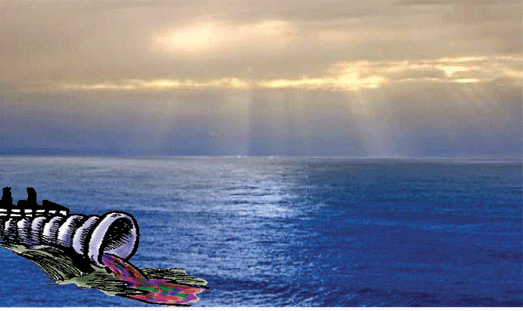 The Global Threat of Fukushima, counterpunch A Global Response is Needed WEEKEND EDITION OCTOBER 25-27, 2013 by KEVIN ZEESE AND MARGARET FLOWERS “………….An estimated 300 tons (71,895 gallons/272,152 liters) of contaminated water is flowing into the ocean every day. The first radioactive ocean plume released by the Fukushima nuclear power plant disaster will take three years to reach the shores of the United States. This means, according to a new study from the University of New South Wales, the United States will experience the first radioactive water coming to its shores sometime in early 2014.
One month after Fukushima, the FDA announced it was going to stop testing fish in the Pacific Ocean for radiation. But, independent research is showing that every bluefin tuna tested in the waters off California has been contaminated with radiation that originated in Fukushima. Daniel Madigan, the marine ecologist who led the Stanford University study from May of 2012 was quoted in the Wall Street Journalsaying, “The tuna packaged it up (the radiation) and brought it across the world’s largest ocean. We were definitely surprised to see it at all and even more surprised to see it in every one we measured.” Marine biologist Nicholas Fisher of Stony Brook University in New York State, another member of the study group, said: “We found that absolutely every one of them had comparable concentrations of cesium 134 and cesium 137.”
In addition, Science reports that fish near Fukushima are being found to have high levels of the radioactive isotope, cesium-134. The levels found in these fish are not decreasing, which indicates that radiation-polluted water continues to leak into the ocean. At least 42 fish species from the area around the plant are considered unsafe. South Korea has banned Japanese fish as a result of the ongoing leaks.
The half-life (time it takes for half of the element to decay) of cesium 134 is 2.0652 years. For cesium 137, the half-life is 30.17 years. Cesium does not sink to the ocean floor, so fish swim through it. What are the human impacts of cesium?……..
There is no end in sight from the leakage of radioactive water into the Pacific from Fukushima. Harvey Wasserman is questioning whether fishing in the Pacific Ocean will be safe after years of leakage from Fukushima. The World Health Organization (WHO) is claiming that this will have limited effect on human health, with concentrations predicted to be below WHO safety levels. However, experts seriously question the WHO’s claims……… http://www.counterpunch.org/2013/10/25/the-global-threat-of-fukushima/
French company installs world’s largest offshore wind turbine
Alstom Installs World’s Largest Offshore Wind Turbine by Energy Matters, 26 Nov 13, French energy company Alstom has successfully completed installing the world’s largest offshore wind turbine, the 6 MW Haliade 150, at the Belwind test site off the coast of Belgium.
Engineered to endure harsh North Sea conditions, the Haliade 150 is the biggest wind turbine ever erected at sea. With a rotor diameter of 150-metres and blades nearly 75-metres long, Alstom predicts each model will provide a 15 percent higher energy yield than other wind turbines – enabling a single unit to power up to 5000 households.
Touted as the new generation in offshore turbine technology, the Haliade 150’s nacelle (engine housing) looms 100-metres above sea level and is designed to operate with a minimum of upkeep. The turbine functions without a gearbox, instead relying on direct drive, and a magnetic alternator system transfers unwanted stresses from strong winds away to the tower, optimising efficiency……http://www.energymatters.com.au/index.php?main_page=news_article&article_id=4044
A sad loss – Bloggers ill health closes down Fukushima news blog!
Op Ed by Arclight2011
26 November 2013

Owing to the loss of the Fukushima Appeal Blog because Mia has some health difficulties to attend to, I would like to thank Mia on behalf of Christina and myself and I presume the readers of this site for her dedication to translating Japanese blogs and articles so that we in the west and Japan could appreciate her Japanese perspective .
In fact I would like to thank many of the bloggers (English speaking and other) that have strived to get the facts from a country that is slowly slipping into a police state, where freedom of speech is now illegal.
The Big Energy oil and nuclear corporations in Japan, USA, Canada, Australia, France and the UK (largely supported but the media) who have lied and prevaricated all the way through this ongoing disaster and it has been the alternative news groups and individuals that have shone a light onto the seedy side of this buisness.
We have seen the rejection of solar, wind and thermal by Japan as shown in the recent oil report I posted yesterday, the denial of health effects with the support of the Science Media centre in the UK, that is directed by the Department for the environment and Climate Change (The UK government), that use industry supported Proffessors that will only admit to the psychological impacts of the disaster on the seriously affected populations of Fukushima and Myagi Prefectures.
So, thank you Mia for all your hard works over the last two years!
I will list but a few of her posts and encourage you all to research her blog as it is an excellent insight to one bloggers perception of this “hidden” disaster from a Japanese perspective.
Mia has also translated English to Japanese so her countrymen could share these articles that would otherwise not be seen by the Japanese speakers.
Good luck with the future Mia
And a word from Christina (The owner of this blog) about our fellow blogger and contributer, Mia;
“A temporary farewell to a brilliant blogger
The website http://fukushimaappeal.blogspot.co.uk/ Fukushima Appeal 福島アピール has been running for nearly 2 years now. It is a unique and brilliant site, giving news and insights on the situation at Fukushima.. Now the author is unwell, and needing time off. But we look forward to recovered health and the resumption of posts before too long.
Not only are these posts completely on the ball, well written and timely, but also,with posts in both English and Japanese, readers are given a special view, not provided by any other website.”
TEPCO -Workers deaths are not reported 報道されない原発作業員の死亡について
…“She said that there have been so many workers dead without being reported. Some died during the 2 days break, some didn’t turn up the next morning and were found dead…. Those who died haven’t been measured for how much exposure they got. Tepco doesn’t count and report the dead unless they die during their work hours.” …
Posted by Mia
Fukushima: 100 babies with polydactyly are on the waiting list for operation 福島在住の夫婦、震災以降「多指症」の赤ちゃん誕生。受診すると「多指症の子の手術がいっぱいで100人待」
UNSCEARが被曝による健康被害はなかったという報告を出そうとしている! UNSCEAR is going to publish a report that says there is no health hazards after the Fukushima disaster!
French System For Cleaning Fukushima Water Blamed For Leukemia, Polluted Beaches In Europe フランスによる福島原発汚染水の浄化システムは、ヨーロッパでは(多数の)白血病を生じさせ、浜辺も汚染してしまっている。
Rapid increase in thyroid cancer in Fukushima kids – cover-up of causes 福島の子供たちに甲状腺がんが急増―その原因を隠蔽
Mushrooms and Lake fish contaminated in Chubu area (West of Kanto area) 長野県のきのこ類、群馬県のわかさぎが、放射能汚染されている
The Japanese Government announced in Fukushima “No More Repeating of Decontamination”, “Giving up reducing to 0.23uSv/” 自己管理を提案 福島で政府説明会 再除染応ぜず
Even Belgian delegates got mad at Upcoming UNSCEAR Report ベルギー代表団でさえ怒った9月に出るUNSCEAR国連科学委員会報告書
The IAEA promotes nuclear in a “sceptical” India
Published on 25 Nov 2013
Walk The Talk with Yukiya Amano, Director General, IAEA
Published On: March 23, 2013
Yukia Amano, the Director General of the International Atomic Energy Agency (IAEA) talks to Shekhar Gupta about nuclear power continuing to be an important option for many countries, the Fukushima disaster in Japan, and more.
INDIA’S NUCLEAR SCIENTISTS KEEP DYING MYSTERIOUSLY
Indian nuclear scientists haven’t had an easy time of it over the past decade. Not only has the scientific community been plagued by “suicides,” unexplained deaths, and sabotage, but those incidents have gone mostly underreported in the country—diluting public interest and leaving the cases quickly cast off by police.
By Joseph Cox 2013 Nov 25
http://www.vice.com/read/why-are-indi…
Detected to Plutonium and Uranium at Takahagi City, Ibaraki Prefecture. 茨城県高萩市
Detected to Plutonium and Uranium 茨城県高萩市


On April 5 2013
We had detected the plutonium and uranium in Takahagi City, Ibaraki Prefecture.
Many children has been living also in this city.

[[ Special Thanks ]]
Yuko Sugimoto
Reactor 4 Fuel pool was partially exposed to the air after accident
http://blog.livedoor.jp/home_make-toaru/archives/7424191.html

Given the amount of decay heat in the fuel in the pool, it is likely that in the days immediately following the accident, the fuel was partially uncovered.
(Japanese translation in the above blog was done by google translation.)

著者:Union of Concerned Scientists(憂慮する科学者同盟)の理事David Lochbaum
 発行人:米国原子力規制委員会(NRC)
 http://www.nrc.gov/reading-rm/doc-collections/commission/slides/2012/20120807/lochbaum-ltr-20120807.pdf
Radiation expert admits giving bad information on Fukushima- Doctor Yamashita got it wrong!
Published on 22 Nov 2013
How can an expert on radiation give fallacious advice and counsel?….
WEBSITE: http://www.naturalnews.com
Author credit: J. D. Heyes
Photo credit: http://www.naturalnews.com
Article link: http://www.naturalnews.com/043004_rad…
From article BBC on the
15 March 2011
“….Radiation from Japan’s quake-stricken Fukushima Daiichi nuclear plant has reached harmful levels, the government says.
The warning comes after the plant was rocked by a third blast which appears to have damaged one of the reactors’ containment vessels for the first time.
Nuclear physicist, Professor Paddy Regan, described the potential health risks stemming from problems at the plant….”
The Next Wave
Broadcast: 05/November/2013
Reporter: Mark Willacy
[extract]
PROFESSOR GERALDINE THOMAS: “Following Fukushima I doubt that there’ll be any rise in thyroid cancers in Japan and this is simply because the amount of radio-iodine that was released post-Fukushima was much, much less than released post-Chernobyl. Absolutely if you look for a problem, especially if you’re using incredibly sensitive technique which is what the Japanese are actually doing, you will find something. You will find part of that problem and you have to be careful you don’t over interpret that and worry people unnecessarily”.
WILLACY: Professor Thomas believes that unnecessary worry and fear has driven parents to make unnecessary choices.
PROFESSOR GERALDINE THOMAS: “And even post-Fukushima some women were having abortions because they were worried. The radiation would have done nothing to their prospective offspring, but the fear that that radiation was going to do something, tipped them over into having an abortion which nobody likes to know about.
http://www.abc.net.au/foreign/content/2013/s3884420.htm
Prof Richard Wakeford, Visiting Professor at Dalton Nuclear Institute at the University of Manchester and contributor to the WHO report, said:
February 28, 2013
[extract]
“The release of radioactive materials into the environment during the Fukushima nuclear accident was substantial; but based on measurement data, the radiation doses received by the surrounding population are small, even for the most exposed communities.
“These doses produce an extra risk of cancer over a lifetime of about 1% at most, in addition to background lifetime cancer risks from all other causes of, on average, 40% for men and 29% for women. The extra cancer risk is much lower than this outside the most exposed communities. Radiation exposure from the Fukushima accident has had only a small impact on the overall health of the nearby population, and much less outside the most affected areas.”
http://www.sciencemediacentre.org/expert-reaction-to-the-who-fukushima-health-risk-report/
1 This Month
Chernobyl: The Lost Tapes – A good documentary on Chernobyl on SBS available On Demand for the next 3 weeks– https://www.sbs.com.au/ondemand/tv-program/chernobyl-the-lost-tapes/2352741955560

of the week–London Campaign for Nuclear Disarmament

Tell the Ukrainian Government to Drop Prosecution of Peace Activist Yurii Sheliazhenko
To see nuclear-related stories in greater depth and intensity – go to https://nuclearinformation.wordpress.com
-
Archives
- April 2026 (139)
- March 2026 (251)
- February 2026 (268)
- January 2026 (308)
- December 2025 (358)
- November 2025 (359)
- October 2025 (376)
- September 2025 (257)
- August 2025 (319)
- July 2025 (230)
- June 2025 (348)
- May 2025 (261)
-
Categories
- 1
- 1 NUCLEAR ISSUES
- business and costs
- climate change
- culture and arts
- ENERGY
- environment
- health
- history
- indigenous issues
- Legal
- marketing of nuclear
- media
- opposition to nuclear
- PERSONAL STORIES
- politics
- politics international
- Religion and ethics
- safety
- secrets,lies and civil liberties
- spinbuster
- technology
- Uranium
- wastes
- weapons and war
- Women
- 2 WORLD
- ACTION
- AFRICA
- Atrocities
- AUSTRALIA
- Christina's notes
- Christina's themes
- culture and arts
- Events
- Fuk 2022
- Fuk 2023
- Fukushima 2017
- Fukushima 2018
- fukushima 2019
- Fukushima 2020
- Fukushima 2021
- general
- global warming
- Humour (God we need it)
- Nuclear
- RARE EARTHS
- Reference
- resources – print
- Resources -audiovicual
- Weekly Newsletter
- World
- World Nuclear
- YouTube
-
RSS
Entries RSS
Comments RSS
 nuclear-news