Dr. Suh Kune-yull, Professor of Nuclear Engineering at Seoul National University: [Freezing the soil around Fukushima reactors] sounds more like a sci-fi story, science fiction. We call this permafrost — frosting the soil — for 50 years and as long as 10,000 years. It’s longer than human history, it’s just unrealistic.
Dr. Suh Kune-yull, Professor of Nuclear Engineering at Seoul National University: I call this permafrost which [is] really freezing the soil but to me sounds more like a science fiction because they have to be doing this for work at least 50 years and as long as 10,000 years. So I think they were probably going to give this up one of these months. […]
“I have visited Fukushima many times, met the evacuees, the fishing union, the farmers, many people whose businesses have been damaged very much. I feel very sorry for them. We have to compensate them fully for the damage we caused by our accident.”
Exclusive: UK government must learn from Japan’s catastrophe as it plans a new generation of plant, nuclear chief claims
e catastrophic triple meltdown at the Fukushima Daiichi nuclear plant in March 2011 was “a warning to the world” about the hazards of nuclear power and contained lessons for the British government as it plans a new generation of nuclear power stations, the man with overall responsibility for the operation in Japan has told the Guardian.
Speaking at his Tokyo corporate headquarters , Naomi Hirose, president of the Tokyo Electric Power Company (Tepco), which runs the stricken Fukushima plant, said Britain’s nuclear managers “should be prepared for the worst” in order to avoid repeating Japan’s traumatic experience. “We tried to persuade people that nuclear power is 100% safe. That was easy for both sides. Our side explains how safe nuclear power is. The other side is the people who listen and for them it is easy to hear OK, it’s safe, sure, why not?
“But we have to explain, no matter how small a possibility, what if this [safety] barrier is broken? We have to prepare a plan if something happens … It is easy to say this is almost perfect so we don’t have to worry about it. But we have to keep thinking: what if …”
Tepco’s Fukushima Daiichi facility on the coast about 124 miles (200km) north-east of Tokyo, comprising six nuclear reactors, was hit by a giant tsunami with waves peaking at 17 metres high caused by the Great East Japan earthquake on 11 March 2011. In what quickly became one of the world’s worst nuclear disasters, operators lost control of the plant when the power supply, including emergency back-up, failed amid massive flooding. As cooling systems malfunctioned, reactors 1, 2 and 3 suffered meltdowns.
Reactor 4 was closed for routine maintenance at the time. But one of several hydrogen explosions blew the walls and roof off the reactor building. This week a delicate and lengthy operation to remove fuel rods from that reactor began.
Radiation leakage following the explosions forced the evacuation of tens of thousands of people from the surrounding area. An exclusion zone roughly 11 miles by 19 miles remains in force around the plant two and half years later. The entire facility is now being decommissioned, but Tepco’s clean-up, which has been strongly criticised by environmentalists, is expected to take up to 40 years.
Hirose said that although the situation facing Fukushima Daiichi on 11 March was exceptional, measures could have been adopted in advance that might have mitigated the impact of the disaster. Tepco was at fault for failing to take these steps, he said.
“After I became president [in 2012], we formed a nuclear safety review committee. We focused mainly on what we could do, what we could learn. We had a lot of data by then. Three other reports, one from the Diet [Japan’s parliament], one from government. We had a lot of information. Tepco’s own report, too. We concluded that we should have avoided that catastrophic accident, and we could have. We could see what we should have done.”
Preventative measures included fitting waterproof seals on all the doors in the reactor building, or placing an electricity-generating turbine on the facility’s roof, where the water might not have reached it. In addition, wrong assumptions were made, he said.
“I don’t know if I could have seen or thought this before the accident … Probably I assumed that people had discussed counter-measures to avoid a huge tsunami by something very special like a complete shutdown.”
It transpired that the huge cost and technical complexity of a multiple shutdown, in what was considered the unlikely event of an abnormally large tsunami, had led managers to discount such a scenario as implausible and inefficient, he said.
“What happened at Fukushima was, yes, a warning to the world,” he said. The resulting lesson was clear: “Try to examine all the possibilities, no matter how small they are, and don’t think any single counter-measure is foolproof. Think about all different kinds of small counter-measures, not just one big solution. There’s not one single answer.
“We made a lot of excuses to ourselves … Looking back, seals on the doors, one little thing, could have saved everything.”
Tepco was willing to share its experience with British and other nuclear plant operators if they wished, Hirose said. “We can share all the information, all the data we obtained, that we learned from this accident, and then hope that people will use the data andinformation to prevent the same thing happening.”
Hirose confirmed that his company has paid a large price for the disaster. It planned to “streamline” the business and shed hundreds of jobs through voluntary retirement to keep itself in business. “We have a huge debt for the compensation for damages and losses and for decommissioning … We have to be sustainable as a going concern.”
Concerned that Tepco may be unable to cope and responding to criticism that the company has bungled parts of the clean-up operation, Japan’s government has agreed to spend 47bn yen (£292m) on dealing with hundreds of static tanks to store radiated water at the plant.
It is also considering paying part of the cost to decommission Fukushima’s damaged nuclear reactors. Tepco will reportedly seek 500bn yen (£3.1bn) in bank loans by the end of the year to help keep itself afloat.
WASHINGTON—A federal court ruled Tuesday that the federal government can’t keep collecting fees for nuclear-waste storage until it finds a way to store the waste, delivering a victory to nuclear-power operators.
Since the early 1980s, the government has collected more than $30 billion from nuclear-power operators to pay for the eventual storage of the spent fuel from nuclear reactors. But owing to longstanding political disputes, the hoped-for permanent storage site in Nevada’s Yucca Mountain has never been built. That has left the operators of nuclear-power plants on the hook for storing their waste, while they continue to pay for a permanent solution.
The U.S. Court of Appeals for the District of Columbia Circuit ruled that the Energy Department must stop collecting fees until there is a plan to deal with nuclear waste. Further, the court said that pegging the fees to the hypothetical cost of storing waste in Yucca Mountain isn’t fair because the Obama administration has stopped work on the project.
“Until the [Energy] Department comes to some conclusion as to how nuclear wastes are to be deposited permanently, it seems quite unfair to force petitioners to pay fees for a hypothetical option, the costs of which might well—the government apparently has no idea—be already covered,” the court ruled.
The National Association of Regulatory Utility Commissioners, which had challenged the fees, applauded the decision.
“Nuclear-power rate payers should not be charged for a program the federal government has closed down,” said Charles Gray, the association’s executive director. “Thankfully, because of today’s actions, nuclear-power consumers will no longer have to pay for the government’s mishandling of this program.”
SIR PAUL McCARTNEY showed his support for victims of Japan’s 2011 nuclear disaster by inviting a group of those affected to his concert in Tokyo on Monday night (18Nov13).
Around 300,000 residents were evacuated from the area around the Fukushima Nuclear Power Plant in March, 2011 after a deadly earthquake and tsunami caused equipment failures at the site and led to the release of radioactive material.McCartney is currently touring Japan, and he met with 10 survivors of the Fukushima disaster after inviting them to watch his concert at the Tokyo Dome on Monday night (18Nov13).
The Beatles star shook hands with the lucky attendees and listened to their stories, while also insisting he hopes his music can help the country heal.
He says, “At this time, we are focused on a lot of the problems that Japan has had, particularly in the last year or two. So, I always like to think that our concerts can have a healing effect, that they can help people through crises.”
During the show, the first of three at the Tokyo venue, McCartney reportedly dedicated Beatles hit Yesterday to the victims of the Fukushima disaster.
[Mia`s note – Correction to main stream media published figures] The number 160,000 is reported as a number of evacuees in the most of Japanese and English news except for a few reports, but I think it is figure of total evacuees who were affected by Earthquake, Tsunami and Fukushima accident in Tohoku region. After searching the regional information concerning refugees, I think seems 86,000 is about right for the Fukushima disaster evacuees. The Japanese government evacuated only the residents in the areas 20km radius of the Fukushima Nuclear power plant and also from Iidate village, Kawauchi village and some from Minami-soma city. Total population in those areas was about 86,000.)
Everyone can contact Allen via emailaprisoner (dot) com he is in Stamford Hill and his number is A4966CW the more emails he gets the more evidence he has to show the Judges he needs to get back to his Mum. Please help.
Please help sign this to raise awareness for Edlington resident Allen Vincent. He suffers from a list of health problems, including Asperger’s Syndrome. He has been treated terribly by a wide range of people because of his disability, and has no care or support. In his frustration, Allen made his opinions known on twitter, some threatening, but had no intention of hurting anyone. He was arrested and treated terribly by local police. Allen was just being himself, a disabled,vulnerable man who is crying out for someone to help. He now finds himself in police custody. This petition will be sent to his local MP Caroline Flint in an attempt to get the help he deserves.
To:
Rt Hon Caroline Flint, Member of Parliament for Don Valley
Please help sign this to raise awareness for Edlington resident Allen Vincent. He suffers from a list of health problems, including Asperger’s Syndrome. He has been treated terribly by a wide range of people because of his disability, and has no care or support. In his frustration, Allen made his opinions known on twitter, some threatening, but had no intention of hurting anyone. He was arrested and treated terribly by local police. Allen was just being himself, a disabled,vulnerable man who is crying out for someone to help. He now finds himself in police custody. This petition will be sent to his local MP Caroline Flint in an attempt to get the help he deserves.
Niigata Prefecture Governor Hirohiko Izumida said:
“I would not accept the restart of Kashiwazaki nuclear power plant unless Tepco gives a full investigation into the cause of the Fukushima disaster, which should be a starting point that whether to restart or not”
“They will not be able to Vent radioactive gases without permission of local residents” , this has been written in the application by Tepco. Just knowing this fact, the Nuclear regulatory Authority (NRA) wouldn’t be able to make it pass. I would like to make this fact clearly.”
Mr. Hirohiko Izumida
Mr. Izumida had a meeting with the TEPCO president Hirose a couple times, the first point was to criticize Tepco’s decision to apply for the restarting and the second point was reported as Mr. Izumida approved of applying the safety regulations to the NRA. Since then, it has been reported in Japanese and foreign media that Niigata prefecture governor Izumida gave the green light towards restarting Kashiwazaki Nuclear Power Plant.
Then…
*The Creditor banks are to loan 500 billion yen to TEPCO 住友、三井、瑞穂、三菱銀行は、来年の再稼動を考慮にいれて、5兆円のローンを東電に融資
Tokyo Electric Power Co.’s main creditor banks agreed to provide 500 billion yen ($5 billion) in loans after the utility forecast a fiscal 2014 profit based on assumptions it can restart two nuclear reactors. http://ajw.asahi.com/article/economy/business/AJ201311150052
Because…
Ever since the nuclear disaster at the Fukushima No. 1 plant, TEPCO has posted huge annual losses for two consecutive fiscal years. The creditor banks may stop providing loans if the utility reports a loss once again for this fiscal year. TEPCO plans to return to the black in this fiscal year by restarting the Kashiwazaki-Kariwa plant. According to its rehabilitation plan, TEPCO planned to resume operations at reactors at the plant in phases from April. Hokkaido Electric Power Co., Kansai Electric Power Co., Shikoku Electric Power Co. and Kyushu Electric Power Co. have also submitted applications for restarts for a total of 12 reactors as early as July 8 2014.
Taking into account that the NRA needs about six months to screen an application, TEPCO decided to apply for permission now, after concluding that it will not be able to restart the reactors for several years if it does not submit applications together with the four other utilities. http://ajw.asahi.com/article/0311disaster/fukushima/AJ201307030055
BUT…
Despite there being all sorts of pressures from pro nuclear groups Mr. Izumida stands on his view firmly.. in his interview in Hodo Radio program that he made clear he would not accept for restarting Kashiwazaki nuclear power plant unless Tepco gave a full investigation on the cause of the Fukushima disaster which should be a starting point that whether to restart or not. He commented that he repeatedly saying this point but never being reported in the media. So he appreciated very much to be invited to this program to say it.
(Source) http://kiikochan.blog136.fc2.com/blog-entry-3362.html報道するラジオ「原発再稼働をめぐる攻防・泉田裕彦・小出裕章・古賀茂明」25/10/13 Talk on “offense and defense” (or battle) over restarting reactors with Niigata Prefecture Governor Hirohiko Izumida, Prof. Hiroaki Koide at Kyoto Nuclear Laboratory, former METI civil officer. Shigeaki Koga, Master of the ceremony: Ms. Mizuno http://youtu.be/OUwMpTIIDU0?t=35m49s (Abstract translation by Mia) He has been followed by a mysterious black car and he has had his personal life checked by nuclear village to find any of his weakness. Apparently, they couldn’t find anything to tarnish his reputation or defeat his views. So, they have been attacking his character instead by saying untrue stories about him such as
“he is strange”,
“he got angry”,
“there must had been various difficulties while he was working for the METI, therefore he left it …..” Mr. Izumida had requested to have a meeting with Mr. Tanaka, the head of the Nuclear Regulatory Agency, however Mr. Tanaka has been rejecting his offer with the reason that he doesn’t normally have private meetings with people from the utility companies that are checked by the Nuclear Regulatory Agency because if he does he would be questioned of his fairness and impartiality. 「審査をされる側の電力会社等々と密室で会うという事は公正中立性を疑われるんでやりません」This from the same gentleman who said that he would happily have a private meeting with Mr. Hirose, president of Tepco in the near future, which seems contradictory. 水野:泉田知事、規制委員会が原発再稼働、安全審査でOKを出した時にはですね、 地元としてはどうなります? 了承は必要ですが、その時は。 When he was asked what he would do if the Nuclear Regulatory Agency passed the safety regulation, he said “If the NRA passes the safety regulation for the Kashiwazaki Nuclear Plant, it would mean that the NRA is not considering the safety of local citizens. Therefore, their credibility would be very much questioned.
“The Vents will not be able to be used without the permission of the local residents” is written on the application by Tepco. With knowing this fact NRS wouldn’t be able to make it pass. I would like everybody to know this fact. (Editor’s note: No reactor can be restarted without the permission by the prefecture governor.) *Niigata governor opposes nuke plant restarts, criticizes TEPCO 3/7/13http://ajw.asahi.com/article/0311disaster/fukushima/AJ201307030055
*Fukushima: Leaking problems to cover up something unusual at reactor 1 and 3 おしどりマコ氏「汚染水のタンク漏えいは1号機と3号機のがれき撤去を隠すための目くらましだ」と発言
Tepco and the Japanese government announced in 2011 soon after the Fukushima accident that explosions at reactor 1&3 were a hydrogen explosion, however, this hasn’t proved scientifically yet. It is important to investigate at the scene to find out a cause of explosions before clearing up highly radioactive debris from reactor buildings. But Tepco started to clear up the debris at reactor 1 and 3 building from this summer.
A new study of the effects of tiny quantities of radioactive fallout from Fukushima on the health of babies born in California shows a significant excess of hypothyroidism caused by the radioactive contamination travelling 5,000 miles across the Pacific. The article will be published next week in the peer-reviewed journal Open Journal of Pediatrics.
Congenital hypothyroidism is a rare but serious condition normally affecting about one child in 2,000, and one that demands clinical intervention – the growth of children suffering from the condition is affected if they are left untreated. All babies born in California are monitored at birth for Thyroid Stimulating Hormone (TSH) levels in blood, since high levels indicate hypothyroidism.
Joe Mangano and Janette Sherman of the Radiation and Public Health Project in New York, and Christopher Busby, guest researcher at Jacobs University, Bremen, examined congenital hypothyroidism (CH) rates in newborns using data obtained from the State of California over the period of the Fukushima explosions.
Their results are published in their paper Changes in confirmed plus borderline cases of congenital hypothyroidism in California as a function of environmental fallout from the Fukushima nuclear meltdown. The researchers compared data for babies exposed to radioactive Iodine-131 and born between March 17th and Dec 31st 2011 with unexposed babies born in 2011 before the exposures plus those born in 2012.
Confirmed cases of hypothyroidism, defined as those with TSH level greater than 29 units increased by 21% in the group of babies that were exposed to excess radioactive Iodine in the womb [*]. The same group of children had a 27% increase in ‘borderline cases’ [**].
Contrary to many reports, the explosion of the reactors and spent fuel pools at Fukushima produced levels of radioactive contamination which were comparable with the Chernobyl releases in 1986. Using estimates made by the Norwegian Air Laboratory it is possible to estimate that more than 250PBq (200 x 1015) Bq of Iodine-131 (half life 8 days) were released at Fukushima.
This is also predicted by comparing the Caesium-137 estimates with I-131 releases from Chernobyl, quantities which caused the thyroid cancer epidemic in Byelarus, the Ukraine and parts of the Russian Republic.
More on this later. At Fukushima, the winds generally blew the radioactive iodine and other volatile radionuclides out to sea, to the Pacific Ocean. The journey 5,000 miles to the West Coast of the USA leaves a lot of time for dispersal and dilution. Nevertheless, small amounts of I-131 were measured in milk causing widespread concern.
The authorities downplayed any risk on the basis that the “doses” were very low; far lower than the natural background radiation. The University of Berkeley measured I-131 in rainwater from 18th to 28th March 2011 after which levels fell. If we assume that mothers drank 1 litre of rainwater a day for this period (of course they didn’t) the current radiation risk model of the International Commission on Radiological Protection (ICRP) calculates an absorbed dose to the adult thyroid of 23 microSieverts, less than 1/100th the annual background “dose”. The foetus is more sensitive (by a factor of about 10 according to ICRP) but is exposed to less as it is perhaps 100 times smaller.
So this finding is one more instance of the fact that the current radiation risk model, employed by the governments of every nation, is massively insecure for predicting harm from internal radionuclide exposures or explaining the clear observations.
The Fukushima catastrophe has been dismissed as a potential cause of health effects even in Japan, let alone as far away as California. And on what basis? Because the “dose” is too low.
(NOTE ; some slight changes to original article for clarity – Story available only in the UK local newspaper, there is no reference to this story on the INTERNET? This would make it more difficult to raise the funds as even the locals could easily have missed the article.. It is worth noting that the article from the Exeter Press and Echo posted its story on-line BEFORE the Fukushima disaster. NOW WEB CENSORED?? . Arclight2011)
A South Hams District charity has suffered “ a great blow” now that it has to raise an extra £1000 (Approx 2000 dollars)in order to fund a visit of Chernobyl children next summer.
For the past 16 years, children from the Ukraine and Belarus (worst hit by Chernobyl fall out causing food contamination issues and increased radiological dose) have been able to visit the UK unr a “Visa Waiver” scheme, but as from th 1st April this year the UK government has ceased to issue free visas for such groups – The only EU (European) country to do so. The cost of the new visa will be £78.00 each.
Sue Wyeth, chairman of the Totnes and South hams link to Chernobyl Childrens Lifeline, said; “This is a great blow to a small link such as ours. It already cost around £7000.00 to bring a group of ten children and their leader over to South Hams for a months respite care. We are now having to rasie a further £1000, which is no easy matter in such difficult times”.
CASE STUDY
A cup of tea and a cake would help to provide a badly needed new wheelchair for a Chernobyl child who is a regular visitor to south Devon.
Anya Nebyshynets (pictured above on the Exeter Press link), now 17, who was a victim of the 1986 Chernobyl disaster, is fostered in Ashington for four months of the year by Joan Edwards and her family. Last year Joan took Anya, who suffers from cerebral Palsy, to Frenchay Hospital in Bristol to see if anything could be one to help her walk.
But the doctors said an operation wasnt possible, so next on the list is a new wheelchair as Anya has outgrown her old one.
Asked how much they needed to raise, Joan said; “Its open ended. You are never quite sure how much it is going to be.”.
She plans to visit the Exeter Disability Centre with Anya, when the 17year old arrives from Belarus at the beginning of December 2013
The Fund raising event was held in Ashington Village hall on Saturday November the 16 2013.
For more information and offers of support please contact Joan or Annie on either 0044 782 460 1163 or 0044 180 373 2451
Two biggest donors are uranium and shale gas producers
• Academics say this makes idea research was independent “laughable”
Senior professors have spoken out against University College London (UCL) Australia’s pro-nuclear, pro-shale gas research, claiming that strong industry ties make the idea it is independent “laughable”.
UCL’s Adelaide-based campus released one green paper calling for Australia to acquire nuclear submarines and another advocating the use of shale gas in the country. Of its two biggest sponsors, one mines uranium – needed to fuel nuclear submarines – and the other produces shale gas.
Speaking on the condition of anonymity, UCL professors told London Student: “The idea that research favouring nuclear submarines and shale gas extraction could possibly be independent (taking into account relevant alternatives) is laughable – UCL Australia has not produced a single piece of research on sustainable, greener, or alternative energies.”
“A university should not only be academically independent and impartial but also be seen to be so. In these matters UCL’s academic integrity is in jeopardy.”
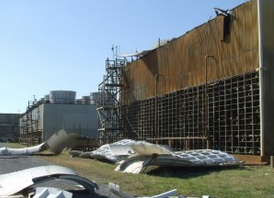
WPSD, Nov. 17, 2013: One of the plant’s four enrichment production buildings, the adjacent cooling towers and nearby electrical switchyard sustained most of the damage. Several of the transite panels that cover the building were torn off or broken. Electrical power poles, wiring and other electrical circuits were also damaged. The shrouds or collars that surround the fans on this set of cooling towers were destroyed.
Damaged cooling tower (SOURCE: USEC)
NBC Lexington, KY, Nov. 18, 2013: Officials were continuing to monitor the facility Monday, but said there had been no hazardous material releases, according to the statement.
NRC Report, Nov. 17, 2013: [A]n alert was declared at the Paducah Gaseous Diffusion Plant due to an apparent tornado strike/severe weather event. […] “This event is reportable under 10 CFR 76.120(a)(4) where an emergency condition has been declared an Alert. […]”
The Courier Journal, Nov. 18, 2013: USEC stopped enriching uranium there in June.
Nearly all news outlets covering the Paducah tornado claim the plant stopped enriching uranium earlier this year. However, according to this report, (Emphasis Added) “On 14 November 2013 Russia has shipped the last batch of low-enriched uranium […] The cargo will be delivered to Baltimore and then to USEC’s Paducah Gaseous Diffusion Plant in Kentucky, where the uranium will be used to manufacture fuel for U.S. nuclear power plants.”
Also note the vast majority of reports only say that no “hazardous materials” were released — releases of “radioactive material” are not denied or admitted (see USEC’s twitter feed). The plant’s internal documents clearly distinguish between “hazardous” and “radioactive”. For example, APPENDIX F reads, “Categories of waste evaluated were LLW [low-level radioactive waste], TRU [transuranic waste], hazardous waste […] All low-level mixed (radioactive and hazardous) waste (LLMW) and hazardous waste at these sites are transported off site.”
Michael Friedman is an evolutionary biologist and adjunct assistant professor at QueensCollege of the City University of New York.
Retired nuclear power plant operator David Walters seeks to make a socialist case for nuclear power as the alternative to fossil fuels. Unfortunately, he parts from the unfortunate and worn-out progressive infatuation with capitalist productivism, the technology that it employs and the technological determinism that justifies it and brings forth a host of magic bullet non-solutions for every problem it engenders. This is succinctly confirmed by his assertions that “the center of this discussion can be narrowed down to one technological and scientific issue: the generation, use, and distribution of energy” and “human use of energy set us apart from all other species, including the higher ones such as dolphins and apes.”
These formulations fly in the face of a Marxist understanding of human development, reducing ‘all hitherto existing human history’ to the history of energy development. That is technological determinism, no more. For Marxists, the “center” of this discussion is the capitalist mode of production, and concretely, its method of appropriation of human labor and natural resources.
Driven to privatize and turn the natural world into marketable commodities incorporating human labor, capital rips natural processes such as biogeochemical cycles or trophic webs to pieces in order to isolate profitable components. We are presented with abominations like monocrop agriculture, fracking and Fukushima.
This mode of production and the reductionist, mechanistic worldview attendant upon it, has turned Homo sapiens’ biological connections to the rest of the natural world upside down; under capitalism, humans are not only alienated from their labor, and each other, but from the nature with which they are inextricably bound. This is the cause of the environmental crisis. Global warming is far from the only major element of this crisis. Many ecologists regard the dramatic decline in biodiversity as just as devastating to humans and all life on this planet as global warming. Deforestation, ocean acidification, the proliferation of human waste and toxic contaminants, the introduction of genetically engineered organisms and invasive species, all of these are, of course interconnected consequences of the market economy, but it is meaningless to subsume them under the rubric of “generation, use and distribution of energy.”
Even global warming cannot simply be reduced to a problem of energy production. Authors Roddy Scheer and Doug Moss observe that, “by most accounts, deforestation in tropical rainforests adds more carbon dioxide to the atmosphere than the sum total of cars and trucks on the world’s roads. According to the World Carfree Network (WCN), cars and trucks account for about 14 percent of global carbon emissions, while most analysts attribute upwards of 15 percent to deforestation.”[1]
What does all of this imply for solutions?
First, the integral environmental crisis we face today quite simply does not admit to technological solutions in the first instance, because it is a product of the peculiar relationship that capitalist society establishes between humans and the natural world. The solution, as Walters might agree, lies through revolutionary transformation of society.
…As of the 2014-2020 programming period, financing will no longer be allocated to non-nuclear projects but will only go for the decommissioning of Units 1-4 of Kozloduy NPP…
SOFIA (Bulgaria), November 18 (SeeNews) – The Bulgarian energy and economy ministry has signed five agreements with the donors of the nuclear plant decommissioning fund KIDSF for grants of a total of 85 million euro ($114.78 million) for energy efficiency projects and decommissioning, the ministry said.
The KIDSF facility, administered by the European Bank for Reconstruction and Development (EBRD), was set up with EU funds to support projects related to the decommissioning of four nuclear reactors at Kozloduy NPP as well as to supports projects for restructuring and upgrades in Bulgaria’s energy sector.
KIDSF will provide some 35 million euro for non-nuclear related projects, including the purchase of new equipment for coal miner Mini Maritsa Iztok and the development of data collection, monitoring and management systems of Bulgaria’s Electricity System Operator (ESO), the Bulgarian energy and economy ministry said in a press release on Saturday. The funding will also cover the reconstruction of Belmeken-Sestrimo-Chaira hydroelectric complex.
The other 50 million euro will be used for the wages of the employees who work on the decommissioning of Kozloduy’s four units, which will take place between 2014 and 2016.
As of the 2014-2020 programming period, financing will no longer be allocated to non-nuclear projects but will only go for the decommissioning of Units 1-4 of Kozloduy NPP.
Bulgaria will receive additional 12.8 million euro for the management of waste from the units’ decommissioning.
The Bulgarian energy and economy ministry has signed a total of 35 agreements for some 355.74 million euros with KIDSF’s Assembly of Donors for non-nuclear projects since its establishment in 2001.







 nuclear-news