U.N. nuclear agency sends new Fukushima expert mission but no word on the Fukushima UNHCR petition?

Image source ; http://fukushimaupdate.com/a-look-at-the-latest-iaea-report-on-decontamination/ 2011
VIENNA |
http://uk.reuters.com/article/2013/10/04/uk-japan-fukushima-iaea-idUKBRE99309120131004
(Reporting by Fredrik Dahl; Editing by Alistair Lyon)
(Reuters) – The U.N. nuclear agency said on Friday it would send an international team of experts to Japan later this month to look into efforts to clean up affected areas around the crippled Fukushima atomic power plant.
Japan’s nuclear regulator earlier ordered the operator of Fukushima to draft in additional workers if needed to plug leaks of radioactive water from its tanks and report within a week on steps taken to fight the crisis.
The warning was the second in as many months issued to Tokyo Electric Power Co, or Tepco, after the company found a second escape of contaminated liquids that probably entered the Pacific Ocean
In Vienna, the U.N. International Atomic Energy Agency (IAEA) said the October 14-21 mission would “review the implementation of remediation activities in areas affected by the accident … and provide advice to address associated challenges”.
It did not give details and an IAEA spokesperson was not immediately available for comment.
The 16-person mission of IAEA as well as other experts, a follow-up from one carried out in 2011, was sent at the request of Japan’s government (See 2011 link under the IAEA logo Arclight2011), the U.N. agency said in a statement.
In the world’s worst nuclear accident in a quarter of a century, reactor meltdowns at the Fukushima facility after an earthquake and tsunami in March 2011 sent radiation spewing over large areas, forcing more than 160,0000 people to flee.
[Arclight2011 notes : The UNHCR has not released any information about the petition for the children and adults left in the contaminated lands, refugees etc nor did it mention any health effects in children or adults in a specific country based way so far as i can see so far , The report does mention the rights of the child to good health and protection from pollution in a more general way, however, the report is listed here and I am studying it now.. feel free to crack on in case my battery dies.. [i live in a field with no connection to the nuclear powered grid].. heres the link to the latest from the UNHCR September 27 2013 report>>>>
http://www.crin.org/resources/infodetail.asp?id=30140
All the information should be there.. Though i heard a rumour that a separate report has been done concerning the children of Fukushima and it will be released at the last minute or during some media excitment but this last comment is hearsay (not proven yet) )
Denial of science, economics, history – Pandora’s Nuclear Propaganda – October 2013
 As stricken Fukushima nuclear power plant continues to spew radioactive water, and teeters still on the brink of a new catastrophe – the nuclear lobby comes up with a new campaign. It is spearheaded by this propaganda film – “Pandora’s Promise”.
This is a good occasion for the usual suspects – pretend environmentalists, vested nuclear interests (Bill Gates, Paul Allen), mainstream cinema reviewers , to praise this nuclear advertising “documentary”.
This film’s lies go beyond its deceptions about ionising radiation, and about safety, and about nuclear waste disposal.
The main selling point – “nuclear power as cure for global warming” is absurd, as the world would need 11,000 nuclear power plants quickly set up, to have any impact on global warming – and that would in fact take decades to set up.
Other lies – the denial of nuclear power’s costs, and of the costs of nuclear waste disposal, and of the costs of security. Also denial of the complete impracticality and cost of setting up thousands of mini nuclear reactors. http://www.beyondnuclear.org/storage/pandoras-false-promises/Aug23_2013_Pandora’s%20False%20Promises.pdf

For business and investment, you can forget nuclear power
 In 5 Charts, Here’s Why Nuclear Energy Is Going Nowhere BUSINESS INSIDER 3 Oct 13, AT LEAST FIVE U.S. NUCLEAR PLANTS HAVE BEEN SHUTTERED THIS YEAR, THE RESULT OF RUNAWAY EXPENSES AND AN INABILITY TO COMPETE WITH CHEAP NATURAL GAS PRODUCED BY THE SHALE BOOM.
So you may not need more reason to think nuclear is going nowhere.
But here are five more charts, via a Citi team led by Jason Channell, showing that nuclear is not only on the wane in America, but also around the world.
Nuclear now requires an up-front investment 5x greater than gas on a per Watt basis.
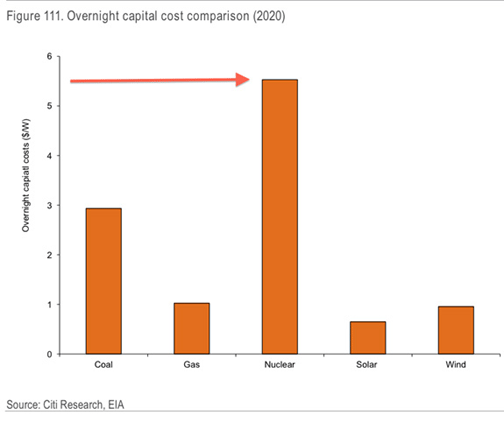
Capital costs comparison….
Operational costs comparison….
Nuclear investment already trailing solar….
Demand for renewables greater than for nuclear….
New power generation capacity in China …. And here’s team Citi’s take on why all this is so.
The capital cost of nuclear build has actually risen in recent decades in some developed markets, partly due to increased safety expenditure, and due to smaller construction programmes (i.e. lower economies of scale). Moreover the ‘fixed cost’ nature of nuclear generation in combination with its relatively high price (when back end liabilities are taken into account) also places the technology at a significant disadvantage; utilities are reluctant to enter into a very long term (20+ years of operation, and decades of aftercare provisioning) investment with almost no control over costs post commissioning, with the uncertainty and rates of change currently occurring in the energy mix. As an example, one need only look at the ongoing debate in the UK over the next generation of nuclear build, and the reluctance of most parties to commit.
A good run, but time to step aside. http://www.businessinsider.com.au/5-charts-that-show-nuclear-is-declining-2013-10
Fukushima’s latest radioactive water leak
 New leak of radioactive water at Fukushima nuclear plant may have flowed into Pacific Ocean: TEPCO Radio Australia 3 October 2013, 13:50 AEST By North Asia correspondent Mark Willacy, wires
More radioactive water is leaking at Fukushima and it may be flowing into the Pacific.The operator of the crippled Fukushima nuclear plant says it has found a new leak of radioactive water that might have flowed into the Pacific Ocean.
The leak from the 450-tonne storage tank is the second of its kind in as many months, and involved water with high concentrations of radioactive strontium and caesium.
Fukashima operator Tokyo Electric Power (TEPCO) says it does not know how much water leaked, adding that it could have flowed from an adjoining drainage ditch into the sea.
TEPCO has apologised for causing anxiety…….http://www.radioaustralia.net.au/international/2013-10-03/new-leak-of-radioactive-water-at-fukushima-nuclear-plant-may-have-flowed-into-pacific-ocean-tepco/1199662
Fukushima radiation-related deaths from fish in Pacific
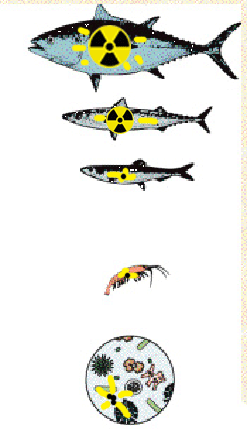 Physician on Cancer Estimates: Epidemic of Fukushima radiation-related deaths from fish in Pacific may have started — “Vast implications for human health” — “I eat so much salmon… I’m vulnerable” http://enenews.com/physician-on-cancer-calculations-epidemic-of-fukushima-radiation-related-deaths-from-fish-in-pacific-may-have-started-vast-implications-for-human-health-i-eat-so-much-salmon-im-vulne
Title: Fish data belie Japan’s claims on Fukushima
Source: Georgia Straight (Canada)
Author: Alex Roslin
Date: Oct. 2, 2013
[…] About 800 people worldwide will get cancer from radiation due to Fukushima in fish eaten to date [through mid-July 2013], according to Georgia Straight calculations. The Straight results relied on a widely used cancer-risk formula developed by the U.S. Environmental Protection Agency as well as radiation levels in 33,000 fish tested by the Japanese Fisheries Agency. […]
Two nuclear experts who saw the Straight’s figures said the real cancer toll could be 100 times higher—or 80,000 cancers. […]
Erica Frank, a Vancouver MD, was taken aback when told the Straight’s results. “How can a person do anything but gasp?” she said in a phone interview. “That’s horrible. This is the beginning of a potential epidemic of radiation-related deaths from fish in the Pacific. It has vast implications for human health.”
Frank is a professor of population and public health in UBC’s faculty of medicine […] She said that after Fukushima, she decided to stop eating fish from Asia. She is especially concerned about impacts on B.C. migratory salmon. “I eat so much salmon. I love salmon; I am vulnerable.” […]
Edward Snowden revealed enormous surveillance powers of US UK governments
 The totalitarian state in Orwell’s Nineteen Eighty-Four would need no broader legal justification than that: it really does allow a government to do anything it likes. It was at this point that I became convinced that Snowden’s revelations are not just interesting or important but vital, because the state is about to get powers that no state has ever had, and we need to have a public debate about those powers and what their limits are to be..
 The Snowden files: why the British public should be worried about GCHQ John Lanchester The Guardian, Friday 4 October 2013
When the Guardian offered John Lanchester access to the GCHQ files, the journalist and novelist was initially unconvinced. But what the papers told him was alarming: that Britain is sliding towards an entirely new kind of surveillance society………
Problems and risks
The problems with GCHQ are to be found in the margins of the material – though they are at the centre of the revelations that have been extracted from the Snowden disclosures, and with good reason. The problem and the risk comes in the area of mass capture of data, or strategic surveillance. This is the kind of intelligence gathering that sucks in data from everyone, everywhere: from phones, internet use from email to website visits, social networking, instant messaging and video calls, and even areas such as video gaming; in short, everything digital. Continue reading
Israel’s dirty secrets – nuclear, biological, and chemical weapons

 Israel’s Secret Nuclear Biological and Chemical Weapons (NBC) http://www.globalresearch.ca/israels-secret-nuclear-biological-and-chemical-weapons-nbc/5352454 By Manlio Dinucci
Global Research, October 01, 2013 For years, Syria and Egypt refused to abandon their chemical weapons facing a threatening neighbor, Israel, which develops very sophisticated ones, in addition to biological and nuclear weapons. However, while Syria has joined the Organization for the Prohibition of Chemical Weapons , we are taking a look at Israeli activities.
The UN inspectors who monitor chemical weapons in Syria would have much to do if they were sent to monitor the nuclear, biological and chemical weapons (NBC) of Israel.
But according to the rules of “international law”, they cannot do so. Israel has not signed the Nuclear Non-Proliferation Treaty, nor the Convention Banning Biological Weapons , and has signed but not ratified the Convention Banning Chemical Weapons.
According to Jane’s Defense Weekly, Israel – the only nuclear power in the Middle East, has 100 to 300 nuclear warheads and their appropriate vectors ( ballistic and cruise missiles and fighter-bombers ). According to SIPRI estimates, Israel has produced 690-950 kg of plutonium, and continues to produce as much as necessary to make from 10 to 15 bombs of the Nagasaki type each year.
It also produces tritium, a radioactive gas with which neutron warheads are made, which cause minor radioactive contamination but higher lethality. According to various international reports, also quoted by the Israeli newspaper Ha’aretz, biological and chemical weapons are developed at the Institute for Biological Research, located in Ness- Ziona, near Tel Aviv. Officially, 160 scientists and 170 technicians are part of the staff, who for five decades have performed research in biology, chemistry, biochemistry, biotechnology, pharmacology, physics and other scientific disciplines. The Institute, along with the Dimona nuclear center , is “one of the most secretive institutions in Israel” under direct jurisdiction of the Prime Minister. The greatest secrecy surrounds research on biological weapons, bacteria and viruses that spread among the enemy and can trigger epidemics. Among them, the bacteria of the bubonic plague (the ” Black Death ” of the Middle Ages ) and the Ebola virus, contagious and lethal, for which no therapy is available. Continue reading
Japan’s Environment Minister, and former PM speak out against nuclear power
Former Japanese PM And Current Environment Minister Speak Out Against Nuclear Power
Climate progress, BY ARI PHILLIPS ON OCTOBER 3, 2013 This week both Japan’s environment minister, Nobuteru Ishihara, and former Prime Minister Junichiro Koizumi, a popular national figure, spoke out against nuclear power.
Ishihara said the country’s target to cut greenhouse gas emissions should be based on a scenario with no nuclear power generation…….. in a speech to a pro-nuclear audience of business executives, Koizuma went against the grain by saying that Japan should “should rid itself of its atomic plants and switch to renewable energy sources like solar power.”
Koizuma went on to say that “there is nothing more costly than nuclear power. Japan should achieve zero nuclear plants and aim for a more sustainable society.”
Japan’s last operating nuclear reactor was halted for maintenance in September, leaving the nation without nuclear energy for the first time since July 2012…….http://thinkprogress.org/climate/2013/10/03/2722531/japan-nuclear-power-leaks/
Fukushima’s 83,000 nuclear refugees will never go home?
 Japan’s Nuclear Refugees, Still Stuck in Limbo Near Fukushima, a Human Crisis Quietly Unfolds: The 83,000 refugees evacuated from the worst-hit areas
  around the nuclear power plant are still unable to go home, two and a half years after the disaster. NYT, By MARTIN FACKLER October 1, 2013 NAMIE, Japan — Every month, Hiroko Watabe, 74, returns for a few hours to her abandoned house near the damaged Fukushima nuclear plant to engage in her own small act of defiance against fate. She dons a surgical mask, hangs two radiation-measuring devices around her neck and crouches down to pull weeds……
“In my heart, I know we can never live here again,” said Ms. Watabe, who drove here with her husband from Koriyama, the city an hour away where they have lived since the disaster. “But doing this gives us a purpose. We are saying that this is still our home.”
While the continuing environmental disaster at the Fukushima Daiichi plant has grabbed world headlines — with hundreds of tons of contaminated water flowing into the Pacific Ocean daily — a human crisis has been quietly unfolding. Two and a half years after the plant belched plumes of radioactive materials over northeast Japan, the almost 83,000 nuclear refugees evacuated from the worst-hit areas are still unable to go home. Some have moved on, reluctantly, but tens of thousands remain in a legal and emotional limbo while the government holds out hope that they can one day return. Continue reading
Fukushima’s small level of radiation in fish can still cause cancers
the radiation detected can still cause cancer, according to the U.S. Environmental Protection Agency’s cancer-risk formula, a leading international standard for forecasting cancer risks from radiation.
Cancer risk linked to radiation levels in fish species after Fukushima http://www.straight.com/life/497651/cancer-risk-linked-radiation-levels-fish-species-after-fukushima
In July this year, a sea bass caught in Japan had 1,000 becquerels per kilogram of radioactive cesium—10 times Japan’s ceiling of 100 becquerels per kilo in food. It was the second-highest amount found in a sea bass since the disaster occurred. Continue reading
Nuclear power plant approvals delayed by US govt shutdown?
“The shutdown of the government is an indication that it can’t be trusted to have institutional controls over radioactive materials for as long as they remain dangerous,” D’Arrigo said. “It seems incredible to me that the NRC is seriously talking about being able to afford and have institutional controls indefinitely.”
 SHUTDOWN MAY FURTHER DELAY NUCLEAR POWER PLANT APPROVALS By Douglas P. Guarino, 3 Oct 13 Global Security Newswire Nuclear power plant licensing decisions — already delayed by a 2012 court ruling — could be pushed back further by the federal government shutdown, Nuclear Regulatory Commission officials said this week.
 If Congress does not approve funding to run the federal government by Friday, the NRC likely will have to reschedule a series of meetings that kicked off this week on a proposed new “waste confidence” rule that is meant to address the ruling, Keith McConnell, head of the NRC waste confidence directorate, said Tuesday.
Most of the federal government shut down on Oct. 1, the start of fiscal 2014, because Democrats and Republicans in Congress cannot agree on a temporary funding bill. Democrats are rejecting GOP attempts include in the budget a repeal of the health-care reform law Congress approved in 2010.
Last year, a federal appeals court sided with the states of New York, Connecticut, Massachusetts and Vermont, which argued the Nuclear Regulatory Commission wrongly assumed spent reactor fuel eventually would move to a permanent waste repository, even though the Obama administration canceled the Yucca Mountain project in Nevada. Continue reading
Pennsylvania water has dangerous levels of radiation due to fracking
Dangerous levels of radiation from fracking found in PA water http://www.salon.com/2013/10/02/dangerous_levels_of_radiation_from_fracking_found_in_pa_water/singleton/ Researchers found 200 times the normal amount of radium downstream of a treatment plant BY LINDSAY ABRAMS The wastewater released into a Pennsylvania river from a plant that processes fracking wastewater tested positive positive for dangerous contaminants — including radium levels elevated 200 times above normal — Duke University researchers found.
“The radioactivity levels we found in sediments near the outflow are above management regulations in the U.S. and would only be accepted at a licensed radioactive disposal facility,” Robert B. Jackson, one of the researchers, said in a statement.
The study, published in the journal Environmental Science and Technology, compared water and sediment samples from downstream of the Josephine Brine Treatment Facility, located on western Pennsylvania’s Marcellus shale formation, to samples from above the plant. In addition to the extreme levels of radium, it also found two to ten times the amoung of chlorides and bromides in the downstream samples. As Smithsonian Magazine notes, Pennsylvania hosts 74 facilities that treat the radioactive water driven to the surface by fracking. Ostensibly, they’re supposed to remove radium and other contaminants from the water before releasing it into rivers and streams. No national standards, however, exist to regulate the plants, many of which, according to the EPA, “are not properly equipped to treat this type of wastewater.” They’re also not required to test to radiation — so until the Duke researchers stepped in, it’s likely no one was aware of just how poorly this plant was performing.
“Each day, oil and gas producers generate 2 billion gallons of wastewater,” Jackson told Climate Central. “They produce more wastewater than hydrocarbons. That’s the broader implication of this study. We have to do something with this wastewater.”
Film: Uranium in situ mining, radiation in water, cancer
The mining companies know that if the leaching solution breaks into an aquifer, the water is contaminated and cannot be corrected. They cannot and will not guarantee it but will only promise to use the best available technology and make the best possible effort to correct the problem. Then as always, they will walk away with the ore and the profits and leave local residents and federal taxpayers to deal with the aftermath.
Hot Water: The Uranium Industry’s Dirty Little Story The only thing green about nuclear power are the people who think it’s safe. Lizabeth Rogers Activist Post 2 Oct 13,
HOT WATER Documentary Trailer
How many do you know today?
I began this odyssey, innocently enough in July 2009 when I led a filmmaking crew to South Dakota to investigate what we had heard was an abandoned uranium mine which had contaminated local groundwater and made local ranchers, their children and even their livestock sick. Continue reading
India is NOT watering down its Nuclear Liability Law to suit USA’s nuclear salesmen
 India in 2010 passed a law making suppliers of nuclear reactors and other equipment liable for any accidents. This spooked companies that wanted to sell nuclear technology
Local media last month reported that the government may dilute the nuclear-liability law in order to push through the deal with Westinghouse.
“No compromise of any kind has been made,” said the official at the Department of Atomic Energy. “All these reports are false.”
 India Official: Won’t Relax Nuclear-Liability Rules Nuclear Power Corp. of India, Westinghouse Sign Preliminary Contract WSJ, By BIMAN MUKHERJI 2 Oct 13
NEW DELHI—India won’t relax a law holding suppliers of nuclear-power equipment responsible for accidents, a senior government official said Thursday, denying media reports that suggested it could bend rules to allow a reactor-supply deal with Westinghouse Electric Co. to go through.
State-run Nuclear Power Corp. of India Ltd. signed a preliminary contract with U.S.-based Westinghouse late last month, the Indian company said. Westinghouse didn’t reply to emailed questions. Continue reading
Uranium company Paladin downgraded by investment analysts
Translating business language – “outperform” – means good to invest. “Sector Perform” mean s not so good
Outperform. The stock’s total return is projected to exceed the average return of the industry (or its sector or its peers). This means the stock will perform better than the competition and is likely rated a “Buy”.
Sector Perform). The stock is expected to perform in line with the average return of the market or sector or its peers. Similar to a “Hold” or a “Neutral” rating.
Paladin Energy Limited Downgraded to Sector Perform at RBC Capital (PDN) North fork vue.com October 2nd, 2013 Paladin Energy Limited (ASX:PDN) was downgraded by investment analysts at RBC Capital from an “outperform” rating to a “sector perform” rating in a note issued to investors on Wednesday, American Banking News reports. They currently have a A$0.80 ($0.75) price target on the stock……..
A number of other analysts have also recently weighed in on PDN. Analysts at TD Securities cut their price target on shares of Paladin Energy Limited (ASX:PDN) from A$0.90 ($0.84) to A$0.65 ($0.61) in a research note to investors on Friday, August 30th. They now have a “hold” rating on the stock. Separately, analysts at BMO Capital Markets cut their price target on shares of Paladin Energy Limited (ASX:PDN) from A$0.80 ($0.75) to A$0.60 ($0.56) in a research note to investors on Friday, August 30th. Finally, analysts at Raymond James downgraded shares of Paladin Energy Limited (ASX:PDN) from an “outperform” rating to a “market perform” rating in a research note to investors on Monday, August 5th. Three equities research analysts have rated the stock with a hold rating and one has issued a buy rating to the stock. The stock presently has an average rating of “Hold” and a consensus price target of A$0.96 ($0.90).
Paladin Energy Ltd (ASX:PDN) is a uranium production company with projects in Australia and two operating mines in Africa. http://www.northforkvue.com/finance/10712/paladin-energy-limited-downgraded-to-sector-perform-at-rbc-capital-pdn/
1 This Month

of the week – Shut Down Drone Warfare!


Tell the Ukrainian Government to Drop Prosecution of Peace Activist Yurii Sheliazhenko

Petition to revoke the licensing of the Near Surface Nuclear Disposal Facility (NSDF) at Chalk River. https://www.ourcommons.ca/petitions/en/Petition/Details?Petition=e-7247
To see nuclear-related stories in greater depth and intensity – go to https://nuclearinformation.wordpress.com
-
Archives
- April 2026 (103)
- March 2026 (251)
- February 2026 (268)
- January 2026 (308)
- December 2025 (358)
- November 2025 (359)
- October 2025 (376)
- September 2025 (257)
- August 2025 (319)
- July 2025 (230)
- June 2025 (348)
- May 2025 (261)
-
Categories
- 1
- 1 NUCLEAR ISSUES
- business and costs
- climate change
- culture and arts
- ENERGY
- environment
- health
- history
- indigenous issues
- Legal
- marketing of nuclear
- media
- opposition to nuclear
- PERSONAL STORIES
- politics
- politics international
- Religion and ethics
- safety
- secrets,lies and civil liberties
- spinbuster
- technology
- Uranium
- wastes
- weapons and war
- Women
- 2 WORLD
- ACTION
- AFRICA
- Atrocities
- AUSTRALIA
- Christina's notes
- Christina's themes
- culture and arts
- Events
- Fuk 2022
- Fuk 2023
- Fukushima 2017
- Fukushima 2018
- fukushima 2019
- Fukushima 2020
- Fukushima 2021
- general
- global warming
- Humour (God we need it)
- Nuclear
- RARE EARTHS
- Reference
- resources – print
- Resources -audiovicual
- Weekly Newsletter
- World
- World Nuclear
- YouTube
-
RSS
Entries RSS
Comments RSS
 nuclear-news