Japanese government spreading misinformation about radiation – says famous actress Norika Fujiwara
 Famous Japanese Actress: Gov’t is covering up Fukushima crisis — “Our nation has a right to know” — People who write the truth on Internet will be punished under new law — TV stars in Japan are to never discuss political views http://enenews.com/famous-japanese-actress-accuses-govt-of-fukushima-cover-up-our-nation-has-a-right-to-know-says-people-who-write-the-truth-on-internet-will-be-punished-under-new-law-stars-expected-to-ne
Japan Times, Sept. 18, 2013: Norika Fujiwara [former Miss Japan] has broken an unwritten rule of the television business: sharing her political views. The popular model and actress has come out against a bill that stiffens penalties against civil servants who leak classified information. […]
In a message posted on Friday, Fujiwara accused the government of covering up the truth about the crisis at the Fukushima nuclear plant, and spreading misinformation about radiation and leaks of radioactive water there. “As a citizen I am really concerned about it,” Fujiwara wrote in another message. “Our nation has a right to know.” […] “Once the bill is signed, the people who will write the truth on the Internet (or through other means) will be punished,” she stressed. […]
Tokyo Reporter,, Sept. 15, 2013: Norika Fujiwara says Secret Security Act could allow government to withhold information, such as radiation readings […]
Blacklisting of Japanese artists who oppose the nuclear industry

 Report: TEPCO paid for creation of a blacklist of actors and musicians who are against nuclear industry http://enenews.com/report-tepco-paid-creation-blacklist-actors-musicians-against-nuclear-industry
Toxic truth about Japan’s ‘miracle’: Post-tsunami harmony is a myth and the reality is startlingly different, Daily Mail by Richard Jones, June 18, 2011:
According to a well-known Japanese documentary maker, TEPCO paid for the creation of a blacklist of actors and musicians who are against the nuclear industry.
When one actor, Taro Yamamoto, joined an anti-nuclear protest, he lost his part in a popular soap opera. Yamamoto’s ‘crime’ was to say that schoolchildren in Fukushima should not be subjected to the same annual radiation dose (20 microsieverts per year) as nuclear power workers in Europe.
Intergovernmental Panel on Climate Change (IPCC) confronts anti science campaign
 IPCC chairman dismisses climate report spoiler campaign Rajendra K Pachauri says ‘rational people’ will be convinced by the science of the forthcoming blockbuster climate report Suzanne Goldenberg, US environment correspondent the guardian.com, Friday 20 September 2013 The chairman of the United Nations‘ climate panel has dismissed a contrarian spoiler campaign targeting next week’s blockbuster report, saying “rational people” will be convinced by the science.
In his first public comments on the organised effort to discredit the major climate change report ahead of its release on 27 September, Rajendra K Pachauri, the chairman of the Intergovernmental Panel on Climate Change (IPCC), said he was confident the high standards of the science in the report would make the case for climate action.
“There will be enough information provided so that rational people across the globe will see that action is needed on climate change,” Pachauri told a conference call.
“I really wouldn’t want to say anything about any perceived effort for a pushback,” he went on. “We are doing our job and we are reasonably confident that rational people in government and all over the world will see the merit of the work that has been done.” Continue reading
Anger in India, as government goes for a “sweetheart deal” with US nuclear companies
 ‘Sweetheart’ nuclear deal for US companies sparks furore Indrani Bagchi, TNN | Sep 20, 2013, NEW DELHI: The government’s effort to find an honourable way around the constraint of the nuclear liability law without actually violating it ran into rough weather on Thursday with the opposition accusing it of seeking to dilute the law for the sake of US and other foreign suppliers.
 nuclear plant, to allege that the government was seeking to dilute the provision in the nuclear liability law that would hold foreign reactor suppliers liable in cases of mishaps caused by faulty and defective equipment………. Continue reading
 India’s Opposition Party critical of PM’s gift to US nuclear companies
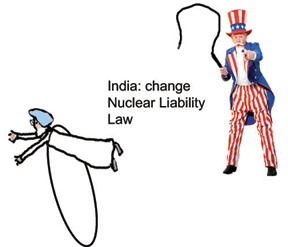 PM compromising on nuclear act is India’s gift to US companies: BJP http://www.firstpost.com/politics/pm-compromising-on-nuclear-act-is-indias-gift-to-us-companies-bjp-1120813.html?utm_source=ref_article Sep 19, 2013 New Delhi: The BJP today said reports of India compromising on crucial clauses in the Nuclear Liability Act regarding fixing of liability is “worrisome” and alleged Prime Minister Manmohan Singh has allowed this to give a gift to American companies during his forthcoming visit to the US.
The main opposition insisted a decision on the issue should be taken after due diligence and no step should be taken that imperils the safety of Indians or compromises the nation’s security.
“The reported media observation that government is trying to compromise the importance of Section 17 (b) of the Nuclear Liability Act passed by Parliament is very worrisome and a cause of serious concern,” Deputy Leader of BJP in Rajya Sabha Ravi Shankar Prasad told PTI.
He maintained that Section 17 (b) of the Nuclear Liability Act specifically fixes the responsibility of the manufacturer of nuclear reactors and provides for their liability in the event of an accident involving design or manufacturing fault. The Opposition parties, including the Left, have been up in arms against an opinion of Attorney General Goolam Vahanvati to the Department of Atomic Energy that it is for the operator of a nuclear plant in India to decide whether it wished to exercise the “right of recourse” provided under Section 17 of the Act. “By this, the whole liability of the manufacturer is sought to be compromised and the entire mandate of Parliament is being disobeyed,” Prasad said.
New report on America’s renewable energy policy
2013 America Renewable Energy Policy Handbook Report http://www.environmental-expert.com/news/2013-america-renewable-energy-policy-handbook-report-393874
|
Sep. 19, 2013 North and South America Renewable Energy Policy Handbook 2013 report presents an in-depth analysis of the renewable energy policies across the major countries in North and South America namely the US, Canada, Brazil, Argentina and Mexico. The report provides the current and future renewable energy targets and plans along with the present policy framework, giving a fair idea of overall growth potential of their renewable energy industry.
The report also provides major technology specific policies and incentives provided in each of these countries. The report also provides insights to major policy initiatives for the market development of renewable energy sources such as wind, solar, geothermal, biopower and biofuels. The report ( http://www.reportsnreports.com/reports/268267-north-and-south-america-renewable-energy-policy-handbook-2013.html ) is built using data and information sourced from industry associations, government websites and statutory bodies. The information is also sourced through other secondary research sources such as industry and trade magazines. Scope
Table of Contents for the report North and South America Renewable Energy Policy Handbook 2013 include: Continue reading |
USA’s fossil fuel friendly politicians don’t like pro renewable energy Ron Binz
US energy regulator nominee criticised for pro-renewables stance Climate Spectator 19 Sep, 1 Reuters Republicans and some Democrats criticised Ron Binz in a hearing on Tuesday on his nomination to lead a key US energy regulatory agency as being non mainstream because his views on the nation’s energy future support renewable sources like wind over coal and natural gas.
Chairman of the Colorado Public Utilities Commission from 2007 to 2011 and currently a regulatory consultant, Binz was nominated by President Barack Obama in July to lead the Federal Energy Regulatory Commission .
His nomination was considered by the Senate Committee on Energy and Natural Resources Committee in an often contentious three-hour hearing. No date has been set for a vote.
Some conservative and free-market groups have opposed Binz, citing comments that, among other things, natural gas is a “dead end” energy source, and saying Binz would orchestrate a push for renewable energy sources like wind over coal and natural gas.
A bipartisan group of 12 former FERC commissioners are among those who have spoken in favor of Binz. Sen. Lisa Murkowski, the committee’s ranking Republican, ended the hearing by saying that she “reluctantly” could not support the nomination. The Alaskan said she was “not convinced” that Binz’s views were compatible with FERC’s mission……..http://www.businessspectator.com.au/news/2013/9/19/renewable-energy/us-energy-regulator-nominee-criticised-pro-renewables-stanc
Arms and uranium trade pact between Zimbabwe and North Korea
Zimbabwe in ‘arms for uranium’ pact with North Korea Nehanda Radio 19 Sept 13, President Robert Mugabe’s military henchmen have reportedly signed an arms trade agreement worth millions of dollars with North Korea, in return for allowing Pyongyang access to Zimbabwe’s controversial Kanyemba district, which has sparked a uranium mining race pitting Iran and other powers, Nehanda Radio has been told.
Kanyemba district is about 160 miles north of the capital, and is believed to be holding significant uranium reserves, first discovered in the 1970s by German prospectors, but never exploited due to low world prices at the time.
Several other countries have sought the rights to mine Zimbabwe’s untapped uranium deposits, and these include Russia, China and a failed bid by neighbouring South Africa and Namibia, as they scramble for the Yellow cake which is a key ingredient needed for the production of nuclear bombs. Continue reading
TEPCO still hopes to restart 2 intact Fukushima nuclear reactors
Japan premier urges full decommissioning of Fukushima nuclear site LA Times, By Carol J. Williams September 19, 2013, Japanese Prime Minister Shinzo Abe toured the crippledFukushima Daiichi nuclear power complex Thursday and urged its owner to abandon hopes of restarting the only two intact reactors and concentrate instead on unfinished cleanup operations, Japanese media reported.
Three of Fukushima’s six reactors suffered meltdowns after the March 11, 2011, earthquake and tsunami, and the fuel-cooling containment pool was seriously damaged at a fourth unit.
Japan is currently nuclear-free, as all 50 of its reactors are closed for maintenance, repairs, safety checks or inoperability.
But Fukushima owner Tokyo Electric Power Co., like most Japanese utilities with nuclear production facilities, has maintained hope of restarting its undamaged reactors if and when a new independent regulatory agency gives the green light after inspection…… http://www.latimes.com/world/worldnow/la-fg-wn-japan-nuclear-fukushima-20130919,0,2520396.story
With possession of nuclear weapons Israel has become a target

 Putin: ‘Israel’s nuclear weapons just make it a target Jerusalem Post, Linda Gradstein/The Media Line contributed to this report. 19 Sept13 ‘Russian President Vladimir Putin said on Thursday that Israel’s alleged nuclear weapons stockpile only serves to make the Jewish state “a target” and creates “foreign policy problems.”…… The chemical weapons deal with Syria has increased pressure on Israel to join the Nuclear Non-Proliferation Treaty.
Some 190 states have joined the NPT, whose goal is to prevent the spread of nuclear weapons and weapons technology.
Of the world’s nuclear powers, only four have not joined the treaty. Of these, India, Pakistan and North Korea have all openly tested nuclear weapons. Israel continues with its policy of nuclear ambiguity.
Israel has refused to sign the NPT despite pressure from the international community.
Putin’s comments, reported by AFP, came in response to questions from reporters on the US and Russia-brokered deal to put Syria’s chemical weapons arsenal under international supervision………http://www.jpost.com/Middle-East/Putin-Israels-nuclear-weapons-just-make-it-a-target-326567
Nuclear weapons need to abolished, as well as chemical weapons
Eliminating Nuclear Weapons Is Just as Important as Eliminating Chemical Weapons, Huffington Post, Lawrence Wittner, 09/19/2013 The apparent employment of chemical weapons in Syria should remind us that, while weapons of mass destruction exist, there is a serious danger that they will be used.
That danger is highlighted by an article in the September/October 2013 issue of the Bulletin of the Atomic Scientists. Written by two leading nuclear weapons specialists, Hans Kristensen and Robert Norris of the Federation of American Scientists, the article provides important information about nuclear weapons that should alarm everyone concerned about the future of the planet. Continue reading
Seattle art show “Echo at Satsop”- aftermath of Fukushima nuclear disaster
 Artist Etsuko Ichikawa’s ‘Echo’ of quake, tsunami, fire, radiation, Seattle Times 20 Sept In drawings, installation and film, Seattle artist Etsuko Ichikawa channels the aftermath of the earthquake, tsunami and nuclear power-plant meltdown that hit her native Japan in 2011. The exhibit runs at Davidson Galleries through Sept. 28, 2013. By Michael Upchurch Seattle Times arts writer EXHIBITION REVIEWEtsuko Ichikawa: ‘Echo at Satsop’
10 a.m.-5:30 p.m. Tuesdays-Saturdays through Sept 6 -. 28, Davidson Galleries, 313 Occidental Ave. S., Seattle (206-624-7684or www.davidsongalleries.com ).
Spare, spooky and, in its rigorous way, spectacular, Etsuko Ichikawa’s “Echo at Satsop” (on show at Davidson Galleries through Sept. 28) has a nightmare beauty to it.
Its drawings, wall sculptures, sound installation and short film were triggered, in part, by the earthquake and tsunami that hit Japan on March 11, 2011. Ichikawa, born in Tokyo and residing in Seattle since 1993, is especially concerned by the meltdowns at the Fukushima nuclear power plant.
“This incident,” she notes in her artist’s statement, “caused substantial radiation leakage that has had an immeasurable impact on people’s health and the environment, and will continue to do so for generations to come.”……..
Taken together, the works of “Echo at Satsop” shine a pale, ghostly light on the damage humankind has done its world. This is a powerful show.
Michael Upchurch: mupchurch@seattletimes.com http://seattletimes.com/html/thearts/2021838272_satsopartexhibitxml.html
found fracture-like traces on steel in the exhaust stack.

Image source ; http://www.japannewstoday.com/?p=4170
Fukushima Daiichi NPS Prompt Report 2013
http://www.tepco.co.jp/en/press/corp-com/release/2013/1230696_5130.html
Fukushima Daiichi NPS Prompt Report (Sep 18,2013)Fracture-like Traces Found on Steel Members (Diagonal Bracings) in the Intermediate Section of the Exhaust Stack for Units 1 and 2 at Fukushima Daiichi NPS
We have been conducting an on-site inspection for seismic safety evaluation on the exhaust stack for Units 1 and 2 at Fukushima Daiichi NPS. Today (on September 18), in the inspection, we found fracture-like traces on steel members (diagonal bracings) of the exhaust stack.
Since the area around the exhaust stack includes a location with a high dose rate, we will start a detailed investigation after examining how the investigation should be conducted.
The exhaust stack in question has been out of use. Neither abnormality in the plant data (the RPV bottom temperature, the PCV internal temperature, etc.) nor significant change has been found.
This incident will be explained in the regular press conference to be held today (on September 18).
“Nuclear Love” Statistics for Japan and the UK
Dr Wouter Poortinga of the Welsh School of Architecture at Cardiff University, lead researcher, comments: “British attitudes towards nuclear power have been surprisingly robust in the wake of the Fukushima accident, and trust in regulation has held up fairly well. It even appears that the attitudes to nuclear have softened somewhat after Fukushima. However, in reality, nuclear power remains relatively unpopular as compared to renewable energy sources”.
“We hope these findings will prove beneficial to both policy makers and industry, and help to ensure that key decisions about the future of Britain’s nuclear policy are informed by the best available evidence on public values and attitudes”.

British public split on nuclear power
Posted by The Editors
 on September 19, 2013, 9:52 am
http://members5.boardhost.com/medialens/msg/1379580726.html
| Via The Times – whose angle on this press release is that climate scepticism has more than quadrupled since 2005. But read below for how relatively small those numbers still are…
‘The survey found that just under three-quarters of the British public (72%) accept that the world’s climate is changing.’ DC == 19.09.13: Opposition to nuclear power in Britain has fallen since 2005 despite Fukushima accident. Researchers based at Cardiff University and the National Institute for Environmental Studies in Japan carried out a number of nationally representative surveys in Britain and Japan, both before and after the Fukushima accident, asking detailed questions about attitudes to nuclear power and covering aspects such as perceived risks and benefits, trust in safety and regulation, and the future of nuclear power in the Britain and Japan. The research found that the Fukushima nuclear accident had virtually no impact on British public attitudes to nuclear power, despite being responsible for a near-total collapse in public confidence in nuclear energy in Japan. Attitudes in Britain have become somewhat more positive in recent years, with similar proportions of people now supporting (32%) and opposing (29%) the use of nuclear power, compared to 26% (supporting) and 37% (opposing) in 2005. While a similar number of people want to continue nuclear at current levels or with expansion (43% in 2005, 46% in 2010 and 44% in 2013), fewer people now want to see nuclear power phased out or shut down (50% in 2005, 47% in 2010 and 40% in 2013). Even though there is still a substantial level of public concern over the storage of radioactive waste and nuclear accidents, concern over nuclear power in Britain has dropped since the Fukushima accident, from 58% in 2005 and 54% in 2010 to 47% in 2013. The proportion of respondents who agree that the risks of nuclear power outweigh the benefits has fallen from 41% in 2005 and 37% in 2010 to 29% in 2013, while the proportion of people who agree that the benefits of nuclear power outweigh the risks has increased from 32% in 2005 to 38% in 2010 and 37% in 2013. While there has been a shift in recent years in favour of nuclear power, fewer people now than in 2005 and 2010 are willing to accept the building of a new nuclear power stations to tackle climate change (47% in 2013 vs. 55% in 2005 and 56% in 2010). However, this may be associated as much with an increase in climate scepticism as with changing attitudes to nuclear power. The survey found that just under three-quarters of the British public (72%) accept that the world’s climate is changing. Nevertheless, the proportion of people doubting the reality of climate change has risen to one of the highest levels since 2005 (4% in 2005, 15% in 2010 and 19% in 2013). Dr Wouter Poortinga of the Welsh School of Architecture at Cardiff University, lead researcher, comments: “British attitudes towards nuclear power have been surprisingly robust in the wake of the Fukushima accident, and trust in regulation has held up fairly well. It even appears that the attitudes to nuclear have softened somewhat after Fukushima. However, in reality, nuclear power remains relatively unpopular as compared to renewable energy sources”. “We hope these findings will prove beneficial to both policy makers and industry, and help to ensure that key decisions about the future of Britain’s nuclear policy are informed by the best available evidence on public values and attitudes”. In comparison, very few Japanese people want to continue nuclear at current levels (15%) or with expansion (2%), and a majority wants to see nuclear power phased out gradually (53%) or immediately (23%). Only 17% of the Japanese public are now willing to accept the building of new nuclear power stations to tackle climate change, as compared to 22% in 2011 and 33% in 2007. While trust in the regulation of nuclear power was already low in Japan before the Fukushima accident (19% in 2007), it dropped to even lower levels after the accident (9% in both 2011 and 2013). Dr Midori Aoyagi of the National Institute for Environmental Studies states: “Our research shows that nuclear power has become very unpopular in Japan after the Fukushima accident. Public trust in the regulation of nuclear power is now at an all-time low. Instead most people would like to see the development of more solar and wind energy to replace nuclear power in the longer term”. – Ends – http://www.ukerc.ac.uk/support/article3253-British-public-split-on-nuclear-power |
| Responses |
1 This Month

of the week – Shut Down Drone Warfare!


Tell the Ukrainian Government to Drop Prosecution of Peace Activist Yurii Sheliazhenko

Petition to revoke the licensing of the Near Surface Nuclear Disposal Facility (NSDF) at Chalk River. https://www.ourcommons.ca/petitions/en/Petition/Details?Petition=e-7247
To see nuclear-related stories in greater depth and intensity – go to https://nuclearinformation.wordpress.com
-
Archives
- April 2026 (57)
- March 2026 (251)
- February 2026 (268)
- January 2026 (308)
- December 2025 (358)
- November 2025 (359)
- October 2025 (376)
- September 2025 (257)
- August 2025 (319)
- July 2025 (230)
- June 2025 (348)
- May 2025 (261)
-
Categories
- 1
- 1 NUCLEAR ISSUES
- business and costs
- climate change
- culture and arts
- ENERGY
- environment
- health
- history
- indigenous issues
- Legal
- marketing of nuclear
- media
- opposition to nuclear
- PERSONAL STORIES
- politics
- politics international
- Religion and ethics
- safety
- secrets,lies and civil liberties
- spinbuster
- technology
- Uranium
- wastes
- weapons and war
- Women
- 2 WORLD
- ACTION
- AFRICA
- Atrocities
- AUSTRALIA
- Christina's notes
- Christina's themes
- culture and arts
- Events
- Fuk 2022
- Fuk 2023
- Fukushima 2017
- Fukushima 2018
- fukushima 2019
- Fukushima 2020
- Fukushima 2021
- general
- global warming
- Humour (God we need it)
- Nuclear
- RARE EARTHS
- Reference
- resources – print
- Resources -audiovicual
- Weekly Newsletter
- World
- World Nuclear
- YouTube
-
RSS
Entries RSS
Comments RSS
 nuclear-news