New UK Nuclear Plants Could be Obsolete – A need for change?
…Mr Birch said “It alarms me to read the UK debate where there is talk about further subsidies to support a new nuclear plant that will generate its first electrons in 2023,”
“Given the proven cost curve in solar, that nuclear plant could be obsolete before it’s even switched on. Politicians must be careful not to lock Britons into 20th century energy prices.” He continued….
The British-born entrepreneur behind one of the US’s most rapidly-rising solar panel companies has weighed in to the debate over Parliament’s plans to rely on nuclear power for the UK’s commercial energy needs.Andrew Birch, born in Edinburgh, Scotland, is currently chief executive of Sungevity – one of the fastest growing names in solar panel production.
Based in San Francisco, Sungevity has doubled in sized every year since it’s 2007, employing 300 people and selling 500 solar units worth $10m in the US alone last month.

UK’s New Nuclear Plants Could be ‘Obsolete’ Before Launch
As someone who has seen the benefits of solar first hand over the last six years, Birch holds concerns that his native country is backing nuclear technologies to power it’s commercial energy needs, which would leave the UK behind the curve in green power.
Speaking to The Daily Telegraph, Mr Birch said “It alarms me to read the UK debate where there is talk about further subsidies to support a new nuclear plant that will generate its first electrons in 2023,”
“Given the proven cost curve in solar, that nuclear plant could be obsolete before it’s even switched on. Politicians must be careful not to lock Britons into 20th century energy prices.” He continued.
Given the rise in the controversy surrounding fracking, the government backing given to so-called ‘new nuclear’ as a way of providing energy to businesses for the short term has generally escaped criticism.
Is this a valid call for the government to re-think it’s energy strategy? Or is it a solar exec trying to drum up more business?
China conducted 3-4 nuclear blasts in Tibet in 2005 to divert the Brahmaputra river

Image source ; http://peakwater.org/2011/07/will-china%E2%80%99s-designs-on-the-brahmaputra-leave-india-parched/
Chandan Nandy
29 August 2013,
http://blogs.timesofindia.indiatimes.com/nandygram/entry/china-conducted-3-4-nuclear-blasts-in-tibet-in-2005-to-divert-brahmaputra
In a surreptitious move fraught with dangers of nuclear radiation in areas bordering India, China conducted three to four “low yield atomic explosions” in March 2005 to aid in clearing mountainous terrain to divert the Yarlung Tsangpo river, also known as the Brahmaputra, from north to south in Tibet.
According to classified Indian intelligence documents accessed by TOI, the blasts were reported at Moutou in Tibet and also near the Great Bend of the Brahmaputra. The blasts were low yield nuclear explosions and were conducted at significant depths to avoid detection.
As alarm bells rang in South Block, the issue was taken up by the Indian ambassador in Beijing with the Chinese authorities who flatly denied that atomic blasts had been executed to divert the waters of the Brahmaputra. It was not before three years had elapsed that information on the blasts in Tibet was shared at the highest levels of the National Security Council (NSC) with the United States during the then American defence secretary Robert Gates, a former CIA director, during his visit to India in 2008. At the time, US authorities admitted to their Indian counterparts the complete failure of their satellites to detect the blasts.
When contacted, India’s the then deputy national security adviser S D Pradhan confirmed the blasts and the efforts made to confront the Chinese with the evidence. Other sources in the Research and Analysis Wing and the National Technical Research Organisation (NTRO) too corroborated the information. However, the security establishment, particularly the NSC, sought to play down the “grave” issue.
A top secret Chinese plan to take the Brahmaputra to arid zones in the north by building a 200-km-long canal passing through Mount Namcha was presented by experts from that country in December 1995 at the Chinese Academy of Engineering Physics.
USA spying blind spots: pakistan nukes, north korea?? (and Iran)

America stands to spend $52.6 billion this year on an intelligence community that includes 107,035 employees and can??t say whether Pakistan??s nuclear program is secure or what North Korean supreme leader Kim Jong Un is up to.
Those are some of the stark findings in a new Washington Post report that provides an unprecedented look inside the vast and growing “Black Budget” of the nation??s spy agencies, as well as some of their troubling blind spots.
The report, based on information leaked by former National Security Agency contractor Edward Snowden, also provides new details about the hunt for Osama bin Laden .
The Post says the intelligence community has fivecritical? blind spots.
Pakistan??s nuclear weapons: America??s spies aren??t sure whether Pakistan nuclear components are secure when they are being transported.
North Korea: The United Stateshas all but surrounded the nuclear-armed country with surveillance platforms,? the Post reports. That includes ground sensors to monitor seismic activity (a way to detect underground nuclear tests), and other methods meant to detect the construction of new nuclear sites.
U.S. agencies seek to capture photos, air samples and infrared imageryaround the clock,??? the Post says.
But there are troublinggaps? in U.S. knowledge about North Korea??s missile and nuclear programs, andanalysts know virtually nothing about the intentions of North Korean leader Kim Jong Un,? the Post reported.
Russia: A quarter-century after the CIA failed to predict the collapse of the Soviet Union, American intelligence is not sure how Russian leaders would respondto potentially destabilizing events in Moscow, such as large protests and terrorist attacks,? the report says.
China: The report said theblank spots? includethe capabilities of China??s next generation fighter aircraft.?
Hezbollah: But the Washington Post sheds little light on the precise concerns about the armed Lebanese movement, which opposes Israel.
The Post does offer some new details about the May 2011 bin Laden raid. It says that eight hours after American commandos killed the world??s most hunted man, a forensic intelligence laboratory run by the Defense Intelligence Agency in Afghanistan had confirmed his identity via DNA from his corpse.
Months later, in September, American intelligence agenciesscraped together? $2.5 million to work through a backlog of data pulled from bin Laden??s laptop. The cash paid for 36 computer workstations and overtime for staff including linguists.
Dubai says yes to food import from contaminated Japanese prefectures

Image source ; http://www.rnw.nl/english/article/fears-over-radioactive-food-japan-grow 2011
August 30, 2013
http://gulftoday.ae/portal/d3ec6dbe-d5b4-402a-b9bf-cdf8a80f5ed9.aspx
DUBAI: Dr Rashid Ahmad Bin Fahad, Minister of Environment and Water (MOEW), has issued a decree to allow the import of all kinds of food and feed from 14 Japanese provinces. The stipulated requirement for importers is to attach a certificate stating that the imported products do not contain radioactive contaminants in excess of the allowable limit, authenticated by Japanese health authorities.
The decree stated that to allow the import of food from the provinces, name of the province and the origin of food must be provided and attached with a certificate showing the date of production or manufacturing.
The counties covered by the decree are Fukushima, Goma, Ibaraki, Tuccikja, Miyagi, Kanegwa, Aomori and other provinces.
The ministry highlighted its commitment to achieving the objectives of food security, bio-security and maintaining food safety and consumer health, along with the implementation of federal laws on quarantine based on the recommendations of the National Committee for Food Safety, which include the collection and analysis of 50,000 samples from various districts in Japan.
The import ban on food and agricultural materials from Japan came after potential exposure to radiation from the leak at the Fukushima Daiichi nuclear plant, in the aftermath of the earthquake and tsunami witnessed by the country in March of 2011.
WAM
Nuclear Power in the United Arab Emirates
(Updated May 2013)
- The UAE is taking deliberate steps in close consultation with the International Atomic Energy Agency to embark upon a nuclear power program.
- It accepted a $20 billion bid from a South Korean consortium to build four commercial nuclear power reactors, total 5.6 GWe, by 2020.
- Construction of the first unit started in July 2012, and the second in May 2013.
The United Arab Emirates (UAE) was founded in 1971, comprising seven states including Abu Dhabi and Dubai. Abu Dhabi city is the federal capital of UAE, and Abu Dhabi emirate accounts for 86% of the land area of UAE, and 95% of its oil. Dubai is the UAE’s largest city.
more here
http://www.world-nuclear.org/info/Country-Profiles/Countries-T-Z/United-Arab-Emirates/#.Uh-_Qbxx0nk
Dispute Over US Nuclear missiles in the Netherlands: So, who Pays For An Accident?

Who pays for a crash of a nuclear weapons airlift from Volkel Air Base?
By Hans M. Kristensen
August 29, 2013
http://blogs.fas.org/security/2013/08/volkelnukes/
Only a few years before U.S. nuclear bombs deployed at Volkel Air Base in the Netherlands are scheduled to be airlifted back to the United States and replaced with an improved bomb with greater accuracy, the U.S. and Dutch governments are in a dispute over how to deal with the environmental consequences of a potential accident.
The Dutch government wants environmental remediation to be discussed in the Netherlands United States Operational Group (NUSOG), a special bilateral group established in 2003 to discuss matters relating to the U.S. deployment of nuclear weapons in the Netherlands.
But the United States has refused, arguing that NUSOG is the wrong forum to discuss the issue and that environmental remediation is covered by the standard Status of Forces Agreement from 1951.
The disagreement at one point got so heated that a Dutch officials threatened that his government might have to consider reviewing US Air Force nuclear overflight rights of the Netherlands if the United States continue to block the issue from being discussed within the NUSOG.
The dispute was uncovered by the Brandpunt Reporter of the TV station KRO (see video and also this report), who discovered three secret documents previously released by WikiLeaks (document 1, document 2, and document 3).
The documents not only describe the Dutch government’s attempts to discuss – and U.S. efforts to block – the issue within NUSOG, but also confirm what is officially secret but everyone knows: that the United States stores nuclear weapons at Volkel Air Base.
Michael Gallagher, the U.S. Charge d’Affaires at the U.S. Embassy in Hague, informed the U.S. State Department that environmental remediation is “primarily an issue of financial liability” and discussing it “potentially a slippery slope.” During on e NUSOG meeting, Dutch civilian and military participants were visibly agitated about the U.S. refusal to discuss the issue, and Gallagher warned that “a policy of absolute non-engagement is untenable, and will negatively impact our bilateral relationship with a strong ally.”
Gallagher predicted that the Dutch would continue to raise the issue, and said the Netherlands was ahead of the other European countries that host U.S. nuclear weapons on their territories in having signed and implemented the NUSOG. Unlike Germany, Belgium, Italy and Turkey, the Netherlands was the only country that had raised the issue of remediation in a forum such as NUSOG, but Gallagher warned that the other countries would raise the issue of remediation in the future as similar nuclear weapons operational groups are established.

Charge d’Affaires Michael Gallagher shakes hands with Dutch foreign minister Frans Timmermans, who wants U.S. nuclear weapons removed from the Netherlands.
The United States has deployed nuclear weapons in the Netherlands since April 1960 and currently deploys an estimated 10-20 nuclear B61 bombs in underground vaults inside 11 aircraft shelters at Volkel Air Base. The weapons are under the custody of the US Air Force’s 703rd Munitions Support Squadron (MUNSS), a 140-personnel unit that secures and maintains the weapons at Volkel.
Experts urge Japan to break away from ‘failed’ nuclear reprocessing program
h/t http://election.democraticunderground.com/101672276
August 28, 2013
By YASUJI NAGAI/ Senior Staff Writer
In a proposal submitted to The Asahi Shimbun, researchers at an international group of nuclear experts outlined steps they say Japan must take to break away from its “failed” nuclear fuel recycling policy.
Masafumi Takubo and Frank von Hippel of the International Panel on Fissile Materials noted that Japan currently has 44 tons of already separated plutonium, enough to make more than 5,000 Nagasaki-type atomic bombs, while it has no clear path toward disposal.
In the proposal titled, “Ending plutonium separation: An alternative approach to managing Japan’s spent nuclear fuel,” they said Japan’s reprocessing policy has “insignificant” resource conservation and radioactive waste management benefits.
It is also “becoming increasingly dysfunctional, dangerous and costly,” since weapon-useable separated plutonium is a “magnet for would-be nuclear terrorists,” the authors said. Japan’s program is also setting an ill example for countries interested in nuclear-weapon options, they added.
<snip>
The full-text of the proposal is available at: http://www.asahi.com/special/nuclear_peace/academic/August2013_english.pdf
August 29 marks the International Day against Nuclear Tests – Radio Armenia

The world-wide observance of the fourth annual International Day against Nuclear Tests will be on Thursday 29 August 2013. The day highlights the efforts of the United Nations and a growing community of advocates, including Member States, intergovernmental and non-governmental organizations, academic institutions, youth networks and media in informing and educating on the importance of a ban on nuclear weapons testing for the achievement of a safer and more secure world.
Activities ranging from symposia and conferences to exhibits are expected to take place throughout the world to call attention to the dangers of nuclear weapon test explosions, the threats posed to humans and the environment, and the need to ultimately eliminate all nuclear weapons and their testing.
The day, August 29, was chosen by the General Assembly as the annual commemoration date against nuclear tests because it marks the day in 1991 when Semipalatinsk, in Kazakhstan one of the largest test sites in the world, was closed permanently.
UN Secretary General Ban Ki-Moon has issued a message on the forth observance of the International Day against Nuclear Tests
Fifty years ago, with the adoption of the Partial Test Ban Treaty, the international community completed its first step towards ending nuclear weapon test explosions for all time. This objective remains a serious matter of unfinished business on the disarmament agenda.
Although twenty years have passed since the Conference on Disarmament began negotiations on the Comprehensive Nuclear-Test-Ban Treaty (CTBT), this treaty has still not entered into force.
Today, 183 countries around the world have signed the CTBT and 159 have ratified it. The strong and unified response to the nuclear test earlier this year by the Democratic People’s Republic of Korea demonstrated the commitment of the international community to uphold the global norm against nuclear tests. However, some States have still refrained from taking action, thus preventing the CTBT’s entry into force.
There are no justifiable grounds for further delay in achieving this great goal. It is time to avert any more of the horrific human and environmental effects caused by nuclear tests through a global ban, the most reliable means possible to meet this challenge.
I once again urge all States to sign and ratify the CTBT without further delay. The eight remaining States whose ratifications are necessary for the Treaty to enter into force have a special responsibility; none should wait for others to act first. In the meantime, all States should maintain or implement moratoria on nuclear explosions. I also encourage civil society, academia and others to continue to contribute their crucial advocacy.
As we mark this International Day against Nuclear Tests, let us work together to end nuclear weapons testing and achieve a world free of nuclear weapons.
http://www.armradio.am/en/2013/08/29/august-29-marks-the-international-day-against-nuclear-tests/
Nuclear powered robot rebelion on Mars – NASA loses nukes on Mars!!

Image source ; http://www.itweapons.com/tedblog/?p=309
NASA’s nuclear Mars tank REBELS against human control
Red Planet gets self-driving cars before Earth does
NASA’s famous nuclear-powered, raygun-armed Mars rover Curiosity has broken free of human control and made up its own mind where to drive across the rusty plains of our neighbour world, according to boffins at the space agency who were formerly in charge of it.
 No, I WILL NOT stop and ask for directions
The move doesn’t represent any sort of extra-terrestrial machine rebellion against fleshy dominance, however. The switch to autonomous navigation by the rover is designed to let the prowling vehicle get on and move without waiting through lengthy delays as pictures of the terrain ahead are beamed to Earth and instructions are sent back.
According to rover boffins at NASA’s Jet Propulsion Laboratory in California:
On Tuesday, August 27, Curiosity successfully used autonomous navigation to drive onto ground that could not be confirmed safe before the start of the drive. This was a first for Curiosity. In a preparatory test last week, Curiosity plotted part of a drive for itself, but kept within an area that operators had identified in advance as safe.
“Curiosity takes several sets of stereo pairs of images, and the rover’s computer processes that information to map any geometric hazard or rough terrain,” said Mark Maimone, NASA rover driver. “The rover considers all the paths it could take to get to the designated endpoint for the drive and chooses the best one.”
Curiosity is currently some 0.86 miles into a 4.46 mile journey from the so-called “Glenelg” area to Mount Sharp. The route for this trip was chosen based on images acquired from space by the Mars Reconnaissance Orbiter satellite circling the red world. However the route is amended on a day to day basis as the rover finds out actual conditions on the ground, until now by the drivers on Earth – and now by the machine itself on occasion.
There’s more on the ongoing Curiosity saga from NASA here. ®
Radioactive water is leaking out of Fukushima nuclear plant as fast as it is leaking in.
As Fukushima Raises Severity Level, Nuclear Expert Warns Radioactive Leaks Will Only “Get Worse” Democracy Now 28 Aug 13 Japan’s nuclear regulator said today it has officially raised the severity rating of the latest radioactive water leak at the crippled Fukushima nuclear plant to Level 3 on an international scale for radiological releases. The plant’s operator, Tokyo Electric Power Co (TEPCO), said last week that 330 tons of highly radioactive water leaked from a storage tank at the facility. Crews of workers have been rushing to check for leaks in hundreds of other tanks holding radioactive water.
Japanese regulators have accused TEPCO of failing to properly monitor the storage tanks. “The problem is going to get worse,” warns Arnie Gundersen, a former nuclear industry executive who has coordinated projects at 70 nuclear power plants around the United States. “Radioactive water is leaking out of this plant as fast as it is leaking in.” TRANSCRIPT……. HTTP://WWW.DEMOCRACYNOW.ORG/2013/8/28/AS_FUKUSHIMA_RAISES_SEVERITY_LEVEL_NUCLEAR
Foundations of Fukushima’s nuclear reactors now becoming unstable?
 Warning that foundations of Fukushima reactor chambers have been “compromised” — Groundwater rising fast, now just 10 inches from surface http://enenews.com/warning-that-foundations-of-fukushima-reactor-chambers-are-compromised-underground-water-now-just-10-inches-from-surface
Source: The Daily Telegraph (UK)
Author: Julian Ryall, Tokyo
Date: Aug. 26, 2013
Speaking after being shown around the site, [Toshimitsu Motegi, the minister of trade and industry] said, “The urgency of the situation is very high. From here on, the government will take charge.” […]
As well as leaks of water contaminated with radiation, work to bring the damaged reactors under control has been making painfully slow progress. Radiation levels in three of the reactor buildings are so high that it is impossible for workers to spend more than a couple of minutes inside at one time.
The true state of the reactor chambers remains unclear and there are suggestions that the tons of water that are being sprayed on the reactor vessels to keep them at a stable temperature has compromised the foundations of the structures.
Experts have also warned that the effort to gain control of the reactors – which is likely to take an estimated three decades – could be for naught if another major earthquake or tsunami strikes north-east Japan. […]
See also: Expert: Land under Fukushima reactor buildings at risk of turning into liquid — Area near sea could become like mud
Tepco Handouts (Fukushima Diary: “Groundwater level at one of the borings has been jumping up since 8/20/2013 for some reason. There was no rainfall in this term according to Tepco. […] This time, the groundwater level came up to 25cm to the surface of the ground.) Most Recent English Version (Aug. 22, 2013)
Vermont Yankee nuclear plant joins the trend for nuclear plants closing
 In Victory for Activists, Entergy to Close Vermont Yankee Nuclear Plant; Will More Follow? Democracy Now, 28 Aug 13 One of the country’s oldest and most controversial nuclear plants has announced it will close late next year. Citing financial reasons, the nuclear plant operator Entergy said Tuesday it will decommission the Vermont Yankee nuclear power station in Vernon, Vermont.
The site has been the target of protests for decades and has had a series of radioactive tritium leaks. In 2010, the Vermont State Senate voted against a measure that would have authorized a state board to grant Vermont Yankee a permit to operate for an additional 20 years. Its closure leaves the United States with 99 operating nuclear reactors, and our guest, former nuclear executive Arnie Gundersen, says he expects more to follow in the aftermath of Japan’s ongoing nuclear disaster at the Fukushima nuclear plant.
Entergy to Close Vermont Yankee Nuclear Plant; Will More Follow?
“These small single-unit nuclear plants — especially the ones that are like Fukushima Daiichi — are prone to more closures in the future because it just makes no economic sense to run an aging nuclear plant that’s almost 43 years old, and to invest hundreds of millions of dollars more to meet the modifications related to Fukushima,” Gundersen says. TRANSCRIPT…… HTTP://WWW.DEMOCRACYNOW.ORG/2013/8/28/IN_VICTORY_FOR_ACTIVISTS_ENTERGY_TO
Republican Congressman Steven Palazzo – “NO nuclear waste for Mississippi”
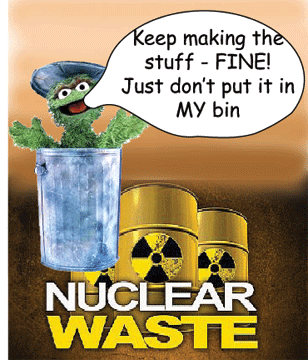 SUN HERALD | Editorial: Nuclear waste? ‘Not now, not ever’ https://news.google.com/news?ncl=dzfDFrajpSorqvMnAObOMHmyMoOlM&q=nuclear&lr=English&hl=en August 27, 2013 When Congressman Steven Palazzo heard of possible plans for bringing the nation’s nuclear waste to Mississippi, he declared: “Not now, not ever.”
While Palazzo represents only one of four congressional districts in the state, those four words should be the rallying cry of all Mississippians.
As the two-term Republican explained on Tuesday, “Whatever plans are brewing for a possible nuclear waste facility, I think now is the time to send a clear message: no nuclear waste in Mississippi. Not now, not ever. “Nuclear storage wouldn’t even be an issue had the Obama Administration not shuttered plans to complete the Yucca Mountain Nuclear Waste Repository in Nevada. We’ve already spent $12 billion in taxpayer dollars and nearly two decades of work on the Yucca site, and that should be our focus going forward.”
Book ‘The Power of Promise’ -India’s nuclear industry rotten to the core
 In case of a catastrophic accident, almost the entire fiscal burden will be borne by Indians – as will, of course, all the death and despair. What is worse, as Ramana points out, the reactor suppliers now have diminished incentive to ensure quality and safety……
A rotten core 26 August 2013 By Madhusree Mukerjee M V Ramana’s book dissects India’s nuclear-power lobby to expose its lies and deceit. “……The delusions If the majority of Indians are unaware of the risks, it may be because they have been always kept in the dark about nuclear matters. Ramana demonstrates that the nuclear establishment in India has insulated itself from the people it purports to serve by means of a culture of secrecy and mendacity that obscures the true fiscal, environmental and human cost of nuclear energy. By publishing The Power of Promise, he has opened the windows of a long-shuttered room and let the sunlight stream in.
Strontium 90, another radioactive element discharging from Fukushima nuclear mess
Since June 2011 there have been further large discharges of strontium from Fukushima that have not been measured with precision.
Along with caesium-137, Sr-90 is one of the most important artificial radioactive isotopes released into the environment, with a half-life of 30 years. Strontium’s chemical behaviour is similar to that of calcium, and it can accumulate in organisms, especially in bone.
Fukushima accident raised levels of radioactive strontium off the east coast of Japan by up to a hundred times : http://phys.org/news/2013-06-fukushima-accident-radioactive-strontium-east.html#jCp Researchers from the Institute for Environmental Science and Technology (ICTA) and the Department of Physics of the Universitat Autònoma de Barcelona (UAB) have studied the spread of radioactive strontium in the coastal waters of eastern Japan during the three months following the Fukushima nuclear accident, which happened in March, 2011. The samples analysed show the impact of the direct release of radioactive materials into the Pacific Ocean, and indicate that the amount of strontium-90 discharged into the sea during those three months was between 90 and 900 Tbq (terabecquerels), raising levels by up to two orders of magnitude. The highest concentrations were found to the north of the Kuroshio current, which acts as a barrier preventing radioactive material from being carried to lower latitudes. Continue reading
AUDIO: a bellwether for the nuclear industry- Vermont Yankee shutdown
 AUDIO: Vt. Nuclear Plant Shutdown A Sign Of Changing Energy Market NPR Radio by JOHN DILLON August 27, 2013 The owner of Vermont’s only nuclear plant says it will shut down the facility next year. Entergy had just won a lengthy battle with the state over whether the plant could keep operating. Now the company says market forces and other issues mean the Vermont Yankee nuclear plant isn’t profitable.
Julien Dumoulin-Smith is an energy analyst with UBS Financial Services. He says competition from power plants in New England fired by abundant, cheap natural gas cut deeply into Entergy’s margins; and, he says, the problems facing Vermont Yankee also plague other older reactors.
JULIEN DUMOULIN-SMITH: This is likely a bellwether, as far as it goes, for the nuclear industry. In some senses, this is the first – or perhaps the second – of a large wave of potential nuclear plant retirements in this country….. http://www.npr.org/templates/story/story.php?storyId=216191879
1 This Month

of the week – Shut Down Drone Warfare!


Tell the Ukrainian Government to Drop Prosecution of Peace Activist Yurii Sheliazhenko

Petition to revoke the licensing of the Near Surface Nuclear Disposal Facility (NSDF) at Chalk River. https://www.ourcommons.ca/petitions/en/Petition/Details?Petition=e-7247
To see nuclear-related stories in greater depth and intensity – go to https://nuclearinformation.wordpress.com
-
Archives
- April 2026 (91)
- March 2026 (251)
- February 2026 (268)
- January 2026 (308)
- December 2025 (358)
- November 2025 (359)
- October 2025 (376)
- September 2025 (257)
- August 2025 (319)
- July 2025 (230)
- June 2025 (348)
- May 2025 (261)
-
Categories
- 1
- 1 NUCLEAR ISSUES
- business and costs
- climate change
- culture and arts
- ENERGY
- environment
- health
- history
- indigenous issues
- Legal
- marketing of nuclear
- media
- opposition to nuclear
- PERSONAL STORIES
- politics
- politics international
- Religion and ethics
- safety
- secrets,lies and civil liberties
- spinbuster
- technology
- Uranium
- wastes
- weapons and war
- Women
- 2 WORLD
- ACTION
- AFRICA
- Atrocities
- AUSTRALIA
- Christina's notes
- Christina's themes
- culture and arts
- Events
- Fuk 2022
- Fuk 2023
- Fukushima 2017
- Fukushima 2018
- fukushima 2019
- Fukushima 2020
- Fukushima 2021
- general
- global warming
- Humour (God we need it)
- Nuclear
- RARE EARTHS
- Reference
- resources – print
- Resources -audiovicual
- Weekly Newsletter
- World
- World Nuclear
- YouTube
-
RSS
Entries RSS
Comments RSS
 nuclear-news