Keiser Report: The Killing of Tony Blair with George Galloway
Published on 28 Aug 2013

In this episode of the Keiser Report, Max Keiser and Stacy Herbert discuss the U.S. regulator’s case against JP Morgan for violations of the Foreign Corrupt Practices Act, known in polite circles as ‘client hires.’ In the second half, Max talks to George Galloway, a Member of Parliament, about the film, The Killing of Tony Blair, that he is crowdfunding on Kickstarter. The film explores the financial killing the former prime minister has made on the mass killings in the various wars he started across the Middle East.
FOLLOW Max Keiser on Twitter: http://twitter.com/maxkeiser
WATCH all Keiser Report shows here:
http://www.youtube.com/playlist?list=… (E1-E200)
http://www.youtube.com/playlist?list=… (E201-E400)
http://www.youtube.com/playlist?list=… (E401-current)
The IAEA sets JAPAN straight on the correct Pro Nuclear Propaganda Technique
NSA

IAEA
TEPCO
IAEA Document Reveals Concerns Over Fukushima Communications
Security & Safety
28 Aug (NucNet): The International Atomic Energy Agency (IAEA) has told Japan to consider producing an “appropriate communications” plan to explain the safety significance of incidents at the Fukushima-Daiichi nuclear plant and to avoid sending “possibly confusing” messages to the media and the public.
In a document responding to questions from Japan’s permanent mission to the Vienna-based agency, the IAEA says that with “clear content and appropriate frequency of messages” such a plan would be “highly effective” and would avoid sending confusing messages on a possibly long series of low-level International Nuclear and Radiological Event Scale (INES) incidents throughout the recovery operation at the plant.
The document, posted online by Japan’s Nuclear Regulation Authority (NRA), was a response to questions from Japan about whether or not it should apply an INES rating in the case of a leak earlier this month of contaminated water from a tank.
The leak was first reported on 19 August 2013 when water was discovered inside and outside a dike surrounding the water tank. On 21 August the NRA revised its initial rating of the leak from a Level 1 to a provisional Level 3 on INES.
The IAEA document notes that the leak was the latest in a number of similar events that were not given an INES rating.
It says the application of an INES rating is a national responsibility, but whatever communications strategy is adopted, it is important that the information needed to properly determine an INES rating is collated and that “a defensible” rating is determined.
“Frequent changes of rating will not help to communicate the actual situation in a clear manner,” the document says.
The document is online: http://www.nsr.go.jp/activity/bousai/trouble/data/20130828-1.pdf
Follow NucNet on Twitter @nucnetupdates
Find us on Facebook: facebook.com/nucnet
To contact the editor responsible for this story David Dalton at david.dalton@nucnet.org
Related reports in the NucNet database (available to subscribers):
|
Source: |
NucNet |
|
Editor: |
David Dalton |
© NucNet a.s.b.l Brussels, Belgium
Bulava missile to be test-launched from Dmitry Donskoy nuclear sub – Ready for Syria??

MOSCOW, August 28 (Itar-Tass) –
http://pda.itar-tass.com/en/c32/855701.html
An intercontinental ballistic missile Bulava will be test-launched from the Project 941 Akula nuclear-powered submarine Dmitry Donskoy in the autumn of this year, a source in the Russian defence and industrial complex told Itar-Tass on Wednesday.
In turn, another source acquainted with the situation explained to Itar-Tass, “A field test of an advanced modification of this missile can be one of possible goals of the Bulava launch from Dmitry Donskoy.” “The nuclear-powered submarine Dmitry Donskoy is a well-developed testing complex, as opposed to silo-based Borei class Bulava carriers,” he added.
All previous test-launches of Bulava from the submarines Dmitry Donskoy and Yuri Dolgoruky (the Project 955 Borei head carrier of Bulava) failed, as no missiles were fired on the orders from the General Staff of the Armed Forces with the use of a new automatic control system for the missiles launches.
Director General of the Severodvinsk shipyard Sevmash Mikhail Budnichenko said at the international naval show, which was held in St. Petersburg last July, that the nuclear-powered submarine Alexander Nevsky, which is the first production Bulava carrier, will test-launch this missile. Budnichenko noted that Alexander Nevsky is planned to be put into service of the Navy on November 15. One or two more test-launches of Bulava are to be made before the end of this year, Director General of the Automation Research-and-Production Association Leonid Shalimov said last April. Thus, a Bulava test-launch from Dmitry Donskoy is to become the second test-launch of the missile this year. Last time the intercontinental ballistic missile Bulava was test-launched from the Project 955 head nuclear submarine Yuri Dolgoruky in December 2011.
It was decided that the modernized missile carrier Dmitry Donskoy will be left in service until 2017 as a testing platform for missiles and other weaponry. Two other Project 941 warships, Severstal and Arkhangelsk, will be scrapped. During the test-launches from Dmitry Donskoy more than ten test-launches of Bulava were made. A total number of the Bulava test-launches from Yuri Dolgoruky and The Dmitry Donskoy is now 18.
© ITAR-TASS. All rights reserved.
Arnie Gundersen: VT Yankee Closing Permanently, Fukushima still in a World of Hurt(ing)
Published on 27 Aug 2013
A Breaking News Podcast:
Vermont Yankee Closing! Also some other stuff going on at Fukushima that is currently going on (all bad) closer to the end of the podcast.
Entergy just announced that they are shutting down Vermont Yankee Nuclear Generating Station in Vernon, Vermont. We’ve been saying that Yankee would probably be shut down in 2014 to avoid the expensive modifications that they would have had to comply with as a result of the Fukushima Daiichi triple meltdowns in 2011, as the Yankee reactors were of the same unsafe design. There are 22 other reactors in the US identical to Fukushima, all of which face these costly modifications. We recorded a special podcast today with Arnie and Nat to respond to the news. Listen In
Vermont Public Radio: “Citing Economics, Entergy To Close Vermont Yankee By End of 2014” http://tinyurl.com/oo87fsu
Seven Days: “Nuclear Expert Says It’ll Take At Least 20 Years — and More Money — to Clean Up Vermont Yankee” http://tinyurl.com/plnz23c
WPTZ Channel 5 News: “Nuclear Engineer Talks Yankee Options” http://tinyurl.com/ozc4spp
Entergy’s Press Release http://tinyurl.com/ka322pa
& FAQs http://tinyurl.com/q9dom73
Press Release: Entergy’s official announcement of their plans to shut down Vermont Yankee Nuclear Generating Station
Entergy Corporation announced that it will permanently shut-down and decommission the single unit boiling water reactor at the Vermont Yankee Nuclear Power Station at the end of its current fuel cycle.
Let’s not forget your newest bonus link for today boys and girls:
Japanese Nuclear Propaganda Cartoon
http://youtu.be/sOFg8oWMHRM
Ten years on and still no plan to lift Russian sunken nuclear submarine
….“Potential lifting of K-159 or other objects in the Arctic is a Russian responsibility,” says Ingar Amundsen. “We have informed the Russian party that the marine resources in the North is of great interest to us, and that we continue to gain knowledge about status of contamination and potential risks in the future, he says…..
K-159, the rust bucket of a nuclear powered submarine that sank off the coast of Russia’s Kola Peninsula on August 30, 2003, remains on the seabed in one of the best fishing areas for cod.

photo: This is how K-159 was looking when she was fastened to the pontoons supposed to keep the submarine floating while being towed from Gremikha on August 28, 2003. On the night to August 30, K-159 sank.
There are still no definite plans to lift the rusty November-class submarine from the depth of 238 meters in the Barents Sea. K-159 sank during towing from Gremikha naval base towards Polyarny shipyard northwest of Murmansk. The initial plan was to lift the submarine in autumn 2004.
In 2007, the St. Petersburg based design and engineering company Malakhit got the order to prepare a lifting plan. A decision would be taken in the beginning of 2008. That is five years ago. Nothing has happened since and no one is longer talking loudly about concrete steps on how to lift the submarine.
Nine of K-159’s crew members went down with the submarine after one of the pontoons that kept her floating was ripped away. Onboard, the two nuclear reactors still contain 800 kilograms of spent nuclear fuel with an estimated amount of radioactivity of some 600,000 Curie.
The waters outside the Kildin island, where K-159 sank, is one of the best joint fishing areas for Norwegian, Russian trawlers and consequently possible leakages of radioactivity concerns both countries. Ingar Amundsen is head of section for international nuclear safety with the Norwegian Radiation Protection Authority.
“It is reported that no serious leakage from the submarine is observed so far and that measurements close to the sub indicate only background activity levels. Our bilateral marine monitoring program does not show elevated levels of radioactivity in the water,” says Ingar Amundsen to BarentsObserver.
Still, Amundsen is concerned about the future.
French nuclear power plants must improve fire safety measures: regulator
The above ideo highlights recent radiological releases in France…
then the article.. [arclght2011]]
London (Platts)–28Aug2013/833 am EDT/1233 GMT
–Robin Sayles, newsdesk@platts
–Edited by Alisdair Bowles, alisdair.bowles@platts.com
The dangers presented by fires at French nuclear power stations must be “taken very seriously” after a report showed there were around 100 fire incidents at nuclear sites in 2011, Jean-Christophe Niel, managing director of national nuclear safety regulator ASN, said in an interview published Wednesday.
Earlier this month, ASN published a report which said that around 40% of the 100 fire incidents reported in 2011 at French nuclear sites — which includes power plants as well as fuel reprocessing and research sites — were caused by electrical faults.
“Out of the hundred fire incidents in 2011, around 10 were considered significant in terms of nuclear safety,” Jean-Christophe Niel told Le Parisien newspaper in an interview.
State-controlled power firm EDF operates all 58 of France’s nuclear power reactors, which typically provide around three-quarters of the nation’s power.
EDF estimates that some Eur55 billion ($73.5 billion) of investment is required to extend the lifespans of its entire fleet for a further 10 years, including around Eur10 billion to cover further safety demands from the ASN following the Fukushima disaster in 2011.
Fires are a particular concern for nuclear power plants as they can can damage generators used for shutdown procedures as well as lead to emissions of radioactive substances, Niel told Le Parisien.
“We are putting pressure on operators to improve fire safety. EDF has made progress, particularly in the design of buildings and the isolation of different parts within a site… Further efforts must be made concerning the management of flammable materials at the sites to avoid further spreading. EDF must increase fire safety exercises,” Niel said.
In its report, ASN said that fire safety could be “broadly improved” in areas such as the protocol for handling materials flammable under extreme heat as well as the containment of fires and the procedure for dealing with them.
Around 80% of the fire incidents reported in 2011 were resolved by fire extinctions or “simple maneuvers,” the watchdog said.
ASN wants to further strengthen safety guidelines through distribution of “fire permits” for areas of nuclear sites in which flammable material or components are used.
The lessons from the Fukushima disaster in 2011 continue to impact the French nuclear sector, which remains dominated by state controlled firms such as EDF and Areva, the nuclear plant and fuel supplier.
As well as commitments made by EDF to improve the safety of its plants, the French government pledged in May to invest Eur50 million in research projects focusing on the impacts of power plant accidents.
The government wants to improve the “management of such accidents [as Fukushima] by operators and public authorities, better understand the consequences of these accidents regarding the release of radioactive materials, and quantify their impact on safety and the environment,” it said.
The safety projects are to include studies on the impact of extreme weather conditions including heatwaves, droughts and tidal surges, government documents showed.
The government is also planning to tighten security against terrorist threats at nuclear installations including fuel sites, and is to propose new laws in the autumn which will hike the financial liability of nuclear power operator EDF in the case of accident from Eur92 billion to Eur700 billion.
These laws are to include new areas of liability for the operator, including non-material damages from accidents, costs from unusable natural resources, as well as emergency procedure costs.
Looming over the nuclear sector is the prospect of downsizing the power plant fleet, as President Francois Hollande has pledged to reduce the share of nuclear power from 75% of generation to 50% by 2025.
However, legislation which puts into practice the multi-year legal process for shutting nuclear power plants is yet to be presented to parliament, and the only closure announced by the government is the shutdown at the end of 2016 of the two oldest operational reactors at the Fessenheim site.
The government is expected to announce this autumn initial proposals for its long-term energy policy, which should include further details on its plan to gradually shut down nuclear plants.
U.S. WC-135C nuclear radiation sniffing plane spotted over Europe. En-route to Syria?
Aug 28 2013
Richard Clements for TheAviationist.com

http://theaviationist.com/2013/08/28/wc-135c-syria/#.Uh41M7xx0xB
During the early hours on Aug. 28, a WC-135C was spotted just to the South of the UK.
The aircraft was being refueled by a KC-135 tanker launched from RAF Mildenhall which met the “Sniffer” maybe out in the Atlantic.
The two WC-135 Constant Phoenix operated by the 45th Reconnaissance Squadron from Offutt Air Force Base, are an atmospheric collections aircraft used to detect the radioactive particles that result from a nuclear detonation.
They were deployed near North Korea in anticipation of Kim Jong Un rocket launches earlier this year.
The WC-135C Constant Phoenix is used to take air samples from possible nuclear explosions. The question is can it do the same for Chemical Weapons?
Someone speculates the aircraft carries sensor even capable to detect chemical substances down wind from the attack area days, or week after they were dispersed.
Another possibility is that the aircraft was either coming or going to monitor Fukushima radioactive leak.
But if it were to be on its way to either Japan or North Korea then it would be expected to route via Hawaii and fly over the Pacific rather than head east over the Atlantic.
Here’s the audio file of the aircraft arranging refueling with its tanker near Malta during its eastbound flight (you can download and hear the whole file on the LiveATC website where we downloaded the raw one).
Richard Clements for TheAviationist.com
[Arclight2011 says they are likely monitoring the nuclear releases happening IN Europe See video below for info (may be a couple of hours before it is uploaded, so bookmark if you want to see info on European nuclear releases including Penly NPP France..]
Nuclear releases over Europe – Penly, Catternom and the Budapest Medical Isotope Institute?
EURDEP is back on and it is showing VERY high peakd in Greece and moderately high peaks in the north western sections of Europe.. Multiple hits over the past few weeks.. And all covered up by EURDEP Germany? (I stand to be corrected.) And the Italian Eurdep has switched it back on (as usual)..
Greece showing a MASSIVE spike as does some surrounding countries monitoring sites including Austria. I cant rule out Turkey but the winds can travel from hungary to greece via the coastal medittereanian route like it did in 2011 after the Hungarian Budapeast Medical Isotope Institutes HUGE releases just AFTER the Fukushima Daichi triple meltdowns. The IAEA even tried to blame the Japanese instead of the Hungarians the medical disaster.. The IAEA is respponsible for that reactor anyway.. Go figure….
Plenty of monitoring “gaps” at the Penly radiation monitoring stations..
Recent strikes can be seen too! Last time i checked yesterday night..
Watch the rain as we dont exactly know whats in it.. There could be many isotopes but my initial findings point to largely Radon.. which could be hiding other alpha and beta energy isotopes? .. concerning the uk
3 and a half hours to upload this video 😦 blimey.. i better put the kettle on then.. 🙂
U.S. has to rely on foreign uranium and enrichment services to fuel its nuclear power plants
August 28, 2013
http://www.eia.gov/todayinenergy/detail.cfm?id=12731
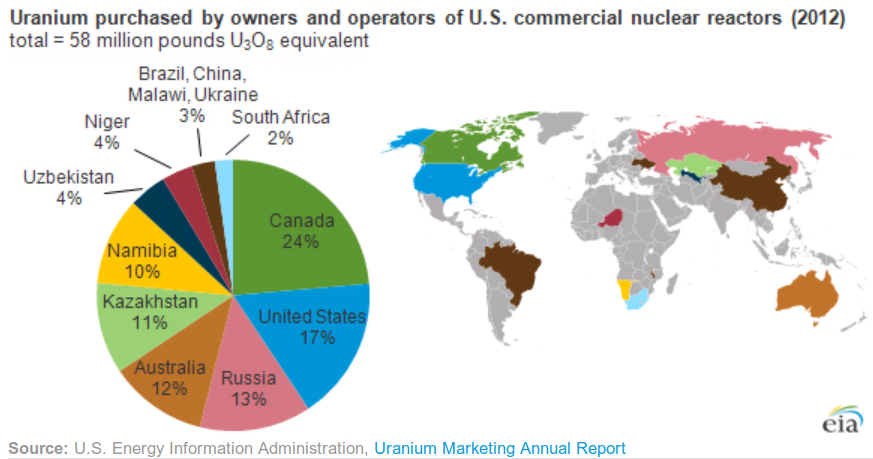
Owners and operators of U.S. commercial nuclear power reactors buy uranium in various forms as well as enrichment services from other countries. U.S. nuclear plants purchased 58 million pounds of uranium in 2012 from both domestic and foreign suppliers; 83% of this total was of foreign origin. About 38% of the enriched uranium needed to fabricate fuel for U.S. reactors was supplied by foreign enrichers.
Owners and operators of commercial nuclear power reactors buy uranium in the form of uranium concentrate, uranium hexafluoride, and/or enriched uranium. If uranium is purchased after the enrichment process, the only step remaining is the fabrication into nuclear fuel. Historically, U.S. owners and operators have purchased most of their uranium from foreign countries. In 2012, 84% of foreign-supplied uranium came from Canada, Russia, Australia, Kazakhstan, and Namibia. The rest came from Uzbekistan, Niger, South Africa, Brazil, China, Malawi, and Ukraine.
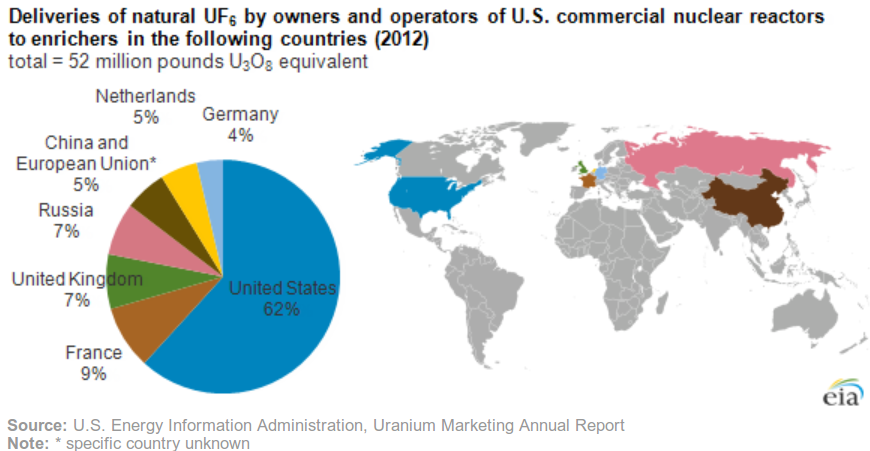
Uranium purchased earlier in the nuclear fuel cycle, such as the purchase of uranium concentrate, must be converted to natural uranium hexafluoride and enriched before reactor fuel can be fabricated. The owners and operators of U.S. commercial nuclear power reactors pay for conversion, enrichment, and fabrication. During 2012, a total of 52 million pounds of uranium hexafluoride (UF6) was delivered to enrichers in China, France, Germany, Netherlands, Russia, United Kingdom, and the United States. Enrichers in the United States received 62% of the deliveries, and the remaining 38% went to foreign enrichers.
…
What is the nuclear fuel cycle?
The nuclear fuel cycle is a multi-step process. Beginning with exploration and mining of uranium, it is then processed into uranium concentrate (U3O8, often called yellowcake). This concentrate is then converted into natural uranium hexafluoride (UF6) gas, enriched, fabricated into nuclear fuel, and sent to reactors. These steps often take place at different facilities…..
The capacity of enrichment plants is measured in terms of separative work units (SWU). SWU is a measure of how much work it takes to enrich uranium. In 2012, the average price per SWU was $141.36, and owners and operators of U.S. commercial nuclear power reactors purchased enrichment services totaling 16 million SWU. This represents a total cost to the owners and operators of U.S. commercial nuclear power reactors of about $2.3 billion.
Huge radiation: Estimated 276 quadrillion Bq of Cs-137 entered Fukushima basements
Water with nuclear fuel coming up from ocean floor off Fukushima coast? Tokyo Professor: 156 quadrillion Bq of Cs-137 once in basements — Double Chernobyl; Getting close to total fallout from every atomic bomb test in history — May be outputting from seeps in seafloor, I don’t know (VIDEO) http://enenews.com/water-with-pieces-of-nuclear-fuel-coming-up-from-ocean-floor-off-fukushima-coast-tokyo-professor-156-quadrillion-bq-of-cs-137-in-basements-getting-close-to-fallout-total-from-every-atomic-bombs-t
Title: Long-term Sources: To what extent are marine sediments, coastal groundwater, and rivers a source of ongoing contamination?
Source: Science Symposium at University of Tokyo
Date: Nov. 13, 2012
Professor Jota Kanda, Tokyo University of Marine Science and Technology:
Jota Kanda Highlight – Science Symposium at University of Tokyo
In the basement of the reactor housings […] they used to have 156 petabecquerels of Cs-137 […]
156 is a huge amount. Double the amount released from Chernobyl, even getting close to the value released from global fallout from bomb testing. […
The volume remains about the same, presumably because of the inflow of groundwater into the basement.
If there is inputting of groundwater, there might be outputting of groundwater, I don’t know.
The possible groundwater seepage from near by seafloor — that’s something I think. However we have no data indicative of this seep from the seafloor.
Watch Kanda’s presentation here
See also:
- Kanda: There may be other sources of contamination stored up inside Fukushima plant’s infrastructure — If it gets into the ocean it will have “devastating impact“
- Tokyo Professor: Cesium hot spots almost 100 times greater than surrounding area in seabed soil a mile offshore Fukushima plant
- Japan Expert: Contamination from Fukushima flowing beneath seafloor? “Could spring up outside the port“
- Nuclear Expert: Fukushima melted fuel is drifting in ocean and onto land, lacking any containment — It ends up on coastline and blows into communities — People get an exceptional dose — Health harm will go on for thousands, if not tens of thousands of years (AUDIO)
- Nuclear Engineer: Estimated 276 quadrillion Bq of Cs-137 entered Fukushima basements — Triple Chernobyl total release — A portion “has already made its way to aquifer, whence it can easily flow into sea”
And now, Vermont Yankee nuclear power plant bites the dust
 Plan to close Vermont Yankee marks latest blow to nuclear power http://www.csmonitor.com/USA/USA- The Vermont Yankee nuclear power plant will shut down by the end of 2014, its owner said Tuesday, citing ‘financial factors.’ It is the fifth nuclear plant this year to close or to have plans made for closure. By Chelsea B. Sheasley, Correspondent / August 27, 2013
The Vermont Yankee nuclear power plant in Vernon, Vt., will be shut down by the end of next year due to financial factors, the company that owns the plant 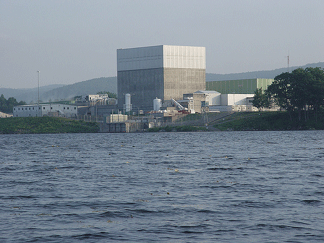 announced Tuesday, in the latest sign of a difficult economic climate for nuclear power companies.Entergy Corp., the New Orleans-based company that owns Vermont Yankee, plans on closing and decommissioning the plant by the fourth quarter of 2014, in cooperation with the US Nuclear Regulatory Commission. It is the fifth nuclear plant this year to close or to have plans made for its closure. The company said the decision to close was based on “a number of financial factors” including sustained lower power prices stemming from the natural-gas revolution, a high cost structure for the plant, and what it called “wholesale market design flaws” that artificially deflate energy prices. Some 630 people work at the plant.
Likely also a contributing factor was the ongoing legal battle with the state of Vermont, where state officials had been trying to shutter the plant on their own authority. In 2006 the state legislature granted itself the authority to close the plant and in 2010 voted to do so
The legal dispute had been turning in Entergy’s favor. Earlier this month a federal appeals court ruled that the Vermont Legislature did not have the authority to close the plant. Entergy had indicated in 2010 that it was considering selling the plant, a single unit boiling water reactor, The Wall Street Journal reports.
Entergy Corp. isn’t the only nuclear power company facing economic challenges. In June, Southern California Edison pulled the plug on the San Onofre Nuclear Generating Station, a 45-year-old facility in northern San Diego County, because of the high cost of repairs needed less than three years after the company invested $780 million in upgrades.
Radiation cancer danger greater for female astronauts than for men
The exposure limits for women are about 20 percent lower compared to men “largely due to additional cancer risk for woman from breast, ovarian, and uterine cancers,
 Female Astronauts Face Discrimination from Space Radiation Concerns, Astronauts Say, Space.com by Miriam Kramer, Staff Writer | August 27, 2013 Female astronauts have fewer opportunities to fly in space than men partially because of strict lifetime radiation exposure restrictions, astronauts say.
Both male and female astronauts are not allowed to accumulate a radiation dose that would increase their lifetime risk of developing fatal cancer by more than 3 percent. A six-month mission on the International Space Station exposes astronauts to about 40 times the average yearly dose of background radiation that a person would receive living on Earth, NASA spokesman William Jeffs said in an email .
.
While the level of risk allowed for both men and women in space is the same, women have a lower threshold for space radiation exposure than men, according to physiological models used by NASA. “Depending on when you fly a space mission, a female will fly only 45 to 50 percent of the missions that a male can fly,” Peggy Whitson, the former chief of NASA’s Astronaut Corps, said. “That’s a pretty confining limit in terms of opportunity. I know that they are scaling the risk to be the same, but the opportunities end up causing gender discrimination based on just the total number of options available for females to fly. [That’s] my perspective.” [Radiation Threat for Mars-Bound Astronauts (Video)]
NASA follows radiation exposure recommendations established by the National Council of Radiation Protection and Measurements. The exposure limits for women are about 20 percent lower compared to men “largely due to additional cancer risk for woman from breast, ovarian, and uterine cancers,” Jeffs told SPACE.com……..
“Depending on when you fly a space mission, a female will fly only 45 to 50 percent of the missions that a male can fly,” Peggy Whitson, the former chief of NASA’s Astronaut Corps, said. “That’s a pretty confining limit in terms of opportunity. I know that they are scaling the risk to be the same, but the opportunities end up causing gender discrimination based on just the total number of options available for females to fly. [That’s] my perspective.” [Radiation Threat for Mars-Bound Astronauts (Video)]
NASA follows radiation exposure recommendations established by the National Council of Radiation Protection and Measurements. The exposure limits for women are about 20 percent lower compared to men “largely due to additional cancer risk for woman from breast, ovarian, and uterine cancers,” Jeffs told SPACE.com…… http://www.space.com/22252-women-astronauts-radiation-risk.html
China to replace coal by wind and solar energy, by 2030
China has already demonstrated what’s in store by reducing the cost of solar PV modules so much that they are now commonplace on roofs across the mortgage belt suburbs of Australia. Between one-in-10 and even as much as one-in-three households now have solar PV systems installed in the outer metropolitan suburbs of Sydney, Brisbane, Perth, Adelaide and Melbourne as well as several regional cities. Such an outcome wasn’t even dreamt about by the most wildly optimistic greenie just four years ago.
What Japan did for home entertainment equipment, China will do for clean energy
 Wind & solar outpace coal in China by 2030 – Bloomberg Tristan Edis 28 Aug 13, Bloomberg New Energy Finance (BNEF) has released analysis which finds renewables will make up more than half of new power capacity growth in China to 2030, across a variety of plausible scenarios. By 2030 total installed capacity of renewable energy power plants will equal that of coal.
This study sought to examine how technological and economic changes might realistically alter the make-up and growth of China’s power sector. They found that coal’s dominance will be challenged by:
– faster technological improvement and cost reductions achieved by renewable energy technologies;
– increased social concern and, consequently, government regulation over environmental pollution;
– the prospects of shale gas, and;
– a potential price on carbon emissions. Continue reading
Fukushima’s most dangerous problem is ignored by mainstream media
Glowing Green with Outrage By Adam Smith OpEdNews Op Eds 8/27/2013 ”………Unfortunately the reality has been that the media have simply not been doing their job. The Tokyo Electric Power Company (Tepco) has been allowed to dictate the narrative of what is occurring with basically no oversight. It turns out that the site was never actually contained and radioactive water has been leaking with “no accurate figures for radiation levels.” You may say that since this issue is being reported by all major news organizations now, the media is doing their job albeit in a very tardy fashion.
However, that would be missing the reality that this leaking radiation water is the least of our worries vis-a-vis the plant. Much less reported by the media is what will be required by the clean-up crew to end this whole saga. Reliable old Reuters often provides the on-the-ground breaking scoops that our local media then report to us. Despite their well-deserved reputation, it seems that most media organizations have chosen to ignore their recent scoop about the dangers involved in the clean-up process.
 Essentially, Tepco needs to remove 1300 spent fuel rods, containing 14,000 times the amount of radiation dropped onto Japan in WWII, from a dilapidated, flooding, and collapsing power plant that still sits in an earthquake-prone location. The whole process will take about 40 years and cost about eleven billion dollars. Each rod weighs 660 pounds, is 15 feet long, and cannot get too close to each other or will trigger a chain-reaction. If exposed to air, they may also trigger a chain-reaction. Usually, when these rods are moved as part of normal operations, a sophisticated robot is used to guide the work and ensure accuracy down to millimeters. Due to the damage caused by the earthquake/tsunami, this is not possible and the cranes will be operated in a poisonously radioactive area by scared human hands with all of their limitations. These rods will be removed individually, one at a time, and a mistake on any of them could trigger an unstoppable chain-reaction…….. http://www.opednews.com/articles/Glowing-Green-with-Outrage-by-Adam-Smith-Cancer_Energy_Energy_Energy-130827-96.html
Small Modular Nuclear reactors (SMRs) promoted by hoax film “Pandora’s Promise”
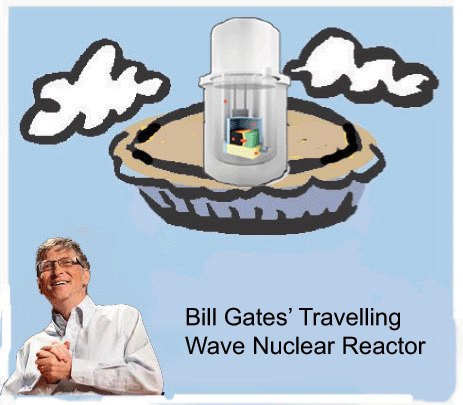 the most obvious deal killer is economic. Even by current calculations, any new reactor design would have difficulty competing with renewable energy sources, especially solar panels that can be installed on rooftops, thus avoiding transmission costs.
 The SMR’s primary customer, the Tennessee Valley Authority, has now pushed back to 2015 the target date for submitting its construction permit application. Even if wildly successful, the SMR could not meaningfully affect climate change for another 20 years—this in the midst of a crisis Hansen and so many others see as critical and immediate. The SMR blueprint hinges on technologies that have already failed. Continue reading
Massive radioactive air pollution from Savannah River Nuclear Site.

 Group calls for air pollution investigation at SRS http://www.aikenstandard.com/article/20130821/AIK0101/130829945/1004/group-calls-for-air-pollution-investigation-at-srs Derrek Asberry, August 21, 2013 A nonprofit environmental group is challenging a government study of air pollutants by calling for an investigation of toxic air pollution from Savannah River Site.
The Blue Ridge Environmental Defense League filed a letter with the Agency for Toxic Substances and Disease Registry, criticizing the toxic agency’s evaluation of SRS.
“The amount of airborne radioactive pollution from SRS is massive,” said Luis Zeller, the director of the environmental group, in a recent press release. “It is greater than the liquid releases to streams and groundwater by at least an order of magnitude. How could the ATSDR miss this?”
The group cited the toxic agency’s July 1 public health evaluation of the Site, which concluded that airborne emissions of radioactive materials and most chemical pollutants from SRS were below levels that could potentially cause harmful health effects.
“The ATSDR’s study is contradictory and inconclusive,” said Charles Utley in the press release.
Utley is the environmental justice campaign coordinator for the Blue Ridge Environmental Defense League. He conducted separate field investigations around SRS and followed up with a report entitled “Sow the Wind.”
“The League’s own investigations centered on the air toxics emitted from hundreds of large and small smokestacks at SRS and how they interact to raise downwind pollution levels in Jackson, New Ellenton, Williston and other communities,” the group stated in the release.
The group continued by recommending the Agency for Toxic Substances and Disease Registry take one of two actions: conduct an analysis and produce conclusive results on radioactive air pollutions, or require the Department of Energy to determine the public health impact of radioactive air pollutants in the Central Savannah River Area.
“Our report indicates that operations at SRS have had, and will continue to have, a negative impact on the health of residents in the Central Savannah River Area,” Utley added in the press release.
SRS did not issue a comment on the issue.
1 This Month

of the week – Shut Down Drone Warfare!


Tell the Ukrainian Government to Drop Prosecution of Peace Activist Yurii Sheliazhenko

Petition to revoke the licensing of the Near Surface Nuclear Disposal Facility (NSDF) at Chalk River. https://www.ourcommons.ca/petitions/en/Petition/Details?Petition=e-7247
To see nuclear-related stories in greater depth and intensity – go to https://nuclearinformation.wordpress.com
-
Archives
- April 2026 (103)
- March 2026 (251)
- February 2026 (268)
- January 2026 (308)
- December 2025 (358)
- November 2025 (359)
- October 2025 (376)
- September 2025 (257)
- August 2025 (319)
- July 2025 (230)
- June 2025 (348)
- May 2025 (261)
-
Categories
- 1
- 1 NUCLEAR ISSUES
- business and costs
- climate change
- culture and arts
- ENERGY
- environment
- health
- history
- indigenous issues
- Legal
- marketing of nuclear
- media
- opposition to nuclear
- PERSONAL STORIES
- politics
- politics international
- Religion and ethics
- safety
- secrets,lies and civil liberties
- spinbuster
- technology
- Uranium
- wastes
- weapons and war
- Women
- 2 WORLD
- ACTION
- AFRICA
- Atrocities
- AUSTRALIA
- Christina's notes
- Christina's themes
- culture and arts
- Events
- Fuk 2022
- Fuk 2023
- Fukushima 2017
- Fukushima 2018
- fukushima 2019
- Fukushima 2020
- Fukushima 2021
- general
- global warming
- Humour (God we need it)
- Nuclear
- RARE EARTHS
- Reference
- resources – print
- Resources -audiovicual
- Weekly Newsletter
- World
- World Nuclear
- YouTube
-
RSS
Entries RSS
Comments RSS
 nuclear-news