A hard-headed look at UK nuclear power – Friends of the Earth decide against nuclear – New report decisive!
The researchers urged us to advocate changes in energy use, supply and storage that are commensurate with reducing the UK’s emissions as fast as possible, and with the aim of securing a carbon intensity of electricity below 50g/CO2/KWh by 2030.
Mike Childs
02 August 2013
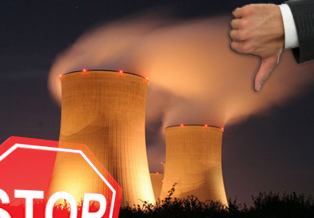
Image source ; http://electrical-engineering-portal.com/thumbs-down-to-the-nuclear-energy
All the evidence is that we are facing a planetary emergency, especially with rapidly rising greenhouse gases and warnings from scientists of the potential breaching of tipping points. This isn’t a reason to panic but it is a reason to take a hard-headed approach in assessing and reassessing positions on technologies and practices. It also requires an ability to think out of the box and imagine a different future; or as Friends of the Earth’s strap-line says, see things differently.
It was with this hard-headed, seeing things differently, approach that we embarked on a review of the evidence for and against new nuclear power stations in the UK. The review could have thrown up information or evidence that would require us to change our current opposition to new nuclear power, but we undertook this review because we consider, objectively and without prejudice, the facts on the issues we work on. This is an important guiding principle given the planetary emergency context we are operating in.
To help us in our reassessment of the evidence we commissioned the Tyndall Centre at Manchester University to carry out a review. We commissioned them because they do not have a position for or against new nuclear power, they have expertise in nuclear power, and they are leading academics on climate change, especially carbon budgets. Their review was peer reviewed by academics in favour of nuclear power and against.
After receiving the Tyndall Report, and after considering it properly, we are of the view that continued opposition to new nuclear power stations in the UK is still a credible position.
The Tyndall Report found:
- The non-nuclear energy pathway that Friends of the Earth advocates is credible and compatible with the capabilities of a future electricity grid. The researchers suggested we should regularly review our energy pathway to take into account technological developments, particularly if higher levels of electricity are needed than modelled due to faster roll out of electric cars and heat pumps than the already very ambitious levels within our energy pathway. We will of course do so but given that the UK is particularly blessed with large amounts of renewable energy it is our current view that the resources are likely to be adequate to fulfil any potential extra demand.
- The health impacts of coal are worse than nuclear power – as Friends of the Earth has said in the past – and that recent life-cycle research also suggests this is the case for gas, including gas with CCS. It also suggests that life-cycle health impacts for renewables are broadly comparable to nuclear, but cautions that the life-cycle assessments have not accounted for all the health impacts resulting from nuclear accidents (e.g. mental health impacts as a result of relocation).
- Nuclear waste management remains an “unresolved issue” in the UK with no safe repository in place. A new build nuclear programme would not add significantly to the quantity of waste but could increase the overall radioactivity of the waste inventory by around 265 per cent.
- Higher estimates of the cost of nuclear power are more plausible than estimates of low costs, stating that “claims that nuclear power is cheaper than other low carbon options (including CCS and wind) are unlikely to be borne out in reality”.
The researchers urged us to advocate changes in energy use, supply and storage that are commensurate with reducing the UK’s emissions as fast as possible, and with the aim of securing a carbon intensity of electricity below 50g/CO2/KWh by 2030.
Since receiving the report we have updated our position paper. We continue to oppose the construction of new nuclear power stations, promote the rapid introduction of renewable energy – particularly offshore wind – and oppose the provision of subsidies to nuclear power as they are reducing the amount of money available to more sustainable energy saving and renewable energy technologies.
http://www.foe.co.uk/news/nuclear_40884.html?gclid=CLvygOaYl7kCFbLMtAodSF8AHQ
And heres the kind of thing that UK government and friends are hiding.. better than wind.. localised industry. chemical driven, (non toxic) cheap, fully recyclable/reusable and not corporation friendly…
https://nuclear-news.net/2013/05/03/an-aluminium-fuel-cell-why-is-uk-government-blocking-it/
1 Comment »
Leave a comment
1 This Month
Chernobyl: The Lost Tapes – A good documentary on Chernobyl on SBS available On Demand for the next 3 weeks– https://www.sbs.com.au/ondemand/tv-program/chernobyl-the-lost-tapes/2352741955560

of the week–London Campaign for Nuclear Disarmament

Tell the Ukrainian Government to Drop Prosecution of Peace Activist Yurii Sheliazhenko
To see nuclear-related stories in greater depth and intensity – go to https://nuclearinformation.wordpress.com
-
Archives
- April 2026 (139)
- March 2026 (251)
- February 2026 (268)
- January 2026 (308)
- December 2025 (358)
- November 2025 (359)
- October 2025 (376)
- September 2025 (257)
- August 2025 (319)
- July 2025 (230)
- June 2025 (348)
- May 2025 (261)
-
Categories
- 1
- 1 NUCLEAR ISSUES
- business and costs
- climate change
- culture and arts
- ENERGY
- environment
- health
- history
- indigenous issues
- Legal
- marketing of nuclear
- media
- opposition to nuclear
- PERSONAL STORIES
- politics
- politics international
- Religion and ethics
- safety
- secrets,lies and civil liberties
- spinbuster
- technology
- Uranium
- wastes
- weapons and war
- Women
- 2 WORLD
- ACTION
- AFRICA
- Atrocities
- AUSTRALIA
- Christina's notes
- Christina's themes
- culture and arts
- Events
- Fuk 2022
- Fuk 2023
- Fukushima 2017
- Fukushima 2018
- fukushima 2019
- Fukushima 2020
- Fukushima 2021
- general
- global warming
- Humour (God we need it)
- Nuclear
- RARE EARTHS
- Reference
- resources – print
- Resources -audiovicual
- Weekly Newsletter
- World
- World Nuclear
- YouTube
-
RSS
Entries RSS
Comments RSS
 nuclear-news
[…] http://thewatchers.adorraeli.com/2012/04/06/nuclear-event-nuclear-power-plant-penly-in-france-automa… […]
Pingback by European EURDEP Radiation mapping unavailable for emergency services during nuclear events at Penly NPP « nuclear-news | August 26, 2013 |