The researchers urged us to advocate changes in energy use, supply and storage that are commensurate with reducing the UK’s emissions as fast as possible, and with the aim of securing a carbon intensity of electricity below 50g/CO2/KWh by 2030.
All the evidence is that we are facing a planetary emergency, especially with rapidly rising greenhouse gases and warnings from scientists of the potential breaching of tipping points. This isn’t a reason to panic but it is a reason to take a hard-headed approach in assessing and reassessing positions on technologies and practices. It also requires an ability to think out of the box and imagine a different future; or as Friends of the Earth’s strap-line says, see things differently.
It was with this hard-headed, seeing things differently, approach that we embarked on a review of the evidence for and against new nuclear power stations in the UK. The review could have thrown up information or evidence that would require us to change our current opposition to new nuclear power, but we undertook this review because we consider, objectively and without prejudice, the facts on the issues we work on. This is an important guiding principle given the planetary emergency context we are operating in.
To help us in our reassessment of the evidence we commissioned the Tyndall Centre at Manchester University to carry out a review. We commissioned them because they do not have a position for or against new nuclear power, they have expertise in nuclear power, and they are leading academics on climate change, especially carbon budgets. Their review was peer reviewed by academics in favour of nuclear power and against.
After receiving the Tyndall Report, and after considering it properly, we are of the view that continued opposition to new nuclear power stations in the UK is still a credible position.
The Tyndall Report found:
The non-nuclear energy pathway that Friends of the Earth advocates is credible and compatible with the capabilities of a future electricity grid. The researchers suggested we should regularly review our energy pathway to take into account technological developments, particularly if higher levels of electricity are needed than modelled due to faster roll out of electric cars and heat pumps than the already very ambitious levels within our energy pathway. We will of course do so but given that the UK is particularly blessed with large amounts of renewable energy it is our current view that the resources are likely to be adequate to fulfil any potential extra demand.
The health impacts of coal are worse than nuclear power – as Friends of the Earth has said in the past – and that recent life-cycle research also suggests this is the case for gas, including gas with CCS. It also suggests that life-cycle health impacts for renewables are broadly comparable to nuclear, but cautions that the life-cycle assessments have not accounted for all the health impacts resulting from nuclear accidents (e.g. mental health impacts as a result of relocation).
Nuclear waste management remains an “unresolved issue” in the UK with no safe repository in place. A new build nuclear programme would not add significantly to the quantity of waste but could increase the overall radioactivity of the waste inventory by around 265 per cent.
Higher estimates of the cost of nuclear power are more plausible than estimates of low costs, stating that “claims that nuclear power is cheaper than other low carbon options (including CCS and wind) are unlikely to be borne out in reality”.
The researchers urged us to advocate changes in energy use, supply and storage that are commensurate with reducing the UK’s emissions as fast as possible, and with the aim of securing a carbon intensity of electricity below 50g/CO2/KWh by 2030.
Since receiving the report we have updated our position paper. We continue to oppose the construction of new nuclear power stations, promote the rapid introduction of renewable energy – particularly offshore wind – and oppose the provision of subsidies to nuclear power as they are reducing the amount of money available to more sustainable energy saving and renewable energy technologies.
And heres the kind of thing that UK government and friends are hiding.. better than wind.. localised industry. chemical driven, (non toxic) cheap, fully recyclable/reusable and not corporation friendly…
…Yucca Mountain may get studied some more. But it will never be used as a permanent nuclear waste storage facility. Too many political, economic and engineering hurdles stand in the way. The time spent examining the issue, though, has not been wasted. The lessons learned are that 250-year disposal sites that are regionally placed could be more practical…
Some thought the idea of using Yucca Mountain that is 90-miles outside of Las Vegas as a permanent nuclear waste disposal site was, well, buried. Not so, now that a federal appeals court has ordered the Nuclear Regulatory Commission to continue the licensing process.
Yucca Mountain (Photo credit: Wikipedia)
The big question is whether the U.S. Congress will pony up so that those nuclear regulators can finish the job. Right now, the fund to continue the research has withered to just $11 million. Potentially wasting more money is one issue. So is “flouting the law,” which is what one of the judge’s said has been going on — a slap in the face to “our constitutional system.” Congress authorized the study of this site back in 1987 and unless or until it pulls the plug on it, lawmakers must bankroll it and regulators must carry out their will.
“By making it a permanent repository, we opened the flood gates for every theory as to why not to do it,” says former Energy Secretary Spencer Abraham, in a phone conversation with this reporter. “We have given critics and opponents the grounds on which to make their case. But centralizing a facility, as opposed to on-site situations, is a much safer approach. Settings in metropolitan areas are not safer than storing nuclear waste under a mountain that is 1,000 feet below the earth.”
Abraham, who is now the board chair for Uranium EnergyUEC+3.42% Corp., goes on to say that the “wiser approach” would have been to recommend a 250-year repository to store nuclear waste. Yucca Mountain, by comparison, is a 10,000-year site. Such a “compromise,” would be political feasible, he says, adding that national policy provides incentives to New Mexico to store low-level radioactive waste.
If anyone is looking for a policy to liven up the election campaign, Bob Hawke has an idea: make Australia the repository of the world’s nuclear waste.
”It’s a no-brainer,” he says. ”If you’ve got the safest geological sites in the world, why haven’t you got the moral responsibility to make them available?”
Mr Hawke has made the argument before, and it’s the one issue he raises when asked if he has achieved all he hoped for in the 22 years since he was prime minister.
Little time to relax: The in-demand Bob Hawke and his wife, Blanche d’Alpuget, now promoting a new book, at their home in July. Photo: Tim Bauer Photo: Tim Bauer
Australia would have that responsibility even if it did not sell uranium, contends Mr Hawke. When I express doubt about his proposal, he says: ”Of course, because you’re not – with respect – being intelligent about it. You’re just being prejudiced, nimby.”
Mr Hawke gave this interview in his office at 100 William Street, Sydney, last month to talk about his wife and biographer, Blanche d’Alpuget, whose new novel is about the politics of 12th-century France and England.
While she’s promoting The Young Lion, he has been fielding ”a thousand requests to speak at functions and open campaigns”.
Though he may have no takers for his nuclear-waste plan, the old lion at 83 remains a player. ”I’m very sad about the quality of our political life,” he says.”People basically hold Parliament in contempt and I put the position to Kevin [Rudd] and to Joe Hockey last night at the football [NSW-Queensland State of Origin in July] that both sides should say there are some things we don’t necessarily have the answer to. So we’ll put up draft legislation, there’ll be no caucus, we’ll go either side and abide by the decision of the Parliament.
”I think that would lift the quality of political life enormously. They both expressed some interest, so we’ll see.”
The change of prime minister from Julia Gillard to Mr Rudd ”had to happen”, Mr Hawke says. ”I like Julia and I supported her but the caucus had to look at the facts.”
…The Independent provided no source information whatsoever for their rather significant disclosure of top secret information. Did they see any such documents, and if so, who, generally, provided it to them? I don’t mean, obviously, that they should identify their specific source, but at least some information about their basis for these claims, given how significant they are, would be warranted. One would think that they would not have published something like this without either seeing the documents or getting confirmation from someone who has: the class of people who qualify is very small, and includes, most prominently and obviously, the UK government itself….
GCHQ’s headquarters on the outskirts of Cheltenham. Photograph: Barry Batchelor/PA
(Updated below)
The Independent this morning published an article – which it repeatedly claims comes from “documents obtained from the NSA by Edward Snowden” – disclosing that “Britain runs a secret internet-monitoring station in the Middle East to intercept and process vast quantities of emails, telephone calls and web traffic on behalf of Western intelligence agencies.” This is the first time the Independent has published any revelations purportedly from the NSA documents, and it’s the type of disclosure which journalists working directly with NSA whistleblower Edward Snowden have thus far avoided.
That leads to the obvious question: who is the source for this disclosure? Snowden this morning said he wants it to be clear that he was not the source for the Independent, stating:
I have never spoken with, worked with, or provided any journalistic materials to the Independent. The journalists I have worked with have, at my request, been judicious and careful in ensuring that the only things disclosed are what the public should know but that does not place any person in danger. People at all levels of society up to and including the President of the United States have recognized the contribution of these careful disclosures to a necessary public debate, and we are proud of this record.
“It appears that the UK government is now seeking to create an appearance that the Guardian and Washington Post’s disclosures are harmful, and they are doing so by intentionally leaking harmful information to The Independent and attributing it to others. The UK government should explain the reasoning behind this decision to disclose information that, were it released by a private citizen, they would argue is a criminal act.”
The US government itself has constantly used this tactic: aggressively targeting those who disclose embarrassing or incriminating information about the government in the name of protecting the sanctity of classified information, while simultaneously leaking classified information prolifically when doing so advances their political interests.
One other matter about the Independent article: it strongly suggests that there is some agreement in place to restrict the Guardian’s ongoing reporting about the NSA documents. Speaking for myself, let me make one thing clear: I’m not aware of, nor subject to, any agreement that imposes any limitations of any kind on the reporting that I am doing on these documents. I would never agree to any such limitations. As I’ve made repeatedly clear, bullying tactics of the kind we saw this week will not deter my reporting or the reporting of those I’m working with in any way. I’m working hard on numerous new and significant NSA stories and intend to publish them the moment they are ready.
Related question
For those in the media and elsewhere arguing that the possession and transport of classified information is a crime: does that mean you believe that not only Daniel Ellsberg committed a felony, but also the New York Times reporters and editors did when they received, possessed, copied, transported and published the thousands of pages of top-secret documents known as the Pentagon Papers?
“We encourage them to have the pills as part of their emergency kits, along with Band-Aids and flashlights,” Murphy said. “Those with old pills should throw them out and replace them with new pills.”
By Christine Legere, Cape Cod Times, Hyannis, Mass.McClatchy-Tribune Information Services
Aug. 24–State health officials supplied communities across the Cape and Islands with 1.7 million potassium iodide pills this week — more than enough to protect the thyroids of residents and visitors should a radioactive release occur at the Pilgrim Nuclear Power Station.
Residents are being urged to pick up pills for their families — two per person — and tuck them in their emergency kits.
According to the Nuclear Regulatory Commission, two pills will protect the thyroid for two days. By that time, the agency’s site states, people should have been evacuated or properly sheltered, and therefore out of harm’s way.
The thyroid gland is part of the endocrine system, which controls metabolism. The thyroid cannot differentiate between potassium iodide and the radioactive iodine that’s released in the steam of a failed reactor. Potassium iodide protects the thyroid by filling the gland to the point where it can’t absorb any more iodine for 24 hours.
The new batch of pills, which have a shelf life of seven years, will replace old potassium iodide tablets set to expire this month.
Residents can obtain pills free of charge from their health departments, courtesy of Entergy Corp., Pilgrim’s owner-operator.
The company is required by state law to provide the pills to residents in the 10-mile emergency zone around Pilgrim, as well as to Barnstable, Dukes and Nantucket counties, and Cape Ann, according to Anne Roach, spokeswoman for the Massachusetts Department of Public Health.
Entergy paid a little over 35 cents for each pill, Roach said. That puts the company’s cost to supply the Cape and Islands at just under $600,000.
According to the Centers for Disease Control and Prevention, the younger the person, the more vulnerable the thyroid is to injury from radioactive iodine. All infants, even those who are breast-fed, should be given the recommended dose of potassium iodide in case of a nuclear event, according to the CDC.
Pregnant women are advised to take the pill since all forms of iodine can cross the placenta to the growing fetus.
Title: Interview with Kevin Kamps Source: The Thom Hartmann Program Date: Aug 21, 2013
Kevin Kamps, Beyond Nuclear7 is the highest rung on this [INES] ladder which is global catastrophe, in my words.
Only Chernobyl and Fukushima Daiichi have reached the seventh rung on this scale.
Fukushima is 1,000x’s worse than we thought!
But as a colleague John Laforge with Nuke Watch in Wisconsin put it back at the time 2 ½ years ago, while there where 3 meltdowns and 4 explosions at Fukushima Daiich, isn’t that at least a 3 times 7, or a 21 on the scale? […] The ocean’s just getting hammered at Fukushima Daiichi.
[…] Tepco said it doesn’t think that water has flowed into the sea but can’t say for sure. Some of the flooded reactor basements are similarly too hot to approach, and it is still not clear where the melted fuel cores are, or in what state.
“In the future there might be even more heavily contaminated water coming through,” said Atsunao Marui, head of the groundwater research group at Japan’s National Institute of Advanced Industrial Science and Technology and a member of a blue-ribbon panel set up in May to figure out ways of managing the radioactive water. “It’s important to think of the worst-case scenario.”
Mr. Marui and others say the biggest reason for the scramble now is that Tepco—and the government bodies that oversee it—weren’t planning far enough ahead and waited too long to respond to problems they should have seen coming long ago.
Fukushima Daiichi was built some 40 years ago on the site of a river that was diverted in order to situate the plant, Mr. Marui says. It should have been clear that lots of groundwater would be rushing through the site, he says, and that any walls or barriers built on the seaward side would soon be overwhelmed—something that, indeed, has happened in recent weeks. […]
He says water is leaking out all over the site and there are no accurate figures for radiation levels. […] “The quantities of water they are dealing with are absolutely gigantic,” said Mycle Schneider, who has consulted widely for a variety of organisations and countries [France, Germany] on nuclear issues.
“What is the worse is the water leakage everywhere else – not just from the tanks. It is leaking out from the basements, it is leaking out from the cracks all over the place. Nobody can measure that. […]
“It is much worse than we have been led to believe, much worse,” said Mr Schneider, who is lead author for the World Nuclear Industry status reports. […] Full BBC report here
Calls for Japan nuclear switch-off threaten ‘Abenomics’Ft.com By Ben McLannahan in Tokyo , 23 Aug 13, Yumi Murakami began her weekly vigils not long after the tsunami-induced meltdowns at Japan’s Fukushima Daiichi nuclear plant almost two and a half years ago. The 64-year-old housewife was at her usual spot outside the ministry of economy, trade and industry in Tokyo on Friday evening, bedecked in “No Nuke” badges, about to join a protest march to the prime minister’s house.
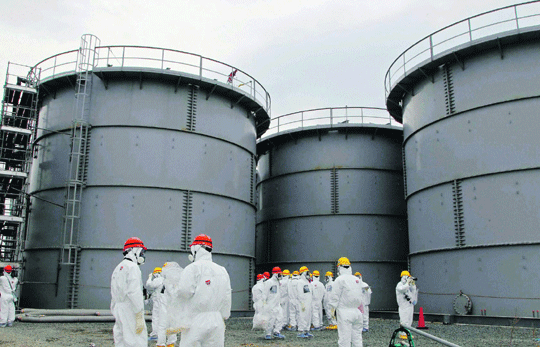
This week’s demonstration was vital, she said, following the disclosure from Fukushima’s operator that it had discovered a 300-tonne leak from one of the hundreds of jerry-built tanks holding contaminated water used to keep melted fuel cool.
“We can’t keep ruining people’s lives”, said Ms Murakami. Switching Japan’s reactors back on would be “hell”.
Shinzo Abe, beginning a five-day trip to the Middle East, was not there in person to see Friday’s protest. But the prime minister is acutely aware of the tensions between economic need and civil unease that elections have done little to resolve.
Mr Abe’s Liberal Democrats – the only party not calling for the elimination of nuclear power – comfortably won last month’s contest for control of the upper house of parliament. But turnout was low, as it was in December for the lower-house election that put the LDP in charge.
Opinion polls show significant shares of Japanese opposed to restarting the 50 reactors shut down in the wake of the Fukushima crisis, all but two of which remain idled. A survey this month by state broadcaster NHK found only 24 per cent of Japanese were in favour of restarting nuclear plants.
For Mr Abe, however, restoring nuclear power is a vital part of the grand project to pull Japan out of the deflation that has dogged it for much of the past 20 years……. Continue reading →
BBC News, Aug 22, 2013: The “worsening situation” at Fukushima has prompted a former Japanese ambassador to Switzerland to call for the withdrawal of Tokyo’s Olympic bid. In a letter to the UN secretary general, Mitsuhei Murata says the official radiation figures published by Tepco cannot be trusted. He says he is extremely worried about the lack of a sense of crisis in Japan and abroad.
Time, Aug 22, 2013: “It’s time we faced the danger, ” said Takashi Hirose, a writer shocked by the under-reported radiation levels he found on recent trip into the evacuation zone. “So many terrible things are not being reported in the news.”
BBC News, Aug 22, 2013: Fukushima leak is ‘much worse than we were led to believe’ […] A nuclear expert [Mycle Schneider] has told the BBC that he believes the current water leaks at Fukushima are much worse than the authorities have stated. […] He says water is leaking out all over the site and there are no accurate figures for radiation levels. […] some nuclear experts are concerned that the problem is a good deal worse than either Tepco or the Japanese government are willing to admit.
Irish Timess,, Aug 21, 2013: Cover-up [….] Many experts believe Japan’s government continues to underestimate the cost and complexity of the decommissioning, and that Tepco has been systematically covering up problems.
Bloomberg, Aug 21, 2013: At least one commissioner at the regulator questioned the accuracy of data being released by operator Tokyo Electric Power Co. (9501) and whether the incident had been fully reported. […] “This INES evaluation is based on the 300-ton leak, but I really wonder if we can trust data provided by Tepco,” Toyoshi Fuketa, a commissioner at the NRA, said at a meeting in Tokyo today. “I really wonder if we should judge based on Tepco’s data.”
The turbine buildings at the Fukushima Dai-ichi plant are about 150 meters (500 feet) from the ocean. According to a Japan Atomic Energy Agency document, the contaminated underground water is spreading toward the sea at a rate of about 4 meters (13 feet) a month.
At that rate, “the water from that area is just about to reach the coast,” if it hasn’t already,
radioactive cesium levels in most fish caught off the Fukushima coast hadn’t declined in the year following the March 2011 disaster, suggesting that the contaminated water from the reactor-turbine areas is already leaking into the sea.
But TEPCO hasn’t provided the details he and other scientists need to further assess the situation.
Radioactive Groundwater at Fukushima Nears Pacificabc news, TOKYO August 23, 2013 (AP) By MARI YAMAGUCHI Associated Press Deep beneath Fukushima’s crippled nuclear power station, a massive underground reservoir of contaminated water that began spilling from the plant’s reactors after the 2011 earthquake and tsunami has been creeping slowly toward the Pacific.
Now, 2 1/2 years later, experts fear it is about to reach the ocean and greatly worsen what is fast becoming a new crisis at Fukushima: the inability to contain vast quantities of radioactive water.
The looming crisis is potentially far greater than the discovery earlier this week of a leak from a tank that stores contaminated water used to cool the reactor cores. That 300-ton (80,000-gallon) leak is the fifth and most serious from a tank since the March 2011 disaster, when three of the plant’s reactors melted down after a huge earthquake and tsunami knocked out the plant’s power and cooling functions.
But experts believe the underground seepage from the reactor and turbine building area is much bigger and possibly more radioactive, confronting the plant’s operator, Tokyo Electric Power Co., with an invisible, chronic problem and few viable solutions. Continue reading →
[…] Nikolaus Gantner, an ecotoxicologist affiliated with Trent University in Peterborough, Ont., said the challenge is to discover how much radiation is accumulating in migratory or long-lived fish, such as halibut, salmon and tuna.
“There are simply not enough measurements being done in water and biota on this side of the Pacific Ocean,” he said.
“Continuous input to water for two years — and counting — will lead to ample opportunity for re-concentrating … up the food chain.”
[…] Gantner would like testing extended to seafood eaten frequently by First Nations, such as oysters and crab.
Gantner doubts whether studies will find dangerous levels of radiation in fish, and said he has no hesitation in eating fish from the Pacific. […]
Man caught in ‘uranium for Iran’ stingSierra Leone man lured to New York with uranium ore hidden in his shoes after US federal agent offered him 1,000-tonne deal Reuters in Miami theguardian.com, Friday 23 August 2013 US prosecutors have charged a man from Sierra Leone with trying to sell undercover agents 1,000 tonnes of yellowcake uranium he thought would be shipped to Iran. He was arrested in New York with a sample of the toxic material hidden in his luggage, authorities said.
Patrick Campbell, 33, of Freetown, was arrested at John F Kennedy airport on Wednesday after he arrived from Sierra Leone with the sample of uranium concealed in the soles of shoes in his luggage, according to a criminal complaint filed in a Florida federal court on Thursday.
He allegedly responded to an ad in May 2012 on the websitealibaba.com seeking to purchase uranium that was placed by an undercover US agent posing as an American broker representing persons in Iran, according to an affidavit by Homeland Security agent Louise Miller.
Campbell agreed to travel to Miami to meet the supposed buyer, who could then analyse the purity of the uranium. Continue reading →
As the court concedes, this leaves open a number of future questions: What will the Energy Department do next, as it continues to attempt to abandon its Yucca application? What if the NRC’s remaining $11 million fund runs out, and Congress fails to appropriate any more money? Furthermore, the NRC might decide to comply with its decision deadline by simply rejecting the Energy Department’s application
The D.C. Circuit Goes Nuclear AUG 23, 2013 • BY ADAM J. WHITETo write about the D.C. Circuit this week is to join a much broader discussion about the court’s role in American law and policy…….In a case titled In re Aiken County, the court took the extraordinary step of ordering the Nuclear Regulatory Commission to continue reviewing the Energy Department’s proposal for a federal nuclear waste repository at Yucca Mountain, Nevada.
I say “extraordinary” not because the court overstepped its bounds, but because the case presents truly rare questions of the D.C. Circuit’s role at the intersection of congressional power, executive duty, agency discretion, and judicial responsibility.
The saga of Yucca Mountain dates back decades, with far too much detail to include in a single blog post. (I tried to summarize the controversy in a longer essay for The New Atlantis last year.) Here are the basics: Continue reading →











 nuclear-news