An explanatory meeting about thyroid gland by Fukushima Medical University was held at my child’s kindergarten today. Mothers that are concerned about radiation, including me, didn’t attend the meeting. We feared we might be brainwashed to accept that radiation is not dangerous, and we also realized we might get furious just by listening to them. I’ve made a decision never to attend seminars on radiation that are organized by municipalities and other authorities, to avoid the brainwashing.
This is an appeal from a mother with two children in Iwaki-shi, Fukushima prefecture. She watched the interview film of Ruri Sasaki who lives in Nihonmatsu-shi, and sent the letter (below) to a member of World Network for Saving Children from Radiation, an Iwaki native who lives in Montreal.
I would like many people to read my e-mail because it describes a present situation.
[…]
A mother who has children in the same kindergarten where my children go has lately gone for evacuation; she is very frustrated to see people living there in peace with no thought about the current situation in Fukushima. Why do people in Fukushima need to suffer so much? My family was forced to split up.
Sasaki’s description of how she had to put up with her child playing outdoors is painful “Gradually I became numb, told myself not to think about it. I must let my children play but for short times only. I really wish I could allow them to play for entire days.”
There are some people who are not concerned about the radiation and who think Iwaki-shi is safe. In reality, most of those people have simply given up, the only way for them to keep living here is to ignore their feeling about the hazards.
People who are concerned about radiation have their thyroid checks performed at sanatoriums. They cannot count on having the examinations carried out by the prefecture. Those who don’t care much about radiation feel secure, because they believe the prefecture will examine their health properly, and because the radiological dosage at Iwaki-shi is low. The attitude to thyroid problems is the one matter that divides people’s opinions most.
[…]
————
The earlier information to the public about thyroid issues has usually been given on the lines of “no health concerns”, but lately I have noticed a change of tone, and there seems to be a feeling that there are possible chances of increasing onsets of thyroid cancers. I have heard that the thyroid examinations in Iwaki, where there was massive fallout of radioactive iodine, have been getting a lot of attention. Still, most mothers seem to be unaware of this fallout and its impact.
I once had a chance to put a question to a member of the municipal assembly at community and asked, “I have heard from people in Nakadoori area that the prefecture’s manner of making thyroid examinations is not considered trustworthy.
I should like the examiners to give the mothers proper explanations, at the time when the ultrasound is being performed, and to give them copies of the ultrasound results on the examining spot.” Immediately, other mothers changed the subject to more positive topics, saying, “It is not good to be worried about it too much.” This happened in January this year.
There are many people who actually believe that no one will get thyroid cancer. They choose to believe in the news that says that the recent onset of thyroid cancer is not related to the nuclear incident. To be honest, the most troublesome at the moment is not the government and TEPCO, but the mothers who don’t want to believe the impact of the accident. There are especially many of those in Iwaki, mothers who believe this way because the air dose radiation rate is low.
People at Nakadoriare more seriously concerned, due to the fact that their screening examination is already finished. Many people there feel tired of even thinking about it.
I guess that many will not start taking action until their children are in a serious condition. However, they will have reached the point of total exhaustion by the time that they realize their kids’ problem.
I think that the reason why the thyroid examinations in Iwaki have been postponed was not merely the doing of the national prefectural and municipal government.
A part of Iwaki city is even located within the 30 km zone. Nevertheless, thyroid examinations here will not be done until after Nakadori. I guess that one of the reasons for this is that a great number of mothers, myself included, have not taken any action. A vast majority of mothers have been thinking like, “Nakadori must be prioritized due to their high radiation levels” , or “The level of health hazards in Iwaki is surely very low, due to the low radiation level”.
Mothers also think “I feel guilty about partaking in recuperation programs because the radiation level in Iwaki isn’t that high, and people at Nakadori should have a priority”. Mutual concessions are certainly important, but should we do it in this emergency situation?
How can we impose an order of priority when our own children are at stake?
Are mothers fine with the fact that their children are going to be tested later?
People in Iwaki tend to hold themselves back because of the low radiation level, feeling like “There are much worse places”.
But they are desensitized. Although the radiation dose is said to be low, most of the parks show more than 0.2 mSv/h because decontamination has not been done. On the lawns, the radiation levels are about 0.3 mSv/h .
The people who are best suited to start taking action are the mothers. However,many mothers blindly believe that their children will be fine. Some of them have been striving to take action in citizens’s groups. Nevertheless, most of them don’t even know of these activities.
I admire mothers who have the guts to raise their voices in such conditions. It takes so much energy to do so. I know that this situation won’t get better until we all stand up and do our best against it. But for my part, I haven’t been able to join any such activities because I have been busy to deal with my child. In addition to taking care of my child I recently became a member of my child’s kindergarten parents’ board.
WE ALL SHARE THE OCEANS!
Please help stop the radioactive contamination of the PacificHello, this is an urgent message from Japan.
It was revealed that, as the result of the nuclear disaster at the Fukushima Daiichi Plant, 300 tons of radioactive waste water containing highly toxic substance such as cesium, strontium, tritium has been leaking in the sea every day.
It is of absolute necessity to prevent the discharge of this contaminated water.
The Japanese government says it will assign a prevention budget but it’s not until the next fiscal year. Plus the plan fails to stop groundwater from flowing into the power plant buildings and lacks fundamental preventative measures. If the present situation lingers, the contamination will continue to spread. Experts from nations throughout the world are needed to solve this problem.
Please, before the world’s beautiful oceans become contaminated,
please share this issue with people all over the world through Twitter,
Facebook, and other means.
High-energy particles called muons created by cosmic rays striking the Earth’s atmosphere could provide an X-ray-style image of the damage to the Fukushima Daiichi nuclear plant after the 2011 tsunami-related meltdown in Japan. Credit: NSF/J. Yang
Radiation is still leaking from the Fukushima Daiichi nuclear plant after the 2011 tsunami-related meltdown in Japan, making any damage assessment dangerous for both humans and machines. Instead, high-energy particles created by cosmic rays striking the Earth’s atmosphere could provide an X-ray-style image of the damage from a much safer distance.
Technology capable of harnessing the high-energy muon particles comes from the Los Alamos National Laboratory (LANL) in New Mexico. Shortly after 9/11, the U.S. lab developed a muon detector that could spot uranium or plutonium nuclear weapons hidden inside cargo containers by tracking the changed paths of ghostly muons as they traveled through the nuclear materials.
MOSCOW — The former and current Presidents of Bashkortostan (Bashkiria) – a Russian republic located between the Volga and the Ural Mountains – asked the federal government to resume construction of Bashkir Nuclear Power Plant, an old Soviet project launched in 1980 and scrapped in 1990. The idea has local ecologists raising their eyebrows: The arguments for the new plant fail even generous scrutiny, while the region certainly does not lack in non-nuclear options. Andrei Ozharovsky, 20/08-2013 – Translated by Maria Kaminskaya
What do you do when the government of your region or republic where you live starts bringing up the subject of building a nuclear power plant? What do you do if you don’t find yourself particularly fond of the idea and want to do something about it?
The immediate thought is probably to try to find out first if there are any arguments to support the nuclear scenario – and if there aren’t non-nuclear alternatives for your region’s development instead.
When she saw reports in the media that the republican government was pushing to resume construction of Bashkir Nuclear Power Plant (Bashkir NPP), a frozen site in the town of Agidel, in northwestern Bashkortostan, she sent an inquiry to the republican government, asking to explain the rationale behind this sudden burst of enthusiasm over the old project.
One of the media reports, published late last March on Novosti Energetiki website (in Russian), cited Yevgeny Romanov, General Director of the Russian NPP operator company Rosenergoatom Concern, as saying that Bashkiria’s government is seeking to expedite the construction of Bashkir NPP.
The story linked to a question asked by an Adigel resident on the nuclear blogging website Publicatom.Ru (in Russian). In his reply, Romanov said that the current federal power generating capacities siting plan envisions launching two Bashkir NPP units after 2021, and in accordance with the current reactor construction program, the first unit is expected to be completed in 2025, and the second in 2027. But according to the information available, Romanov said, the government of the Republic of Bashkortostan is “taking measures” to speed up the construction.
“We are very surprised that even despite the recent events at Fukushima [Daiichi Nuclear Power Plant in Japan], and the Year of the Environment declared [in 2013] in Russia, there is continued talk in the Republic of Bashkortostan about building the nuclear power plant in Agidel – all the while the world is moving with a gathering momentum toward phasing out nuclear energy and transitioning to renewable energy sources, and toward thoughtful handling of the resources it has,” Latypova told Bellona in an interview.
“We would really like to know the grounds and reasons that compelled the President and the Government of Bashkortostan to ask to resume construction of the NPP,” Latypova said.
Bashkortostan’s Minister of Industry and Innovation Policy Alexei Karpukhin did not just respond to Latypova’s inquiry with a letter but also, as per the ecologists’ request, attached to his response copies of two letters that the former and current presidents of Bashkortostan wrote within just several months to the federal government. In their letters, they championed completion of the old project.
One of the letters, of February 6, 2010, was written by former President of Bashkortostan Murtaza Rakhimov and addressed to Vladimir Putin, at the time Russia’s prime minister. The other, of October 18, 2010, was written by Rakhimov’s successor at the presidential post, Rustem Khamitov, and is addressed to the then President of the Russian Federation, Dmitry Medvedev.
Bellona has both letters, as well as Minister Karpukhin’s response to Latypova, at its disposal (downloadable on bellona link, in Russian) – and thus has the unique opportunity to see just how two leaders of a Russian region go about asking the federal government to build them a nuclear power plant.
It would seem upon analysis that their requests lack in solid arguments – while both Agidel and the republic’s energy complex, in fact, have options other than nuclear power for future development.
The evidence from independent and government experts against the proposed New Prosperity Mine proves the Tsilhqot’in Nation is fully justified in its total opposition to the proposed Teztan Biny (Fish Lake) proposal.
Dr. John Stockner from the UBC Fisheries Centre, a senior lake research scientist and past associate editor of Canada’s most prestigious aquatic journal, the Canadian Journal of Fisheries and Aquatic Science, told the federal panel hearing on the proposed New Prosperity mine that the project would render the lake dead to fish within a decade. Stockner testified the lake would effectively become an aquarium, and nutrient loading and algae blooms would create oxygen deficiencies in the water, resulting in a massive die-off of rainbow trout.
“I feel like a town crier because what I have to tell you after considerable thought, I am of the firm opinion that within a decade, Fish Lake will die. It will die for fish,” Stockner told the Canadian Environmental Assessment Agency review Panel hearings. His findings were echoed by Darren Brandt, another lake ecologist who studies how lakes respond to human disturbances.
Federal and provincial government experts raised serious concerns about the proposal that add to Stockner’s and Brandt’s findings during the technical phase of the Canadian Environmental Assessment Agency’s review panel hearings.
This evidence has reinforced the Tsilhqot’in Nation’s total opposition to the project during the past two weeks of community hearings and will continue to do so as the hearings move this week to the Secwepemc Nation and final arguments on Friday August 23rd.
Renewable energy facilities that newly started operating in fiscal 2012 in Japan totaled 2.08 million kilowatts in capacity, which is worth two nuclear reactors, the Economy, Trade and Industry Ministry said Tuesday.
Solar power facilities, including those installed at homes and megasolar plants, largely contributed to the reading on the back of incentives introduced in July last year to promote renewable energy sources. Their capacity reached 1.98 million kw.
Because deliveries of some solar panels were not made in time, the capacity of operating facilities did not reach the 2.5 million kw as projected by the government for the year ended in March.
But a ministry official said the introduction of renewable energy is “smooth,” noting that facilities with a combined 1.28 million kw capacity commenced operations in April and May.
Meanwhile, the capacity of facilities approved to operate by the ministry came to about 21.09 million kw between July last year and March this year, in a sign that many facilities are not yet in service despite winning the permission.
Under the so-called feed-in tariff scheme, power utility firms are obliged to pay for electricity generated from renewable energy sources at fixed prices. The costs are passed on to consumers.
Japan is gearing up to introduce renewable energy after the 2011 Fukushima Daiichi nuclear power plant disaster heightened public concerns over the use of nuclear power. Of the 50 commercial reactors, only two are currently online.
In fiscal 2011, renewable energy accounted for about 10 percent of Japan’s total power generation. Excluding hydroelectric power, the figure stood at a mere 1.4 percent, according to METI.
West Palm Beach, Fla. – New water tests conducted over the past few months in The Acreage show there are high levels of radioactive material in the water, according to lawsuits recently filed in South Florida.
In the lawsuits, attorney Jack Scarola claims two South Florida companies, Pratt & Whitney and Palm Beach Aggregates, are responsible for the high levels. Business practices led to the alleged radioactive material getting into the groundwater, according to the lawsuit.
Neither company is releasing any comments related to the lawsuits or allegations. But, in a letter from an attorney for Pratt & Whitney sent to Scarola, the company claims the testing is incomplete and contains inaccurate data.
Back in 2009, the health department confirmed a pediatric cancer cluster in the acreage.
The lawsuits are twofold. First, the attorney is trying to get “class action lawsuit status” from a judge. He wants money for the up to 10,000 homeowners who live in the acreage. He claims the negative stigma of the “cancer cluster” designation caused property values to decline.
Second, Scarola wants personal damages for the parents of four children who developed brain cancer over the past few years.
Pratt Whitney released this statement to the WPTV Contact 5 Investigators:
“Pratt & Whitney maintains a comprehensive environmental, health and safety program that protects the environment, our employees and others in the surrounding communities. On Aug. 16, Searcy Denney filed suit against the company. While we have yet to be served with the complaint, we believe the lawsuit, based on comments from Searcy Denney’s recent press release, lacks merit and we will vigorously defend the company.”
Palm Beach Aggregates has not released any comments related to the lawsuits or allegations.
Scarola will be holding a news conference Tuesday afternoon where he is expected to go over the results of the testing in more detail.
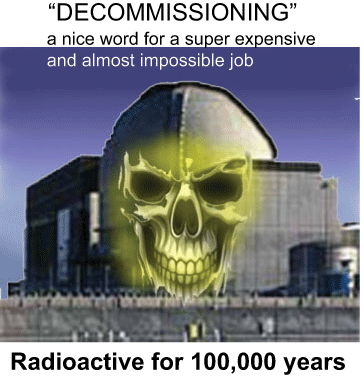
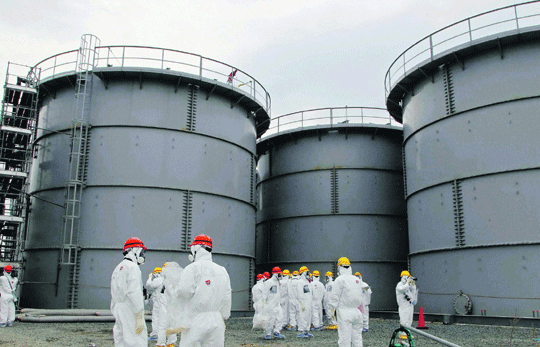
the inevitable discourse manipulation – something that we have seen in the media ever since this disaster occurred. “Decommission the plant” suggests some calm and ordered scientific process akin to shutting down and defueling an old reactor which has reached the end of its design life. It sparks images of a wise nuclear engineer in a lab coat consulting a document, discussing some issue with a worker in brilliant white overalls with a Tepco logo, wearing a white hard-hat. The reality is that this is a nightmare disaster area where no one has the slightest idea what to do and which has always been out of control. All that they can do is continue to pump in the seawater to hope that the various lumps of molten fuel will not increase their rate of fissioning. And pray.
Pump and pray: Tepco might have to pour water on Fukushima wreckage forever Science Alert, CHRISTOPHER BUSBY 19 AUGUST 2013 Fukushima is a nightmare disaster area, and no one has the slightest idea what to do. The game is to prevent the crippled nuclear plant from turning into an “open-air super reactor spectacular” which would result in a hazardous, melted catastrophe…..
it is quite clear that the reactors are no longer containing the molten fuel – some proportion of which is now in the ground underneath them. Both this material and the remaining material in what was the containment are very hot and are fissioning. Tepco is quite aware – and so is everyone else in the know – that the only hope of preventing what could become an open-air super reactor spectacular is to cool the fuel, the lumps of fuel distributed throughout the system, mainly in the holed pressure vessels, and also in the spent fuel tanks and in the ground under the reactors.
That all this is fissioning away merrily (though at a low level) is clear from the occasional reports of short half life nuclides like the radioXenons. The game is to prevent it all turning into the open air super reactor located somewhere under the ground. To do this, they have to pump vast amounts of water into the reactors, the fuel pond and generally all over the area where they think the stuff is or might be. This means seawater since luckily they are near the sea. But they are also unluckily near the sea – since you cannot pump the sea onto the land without it wanting to flow back into the sea.
Now a good proportion of the radioactive elements, the radionuclides, are soluble in water. Continue reading →
5 Companies That Make Money By Keeping Americans ScaredReader Supported News, By Alex Kane, Salon 19 August 13A massive industry profits off the government-induced fear of terrorism.
ichael Hayden, the former director of the National Security Agency, has invaded America’s televisionsets in recent weeks to warn about Edward Snowden’s leaks and the continuing terrorist threat to America.
But what often goes unmentioned, as the Guardian’s Glenn Greenwald pointed out, is that Hayden has a financial stake in keeping Americans scared and on a permanent war footing against Islamist militants. And the private firm he works for, called the Chertoff Group, is not the only one making money by scaring Americans.
Post-9/11 America has witnessed a boom in private firms dedicated to the hyped-up threat of terrorism. The drive to privatize America’s national security apparatus accelerated in the aftermath of the terrorist attacks, and it’s gotten to the point where 70 percent of the national intelligence budget is now spent on private contractors, as author Tim Shorrock reported. The private intelligence contractors have profited to the tune of at least $6 billion a year. In 2010, the Washington Post revealed that there are 1,931 private firms across the country dedicated to fighting terrorism.
What it all adds up to is a massive industry profiting off government-induced fear of terrorism, even though Americans are more likely to be killed by a car crash or their own furniture than a terror attack.
Here are five private companies cashing in on keeping you afraid.
1. The Chertoff Group…..
2. Booz Allen Hamilton……
3. Science Applications International Corp…..
4. Center for Counterintelligence and Security Studies….
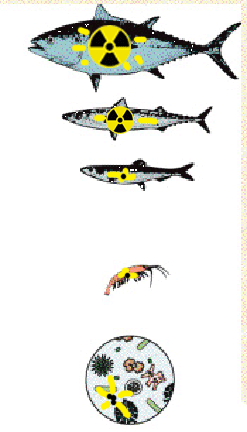
Arirang News,, Aug 19, 2013: Consumer concerns about the safety of Japanese fish imports into Korea since the Fukushima nuclear disaster look to be justified as authorities here say over 3-thousand tonnes of fish from Japan have been found to contain levels of radioactive cesium since 2011. Korea’s Ministry of Food and Drug Safety on Sunday said there were 131 different cases in which fish containing traces of cesium were detected since March 2011. […] Cases peaked in 2012, but the amount has dropped sharply this year.
The Korea Herald, Aug 18, 2013: Government slammed over monitoring of Japanese seafood […] Seafood contaminated by radiation leaks from the Fukushima nuclear plant has been found in the local market recently, adding to public fears […] However, the food ministry was found not to have carried out additional inspections nor tightened return procedures […] While most products had below 10 becquerels of radiocesium (134Cs and 137Cs) per kilogram, some products showed up to 98 becquerels ― just two becquerels less than the level considered unsafe. […] The government’s stance has sparked strong public backlash. [Tepco] has recently confirmed long-held suspicions that the sea had been contaminated […]
Watch the video below. – Robinson avoids the question for a long time. Now if you are short of time, the following link Watch Robinson discuss this matter on MSNBC here will cut to the chase, with Robinson’s views on radiation hormeisis and AIDS
(R-OR) Art Robinson Throws Hissy Fit On Rachel Maddow!!! – Pt.
Access to Energy Newsletter, April 1, 1997, April 1, 1997: All we need do with nuclear waste is dilute it to a low radiation level and sprinkle it over the ocean – or even over America after hor-mesis is better understood and verified with respect to more diseases.
Albany Democratic-Herald, , July 15, 2010: Robinson wrote in 1997, when radioactive groundwater was found beneath a decommissioned nuclear generating plant […] “It is unfortunate that this water under San Onofre is being wasted,” Robinson wrote then. “If we could use it to enhance our own drinking water here in Oregon where background radiation is low, it would hormetically enhance our resistance to degenerative diseases.” […] This week, in response, Robinson wrote that he would have liked to add radioactive isotopes to the foundation of his lab in rural Josephine County. “Had I been able to do this, the risk of cancer and other degenerative disease would have been lowered for those of us who work in this building.” Watch Robinson discuss this matter on MSNBC here
A lot happens in America every four minutes. During that short time period, 30 babies areborn, 4,080 McDonald’s Big Macs are consumed, and 48,000 tons of CO2 are emitted.
And as it turns out, the U.S. is now installing one solar photovoltaic (PV) system every four minutes as well. If market growth continues at its current pace, the American solar industry could be installing a system every minute and twenty seconds by 2016. That’s a dramatic difference from 2006, when installers were only putting up one system every 80 minutes. Shayle Kann, vice president of GTM Research, documents the accelerating speed of solar deployment in the chart below:
It may not quite match Big Mac sales yet, but solar is on an extraordinarily fast growth trajectory. According to figures from GTM Research, two-thirds of all distributed solar in the U.S. has been installed over the last 2 1/2 years. And by 2016, cumulative installations of distributed PV will double.
That means the U.S. will hit 1 million cumulative residential solar installations by then — making the market in 2016 ten times larger than it was in 2010. For more information on American solar trends, check out the U.S. Solar Market Insight Report from GTM Research and SEIA.
press coverage is important because it can influence not only “what people perceive and believe” but also “what politicians think they believe.”
This misleading coverage fuels policy uncertainty and doubt, reducing investment security and industry development. Disinformation hurts the industry and retards its—and our nation’s—progress. As Germany has shown, investing in renewables can grow economies and create jobs while cutting greenhouse gas emissions even in a climate as “sunny” as Seattle. We just have to get the facts right, and insist that our reporters and media tell us the truth, the whole truth, and nothing but the truth.
Debunking the Renewables “Disinformation Campaign”,Mother Earth News, Despite vast evidence supporting the advancement of renewable energy, various media outlets insist on denying its progress, blurring the lines between inefficient reporting and deliberate lying. By Rocky Mountain InstituteAugust 19, 2013 According to Fox Business reporter Shibani Joshi, renewables are successful in Germany and not in the U.S. because Germany has “got a lot more sun than we do.” Sure, California might get sun now and then, Joshi conceded during her now-infamous flub, “but here on the East Coast, it’s just not going to work.” (She recanted the next day while adding new errors.)
Actually, Germany gets only about as much annual sun as Seattle or Alaska; its sunniest region gets less sun than almost anywhere in the lower 48 states. This underscores an important point: solar power works and competes not only in the sunniest places, but in some pretty cloudy places, too.
A pervasive pattern
The Fox Business example is not a singular incident. Some mainstream media around the world have a tendency to publish misinformed or, worse, systematically and falsely negative stories about renewable energy. Continue reading →
Heat records tumble as Alaska bakes, burns SMH, August 19, 2013 Alaska residents have been enjoying an unusually warm, sunny summer, but the pleasant weather has come at a cost: choking smoke from an extended wildfire season, flooding rivers due to fast-melting snow and glacial ice, and fish covered in algae.
Wildfires have burned 1.25 million acres (500,000 hectares) across Alaska this summer, according to the state’s fire-management center, the Alaska Interagency Coordination Center. Seventy fires were active on Friday, including a 57,870-acre (23,400-hectare) blaze near Delta Junction, about 95 miles (153 km) southeast of Fairbanks.
The fire season usually winds down in late June or early July, but not this year, said Jim Schwarber, a spokesman for the centre……
Heat brings more problems than just wildfires, Thoman and other experts said. Hot and dry conditions are stunting spruce tree growth in interior Alaska, and adding to stress for nearly all species of trees in the northern forest, he said.













 nuclear-news