International Atomic Energy Agency (IAEA) moves from deception to self-deception
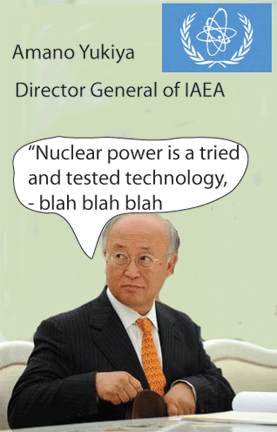 It is notable that Mr. Amano made comments that mostly reflect the responsibility of the IAEA to promote nuclear power, but not the responsibility to guarantee safety. Many regulatory bodies have been captured by the industries they are supposed to oversee, but the IAEA doesn’t even have to pretend that it operates at arm’s length from industry. It is the founding mission of the IAEA to promote nuclear power
We could ask what scenario, if any, would prompt the IAEA to give up promotion of nuclear energy and lead the world toward alternatives?
What about ……..the destruction of a spent fuel pool near a large metropolis?
you can bet that the director general of the IAEA, and every other representative of the nuclear industry, would be feeding the media with statements about how lessons have been learned and nuclear is still a feasible alternative to fossil fuels.
THE POST-FUKUSHIMA NUCLEAR INDUSTRY: A CASE STUDY IN INSTITUTIONAL SELF-DECEPTION , Fukushima Update, 14 August 13, by Dennis Riches / nf2045.blogspost.com / “…....when a man suspects any wrong, it sometimes happens that if he be already involved in the matter, he insensibly strives to cover up his suspicions even from himself…..”
At the recent International Atomic Energy Agency (IAEA) Ministerial Conference in St. Petersburg (June 2013), director general Yukiya Amano repeated the familiar platitudes about Fukushima that deflect and deny the heavy responsibility of the IAEA and the Japanese nuclear establishment for having failed to prevent the catastrophe – one that every anti-nuclear group in Japan had been warning about for years. In a report on the conference published by The Hindu, Mr. Amano refers to Fukushima as not a disaster, accident or catastrophe, but as a “tragedy,” a word that suggests it was caused by cruel gods rather than human failings. He went on to repeat the familiar trope about “lessons learned” and the effective steps taken to make nuclear power plants safer.
Such statements from the head of the global nuclear establishment are emblematic of what is argued below: in trying to sustain itself against mounting evidence that points to its unacceptable dangers and costs, the nuclear industry has resorted to deceit and self-deception. Psychological experiments have revealed that deceit is soon followed by self-deceit, all the better to make the deception more likely to succeed. This strategy may be an evolved mechanism of the brain, and it may succeed in the short term, in terms of the reproductive success of an organism, but it can come at a high cost to individuals and groups over the long term. The vicious circle of deceit and self-deceit reaches a point at which the inconsistencies become absurd to outsider observers.
It is notable that Mr. Amano made comments that mostly reflect the responsibility of the IAEA to promote nuclear power, but not the responsibility to guarantee safety. Many regulatory bodies have been captured by the industries they are supposed to oversee, but the IAEA doesn’t even have to pretend that it operates at arm’s length from industry. It is the founding mission of the IAEA to promote nuclear power, in addition to advancing safety. It is as if the U.S. Environmental Protection Agency could be proud of promoting British Petroleum and Union Carbide, or as if the Federal Aviation Administration spent much of its budget on convincing the public to use airplanes instead of trains and cars.
At the conference in St. Petersburg, Mr. Amano touted the fact that, unlike in the aftermath of the Chernobyl accident when nuclear expansion stopped, many countries are building their first nuclear power plants, in spite of the Fukushima “tragedy.” He even suggested “growth could be much higher,” and he claimed “nuclear power actually has a very good safety record” and is a “tried and tested technology.”…..
This simple, easily digested message intended for mass consumption (not for the audience in the room) actually reveals much about the psychology of nuclear promotion. We could ask what scenario, if any, would prompt the IAEA to give up promotion of nuclear energy and lead the world toward alternatives. Before 2011, we might have thought that the answer was a triple meltdown and the barely averted evacuation of Tokyo. The 50-year, trillion-dollar cleanup (estimates vary wildly, but they have been in the hundreds of billions so far) should have been the final nail in the coffin. It was the nightmare scenario that we were promised could never happen.
What about something worse, but still of a higher probability than we would like to admit, such as the destruction of a spent fuel pool near a large metropolis? That event would require the evacuation of millions of people, if the authorities were brave enough to admit the necessity. Based on what happened during the Fukushima catastrophe, we can conclude that it’s more likely the authorities would decide that the future cancer cases were preferable to the economic damage and the deaths caused by a panicked evacuation. The truth of the situation would be revealed in stages in the hope that the depopulation of the city could be done over several months. Nonetheless, you can bet that the director general of the IAEA, and every other representative of the nuclear industry, would be feeding the media with statements about how lessons have been learned and nuclear is still a feasible alternative to fossil fuels. The cup is always half full, regardless of what happens. http://fukushimaupdate.com/the-post-fukushima-nuclear-industry-a-case-study-in-institutional-self-deception/
No comments yet.
1 This Month

of the week – Shut Down Drone Warfare!


Tell the Ukrainian Government to Drop Prosecution of Peace Activist Yurii Sheliazhenko

Petition to revoke the licensing of the Near Surface Nuclear Disposal Facility (NSDF) at Chalk River. https://www.ourcommons.ca/petitions/en/Petition/Details?Petition=e-7247
To see nuclear-related stories in greater depth and intensity – go to https://nuclearinformation.wordpress.com
-
Archives
- March 2026 (230)
- February 2026 (268)
- January 2026 (308)
- December 2025 (358)
- November 2025 (359)
- October 2025 (376)
- September 2025 (257)
- August 2025 (319)
- July 2025 (230)
- June 2025 (348)
- May 2025 (261)
- April 2025 (305)
-
Categories
- 1
- 1 NUCLEAR ISSUES
- business and costs
- climate change
- culture and arts
- ENERGY
- environment
- health
- history
- indigenous issues
- Legal
- marketing of nuclear
- media
- opposition to nuclear
- PERSONAL STORIES
- politics
- politics international
- Religion and ethics
- safety
- secrets,lies and civil liberties
- spinbuster
- technology
- Uranium
- wastes
- weapons and war
- Women
- 2 WORLD
- ACTION
- AFRICA
- Atrocities
- AUSTRALIA
- Christina's notes
- Christina's themes
- culture and arts
- Events
- Fuk 2022
- Fuk 2023
- Fukushima 2017
- Fukushima 2018
- fukushima 2019
- Fukushima 2020
- Fukushima 2021
- general
- global warming
- Humour (God we need it)
- Nuclear
- RARE EARTHS
- Reference
- resources – print
- Resources -audiovicual
- Weekly Newsletter
- World
- World Nuclear
- YouTube
-
RSS
Entries RSS
Comments RSS
 nuclear-news
Leave a comment