Sequel to ‘On Fukushima Beach‘: The Lights of Fukushima
Please rate, comment, share and subscribe. Any donations to Ebisu Studios will be gratefully accepted at facebook page “On Fukushima Beach” (ebisu73 at gmail dot com)Remixable version coming soon. Thanks all for your patience. Upload took a long time 😛
UK’s nuclear weapons being dismantled under disarmament obligations
Rob Edwards
The Guardian
August 11, 2013
Quietly, slowly and without any fuss, Britain is dismantling its nuclear weapons. Three Trident warheads a year are being moved from the Clyde to the home counties to be taken to pieces, according to evidence seen by the Guardian.
The Ministry of Defence (MoD) has revealed that it is overseeing a programme “to disassemble Trident warheads” at Burghfield in Berkshire, in a way that will prevent them from being put back together. This fulfils a government promise to cut the number of the nation’s nuclear weapons from 225 to 180 by the mid 2020s.
Ministers announced in June 2011 that Britain’s stockpile of nuclear weapons was being reduced by 45 to “no more than 180” over about 15 years to comply with international disarmament obligations. Until now it’s not been clear what was happening to the warheads, with critics suspicious that they could just be disarmed and stored ready to be rearmed if necessary.
But in response to a freedom of information request the MoD has made clear that the weapons are being dismantled at Burghfield. There is a secretive and heavily fortified weapons disassembly plant on the site operated for the MoD by a private consortium, the Atomic Weapons Establishment (AWE).
She added: “The main components from warheads disassembled as part of the stockpile reduction programme have been processed in various ways according to their composition and in such a way that prevents the warhead from being reassembled.”
According to Ford, warheads “yet to be disassembled” are stored at Coulport or as “work in progress” at Burghfield. “A number of warheads identified in the programme for reduction have been modified to render them unusable whilst others identified as no longer being required for service are currently stored and have not yet been disabled or modified,” she stated.
As well as reducing the overall stockpile from 225 to 180, defence ministers have said that the number of “operational” warheads will drop from “fewer than 160” to “no more than 120”. As a result fewer Trident missiles and warheads are being carried by Britain’s four nuclear-powered Vanguard-class submarines, based near Coulport at the Faslane naval base on Gareloch.
The warheads are regularly transported by road between Coulport and Burghfield in heavily guarded convoys. They are observed by activists from Nukewatch, which publishes annual reports charting the movements.
Its report for 2012, due out this week, will suggest that a minimum of three warheads were kept at Burghfield, while at least two others were returned to Coulport after refurbishment. A similar pattern was observed in 2011.
The MoD has not disclosed how much it is currently spending on decommissioning nuclear weapons. But in a parliamentary answer in 2006, it put the cost of dismantling all Trident warheads at £146.4m.
A sophisticated system aimed at protecting the UK from nuclear terrorism has not been activated because the Government is yet to sign a contract, Labour is to claim.
The scanners, designed to detect nuclear fissile material, have not been switched on, shadow immigration minister Chris Bryant will allege in a speech attacking the Government’s efforts to secure the borders and tackle immigration.
He will warn that the failure to turn on the Cyclamen system is a “disaster waiting to happen” and the result of “chaos” in the way that measures to protect the borders have been procured by Theresa May and the Home Office.
“This is what guarantees protection from nuclear fissile material at our ports,” he will say. “The kit is in place. The portals have been built. But they are not switched on because the Government still hasn’t signed the contract. This is a disaster waiting to happen.”
The annual report on the Government’s Contest counter-terror strategy published in March said: “We have completed the major programme for the installation of equipment to detect and deter the illicit importation of radiological and nuclear material (known as Cyclamen).
“Fixed installations are supported by mobile radiation detection units that can be deployed to any location nationally and in support of police operations. We will continue to invest in maintaining and developing this capability to keep abreast of changes at the border and improvements in technology.”
Elements of the Cyclamen system were deployed at the Olympics and an agreement was signed last year with France to install it at the Channel Tunnel terminal in Coquelles.
In a wide-ranging speech the Labour frontbencher will accuse ministers of using “gimmicks” such as the van encouraging illegal immigrants to go home, and propose new powers to tackle an “epidemic” of sham marriages. Mr Bryant will say that the way marriage law interacts with immigration is “not fit for purpose” and will propose the Home Office be given greater information and powers to investigate suspicious.
In the speech in Westminster Mr Bryant will say: “Registrars have told me that they are facing an ‘epidemic’ of sham marriages. Why? Partly because when you close down one route it is likely that people will use another. But also because the way marriage law interacts with immigration is simply not fit for purpose. Understandably, registrars do not see themselves as immigration officers. They see their job as facilitating marriage.”
Mr Bryant said the Home Office should have real-time online notification of all notices of marriage where one or both people are under immigration control and for the notice period to be extended from 15 days to 20 or 25. Under his plan, if the Home Office detects any anomalies the period can be extended to 60 or 90 days, during which officials can do full and proper investigations and “if the marriage does prove to be sham the person under the immigration control would be removed”.
http://www.free-scores.com/Download-P… “Flower of Japan” – Piano Instrumental (composed by French romantic composer Sylvain Guinet) This piece was written for the Japanese people and all of those who had been affected by the Great East Japan Earthquake. We sincerely appreciate Mr.Guinet’s thoughtfulness. Thank you so much for listening!!
Police said they are searching for two British journalists of The Times of London, one visiting for the July 31 elections, over the uranium report.
Published August 11, 2013
Associated Press
HARARE, Zimbabwe – Zimbabwe’s state radio says the country’s ministry of mines controlled by longtime ruler President Robert Mugabe has not struck a deal to sell uranium to Iran for its nuclear program.
The radio said Sunday that mining ministry dismissed reports in the British media that the two countries have signed an agreement on uranium exports as “a malicious and blatant lie.”
The mining ministry statement said Zimbabwe’s uranium deposits have not been exploited and “we have never issued any license to any Iranian company.”
Police said they are searching for two British journalists of The Times of London, one visiting for the July 31 elections, over the uranium report.
It is a criminal offense with a penalty of imprisonment or a fine for “publishing falsehoods” under Zimbabwe’s sweeping media laws.
Press “control” and “+” or “-” to make Feinsteins head fit the centaurs body.. (should work in most browsers 🙂 )
California Senator Dianne Feinstein has proposed an amendment to the Media Shield Law – an irrelevant law ignoring protection already afforded by the First Amendment – that would limit the law’s protection only to “real reporters,” not bloggers and other upstart alternative media types.
A real reporter, declared Madame Feinstein during a Senate Judiciary Committee hearing, is “a salaried agent” of a media company like the New York Times or ABC News, not a shoestring operation with volunteers and writers who are not paid.
Feinstein voiced her concern “that the current version of the bill would grant a special privilege to people who aren’t really reporters at all, who have no professional qualifications,” like bloggers and citizen journalists.
Last week, Senator Charles Schumer, a New York Democrat, worried the Shield Law, if passed, would be used to protect whistleblowers and others who ferret out government corruption.
“The world has changed. We’re very careful in this bill to distinguish journalists from those who shouldn’t be protected, WikiLeaks and all those, and we’ve ensured that,” Schumer said. “But there are people who write and do real journalism, in different ways than we’re used to. They should not be excluded from this bill.”
The bill moving through Congress would require the Justice Department to notify reporters it decides to monitor. The law would allow Justice Department officials to delay notice for a period of 45 days. In addition, it would permit the DOJ to ask for an extension of 45 days.
In May, it was learned that the Justice Department had illegally seized the phone records of Associated Press journalists over a two month period. Obama’s Justice Department did not provide notice or a court-issued warrant prior to violating the confidentiality of the journalists.
In response to criticism of the illegal surveillance of journalists, Justice Department boss Eric Holder presented rule changes to the White House in July. The changes will require that journalists involved in “ordinary news-gathering activities” cannot be served with a warrant connected to their own investigative work unless the journalist in question is the subject of a criminal investigation.
ST. PETERSBURG – A comprehensive report summing up the results of a recent radiation and environmental survey in the territory surrounding Russia’s infamous nuclear reprocessing plant Mayak in Chelyabinsk Region reveals serious gaps in the area’s radiation monitoring of past years – blank spots that must be filled for a full picture of radioactive contamination in an area that has been dubbed the world’s dirtiest radioactive “hot spot.”
Last spring, an eleven-strong environmental survey expedition traveled to the area around Mayak, the USSR’s first enterprise for industrial production of weapons-grade fissile materials, uranium-235 and plutonium-239, and the birthplace of the Soviet atomic bomb. The group, comprising environmental activists and experts in natural science and technology history, nuclear industry, and radiation control, surveyed the floodplains of the Techa-Iset and Sinara-Karabolka-Iset river systems and the territories of the villages of Muslyumovo, Novomuslyumovo, Russkaya Techa, and other settlements that have been exposed to radioactive contamination as a result of Mayak’s operations and following the so-called Kyshtym disaster of 1957.
A report (in English, downloadable above) has now been published, detailing the results of the expedition and concluding with a set of recommendations on ways to mitigate the harmful effects of the consequences of Mayak’s activities on public health and the area’s environment.
The document – entitled “Report on the results of radiation monitoring of rivers and lakes in the area of impact of Production Association Mayak” – compares the latest data with that obtained in previous years, showing a picture of how levels of radioactive contamination have been changing over the years in the areas surrounding Mayak.
The eleven members of the expedition included experts from the S.I. Vavilov Institute for the History of Science and Technology of the Russian Academy of Sciences, the radiation control laboratory of the state enterprise Center for Industrial Safety of the Fuel and Energy Complex, and a St. Petersburg-based testing laboratory. These were responsible for measuring and analyzing the levels of radioactive contamination of some of the Techa floodplains.
An expert with Environmental Rights Center (ERC) Bellona, Bellona’s St. Petersburg branch, and a representative of Greenpeace Russia took part in the expedition as independent observers. ERC Bellona was represented by the nuclear projects expert Alexei Shchukin.
Altogether during the expedition, 1089 measurements were made of the dose equivalent of external gamma radiation, and 815 measurements of the beta particle emission rate. Experts also took 122 river and lake silt, water, and soil samples.
A worker near water tanks at the Fukushima Daiichi plant in Japan.
A pool photo taken during a visit of journalists to the Fukushima Daiichi plant.
Japanese officials yesterday escalated their alarm, saying that radioactive water from the crippled Fukushima Daiichi plant was not only poised to leak – but was already spilling into – the ocean, in yet another public relations blunder for the plant’s owner, Tokyo Electric Power Co., or Tepco, various government sources told Bellona.
When they finally came clean yesterday to government officials that the leak rate was some 300 tons a day of highly contaminated radioactive water, and that they didn’t have any real idea as to how long such emissions had been taking place, the government of Prime Minister Shinzo Abe announced it would be stepping in to assist the beleaguered utility staunch the flow.
The revelation of the quantity of water escaping the inundated plant amounted to an acknowledgment by Tepco that it hardly has the situation at Fukushima Daiichi – more than two years after it was hit by a triple meltdown caused by a huge earthquake and tsunami – anywhere close to under control.
Indeed, it was only recently that Tepco had admitted that it was having leakage problems with its underground water barriers at all.
The buildup of water, according to various media reports and interviews to Bellona seem to be leading in the direction of further dumps by Tepco of irradiated water into the ocean, some two years after Japan and the world though that would no longer be necessary.
Prime Minister puts government’s neck on the chopping block
Calling water containment at the hobbled nuclear station an “urgent issue,” Abe, the popular, yet pro-nuclear, head of state, ordered the government for the first time to get involved to help struggling Tepco handle the crisis.
According to estimates by Reuters and government officials who emailed Bellona, the leak from the plant 220 km northeast of Tokyo is enough to fill an Olympic swimming pool in a week.
The water is spilling into the Pacific Ocean, though it was not immediately clear how much of a threat it poses.
Local fishermen and independent experts had at that point already suspected that massive leaks of highly irradiated water from the plant were ongoing, but Tepco had denied the claim.
Water problems an old woe
This rockfish, caught at a port inside the devastated Fukushima Daiichi nuclear power plant in January by Tepco, measured 240,000 Becquerel of cesium – 2,540 times Japan’s legal limit for seafood.
TEPCO
i
Overflows of water and dumping highly irradiated amounts of it a into the ocean became a problem early in the Fukushima crisis.
The 11-meter tsunami that hit the plant knocked out all back up cooling systems, necessitating that thousands of tons of sea water be fired from water cannons and dumped from helicopters as three of the plant’s six reactors were melting down and spent nuclear fuel storage ponds were heating up.
Very likely some of Fukushima’s melted cores have moved into the earth — “It’s beyond containment right now”
Paul Gunter director of the reactor oversight project at Beyond Nuclear: Indications are right now that the reactor structures themselves have been breached.
It’s very likely that some of the radioactive material — the melted cores — have moved into the earth.
So it’s beyond containment right now.
I think that’s the tragedy that we see unfolding as Fukushima’s radioactive water crisis is only beginning. http://tinyurl.com/l4ygapr
IAEA Expert Mission to Japan: Further Cooperation in Radiation Monitoring and Remediation at Fukushima
26 July 2013
“…The IAEA’s support as part of this arrangement will continue over three years. The remediation efforts in the Fukushima Prefecture aim to prevent the radioactive contaminants’ movement into waterways, the food chain or air, thus reducing or preventing human exposure to radiation now and in the future….”
“…The Agency’s continued assistance to Japan was also part of the May 2013 IAEA Response and Assistance Network (RANET) Workshop in the Fukushima Prefecture to strengthen the Agency’s emergency response network. During this workshop 40 experts from 18 countries participated in taking measurements of radionuclides in the evacuated areas….” (No details available on actual measurement figures or methods of sampling)
Al Jazeera’s Rob McBride reports from Ikawi, Japan.
Japanese media have reported that prosecutors are unlikely to indict the operators of the Fukushima nuclear plant more than two years after it was crippled by a tsunami.
There is still a 20km exclusion zone around the plant and it is still leaking radioactive material at significant levels.
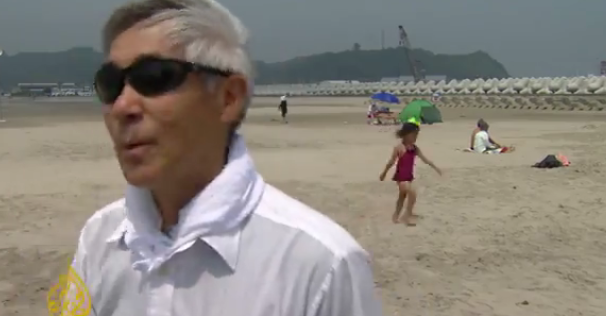
However, some Japanese are defying the threat by visiting nearby beaches in the city of Iwaki over the summer holidays.
Al Jazeera’s Rob McBride reports from Ikawi, Japan.
...”People ask when will it be safe, and we can’t answer that,” says Buesseler. “The only thing you can do is stop the source, and that’s a huge engineering challenge.”…
Last month the plant’s owner, Tepco, finally admitted what many had suspected – that the plant was leaking. Now Japan’s Nuclear Regulatory Authority is calling it an emergency. It says Tepco’s plans to stop the leak are unlikely to work.
The problem is that groundwater is entering the damaged reactor buildings, picking up radioactive elements and seeping out to sea. Tepco has spent months pumping the water to the surface and storing it in tanks, and sinking wells to lower the water table. Now it is building a series of underground walls to act as a dam. But this is probably too late: the rising water will soon swamp them.
“We’ve known for some time the reactors are still leaking,” says Ken Buesseler of the Woods Hole Oceanographic Institution in Massachusetts. The biggest leaks happened soon after the tsunami. The ongoing leaks are thousands of times smaller, but still detectable.
The radioactive elements disperse once in the ocean, so there is no threat to the Pacific at large, says Simon Boxall of the National Oceanography Centre in Southampton, UK.
But Japan has set a strict limit on levels of caesium in seafood, so the leaks will only extend the ban on locally caught fish and seafood being sold, depriving communities of their livelihoods.
This article appeared in print under the headline “Fukushima still leaking”
This facility will require a steady supply of electricity in vast amounts because in an extended power failure, the soil would thaw, Tepco officials revealed.
Tokyo, Aug. 10 (ANI): Tokyo Electric Power Co. (Tepco) has started pumping out toxic groundwater from one of the three contaminated areas near the Fukushima No. 1 nuclear plant in a bid to slow down the massive outflow of radioactive substances into the Pacific Ocean.
However, the entire process of clearing the ocean of highly contaminated water will take at least two years, the Japan Times reports.
About 1,000 tons of groundwater flows from the mountainside into the reactor compound each day, including 300 tons released to the sea after being contaminated with radioactive materials, like strontium and tritium, from the damaged plant, the report added.
Tepco has started digging a pit near the coast between Reactors 1 and 2, which is believed to be getting about 100 tons of contaminated groundwater every day.
However, it will take several months for the company to start pumping 200 tons per day of tainted water from two other contaminated areas near the coast.
The government alongwith Tepco, after a series of meetings, have decided to use taxpayer’s money for creating a barrier of frozen soil around reactors 1 to 4, by sinking a vast network of coolant pipes.
This facility will require a steady supply of electricity in vast amounts because in an extended power failure, the soil would thaw, Tepco officials revealed.
The government officials said that the concerned action has been delayed since it was revealed, as early as in June, that radioactive water was found in the samples taken from a monitoring well near the coast within the plant compound.
The water leakage crisis is likely to raise further concerns about local seafood and could severely harm Japan’s credibility, if both Tepco and the government fail to solve the problem. (ANI)
….Tokyo apparently refused to sign the document because of its security arrangement with the United States, which could include an option to deploy nuclear weapons from Japan to counter the threat of North Korea….
Mari Yamaguchi,
Associated Press Posted:
Saturday, August 10, 2013, 1:07 AM
TOKYO – Nagasaki’s mayor criticized Japan’s government Friday for failing to back an international nuclear-disarmament effort as the country marked the 68th anniversary of the atomic bombing of his city.
Mayor Tomihisa Taue said Japan’s inaction “betrayed expectations of the global community.” Japan refused in April to sign an unconditional pledge by nearly 80 countries to never use nuclear weapons. The document, prepared by a U.N. committee, is largely symbolic, because none of the signatories possesses nuclear weapons.
Countries with nuclear arsenals that have not signed it include the United States, Russia, India, and Pakistan. Japan does not have nuclear weapons and has pledged not to produce any, although some hawkish members of the ruling party say the country should consider a nuclear option.
Taue said the refusal by Japan, as the world’s only victim of atomic bombings, to join the initiative contradicted its nonnuclear pledge. “I call on the government of Japan to return to the origin of our pledge as an atomic-bombed country,” he said at the peace park near the epicenter of the 1945 blast.
Tokyo apparently refused to sign the document because of its security arrangement with the United States, which could include an option to deploy nuclear weapons from Japan to counter the threat of North Korea. About 6,000 people, including U.S. Ambassador John Roos, attended Friday’s ceremony after offering silent prayers for the victims of the U.S. atomic bombings – on Nagasaki on Aug. 9, 1945, and on Hiroshima three days earlier. http://www.philly.com/philly/news/nation_world/20130810_Nuclear_rebuke_as_Nagasaki_marks_68th_year.html
Tomihisa Taue, Mayor of Nagasaki, addressing the NPT delegates to the 2010 Review Conference of the NPT at the UN
Sharing monitoring information with test-ban agency expected to add to pressure on North Korea over controversial weapons programme
China has agreed to share data from its monitoring stations that watch for signs of atomic tests – including seismic waves and radioactive traces – with the global agency that oversees the nuclear test ban treaty.
The move could help dissuade North Korea from carrying out more nuclear tests, a researcher at the China Arms Control and Disarmament Association said.
The decision was announced by the Comprehensive Nuclear-Test-Ban Treaty Organisation in Vienna on Wednesday.
The organisation said its executive secretary, Lassina Zerbo, met Zhang Yulin, a deputy minister of defence, last week.
Zhang pledged the country’s full support and commitment in co-operating with it.
RWE npower has sold off two UK sites that the company had originally earmarked for potential nuclear new-build in Cumbria.
The two sites, Kirksanton and Braystones, were not included in the UK government’s 2011 national policy statement for nuclear, which set out details of eight sites in England and Wales appropriate for the siting of new nuclear plants.
RWE npower said today that it had chosen not to challenge the policy statement and began looking…
Read more at













 nuclear-news