The Untold Story of Pilgrim’s Nuclear Thermal Pollution – Death Plume!
by Karen Vale on July 28, 2013
http://www.capecodbaywatch.org/2013/07/a-journey-into-the-death-plume-the-untold-story-of-pilgrims-thermal-pollution/
Adam Augello, CCBW’s intern, writes about the effects of thermal pollution and the cooling system on the ecosystem – primarily fish – in Cape Cod Bay.
Pilgrim Nuclear Power Station is located in one of the most important habitats in the world. Coastal zones, such as those located around Cape Cod Bay, have some of the highest levels of biological productivity in the world, and now produce about 10% of the world’s fish harvest[i].
It is within this context that Pilgrim currently runs its operation, and in its 40 year history has developed an “interesting” relationship with the bay. In order to cool its reactor at the same time as it generates steam for electricity, Pilgrim takes in up to 510 million gallons of water a day from Cape Cod Bay. The cooling water, in the process of passing through the reactor, is heated up before being returning to the bay[ii]. Because of Pilgrim’s day-to-day operations, a thermal plume of about 5 square miles (which may be smaller or larger at times depending upon tidal and wind conditions) containing water at least 2⁰F hotter than the ambient waters, has developed in Cape Cod Bay[iii].
Temperature changes of as little as 2⁰F will trigger responses in marine organisms of either avoidance or attraction[iv]. This stratification of the food web poses a significant problem in itself. However, often times the presence of food will override thermal preferences and cause fish that would normally avoid a thermal plume to venture into waters that could be lethal[v]. Once inside a thermal plume for a short period of time, it becomes very difficult for the fish to leave because their bodies become acclimated to the warmer temperature, which depletes their energy level and swimming endurance[vi]. Then when the power plant suddenly goes offline for maintenance, which happened six times from 2011 to January 2013, virtually all trapped adult fish as well as free-floating eggs, larvae, and juveniles who happen to be passing through the plume can be killed from cold shock[vii].
Often times the plume attracts fish towards the intake canal, causing the smaller fish, if they are not impinged on the power plant’s intake screens, to get sucked into the pipes of the plant where many are scalded, pulverized and then spewed back out into the bay as lifeless sediment[viii]. It is in this way that the waters around Pilgrim act as a sort of biological sink, beguiling marine organisms across Cape Cod Bay to their deaths along our shores.
Many of these fish stocks are in decline, and accordingly the commercial fishing industry is highly regulated in terms of quantities of catch to protect these species[ix]. Why then is Pilgrim allowed to kill these species en mass in its day-to-day operations? When you take into account the rippling effect the destruction of zooplankton and fish stocks has on the ecosystem of Cape Cod Bay, Pilgrim’s actions reach far beyond the ill-defined boundaries of the thermal plume.
There is also concern that the development and survival of fish eggs and larvae, as well as the spawning success and migration patterns of the adult fish, may be affected by the increase in temperature[x].
The answers to these and many other concerns remain unclear, since Entergy hasn’t bothered to conduct any updated studies to find out the impacts of their continual thermal pollution of the bay, and no one, including the EPA, is making them.
It is with these considerations in mind that the impact of Pilgrim’s thermal discharge could be more than of “small significance” as the NRC determined in its renewal of Pilgrim’s operating license in 2012[xi]. That determination was based upon flawed, insufficient, and antiquated data which was collected mostly in the 1970s, and which couldn’t account for new variables such as climate change and declining fish stocks. Therefore, Cape Cod Bay Watch is advocating for Entergy to spend some money to update its cooling system so that our bay can stop being used as a dumping ground, and instead fully realize its ecological potential.
[i] J.W. Maurits la Riviere, “Threats to the World’s Water,” Readings from Scientific American: Managing Planet Earth (1990): 44
[ii] Pilgrim Station Unit 2 Zoning Permit Application and Supplementary Data
[iii] Entergy’s 2000 316 Demonstration Report- Thermal Impact Assessment (Section 5)
[iv] Michael J. Kennish, “Pollution in Estuaries and Coastal Marine Waters,” Journal of Coastal Research Special Issue No. 12: Coastal Hazards (1994): 27-49
[v] John Janssen and John P. Giesy, “A Thermal Effluent as a Sporadic Cornucopia: Effects on Fish and Zooplankton,” Environmental Biology of Fishes Volume 11 No. 3 (1984): 191-203
[vi]Charles H. Hocutt, Jay R. Stauffer, Jr., John E. Edinger, Lenwood W. Hall, Jr., and Raymond P. Morgan II, eds., Power Plants: Effects on Fish and Shellfish Behavior (Elsevier, Jan 1, 1980); Entrainment, Impingement, and Thermal Impacts at Indian Point Nuclear Power Station, Pisces Conservation Ltd. (2007)
[vii]Cape Cod Times 01/23/2013; Michael J. Kennish, “Pollution in Estuaries and Coastal Marine Waters,” Journal of Coastal Research Special Issue No. 12: Coastal Hazards (1994): 27-49
[viii] Linda Gunter, Paul Gunter, Scot Cullen, and Nancy Burton, Licensed to Kill: How the Nuclear Power Industry Destroys Endangered Marine Wildlife and Ocean Habitat to Save Money (2001)
[ix] Chemistry Dept.-Environmental Group: Entergy Nuclear-Pilgrim Station, Marine Ecology Studies Jan.-Dec. 2007 Pilgrim Nuclear Power Station Report No. 71, (October 15, 2008); Linda Gunter, Paul Gunter, Scot Cullen, and Nancy Burton, Licensed to Kill: How the Nuclear Power Industry Destroys Endangered Marine Wildlife and Ocean Habitat to Save Money (2001)
[x] CMZ Review of Entergy’s 2000 316 Demonstration Report
[xi] Generic Impact Statement for License Renewal of Nuclear Plants: Regarding PNPS- Final Report, Main Report (NUREG-1437, Supplement 29, Volume 2)
2 Comments »
Leave a reply to Schuyler Gould Cancel reply
1 This Month
26 April – Chernobyl: Inside the Meltdown airs on National Geographic on Sunday 26th April from 4pm

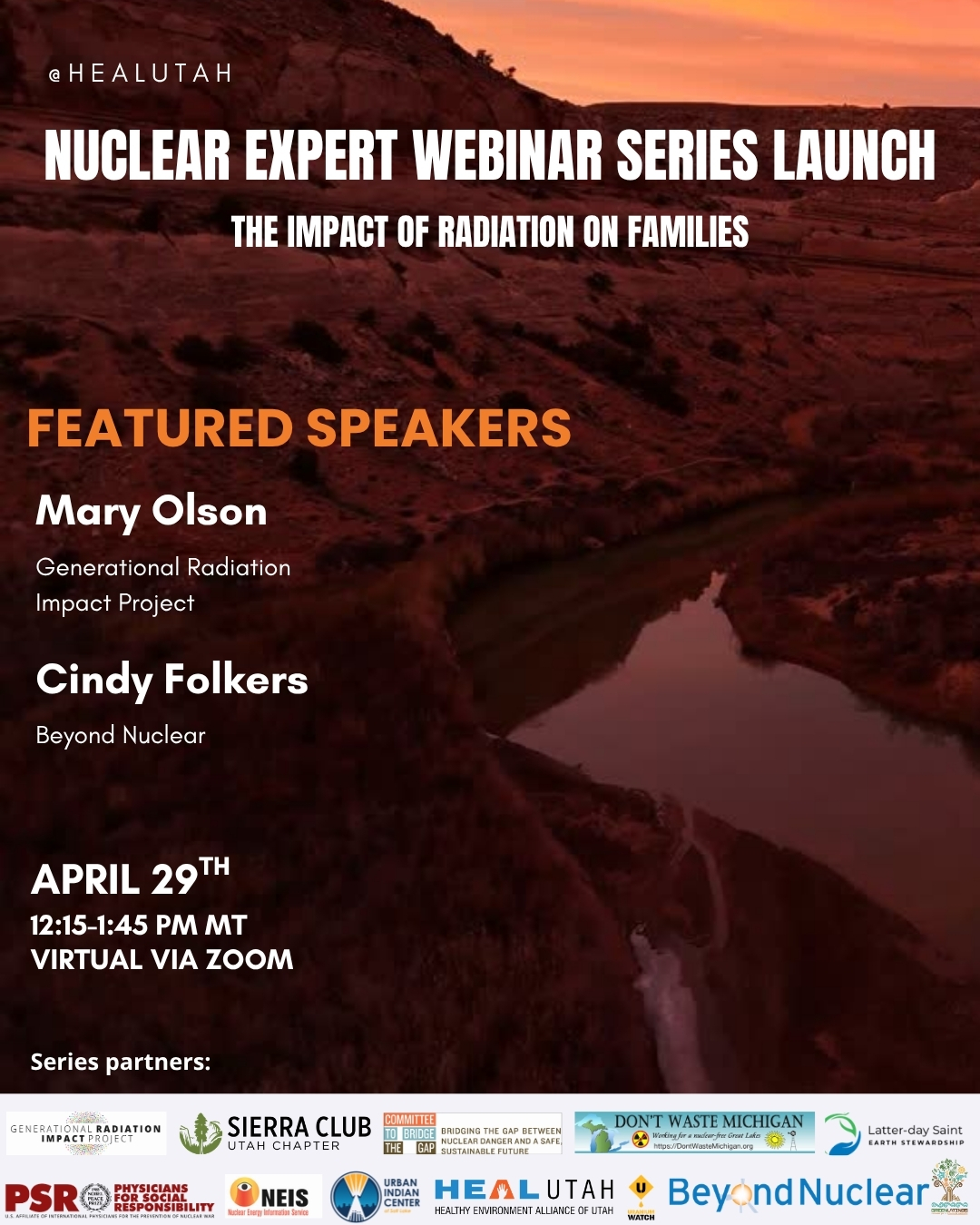
29 April – Nuclear Expert Webinar #1 – Radiation Impacts on Families with Mary Olson and Cindy Folkers
- 12:15 PM MT – 1:45 PM MT
- Location: Virtual – REGISTER TODAY

4 May -West Suburban Peace Coalition to discuss Iran war at May Educational Forum
Monday, May 4, 7:00 – 8:00 PM Central Standard Time
Title: : How Trump’s Narrative Tries to Shape the Reality of the War on Iran.
Contact Walt Zlotow, zlotow@hotmail.com 630 442 3045 for further information
14 May – online event From Bombs to Data Centres: the Face of Nuclear Colonialism


Pine Ridge Uranium is the real threat, not Tehran- Tell Burgum: Stop the Extraction.
Chernobyl: The Lost Tapes – A good documentary on Chernobyl on SBS available On Demand for the next 3 weeks– https://www.sbs.com.au/ondemand/tv-program/chernobyl-the-lost-tapes/2352741955560
To see nuclear-related stories in greater depth and intensity – go to https://nuclearinformation.wordpress.com
-
Archives
- April 2026 (338)
- March 2026 (251)
- February 2026 (268)
- January 2026 (308)
- December 2025 (358)
- November 2025 (359)
- October 2025 (376)
- September 2025 (257)
- August 2025 (319)
- July 2025 (230)
- June 2025 (348)
- May 2025 (261)
-
Categories
- 1
- 1 NUCLEAR ISSUES
- business and costs
- climate change
- culture and arts
- ENERGY
- environment
- health
- history
- indigenous issues
- Legal
- marketing of nuclear
- media
- opposition to nuclear
- PERSONAL STORIES
- politics
- politics international
- Religion and ethics
- safety
- secrets,lies and civil liberties
- spinbuster
- technology
- Uranium
- wastes
- weapons and war
- Women
- 2 WORLD
- ACTION
- AFRICA
- Atrocities
- AUSTRALIA
- Christina's notes
- Christina's themes
- culture and arts
- Events
- Fuk 2022
- Fuk 2023
- Fukushima 2017
- Fukushima 2018
- fukushima 2019
- Fukushima 2020
- Fukushima 2021
- general
- global warming
- Humour (God we need it)
- Nuclear
- RARE EARTHS
- Reference
- resources – print
- Resources -audiovicual
- Weekly Newsletter
- World
- World Nuclear
- YouTube
-
RSS
Entries RSS
Comments RSS
 nuclear-news
Cape Cod Bay is on the north shore of Cape Cod. I’m all for closing down Pilgrim yesterday, but this sea surface temperature map does not indicate a visibly significant change in temperature around the Pilgrim plant in Plymouth, MA. The suggestion by the pairing of this map with the statistics given around Pilgrim’s heating of the bay is that it is causing the overheating of the ocean on the south shore of Cape Cod in the neighborhood of Falmouth. State the facts, they speak for themselves, but don’t deceive, it only distracts from the truth.
true on closer inspection i see what you mean.. i will remove the picture.. many thanks for spotting it..