Fukushma Nuclear Reactor 4: constant danger from fuel pool
By Harvey Wasserman 25 July 13 Radiation leaks, steam releases, disease and death continue to spew from Fukushima and a disaster which is far from over. Its most profound threat to the global ecology—a spent fuel fire—is still very much with us. ………
the worst fear of all remains unabated. At Unit Four, which apparently did not actually explode, the building’s structural integrity has been seriously undermined. Debate continues to rage over exactly how this happened.
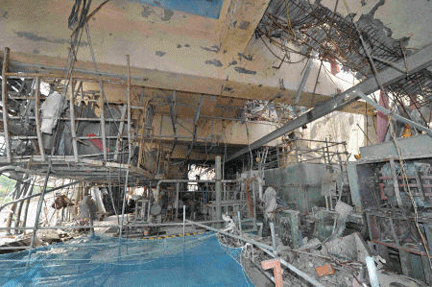
In such an event, the radioactive emissions could be catastrophic. Intensely lethal emissions could spew for a very long time, eventually circling the globe many times, wrecking untold havoc.
The Japanese have removed two apparently unused rods from the fuel pool so far. But intense international pressure to clear out the rest of them has thus far been unsuccessful.
So while a depleted, discredited and disorganized nuclear utility moves to restart its other reactors, its stricken units at Fukushima continue to hold the rest of us at the brink of apocalyptic terror.
Devastating effect of methane, as Arctic permafrost thaws
 Release of methane gas from Arctic permafrost could devastate global economy: study http://www.abc.net.au/news/2013-07-25/arctic-methane-could-devastate-economy3a-study/4842994 By David Mack and Stuart Gray
European scientists say the release of large amounts of methane gas from thawing Arctic permafrost could devastate the global economy.
Permafrost, or soil below the freezing point, has been thawing under rising global temperatures for many years.
The thawing is releasing the powerful greenhouse gas methane, which is concentrated in the Arctic tundra and is also found as semi-solid gas hydrates in the sea. A study in the science journal Nature says the release of 50-gigatonnes of methane over a decade will result in flooding, sea-level rise, agriculture damage and health impacts amounting to $60 trillion – which was roughly the size of the entire global economy last year.
The researchers say the impacts will be particularly devastating in developing countries..
Separate research also shows permafrost melting at alarming rates in the Antarctic.
Radiation-induced heart disease in cancer patients
 Guidelines issued on radiation-induced heart disease By: M. ALEXANDER OTTO, Oncology Report Digital Network 25 July 13 Cancer patients undergoing radiation therapy need to have baseline studies of cardiac function and routine screening for heart disease, according to recommendations from the European Society of Cardiology and the American Society of Echocardiography published July 16 in the European Heart Journal–Cardiovascular Imaging.
The groups recommend baseline preradiation echocardiography along with a cardiac exam as well as screening for risk factors. An annual cardiac history and physical should be performed to check for new-onset heart problems.
Within 10 years of treatment, 10%-30% of patients who undergo radiation therapy develop radiation-induced heart diseases (RIHD), including chronic pericarditis, myocardial fibrosis, coronary artery disease, aortic calcification, and valve regurgitation or stenosis. The hope of screening is to catch early RIHD, but screening is not currently routine………..
Using targeted radiation and alternate radiation fields, with avoidance and shielding of the heart, remain “the most important interventions to prevent” cardiac complications, the authors noted.
The task force advises that high-risk patients without evidence of heart disease on history and physical should have screening echocardiography every 5 years and noninvasive stress testing every 5-10 years; low-risk patients should have screening echocardiography every 10 years. If heart disorders are detected, routine monitoring should include echocardiography, cardiac magnetic resonance imaging, or carotid ultrasound as appropriate.
High-risk patients include those who received radiotherapy at younger ages; those who have cardiovascular risk factors or preexisting heart disease; and those who receive high-dose radiation (greater than 30 Gy), concomitant chemotherapy, radiation without shielding, or anterior or left chest radiation (Eur. Heart J. Cardiovasc. Imaging 2013;14:721-40).
The recommendations are based on an extensive literature review and analysis by Dr. Lancellotti and other specialists. http://www.oncologypractice.com/oncologyreport/news/top-news/single-view/guidelines-issued-on-radiation-induced-heart-disease/9a731b2ef5d351d2806d1b3ac3694f3a.html
VIDEO: old nuclear weapons storage facility
VIDEO: Cold War nuclear weapons storage facility video now available, Phys Org, 25 July 13 Down a remote canyon near Los Alamos National Laboratory lies a facility known as the “Tunnel Vault,” once one of the most secret and secure locations in the United States, it’s the original post-WWII nuclear stockpile storage area.Located in Los Alamos canyon at Technical Area 41, the Tunnel Vault was built between 1948 and 1949. The facility has a formidable security perimeter, a hardened guard tower—complete with gun ports and bulletproof glass—and a series of gates and doors that lead to a 230-foot long concrete tunnel that goes straight into the canyon wall.
At the end of the tunnel is a large alcove room with a single bank vault door. Through that door is a vault built inside a vault with five storage areas, all protected with identical bank vault doors. All these features can be seen on a video that tours the recently declassified, historically significant facility……http://phys.org/news/2013-07-cold-war-nuclear-weapons-storage.html
Closure of San Onofre nuclear plant brings peace of mind, as well as problems
State law bans the permitting of new nuclear facilities until the federal government built a permanent disposal site for nuclear waste, which effectively amounts to a moratorium on new plants.
While the nuclear waste remains on-site and the plant is being decommissioned, the emergency sirens will stay in San Clemente. But for many residents, just the knowledge that the plant is no longer splitting atoms has already offered some peace of mind.
Californians Consider a Future Without a Nuclear Plant for a Neighbor NYT, By IAN LOVETT July 25, 2013SAN CLEMENTE, Calif. — Residents of this quiet Orange County beach community often all but forgot about the hulking nuclear plant just south of the city limits.
But after nearly half a century living with a radioactive neighbor, San Clemente is now adjusting to a future without the San Onofre nuclear power plant, whose proximity has long shaped life here in ways big and small.
Last month, Southern California Edison announced that the nuclear plant, which was closed in January 2012 when a problem with its new steam generators led to a small leak of radioactive steam, would shut down for good………..
As more of the aging nuclear reactors around the country are closed — four reactors, including the two at San Onofre, have been retired this year — more communities around the country may soon find themselves in circumstances similar to San Clemente’s. The dismantling of San Onofre’s reactors will be among the largest decommissioning of nuclear power plants in the country. Experts say it will likely take at least a decade.
But the effects of the plant’s closing are already reverberating. Continue reading
Depleted uranium discovery causes Florida airport evacuation
Florida airport evacuated after depleted uranium discovered http://rt.com/usa/uranium-depleted-miami-airport-595/
Rapid climate change, global starvation – a nuclear war would do it
STUMBLING IN THE DARK, REACHING FOR THE LIGHT, Right Now By Tilman
Ruff , 26 july 13, “……….Just 100 Hiroshima-sized nuclear bombs, less than one per cent of the global nuclear arsenal, would generate more than five million tons of soot and smoke if targeted at cities. In addition to local devastation and widespread radioactive contamination, the climate impact would be catastrophic.
Global cooling would be twice as large as following the Tambora explosion, and would persist not a
couple of years but for over a decade, decimating global agriculture. On top of that would come the effects of price hikes; hoarding of food; food riots; intrastate and potential interstate conflicts over
food supplies; the disease epidemics that inevitably spread through malnourished populations; disruption to trade and the complex international supply chains for agricultural inputs – seed, fertiliser, pesticides, fuel and machinery. Continue reading
Religious faith of uranium industry in the face of financial doom
Elemental: How some people are playing the uranium glut 24 Jul 2013 | By: Anna Andrianova | Special to CNBC.com With Japan shuttering its nuclear reactors and Europe pulling away from the nuclear power, the world has more uranium than it needs. But that’s not stopping some people from betting on the radioactive element in the longer term. ……
Nuclear bulls
Despite those low prices—or perhaps because of them—some investors are putting bets on a uranium turnaround.
Uranium Energy Corp, an exploration and production company, said it expects demand to pick up faster than production can respond.
“With the uranium prices falling so low post-Fukushima, they are well below the economic incentive level needed to see new mine construction,” said Amir Adnani, CEO of Uranium Energy Corp.
As mines struggle because of the low prices, now is the time to buy them, Adnani said………….
All the acquisitions could gain value when demand revives, which could be triggered by the Japanese reactors’ coming back—at least that’s what investors hope………..
Demand for uranium is expected to grow less than 1 percent this year, leaving the industry with a net oversupply of 7 million pounds, said Nicolas Carter, senior vice president for uranium at Ux Consulting, a nuclear industry consultancy.
The world’s net oversupply of uranium may reach 18 million pounds this year, according to Ux. The difference between demand (185 million pounds) and the supply from mining (155 million pounds) is covered by 48 million pounds from secondary sources.
Those sources include government stockpiles, as well as recycled uranium from a U.S.-Russia treaty that lets U.S. utilities acquire uranium from former Soviet nuclear weapons. That treaty is set to expire this year.
However, USEC is a buyer of that Soviet uranium, and Donald said that even the expiration of the treaty will not create a shortage in the near term. The market has been prepared for the change, so it is unlikely to have a big impact on prices, he added.
Exelon, a utility company with 10 power plants and 17 reactors in Illinois, Pennsylvania and New Jersey, said that it does not expect any uranium shortage soon and that it has planned its purchases with the cessation of the Russian treaty in mind. http://www.cnbc.com/id/100901959
Radiating Americans: Fukushima rain, Clinton’s secret food pact
“I’m estimating over the next five years, you’re going to see a 20% increase in lung cancer. You’re not going to be able to say a person’s individual cancer came from Fukushima, but when you look at northern Japan, whatever the rate would have been, there will be a 20% more.”
http://www.examiner.com/article/radiating-americans-fukushima-rain-clinton-s-secret-food-pact
Fukushima is far from stabilized according to energy advisor veteran with 39 years of nuclear power engineering experience, Arnie Gundersen who told Solar IMG Saturday that Americans, not just in the northwest, are unaware of being rained on with Fukushima nuclear hot particles and eating Fukushima contaminated food because the US government has deliberately minimized the catastrophe, partially due to a pact Secretary of State Hillary Clinton signed with Japan. Gundersen, with a team of other scientists, intends to prove government statements about Fukushima are false.
“The United States came up with a decision to downplay Fukushima,” said Gundersen who is awakening the public with information such as hot particles in rain will continue falling in the U.S., not just in the Pacific Northwest, for another year, and mentioning high-level fallout in Oklahoma a few days ago.

Gundersen told SolarIMG that high-level people he knows in the State Department said Hillary Clinton signed a pact with her counterpart in Japan agreeing for the United States to continue buying food from Japan, despite that food not being properly tested for radioactive materials.
“So we are not sampling the food coming into the United States,” he said, repeating, “The US government has come up with a decision at the highest levels of the State Department, as well as other departments who made a decision to downplay Fukushima.”
In April, the month after the powerful tsunami and earthquake crippled Japan including its nuclear power plant, “Hillary Clinton signed a pact with Japan that she agreed there is no problem with Japanese food supply and we will continue to buy them so we are not sampling food coming in from Japan” according to Gundersen.
Due to this high degree of secrecy enshrouding the Fukushima nuclear catastrophe, that Gundersen said is ongoing, he has called on Americans with Geiger counters to send samples to him for an independent research team’s study.
Gundersen says the new study will prove that what the U.S. government is telling Americans is false.
To help Americans come to terms with the present and ongoing Fukushima catastrophe, the former nuclear industry senior vice president who earned his Bachelor’s and Master’s Degrees in nuclear engineering, who holds a nuclear safety patent, and was a licensed reactor operator, Arnie Gundersen recently featured on his Fairwinds website a new documentary short titled, “Dial ‘M’ For Meltdown.”
Brian Rich created the video to ensure the history of commercial nuclear power was documented and presented to a younger generation.
“I found most of the public was turned off by the complex nature of Nuclear Physics, even if what they didn’t know was going to kill them and their loved ones,” reported Rich.
One reason millions will die from Fukushima is what some experts in July called scandalous collusion to cover-up the horrendous facts about the nuclear holocaust occurring.
Fukushima stabilized? Many children to suffer thyroid cancer in three to five years
Japan Secretly Revises Radiation Dose Charts! Insurance liability tweak?

Published on 25 Jul 2013
Institute revises radiation exposure chart without explanation
Thanks you JRae50021 http://youtu.be/kAMT6zTbEvk
Link to article here: http://tinyurl.com/lsccaaj
http://ajw.asahi.com/article/behind_n…
in The Asahi Shimbun.
The National Institute of Radiological Sciences (NIRS) association, whose directors include senior officials with electric power companies, said it quoted figures in the new report, which are from literature available both in Japan and abroad, after verifying the data.
A key institute that studies the effects of radiation has revised its chart of doses and related health risks without offering an explanation, triggering confusion and criticism as a result of the disparity among government figures circulating among the public.
The National Institute of Radiological Sciences (NIRS) in Chiba posted the chart as a reference that listed exposure from natural radiation and that from radiation leaked by the crippled Fukushima No. 1 nuclear power plant and possible health risks on its website after the nuclear accident unfolded in March 2011.
In April 2012, the NIRS deleted a description saying that there were no increased cancer incidences with a radiation dose of 100 millisieverts or less.
Instead, the new chart said it has been found that the risk of dying from cancer gradually rises in accordance with an increase in radiation doses exceeding 100 millisieverts.
An NIRS official said that the revision was meant to avoid misleading the public.
“We changed the expression because some people misunderstood that, ‘It has been scientifically established that incidences of cancer will not increase’ (if the radiation dose is 100 millisieverts or less),” the official told The Asahi Shimbun.
When the NIRS revised the chart, however, it gave no explanation for the change and the history of the revision.
John McCains continued relocation of Navajo on superfund Nuclear site GENOCIDE

Published on 24 Jul 2013
created with the YouTube Video Editor (http://www.youtube.com/editor)
Native Americans: Navajo Indians targeted for brutal genocide,
in Arizona, USA …by Sen. John McCain, the BIA & a few greedy Politicians
http://www.cain2000.org/
United Nuclear Corporation Mill Site, New Mexico scroll down to see where forced relocated Navajos are
http://www.epa.gov/region6/6sf/newmex…
More mud right at McCain: A Tragedy- GENOCIDE ! Right here in America !!
http://www.democraticunderground.com/…
“This is what I see, A protest over a black youth by a hispanic who was found innocent
Yet thousands of Navajo and Hopi are being Killed for Profit and it does not even make the news
what is worse the forced relocation was to a Superfund Nuclear dumping ground
Where is the sanity or even Al Sharpton Human rights dude so he says and where is the empathy, because this breaks my heart
As far as John McCain he should be tried for crimes against humanity and serve the rest of his days with his extended family and the corporation on this superfund nuclear waste dump, drink the water and they can eat whatever contaminated food they can find
Peace, Love and Truth Love Linda.”
click below to make a donation. every little bit Helps 🙂 (This is Linda’s PP)
https://www.paypal.com/cgi-bin/webscr…
-
Category
-
Licence
Creative Commons Attribution licence (reuse allowed)

Images source ; https://www.facebook.com/pages/Native-Elders-International-Peacemakers-Gathering/169135326458570
Fukushima – Science Media Centres and their part in corrupting truth. 福島-科学Mediaセンターとその腐敗してしまった真実について
Fukushima – Science Media Centres and their part in corrupting truth. 福島-科学Mediaセンターとその腐敗してしまった真実について


“they could rely on the supply of press releases from the Australian SMC so that their general reporters could write the science news”.
“一般のレポーターたちが科学ニュース記事をかけるぐらい十分な情報がオーストラリアSMCからの広報から得られるため、だという。”
“Science PR was increasing and independent science journalism was decreasing.”
“科学の報道発表は増えてきているが、独立した科学ジャーナリストが減っている。”
https://nuclear-news.net/2013/07/11/fukushima-science-media-centres-and-their-part-in-corrupting-truth/
(Editor’s note)
Science Media Centre of Japan has been inactive since 12/3/13. Last article on Fukushima disaster was June 2012.
Manchester United players meet Fukushima children
The Guardian
- Source: SNTV
- Length: 59 sec
- SNTV
- Tuesday 23 July 2013

Jonny Evans, Jesse Lingard and Ben Amos visit a Unicef project for families displaced by the 2011 Fukushima earthquake in Yokohama, Japan.
The Manchester United players, and former United goalkeeper Gary Bailey, enjoy traditional Japanese tea and cake with children at the Fukushima Cafe, a project set up by Unifcef to help displaced families
- Source: SNTV
- Length: 59 sec
- SNTV
- Tuesday 23 July 2013
Fukushima steps up children’s thyroid recheck -Too little too late?
Prefectural officials took the step because only one-third of the children requiring re-examination have been able to undergo the procedure.

Fukushima Unit 3 Steaming Again! Aid worker whistleblows on bad Thyroid health check
This video and researched articles below are worth checking out. There is an interview in this video that refers to the plight of the children of Fukushima and their families.. And some admissions of how the Japanese authorities are managing to cover up the true statistical impacts on this unfortunate group of people.
So please listen to the interview and you will see a repetition of the situation after Chernobyl, where support/health workers understood the problems but would never be given a platform on the main stream news outlets.
I will also leave a link at the bottom where a belarus UK worker says she was told not to talk about the health effects she was seeing to anyone in the UK after the Chernobyl disaster (foe anyone who may have missed the article).[Arclight2011part2]
[210] Nation Under Surveillance, Egypt’s Rising Tensions, US Dictatorship Over Okinawa
Published on 25 Jul 2013
Abby Martin Breaks the Set on lawmakers who support surveillance, heightening tensions in Egypt, the US’ role in destroying Okinawa, and A Few Deceitful Corporations.
LIKE Breaking the Set @ http://fb.me/BreakingTheSet
FOLLOW Abby Martin @ http://twitter.com/AbbyMartin
FOLLOW Manuel Rapalo @ http://twitter.com/Manuel_Rapalo
EPISODE BREAKDOWN: On this episode of Breaking the Set, Abby Martin remarks on recent vote over an amendment that could have blocked unwarranted surveillance by the NSA, adding the need to pressure congress to act promptly on this issue. Abby then talks to Egyptian activist Amin Mahmoud, and Associate Law Professor at Texas’ Wesleyan University, Sahar Aziz, about the growing tensions in Egypt between supporters of deposed president Mohamed Morsi and those against his government. Abby then goes over the effect of prolonged US military presence in bases all over the world, highlighting the case of Okinawa, Japan, which has hosted over 60 years of US occupation, and thousands of young troops who are almost immune from prosecution against crimes committed on the island. BTS wraps up the show talking to BTS producer Manuel Rapalo about the lawsuit against Pepsi’s ‘Naked’ brand over false labeling, and going over some of the most deceitful corporations in the world right now.
United Nations Further steps to enhance resolution 1738 needed more than ever
Reporters Without Borders welcomes the United Nations Security Council interest in considering to take further steps to enhance the implementation of resolution 1738 and improve the protection of journalists on the ground.

The Security Council is scheduled to hold an open debate on the protection of journalists on July 17, 2013. Reporters Without Borders worked very closely with France on the draft and adoption of resolution 1738 in 2006.
“Since resolution 1738 was unanimously adopted by the Security Council condemning intentional attacks against journalists in conflict situations, the level of violence against journalists and citizen-journalists is increasing. With 89 journalists killed in connection with their work, 2012 has been the deadliest year for journalists since Reporters Without Borders began producing an annual roundup in 1995”, explains Christophe Deloire, Reporters Without Borders Executive Director. “Further steps to enhance the implementation of resolution 1738 are needed more than ever”.
In repressive countries or countries at war, professional and citizen journalists are often the only sources of firsthand information about human rights violations by governments, warlords, religious extremists. By covering the plight of their fellow citizens and reporting abuses by leading officials, they expose themselves to the possibility of very violent reprisals. On the basis of its experience, Reporters Without Borders recommends that certain steps should be made in order to protect journalists.
1. Establish effective monitoring for states’ respect of their obligations 2. Extend member states’ obligations to non-professional “news providers” 3. Extend member states’ obligations beyond armed conflict situations 4. Reaffirm member states’ obligations to protect foreign exiled news providers
Please find attached the note addressed to Member States.
Resolution 1738 already requires states to protect journalists and combat impunity for those responsible for physical attacks against journalists. “So the problem is not a legal void but the lack of any verification of respect by member states for their obligations, highlights Christophe Deloire, that’s why we are especially asking the UN Security Council to seek the creation of a group of independent experts tasked with monitoring respect for UN Security Council Resolution 1738 by member states and presenting its findings during UNESCO general conferences. This group would also be tasked with informing, helping and advising the UN secretary general on the drafting of the section on the safety of journalists in his next reports on the protection of civilians during armed conflicts.”
In most of the cases when journalists have been killed, the murderers stay unpunished. Reporters Without Borders urges again member states to investigate systematically all acts of violence or fatal incidents in which journalists, media workers and related personnel are the victims, both those that take place on their territory and those that take place abroad. An example of this is the investigation launched in France by the French prosecutor on the attack that killed the French photographer Remi Ochlik and seriously wounded the French journalist Edith Bouvier in Homs in February 2012. The American veteran journalist Marie Colvin died as well in this attack.
Published on Wednesday 17 July 2013
Reporters Without Borders has been dedicated to the protection of journalists, media assistants and citizen journalists in conflict situations for more than 25 years, by providing insurances, bullet proof jackets and digital safety advises.
Reporters Without Borders co-signed a letter addressed to all UN Security Council members states with FIDH – International Federation for Human Rights, Canadian Association of Journalists, Committee to Protect Journalists, Free Press Unlimited, Global Forum for Media Development, International Center for Journalists, International Media Support, International Press Institute, Internews and Rory Peck Trust.
http://en.rsf.org/united-nations-further-steps-to-17-07-2013,44942.html
Bloggers and Journalists, time to fight back against oppression
UNESCO extends its call for proposals: Research on the Safety of Online Media Actors Doing Journalism
12.07.2013 – Communication & Information Sector
UNESCO launches a call for research proposals in order to produce a qualitative picture of cases around the world linked to guaranteeing the safety of journalists using digital media. The research will analyse the role of governments, intergovernmental organizations, civil society and the media in the protection of online media actors. It will also provide guidelines, good practices and policy recommendations on how to respect the right to freedom of expression in the digital environment.
1 This Month

of the week – Shut Down Drone Warfare!


Tell the Ukrainian Government to Drop Prosecution of Peace Activist Yurii Sheliazhenko

Petition to revoke the licensing of the Near Surface Nuclear Disposal Facility (NSDF) at Chalk River. https://www.ourcommons.ca/petitions/en/Petition/Details?Petition=e-7247
To see nuclear-related stories in greater depth and intensity – go to https://nuclearinformation.wordpress.com
-
Archives
- April 2026 (57)
- March 2026 (251)
- February 2026 (268)
- January 2026 (308)
- December 2025 (358)
- November 2025 (359)
- October 2025 (376)
- September 2025 (257)
- August 2025 (319)
- July 2025 (230)
- June 2025 (348)
- May 2025 (261)
-
Categories
- 1
- 1 NUCLEAR ISSUES
- business and costs
- climate change
- culture and arts
- ENERGY
- environment
- health
- history
- indigenous issues
- Legal
- marketing of nuclear
- media
- opposition to nuclear
- PERSONAL STORIES
- politics
- politics international
- Religion and ethics
- safety
- secrets,lies and civil liberties
- spinbuster
- technology
- Uranium
- wastes
- weapons and war
- Women
- 2 WORLD
- ACTION
- AFRICA
- Atrocities
- AUSTRALIA
- Christina's notes
- Christina's themes
- culture and arts
- Events
- Fuk 2022
- Fuk 2023
- Fukushima 2017
- Fukushima 2018
- fukushima 2019
- Fukushima 2020
- Fukushima 2021
- general
- global warming
- Humour (God we need it)
- Nuclear
- RARE EARTHS
- Reference
- resources – print
- Resources -audiovicual
- Weekly Newsletter
- World
- World Nuclear
- YouTube
-
RSS
Entries RSS
Comments RSS
 nuclear-news