Nuclear agency stifle private health growth in Nigeria
Published on Saturday,
20 July 2013 06:00
Written by Ruby Leo and Judd Leonard Okafor
Private health investors and practitioners have said that the Nigerian Nuclear Regulatory Agency (NNRA) is frustrating and hampering the import of equipment for medical imaging services in the country with its ‘exorbitant charges’.

Image source ; http://www.noi-polls.net/index.php?s_id=3&p_id=152&p_pt=1&parent=11#.UfG6v85x0xA
Senator Ikechukwu Abana, chairman of LifeBridge Diagnostics, which runs high-tech dialysis, laboratory and imaging equipment that use radiation, insisted that NNRA charges “target medical radiation equipment like CT scanners and X-ray machines.”
He said LifeBridge opened with equipment for mammography, electrocardio-gram and imaging—including a 64-slice CT scanner capable of getting full brain scan in five seconds and a full body scan in 10 seconds.
But Abana said NNRA charges exorbitant fees “at par with what they charge oil companies that make their profits in billions of naira.”
He also called for import duty concessions to medical service providers as well as a reduction in multiple taxation, insisting that they “pose serious challenges and barriers to entry for investors in the healthcare sector.”
Meanwhile President Goodluck Jonathan, who commissioned LifeBridge Diagnostics Centre in Abuja, insisted that medical equipment to be installed in health facilities in Nigeria would be duty free to support the growth of private health sector.
http://weeklytrust.com.ng/index.php/new-news/13355-nuclear-agency-stifle-private-health-growth
UK government failing to test adequetly for potential radioactivivity in food
The article provides an analytical review of the effectiveness of the monitoring of (marine discharged) radioactivity in foodstuffs and concludes that it is highly IN-effective!
On the basis of this review it’s my conclusion that the current programme for monitoring doses of marine derived radioactivity in food lacks the appropriate scientific rigour. It is not fit for current purpose because, owing to the weaknesses described above, it cannot provide sufficiently detailed data to justify the FSA claim that there is a “low risk from radioactivity in food” and that “no food safety risks have been identified”.Tim Deere-Jones
UK government failing to protect population from potentially radioactive food
by Tim Deere-Jones
10 July 2013
2013 has seen a major surge in the potential for expansion of UK nuclear power. In February, the Environment Agency (EA) found no objection to the discharge and disposal of radioactive wastes from a proposed nuclear power station with two CPWRs (contained pressurised water reactors) at Hinkley Point on the Somerset coast. It stated that the discharge of gaseous and liquid wastes to the marine environment and atmosphere of the Bristol Channel could proceed.
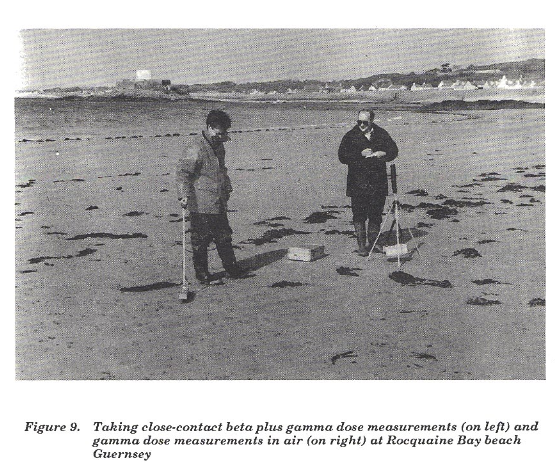
One month later the UK Government granted permission for the construction of the Hinkley CPWR, paving the way for a three-fold increase in the amount of some radio nuclides discharged to sea and also for the rolling out of planning permissions for another eight stations holding two or three reactors each.
In the same period, the Food Standards Agency (FSA), responsible for monitoring radioactivity in food, stated that, since “an annual monitoring programme has been in place for more than 25 years and no food safety risks have been identified during this period”, it now proposed to “optimise” the monitoring of radioactivity in food by reducing the scope and volume of its annual environmental monitoring and analysis programmes.
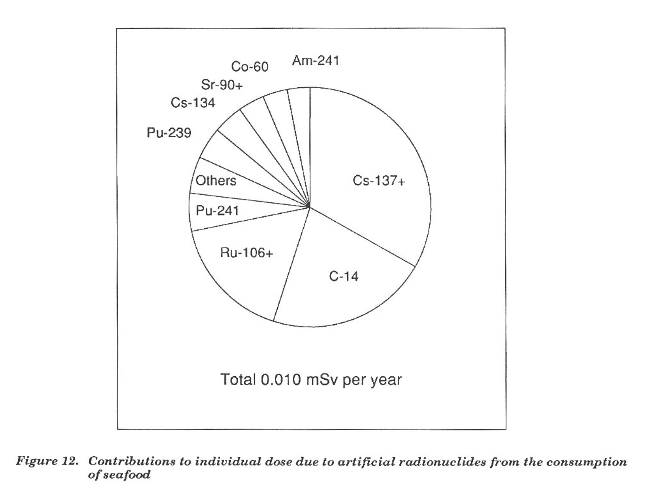
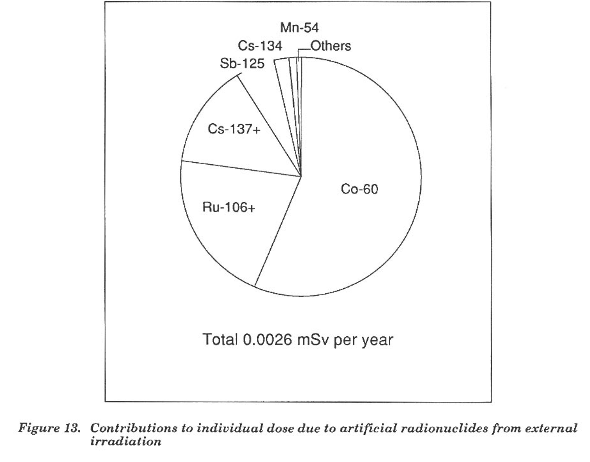
The FSA risk estimate for marine radioactivity is based on the outcome of assessment modelling of dietary dose, received from a range of foodstuffs thought to be representative of dietary exposure pathways. Here follows my review of the data inputs quality, upon which such modelling relies for its accuracy and relevance.
The original hypothesis for the behaviour of radioactivity in the sea
In the early 1950s, the first pipelines for the discharge of liquid nuclear waste to the UK’s coastal waters were commissioned. In the absence of empirical data, it was hypothesised that soluble radio-nuclides, such as Caesium or Tritium, would disperse and dilute through the water column and present no threat to human populations.
Insoluble nuclides, such as Plutonium, Americium or Cobalt 60, would adsorb to the outer surface of particles suspended in the marine water column, sink to the sea bed close to the point of discharge and remain immobilised in sub-tidal sedimentary deposits, sequestered from human populations and their immediate environment.
With support from the International Atomic Energy Agency, this theory provided the basis for the subsequent scientific, ethical and legal justifications for sea disposal of liquid radioactive wastes from nuclear sites. Its purely hypothetical nature was confirmed in 1958, when the UK industry and regulators publicly admitted that the sea disposal of liquid radioactive wastes had actually been an enormous research project.
Since the UK Government has not publicly revised or refuted this basic hypothesis, it remains the “official” position on the fate and behaviour of liquid radioactive waste discharges into UK coastal waters. No evidence gathered as a result of subsequent empirical scientific research has changed the basic position.
The monitoring programme
Annual reports such as “Radioactivity in Food and the Environment” (RIFE) published by the FSA and the EA state that most monitoring investigates the “local effects of discharges from nuclear licensed sites”, while there is “some ongoing monitoring of Chernobyl impacts”.

Historically, a small programme monitoring food and the environment “remote from nuclear licensed sites” was also carried out to give “information on background concentrations of radio nuclides”. This is what the FSA has proposed to abandon in order to “optimise” monitoring.
Turkey Jails 64 Journalists For Coverage of People’s Protest
Sacked veteran journalist: ‘It’s not possible to conduct serious journalism in such a polluted system.’ – Lauren McCauley, staff writer

Journalists in Turkey who covered this spring’s Gezi Park protests are living in a “half-open penitentiary,” say critics, as media bosses—under pressure from Prime Minister Recep Tayyip Erdoğan’s government—have sacked dozens of reporters while others face criminal prosecution.
Sixty-four journalists are currently under arrest and another 123 are facing charges of terrorism, said a report issued by the opposition Republican People’s Party (CHP) Tuesday.
“Mr. Prime Minister has turned the country into a half-open penitentiary and made it impossible to live for journalists,” said CHP leader Kemal Kılıçdaroğlu during a press briefing.
“We are experiencing a process in which […] the media bosses are under the rule of political authority and publish the news that the political authority accepts,” he added. “We have gone 105 years back in time.”
Nuclear lobby’s big advertising push – the Sydney “CON”ference
Putting the Con back into Conference: No social license for nuclear power. July 25: Natalie Wasley, Beyond Nuclear Initiative and Uranium Free NSW On July 25/26 the Australian Academy of Technological Sciences and Engineering (ATSE) is holding a conference in Sydney titled ‘Nuclear Energy for Australia?’
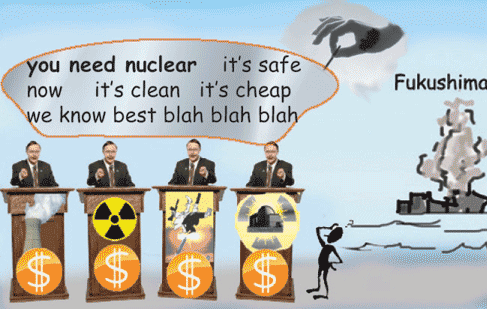
The conference might be framed as a question but the answer is predictable given that the majority of keynote speakers are from organisations in favour of developing a nuclear power industry in Australia, including industry representative bodies and pro-nuclear think tanks. Continue reading
Big buildings with Solar Skins are on the way
Switched on: solar cladding takes off SMH July 24, 2013 From stadiums in Brazil to a bank headquarters in Britain, architects led by Norman Foster are integrating solar cells into the skin of buildings, helping the market for the technology triple within two years. Continue reading
False arguments on the “necessity” for the atomic bombing of Hiroshima and Nagasaki
Will Media Raise Key Questions About Hiroshima, and Nuclear Legacy, This Year? THE NATION,Greg Mitchell on July 24, 2013 Sixty-eight years ago last week the Nuclear Age began with the first successful test of an atomic weapon at the Trinity site in the New Mexico desert. The test and what surrounded it set the standard for much of what followed in the decades to come: radiation dangers, official secrecy and cover-ups, a nearly endless nuclear arms race, and the triumph of the national security state……
Every summer for the past thirty years I’ve written numerous articles about this and related subjects—because the US media, with the exception of the fiftieth anniversary in 1995, fail to raise new, or even longstanding, questions. I’ve written three books on the subject: Hiroshima in America (with Robert Jay Lifton), Atomic Cover-Up (on the decades-long suppression of shocking film shot in the atomic cities by the US military) and Hollywood Bomb (the wild story of how an MGM 1947 drama was censored by the military and Truman himself).
For now, here’s a kind of summary of the debate of the use of the bomb in August 1945. Continue reading
Immediate climate change: nuclear war can do this
STUMBLING IN THE DARK, REACHING FOR THE LIGHT, Right Now By Tilman
Ruff 25 July 13 “……….Just 100 Hiroshima-sized nuclear bombs, less than one per cent of the global nuclear arsenal, would generate more than five million tons of soot and smoke if targeted at cities. In addition to
local devastation and widespread radioactive contamination, the climate impact would be catastrophic. Global cooling would be twice as large as following the Tambora explosion, and would persist not a couple of years but for over a decade, decimating global agriculture. Continue reading
Israel’s nuclear safety procedures criticised
“…….The Dimona facility’s safety procedures have been severely criticized by the courts in recent years, following a suit by 44 employees and the families of former employees who claimed they had developed cancer and other diseases due to overexposure to radiation.
IAEC officials insisted that the number of cancer cases among employees isn’t higher than that among the general population. Nevertheless, a year and a half later, Justice Minister Tzipi Livni appointed a committee to recommend special compensation for employees who developed fatal diseases. “….. Haaretz 23 July 13
Fukushima Unit 3 Steaming Again! Aid worker whistleblows on bad Thyroid health check
This video and researched articles below are worth checking out. There is an interview in this video that refers to the plight of the children of Fukushima and their families.. And some admissions of how the Japanese authorities are managing to cover up the true statistical impacts on this unfortunate group of people.
So please listen to the interview and you will see a repetition of the situation after Chernobyl, where support/health workers understood the problems but would never be given a platform on the main stream news outlets.
I will also leave a link at the bottom where a belarus UK worker says she was told not to talk about the health effects she was seeing to anyone in the UK after the Chernobyl disaster (foe anyone who may have missed the article).[Arclight2011part2]
Published on 24 Jul 2013
Fukushima Unit 3 steaming again, third time in a week — Asahi: High radiation levels detected near where it was observed — Tepco does not know where it’s coming from (PHOTOS)
AFP, July 24, 2013: […] Today, TEPCO said workers had noticed steam around the fifth floor of the building housing Reactor Number 3, which was wrecked by the tsunami of March 2011. It was the second time in two days and the third time in a week that steam had been observed. The firm has said there has been no increase in the amount of radioactive material being released, although it does not know where the steam is coming from.
TEPCO, July 24, 2013: Steam Found Near the Central Part of the Fifth Floor (Equipment Storage Pool Side) of Unit 3 Reactor Building at Fukushima Daiichi Nuclear Power Station (Follow-up Information 12) […] This is a follow-up report on the statuses of steam found wafting through the air near the central part of the fifth floor (equipment storage pool side) of Unit 3 on July 18. At around 4:15 AM today (July 24), we found steam coming from near the central part of the fifth floor (equipment storage pool side) of Unit 3 by a camera. […]
Asahi, July 24, 2013: High levels of radiation were detected near an area where steam was spotted July 23 at the No. 3 reactor building of the stricken Fukushima No. 1 nuclear plant, Tokyo Electric Power Co., the plant operator, said. TEPCO gave a measurement of 562 millisieverts per hour. The Nuclear Regulation Authority, the government’s nuclear industry watchdog, instructed TEPCO to investigate further because the dose level is high. […]
Stories from a Fukushima aid volunteer 福島援助ワーカーからストーリー – Walking in Japan 日本でのウォーキング
http://youtu.be/-Um4qle9w6E
Fukushima steps up children’s thyroid recheck
http://www3.nhk.or.jp/nhkworld/englis…
http://tinyurl.com/mdlbutz
See infrared images of Reactor 3 from July 24 here
http://www.tepco.co.jp/en/nu/fukushim…
http://tinyurl.com/m84bn2a
Radioactive material may have leaked from tunnel
http://www3.nhk.or.jp/nhkworld/englis…
http://tinyurl.com/n36f6bg
Radioactive materials found near Fukushima Daiichi
http://www3.nhk.or.jp/nhkworld/englis…
http://tinyurl.com/kq84xf7
Decontamination slow, effectiveness in doubt
BIKES NOT BOMBS! Nuclear Abolition Week 2013 – Melbourne, Australia
Published on 24 Jul 2013
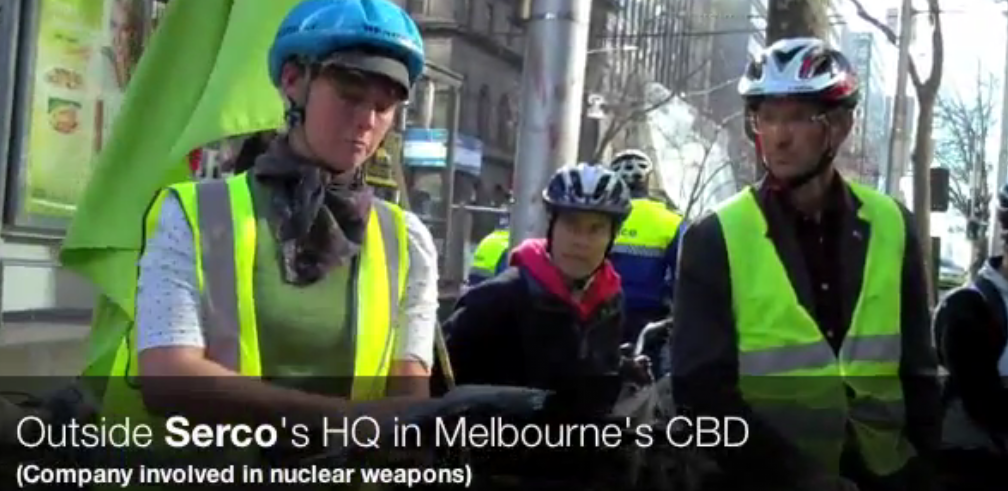
During ICAN’s global Nuclear Abolition Week we hit the streets rolling in Melbourne. We collected signed Parliamentary Appeals from several politician’s offices, imagined the hypothetical effects of a modern-day nuclear weapon on the city of Melbourne and visited Serco and the Australian Government’s Future Fund.
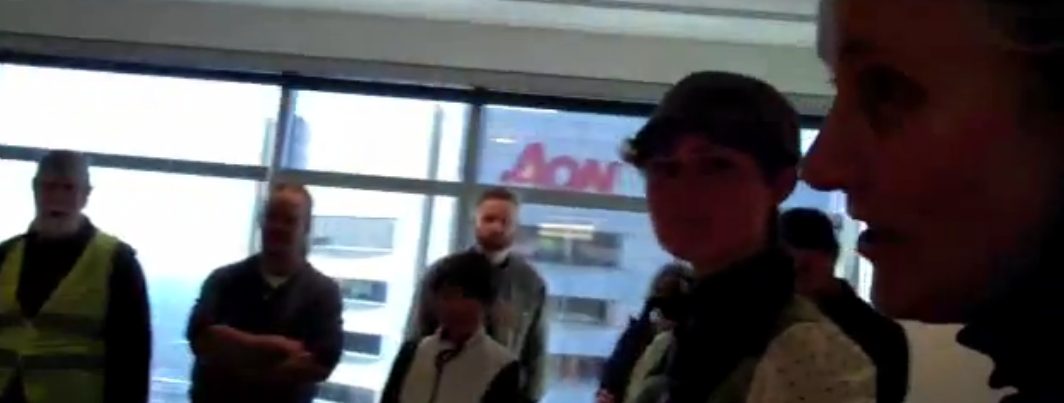
This video features the very awkward interaction we had with a Future Fund employee in their office when we delivered a petition of 13,675 signatures calling on them to divest public money from nuclear weapons companies. They were keen to show us where the door was…
Bikes Not Bombs Tour- 12th July 2013
Footage: Nancy Atkin
Production: Gem Romuld
Music: The Formidable Vegetable Sound System
1 This Month

of the week – Shut Down Drone Warfare!


Tell the Ukrainian Government to Drop Prosecution of Peace Activist Yurii Sheliazhenko

Petition to revoke the licensing of the Near Surface Nuclear Disposal Facility (NSDF) at Chalk River. https://www.ourcommons.ca/petitions/en/Petition/Details?Petition=e-7247
To see nuclear-related stories in greater depth and intensity – go to https://nuclearinformation.wordpress.com
-
Archives
- April 2026 (57)
- March 2026 (251)
- February 2026 (268)
- January 2026 (308)
- December 2025 (358)
- November 2025 (359)
- October 2025 (376)
- September 2025 (257)
- August 2025 (319)
- July 2025 (230)
- June 2025 (348)
- May 2025 (261)
-
Categories
- 1
- 1 NUCLEAR ISSUES
- business and costs
- climate change
- culture and arts
- ENERGY
- environment
- health
- history
- indigenous issues
- Legal
- marketing of nuclear
- media
- opposition to nuclear
- PERSONAL STORIES
- politics
- politics international
- Religion and ethics
- safety
- secrets,lies and civil liberties
- spinbuster
- technology
- Uranium
- wastes
- weapons and war
- Women
- 2 WORLD
- ACTION
- AFRICA
- Atrocities
- AUSTRALIA
- Christina's notes
- Christina's themes
- culture and arts
- Events
- Fuk 2022
- Fuk 2023
- Fukushima 2017
- Fukushima 2018
- fukushima 2019
- Fukushima 2020
- Fukushima 2021
- general
- global warming
- Humour (God we need it)
- Nuclear
- RARE EARTHS
- Reference
- resources – print
- Resources -audiovicual
- Weekly Newsletter
- World
- World Nuclear
- YouTube
-
RSS
Entries RSS
Comments RSS
 nuclear-news