In the shadow of Chernobyl – 27 years later : Cesium-137 found in wood ash from Japan
http://ex-skf.blogspot.co.uk/2013/04/long-shadow-of-chernobyl-224-bqkg-of.html
26 April 2013
Published by EXSKF
And of atmospheric testing of nuclear weapons by world nuclear powers, which did not stop until 1980 (China).
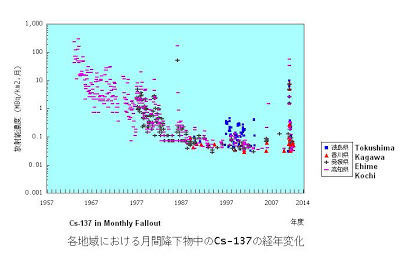
One of my twitter followers lives in south western Japan. A while ago he sent me the result of the test he had it done with the ashes from burning wood pellets in his stove this winter. The lab test, using the germanium semiconductor detector, found 223.8 Bq/kg of cesium-137.
He was upset, thinking it is from Fukushima I Nuclear Power Plant, until I pointed out to him that there was no cesium-134 found. The Cesium in the ashes is most likely from the fallout from atmospheric testing, and the Chernobyl accident in 1986.
He burned 600kg of wood pellets made from cedar trees in Ehime Prefecture in Shikoku Island in southwestern Japan. According to the pellet manufacturer, the concentration factor was about 375, and radioactive Cesium (Cs-137) in the pellets was estimated to be about 0.59 Bq/kg.
He said he will “entomb” the ashes with concrete and bury.
The chart plotting the historical monthly fallout in entire Shikoku (4 prefectures, as they didn’t start measuring the fallout in Ehime until 1977) shows the spike from the Chernobyl accident was less than that of the atmospheric testing, and larger than that from the Fukushima accident. (The chart was created from data at Japan Chemical Analysis Center. Y-axis in log scale.)
In 2012 he tested the ashes from burning the wood pellets from a different company, and to his great dismay the test found 1,000 Bq/kg of radioactive Cesium (Cs-137) in the ashes. He had already spread some of those ashes on his home garden. Those pellets, it turned out, were made from trees from Europe (Sweden, Finland, Germany, Austria) that the manufacturer had started to purchase in 1994 . That manufacturer told him that it had never ever occurred to them that the trees were contaminated from the Chernobyl accident, and there was no regulation on importing. The manufacturer told him that they chose European trees because they were cheap, and supply was steady.
April 26 marks the 27th anniversary of the Chernobyl Nuclear Plant accident.
Radiation of Chernobyl blast discovered in Sri Lankan soil
Friday, 19 April 2013 – 01:06 PM
A sample test carried out by the Sri Lankan Atomic Energy Authority has found some acute radioactive particles which were released by the Chernobyl nuclear explosion of Ukraine in Sri Lankan soil.
1 Comment »
Leave a reply to SA Kiteman Cancel reply
1 This Month
26 April – Chernobyl: Inside the Meltdown airs on National Geographic on Sunday 26th April from 4pm

29 April – Nuclear Expert Webinar #1 – Radiation Impacts on Families with Mary Olson and Cindy Folkers
- 12:15 PM MT – 1:45 PM MT
- Location: Virtual – REGISTER TODAY

4 May -West Suburban Peace Coalition to discuss Iran war at May Educational Forum
Monday, May 4, 7:00 – 8:00 PM Central Standard Time
Title: : How Trump’s Narrative Tries to Shape the Reality of the War on Iran.
Contact Walt Zlotow, zlotow@hotmail.com 630 442 3045 for further information
14 May – online event From Bombs to Data Centres: the Face of Nuclear Colonialism

Pine Ridge Uranium is the real threat, not Tehran- Tell Burgum: Stop the Extraction.
Chernobyl: The Lost Tapes – A good documentary on Chernobyl on SBS available On Demand for the next 3 weeks– https://www.sbs.com.au/ondemand/tv-program/chernobyl-the-lost-tapes/2352741955560
To see nuclear-related stories in greater depth and intensity – go to https://nuclearinformation.wordpress.com
-
Archives
- April 2026 (327)
- March 2026 (251)
- February 2026 (268)
- January 2026 (308)
- December 2025 (358)
- November 2025 (359)
- October 2025 (376)
- September 2025 (257)
- August 2025 (319)
- July 2025 (230)
- June 2025 (348)
- May 2025 (261)
-
Categories
- 1
- 1 NUCLEAR ISSUES
- business and costs
- climate change
- culture and arts
- ENERGY
- environment
- health
- history
- indigenous issues
- Legal
- marketing of nuclear
- media
- opposition to nuclear
- PERSONAL STORIES
- politics
- politics international
- Religion and ethics
- safety
- secrets,lies and civil liberties
- spinbuster
- technology
- Uranium
- wastes
- weapons and war
- Women
- 2 WORLD
- ACTION
- AFRICA
- Atrocities
- AUSTRALIA
- Christina's notes
- Christina's themes
- culture and arts
- Events
- Fuk 2022
- Fuk 2023
- Fukushima 2017
- Fukushima 2018
- fukushima 2019
- Fukushima 2020
- Fukushima 2021
- general
- global warming
- Humour (God we need it)
- Nuclear
- RARE EARTHS
- Reference
- resources – print
- Resources -audiovicual
- Weekly Newsletter
- World
- World Nuclear
- YouTube
-
RSS
Entries RSS
Comments RSS
 nuclear-news
Does anyone know of a way to extract the Cesium from the ashes? Ashes are good for plants (to a point) radio-cesium, not so much. If your TF could easily extract the Cesium, perhaps the ashes could still be used.