Lengthy and dangerous process to remove nuclear fuel rods
The pool at No. 4 was behind the secret worst-scenario mapped out by the government, which warned millions of people might have to flee from spewing radiation, including parts of the Tokyo area, which has a population of 35 million people. U.S. authorities have also repeatedly expressed worries about the spent-fuel pool at reactor No. 4.
“If we are asked whether things are completely safe, we cannot say that,” “If there is another major earthquake, we don’t know what may happen,
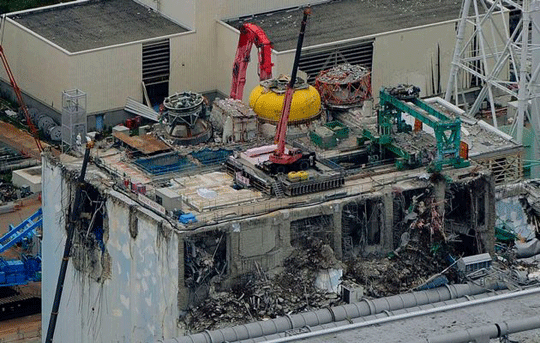
Japan removes two nuclear fuel rods from Fukushima plant Times Live Sapa | 18 July, 2012 A giant crane removed two rods packed with nuclear fuel from the Fukushima nuclear plant. This is the beginning of a delicate and long process to deal with a remaining risk of more radiation escaping from the disaster-struck plant.
All of the 1,535 rods next to reactor No. 4 at the crippled Fukushima Dai-ichi plant in northeastern Japan must eventually be removed from a spent-fuel pool to safer storage – an effort expected to take through the end of next year, according to the government. Continue reading
Revelations of UK government’s deceit over true state of its nuclear energy programme
“The government has been colluding with the nuclear industry to try to media manage the collapse of their hopes,”
“In reality the cost of new nuclear power has doubled in recent years and continues to rise. Instead of trying to pull the wool over the public’s eyes, the government should accept their nuclear dream is over and back renewable energy.”

 Emails reveal UK government’s moves to protect nuclear power from bad news
Government officials worked closely with E.ON and RWE to soften the impact of a major blow to plans for a new nuclear programme Rob Edwards guardian.co.uk, 19 July 2012 Government officials worked closely with two energy companies to soften the impact of a major blow to ministers’ plans for a new programme of nuclear power stations, internal emails reveal.
The revelation is further evidence of how Westminster has collaborated with the industry to try and protect nuclear power from bad news, first exposed by the Guardian in the aftermath of the Fukushima accident in Japan last year. Continue reading
Young Americans not well educated? Ignorance about Climate Change
 “Most Generation Xers are surprisingly disengaged, dismissive or doubtful about whether global climate change is happening “
“The results of this report suggest that better educated young adults are more likely to recognize the importance of the problem”
Uninformed Generation X are unconcerned about climate change, Click Green, 19 July 12, As the United States suffers a summer of record-shattering heat and the UK experiences record summer rainfall, a University of Michigan report finds that Generation X is lukewarm about climate change – uninformed about the causes and unconcerned about the potential dangers Continue reading
USA’s AirSea Battle (ASB) plan brings serious risks of nuclear weapons escalation
serious risks to this approach, including the danger of nuclear escalation if AirSea Battle is ever implemented in a shooting war with China.

 Three Paths to Nuclear Escalation with China The National Interest, Joshua Rovner | July 19, 2012 The U.S. military has enjoyed extraordinary freedom of maneuver since the end of the Cold War. The fall of the Soviet Union meant that no one else was left to seriously challenge the United States when it decided to act abroad. Today, however, strategists worry that U.S. rivals are developing weapons that will make it difficult or impossible to gain access to contested areas. Dealing with the so-called “anti-access” problem has become a central task for civilian and military planners—and something close to an obsession for the navy.
One popular solution is AirSea Battle (ASB). Continue reading
Dispute over UK plan for underground nuclear waste bunker
Kent and Shepway councils in Romney Marsh nuclear waste row, BBC News 19 July 12 The facility would have nuclear waste underground with research facilities at ground level Two council leaders have clashed over a report opposing plans for a nuclear waste facility on the Romney Marsh. The report, co-authored by Kent County Council leader Paul Carter, has been criticised by Shepway council leader Robert Bliss as emotive and inaccurate.

Mr Carter said he believed the report, which said the facility would blight the area, was factually correct but Mr Bliss said it was a knee-jerk reaction.
Earlier, Kent County Council voted to “totally oppose” the facility. The area is already the site of Dungeness nuclear power station, where Dungeness A is being commissioned and Dungeness B is due to stop generating power in 2018 or 2023…….
Public consultation On Thursday, Kent County Council voted to oppose the establishment ofa nuclear research and development facility in the county. It also agreed that if Shepway council decided to progress the proposal further, Kent council should review whether or not to hold acounty-wide referendum…
The facility would place nuclear waste in secure containers underground in vaults and tunnels, and at ground level, buildings would house research, office, transport and other facilities. The Shepway consultation is asking people whether it should find out more information about a possible facility on the Marsh. http://www.bbc.co.uk/news/uk-england-18917732
In last 24 hours – 3 earthquakes hit Fukushima
M4.5 quake hits Fukushima — Third M4 in last 24 hours July 19th, 2012 By ENENews Title: : Earthquake Information
Source: Japan Meteorological Agency Date: July 20, 2012 http://enenews.com/m4-5-quake-hits-fukushima-third-m4-in-last-24-hours
Earthquake fault line under Japan’s only operating nuclear reactor?
 Japan nuclear watchdog probes claims that country’s only working reactor sits on active fault line Warning comes just 18 months after tsunami wiped out Fukushima plant DAILY MAIL, 19 July 2012 Japan’s nuclear safety watchdog has ordered an investigation into claims the country’s only active nuclear power station is positioned above a tectonic fault line.
Geologists believe the Oi plant in Fukui Prefecture is at real risk of earthquake if the tectonic plates it sits on suddenly shift.
The news comes at a sensitive time for the Japanese nuclear industry – less than 18 months after a tsunami struck the nuclear power station at Fukushima, causing a meltdown…
The first reactor was fired up a few weeks ago and a second is planned to restart later in July. The power company insists it won’t alter its schedule, despite the order to examine the earth under the huge plant…. Experts reporting to the safety watchdog have also recommended tests are carried out at the nearby Shika plant, claiming both sites could be sitting on active fault lines. http://www.dailymail.co.uk/news/article-2176062/Japan-nuclear-watchdog-probes-claims-countrys-working-reactor-sits-active-fault-line.html#ixzz21C4tdqr4
High cesium levels in migratory fish in Pacific: Is Fukushima still leaking radiation?
 the persistently high cesium numbers may be a sign that the Fukushima plant is still leaking radiation into the ocean.
Lead scientist surprised by Japan data: Fukushima plant still leaking radiation into ocean? By ENENews Title: Post-Fukushima, Japan’s irradiated fish worry B.C. experts Source: Vancouver Free Press Author: Alex Roslin Date: July 19, 2012
The numbers show that far from dissipating with time, as government officials and scientists in Canada and elsewhere claimed they would, levels of radiation from Fukushima have stayed stubbornly high in fish. Continue reading
TEPCO covering seafloor with enormous amounts of concrete. Why?
Tepco completes covering seafloor with layers of cement mix — More coating used at Reactors 5 & 6 than for Reactors 1, 2, 3 & 4 combined (PHOTOS &  VIDEOS) July 19th, 2012 By ENENews http://enenews.com/tepco-completes-covering-seafloor-with-layers-of-cement-mix-more-coating-used-outside-reactors-5-6-than-for-reactors-1-2-3-4-combined-photos-videos
And all those funny looking black containers which were placed/dropped into the water..just COVER those things up with LAYERS of CONCRETE. Next generation can worry about it. Sadly, Mr. TEPCOman, one has to ask WHAT next generation will be healthy enough to work the problem?
One question to ask..what happened at Reactors 5 and 6 to require as much concrete or MORE than Reactors 1-4? Were more containers dumped into the ocean? More meltdown corium heading for the ocean..or is the ground so unstable..I hope its not the last. Subsidence(loss of ground HEIGHT) could be raising its ugly head. That is bad– almost as bad as Reactor 1-4 “payloads.”
Also note the non-concern of “radiation” going out into the OCEAN. What do they think the ocean is? An endless pit? Its not.
VIDEO: USA’s soldier guinea pigs watched atomic explosion
“It was a publicity stunt to show the American public how safe it was during an atomic bomb,” Yoshitake says, “and if there was a war or something, with atomic bombs going off, that it was going to be safe for the general public.”..
all six people who were there that day have had cancer
VIDEO How not to watch an overhead nuclear test http://www.cbsnews.com/8301-505263_162-57475611/how-not-to-watch-an-overhead-nuclear-test/ CBS News COLLEGE POINT, Md. 19 July 12 – On this date in 1957, the U.S. conducted one of the most important tests of the atomic age.
A nuclear-tipped missile was fired and detonated in the skies over the Nevada desert.
But what was happening on the ground at that moment seems beyond comprehension today. Continue reading
Book: guide to radiation cancer treatment
 Book details minimum recommended guidelines for radiation oncology practices News Medical July 19, 2012 The American Society for Radiation Oncology (ASTRO) is proud to announce the publication of Safety is No Accident: A Framework for Quality Radiation Oncology and Care, a comprehensive book detailing minimum recommended guidelines for radiation oncology practices.
The 52-page document represents an intensive collaboration among 31 specialists from all of the major societies in the radiation oncology field, representing physicians, medical physicists, radiation therapists, medical dosimetrists, nurses and administrators to ensure safe and effective radiation therapy treatment for patients, led by Writing Chairmen Anthony L. Zietman, MD, FASTRO, Jatinder R. Palta, PhD, and Michael L. Steinberg, MD, FASTRO……
http://www.news-medical.net/news/20120719/Book-details-minimum-recommended-guidelines-for-radiation-oncology-practices.aspx
Nuclear power not the fix for global warming: it’s the other way around!
Nationally, thousands of daily high temperature records and warm overnight low temperature records have been set this summer.
With global warming already increasing the odds of extreme heat events, the challenges faced at Braidwood and Browns Ferry are likely to become more common in the coming years. It’s an open question as to whether the nuclear industry is prepared for this. As the Union of Concerned Scientists‘ David Lochbaum told the Times, “Nuclear plants like Goldilocks weather — not too hot, not too cold, but just right.”
Such weather is getting harder and harder to come by.
Heat and Drought Pose Risks for Nuclear Power Plants, Climate  Central July 18th, 2012, By Andrew Freedman ”…….. it seems that climate change is increasingly causing problems for operators of nuclear plants. Like coal-fired power plants, nuclear facilities use large amounts of water for cooling purposes. After water has cycled through the plant, it is discharged back into a nearby waterway, usually a lake or a river, at a higher temperature. State regulations prohibit nuclear plants from operating once water temperatures go above a certain threshold, in part because it could compromise the safe operation of the facility, and also because discharging very warm water can kill fish and other marine life. Continue reading
Japan’s government on shaky ground as it promotes nuclear power
In another development that could fan public concerns about nuclear safety, Trade and industry minister Yukio Edano said the government would review seismological data for nuclear plants to assess whether any are built on active fault lines.
He was responding to media reports that a review by the nuclear watchdog indicated Hokuriku Electric Power Co’s Shika station northwest of Tokyo sits atop a faultline……
Nuclear issue puts increasing pressure on Japan government By Linda Sieg, additional reporting by Osamu Tsukimori and Risa Maeda TOKYO Jul 18, 2012 (Reuters) – Japan’s government came under fire on Tuesday over its handling of public hearings on nuclear energy policy, threatening to dent already sagging support for the 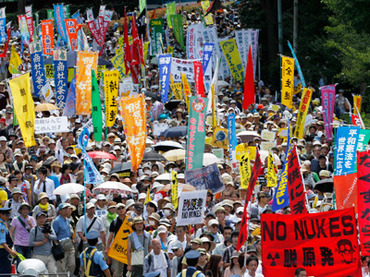 ruling party ahead of an election many expect to be this year.
The latest furor follows Monday’s massive rally in Tokyo against nuclear power in the wake of the Fukushima disaster, an issue now so contentious that lawmakers and analysts say it could trump taxes as the focus of lower house elections, which must be held by September 2013 but could come sooner.

“This gives the impression that they haven’t learned anything,” Continue reading
Youth climate movement for a carbon free, nuclear free world
 Working Together for a Nuclear Free, Carbon Free Energy Future Clean Energy Footprints July 18th, 2012 › Jacquie Ayala. At the end of June, in the blistering heat of Chattanooga, Tennessee, over 120 activists converged at the kNOw Nukes Y’all Summit to learn, strategize and build relationships across the South around nuclear issues. The summit was intergenerational – young people as well as activists who have been bravely fighting nuclear power since the first wave of the environmental movement in the 1960s, had a chance to meet, build relationships, and learn together. ….. Here’s some of what I learned: …….
Here’s what I think: as the youth climate movement, we have not addressed the nuclear issue directly. In our eagerness to stop Big Coal, we are letting the nuclear industry sneak its way back to the forefront. If we don’t engage our communities and our campuses for a carbon-free AND nuclear-free future NOW, I fear that we will be fighting the same fight again, just shifting from Big Coal over to Big Nuclear, and never getting anywhere with the renewables and energy efficiency advancements that we know can really create the clean energy economy we so desperately need.
I know we are smart enough and savvy enough to stop the nuclear industry from putting our communities at risk. We just have to work together. At the summit, conversations like this have already started. I was lucky enough to get the chance to participate in a movement-building breakout with about 15 other incredible activists – young and old alike. In the breakout, we discussed how we could work to build the nuclear movement by raising up communities at risk, and building momentum against new nuclear with abig push against Vogtle in Georgia, and coordinated actions across the country around other proposed plants. In Florida, for example, we’ll join in on a coordinated effort to take action against the four new proposed reactors in that state.
So, join the movement today to make our future a carbon-free, nuclear-free one. http://blog.cleanenergy.org/2012/07/18/working-for-a-nuclear-free-carbon-free-future/
“Waste Confidence Rule” allows nuclear waste keep growing, with no solution!
the NRC also stated that it ‘retains confidence that spent fuel can be safely stored with no significant environmental impact until a repository can reasonably be expected to be available and that the Commission has a target date for the availability of the repository in that circumstance’”
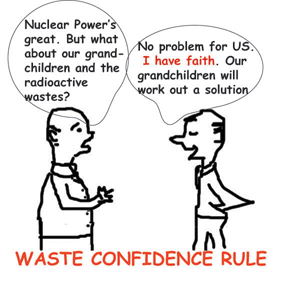
As a result of its confidence in the safety of spent fuel storage, NRC rules note that “no discussion of any environmental impact of spent fuel storage in reactor facility storage pools or independent spent fuel storage installations for the period following the term of the reactor operating license . . . is required in any environmental report, environmental impact statement, environmental assessment or other analysis prepared in connection with the issuance or amendment of an operating license for a nuclear reactor,”
 Group seeks to have spent fuel a factor in re-licensing Limerick plant The Mercury By Evan Brandt 07/17/12 LIMERICK “…….Spent fuel rods are what remains after the uranium pellets inside the fuel rods in a reactor no longer generate enough heat to create the steam that turns the turbines and generates electricity at a nuclear power plant.
Although cooler, this spent fuel remains radioactive to some extent for hundreds of years. For years, spent fuel was kept in concrete “spent fuel pools” located inside a nuclear plant and filled with water to keep it from overheating.
According to the NRDC filing, in 2008 NRC proposed “‘remov(ing) its expectation that a repository (for spent fuel) will be available by 2025’ and acknowledged that its previous finding that sufficient disposal capacity would be available within 30 years after any
reactor’s licensed life ‘is not supportable.’” Continue reading
1 This Month

Protect Sazan Island from the Trump family! https://secure.avaaz.org/campaign/en/protect_sazan_island_from_the_trump_family_loc/?bqFCVab&v=174511&cl=22707147157&_checksum=5e9dde668860e8231c33699735e16a1fbf22ab2cb01da50c999fe8732b9775ef&utm_source=email&utm_medium=blast_email&utm_campaign=174511

Cuba Is Not a Failed State – It Is a Besieged State
PETITION: “Global Appeal to Endorse Palestinian Right of Return of Refugees”
To see nuclear-related stories in greater depth and intensity – go to https://nuclearinformation.wordpress.com
-
Archives
- June 2026 (129)
- May 2026 (306)
- April 2026 (356)
- March 2026 (251)
- February 2026 (268)
- January 2026 (308)
- December 2025 (358)
- November 2025 (359)
- October 2025 (376)
- September 2025 (257)
- August 2025 (319)
- July 2025 (230)
-
Categories
- 1
- 1 NUCLEAR ISSUES
- business and costs
- climate change
- culture and arts
- ENERGY
- environment
- health
- history
- indigenous issues
- Legal
- marketing of nuclear
- media
- opposition to nuclear
- PERSONAL STORIES
- politics
- politics international
- Religion and ethics
- safety
- secrets,lies and civil liberties
- spinbuster
- technology
- Uranium
- wastes
- weapons and war
- Women
- 2 WORLD
- ACTION
- AFRICA
- Atrocities
- AUSTRALIA
- Christina's notes
- Christina's themes
- culture and arts
- Events
- Fuk 2022
- Fuk 2023
- Fukushima 2017
- Fukushima 2018
- fukushima 2019
- Fukushima 2020
- Fukushima 2021
- general
- global warming
- Humour (God we need it)
- Nuclear
- RARE EARTHS
- Reference
- resources – print
- Resources -audiovicual
- Weekly Newsletter
- World
- World Nuclear
- YouTube
-
RSS
Entries RSS
Comments RSS
 nuclear-news