Radioactive danger of Chernobyl forest fires
Chernobyl’s radioactive trees and the forest fire risk BBC News 7 July. (this article also describes the heroism of Ukraine’s firefighters.) By Patrick Evans Chernobyl, Ukraine Much of the 30km exclusion zone around the Chernobyl nuclear plant is pine forest, and some of it so badly contaminated that a forest fire could create a devastating radioactive smoke cloud.
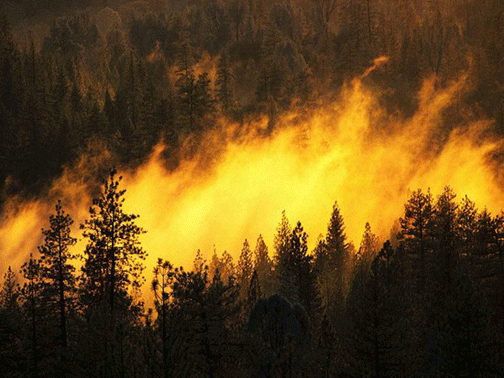
Heading north from Kiev in Ukraine, Continue reading
Nuclear and fossil fuel lobbies have conned Australia about wind energy
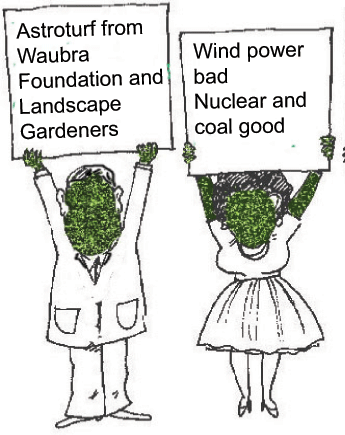 There are two main anti-wind farm groups in Australia busily fomenting anxiety and opposition. One is the Waubra Foundation, a group of mainly wealthy individuals, none of whom live in or near the town of Waubra, near Ballarat. Several of them, NIMBY style, have opposed turbines near their own properties elsewhere. They are led by an unregistered doctor, Sarah Laurie, and a wealthy mining investor, Peter Mitchell who also has connections to the Landscape Guardians. Despite their name, the Guardians have never attempted to guard our landscape from over-zealous residential developers, open cut coal or coal seam gas mining. They only target wind farm developments. All three – Waubra, the Guardians and Mitchell’s mining investment company share a South Melbourne post office box.
Wind turbine syndrome: a classic ‘communicated’ disease https://theconversation.edu.au/wind-turbine-syndrome-a-classic-communicated-disease-8318?utm_medium=email&utm_campaign=Latest+from+The+Conversation+for+20+July+2012&utm_content=Latest+from+The+Conversation+for+20+July+2012+CID_be7f8aff1000afd17cabaf558b629431&utm_source=campaign_monitor&utm_term=Simon+Chapman+investigates At the beginning of this year I started collecting examples of health problems some people were attributing to wind turbine exposure. I had noticed a growing number of such claims on the internet and was curious about how many I could find. Within an hour or two I had found nearly 50 and today the number has grown to an astonishing 155. Continue reading
20,000 cleanup workers not counted, in estimating Fukushima cancer risks

 Thousands More Radiation-Related Deaths Expected From Fukushima, Asian Scientist, Study By Rebecca Lim July 20, 2012 Thousands of deaths could still be expected from the Fukushima nuclear fallout in the years to come, according to the first estimate of the disaster’s worldwide impact AsianScientist (Jul. 20, 2012) –
The research, published in the latest edition of the journal Energy & Environmental Science, found that inhalation exposure, external exposure, and ingestion exposure of the public to radioactivity may result in up to 1,300 cancer mortalities and up to 2,500 cancer morbidities worldwide, mostly in Japan.
Stanford University researchers John Ten Hoeve and Mark Jacobson feel that the risk of a meltdown is not small, given that “modest to major radionuclide releases (occurred) in almost 1.5 percent of all reactors ever built.”….
Estimates in the paper do not account for the increased radiation risk to the roughly 20,000 workers at the plant in the months following the accident.
Psychological effects such as depression, anxiety, fear, and unexplained physical symptoms which were seen post-Chernobyl, are likely to be repeated in evacuees after Fukushima, they say….
Nuclear Disasters and Lessons Learned… A Mother’s Response
 Silence Deafening http://www.silencedeafening.com/index.html Fukushima Fallout … Nuclear Disasters and Lessons Learned… A Mother’s Response Facts are facts. There have been at least three major nuclear power disasters to date: Three Mile Island in 1979, Chernobyl in 1986, and now Fukushima Daiichi in 2011… and there are many more smaller nuclear accidents and near misses every year. Do we wait for another catastrophic event, or do we act now?
Nuclear fallout is a harmful and mysterious tragedy that we can’t see, taste, hear, smell or feel. Rather than recoil in fear from Fukushima Daiichi, it really only serves to empower us into further action. This book is a mother’s account of dealing with radioactive fallout from the Fukushima Daiichi disaster, the worst in world history. This book speaks to the urgent need for food monitoring, conservation and renewable energy, as radiation from nuclear power is now migrating into our homes and kitchens.
India’s farmers opposing nuclear power, and politicians taking up their fight
Nuclear power or not? Leaders fight it out (Haryana Newsletter) India Daily News, Chandigarh, July 20 — Leaders of all political hues in Haryana are fighting a nuclear war these days. The leaders have gone ballistic with their positioning over the issue of setting up a nuclear power plant in southwest Haryana. Continue reading
Australia’s anti uranium protestors were no bludgers, as BHP would call them
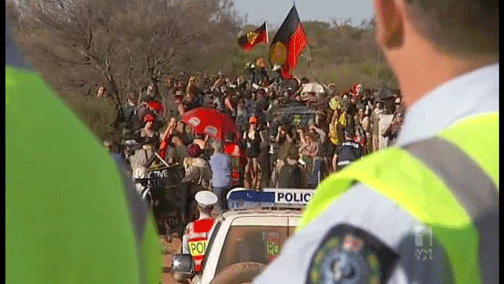 many of the group.. had taken leave without pay to travel to Roxby Downs to spread their message.
“There are other alternatives (to uranium for power) and I think an event like this can bring that more into discussion.”
We’re no bludgers, say mine protesters, Ben Hyde, The Advertiser July 20, 2012 THEY came from interstate and even overseas to protest against uranium mining, and some could be camped on the doorstep of BHP Billiton’s Olympic Dam mine for another two weeks. The group of Lizard’s Revenge protesters, which peaked at about 400 activists last weekend, were an eclectic bunch, united in their anti-nuclear stance. Continue reading
Majority of Americans want renewable energy: petition launched
Today, EcoWatch.org is launching a petition that outlines a renewable energy policy that we believe everyone in the grassroots movement and fellow Americans can support. We are asking you to sign the petition directed to the U.S. Senate Committee on Energy & Natural Resources andHouse Energy & Commerce Committee. This petition can help serve as a basis for bipartisan legislation that members of Congress can introduce in their committees and ultimately on the House and Senate floor.
Congress: Expedite Renewable Energy HUFFINGTON POST, Stefanie Penn Spear, : 07/19/2012 In 2009 it seemed as though Congress was finally going to pass legislation that would transition our country to a renewable energy future. The American Clean Energy and Security Act of 2009, also known as the Waxman-Markey Bill, would have created a cap and trade system on greenhouse gases, required electric utilities through a renewable electricity standard (RES) to meet 20 percent of their electricity demand through renewable energy sources and energy efficiency by 2020, subsidized renewable energy and energy efficiency technologies, and financed modernization of the electrical grid, among many other provisions.
The bill was approved by the House of Representatives on June 26, 2009, by a vote of 219-212, but died in the Senate. Continue reading
Radioactive risks of ‘rust belt’ nuclear reactors
Resisting “Rust Belt” reactors’ radioactive risks! Beyond Nuclear 19 julyThe Great Lakes, which “host” 33 atomic reactors along its shores in the U.S. and Canada, is the drinking water supply for 40 million North AmericansAs if the closing steel mills and automobile manufacturing plants weren’t bad enough, some of the oldest, most risky atomic reactors in the U.S. are located in the Midwest. Worse still, they are on the shores of the Great Lakes, putting at risk the drinking water supply for 40 million people downstream in the U.S., Canada, and a large number of Native American First Nations. Altogether, 33 atomic reactors are located on the shorelines of the Great Lakes.
Two of the most infamous of these radiologically risky “Rust Belt reactors” are Entergy Nuclear’s Palisades in southwest Michigan, and FirstEnergy’s Davis-Besse in northwest Ohio….. http://www.beyondnuclear.org/nuclear-power/2012/7/19/resisting-rust-belt-reactors-radioactive-risks.html
Stolen vehicle contained radioactive material
Nuclear material on stolen ute TVNZ July 21, 2012 Police fear radioactive material could be released from a nuclear density metre on a utility stolen in Christchurch. Continue reading
Reflections on the past week in nuclear news

Christina Macpherson’s websites & blogs
It has been a week of protests – so intense that the mainstream media has felt obliged to actually cover them. In Australia, the Lizards Revenge http://lizardsrevenge.net/ brought hundreds of protestors travelling hundreds, even thousands of miles. for a festival of music, entertainment and information – to the very heart of the uranium industry – BHP’s Olympic Dam mine in South Australia. A massive police and security presence did not bring about the violence (that the media might have enjoyed).
The Anti-Nuclear Alliance of Western Australia led the protest in Fremantle, targeting the Australian uranium conference, and particularly, Toro Energy.
In Japan, in the sweltering heat, 170,000 people rallied outside Prime Minister Noda’s residence peacefully voicing their protest at the restart of one nuclear reactor. As in Australia, this protest was peaceful.
In other developments, the rise of thyroid abnormalities in Fukushima children indicates the continuing seriousness of the health effects of Fukushima. The nuclear lobby continues to push the completely unproven and scientifically unaccepted theories of low doses of radiation being “good for you”, or at least harmless. The USA’s nuclear revival well and truly stalled, due to the growing recognition that “new nuclear” can’t go ahead without a real plan for waste disposal. Meanwhile Britain struggles with the unacceptable costs of its planned nuclear expansion, and even more, with its dilemma over what to do with its huge plutonium waste pile at Sellafield.
Media’s strange silence on thyroid abnormalities in Fukushima children
We also spoke with Dr. Bryan Haugen, president-elect of the American Thyroid Association and head of endocrinology at the University of Colorado School of Medicine, who hadn’t heard of the report before we contacted him.
Haugen agreed with the Caldicott’s assessment that it is surprising for kids to “have this many nodules and cysts seen, especially this soon after the accident,” and the fact that “this something that is not more widely known.”
The New York Academy of Sciences estimates that nearly one million people around the world have died from exposure to radiation released by the 1986 nuclear disaster at the Chernobyl reactor.
 CONFIRMED: 36 Percent Of Fukushima Kids Have Abnormal Thyroid Growths And Doctors Have Been Left In The Dark : http://www.businessinsider.com/fukushima-children-have-abnormal-thyroid-growths-2012-7#ixzz21CwegRH8 Michael Kelley | Jul. 19, 2012 A few days ago we reported that 36 percent of Fukushima children have abnormal thyroid growths likely from radiation exposure, based on the “Fukushima Prefecture Health Management Survey.”
We got in touch with Australian pediatrician Dr. Helen Caldicott, who has spoken about the growths, to ask her about the implications of the study.
After confirming the validity of the report, Caldicott reinforced the alarming nature of the findings:
1. “It is extremely rare to find cysts and thyroid nodules in children.”
2. “This is an extremely large number of abnormalities to find in children.”
3. “You would not expect abnormalities to appear so early — within the first year or so — therefore one can assume that they must have received a high dose of [radiation].”
4. “It is impossible to know, from what [officials in Japan] are saying, what these lesions are.”
Doctors worry about these abnormal growths because even though thyroid nodules are relatively common, they are not common in children and some of them could become cancerous. When asked why these results haven’t been widely reported, Calidcott noted that Japanese officials are not sharing ultrasound results with foremost experts of thyroid nodules in children and accused the media of “practicing psychic numbing,” saying that she doesn’t understand why media outlets are choosing to ignore the nuclear fallout. Continue reading
Japan now has to take its anti nuclear movement seriously
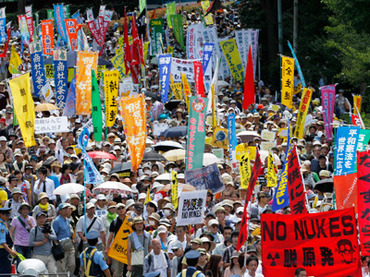
Hemmed in by police in the sweltering heat, the demonstrators are mostly
good-natured. But for how long?
Japan’s anti-nuclear protests The heat rises The restart of two nuclear reactors has belatedly lit a fuse under the Japanese, The Economist Jul 21st 2012 | TOKYO | PEOPLE power is not a phrase usually associated with Tokyo. A famously buttoned-up city, epitomised by its obedient ranks of identikit commuter salarymen, Tokyo rarely hosts serious protests…Suddenly, what had looked like the waning cause of a core of diehard liberals has become a protest movement. . … on July 16th tens of thousands braved 30-degree heat in a central Tokyo park to attend a “Sayonara Nukes” rally.
The generous sprinkling of ordinary families, as well as the 7.5m signatures that Mr Oe and company claim to have gathered, gave the protest more than nostalgic value. Its fuel was anger. Recent reports into last year’s triple Fukushima meltdown 210km (130 miles) away have shown that the world’s most crowded metropolis narrowly avoided
catastrophe.
Though many worry about the economic cost of scrapping nuclear power, others belatedly question the logic of having 54 commercial reactors in a country with one-fifth of the world’s strong earthquakes.
Even worse, people said, was that the government had restarted at least one nuclear reactor (a second was switched on again on July 18th) while questions still remain about the safety of nuclear power, and about a regulatory structure that took the threat of natural
disaster too lightly. Continue reading
USA sparking ‘missile envy’ with expanding missile defence system
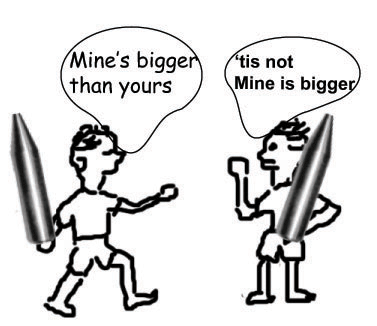 The United States is spending about $10 billion a year to develop, test and deploy missile defences, which would include a European shield as part of a layered system. The defences would also include ship-based interceptors that could be deployed in the Middle East and
Asia-Pacific – for instance as a hedge against North Korea – plus ground-based missile interceptors in silos in Alaska and California.
Missile defences, however benign they appear to the side building them, always force others nations to improve and increase their offensive weapons,”
Missile shield may spark China nuclear upgrade-officer http://in.reuters.com/article/2012/07/18/china-usa-nuclear-idINDEE86H0EY20120718 By Fredrik Dahl VIENNA Jul 19, 2012 (Reuters) – China may need to modernise its nuclear arsenal to respond to the destabilising effect of a planned U.S.-backed missile defence system, a senior Chinese military officer said on Wednesday. Continue reading
Abnormal thyroid growths in 36% of Fukushima children

 36 Percent Of Fukushima Children Have Abnormal Growths From Radiation Exposure http://www.businessinsider.com/a-stunning-36-percent-of-fukushima-children-have-abnormal-growths-from-radiation-exposure-2012-7#ixzz21Cetabn4 Michael Kelley | Jul. 16, 2012, Of more than 38,000 children tested from the Fukushima Prefecture in Japan, 36 percent have abnormal growths – cysts or nodules – on their thyroids a year after the Fukushima nuclear disaster, as reported by ENENews.
The shocking numbers come from the thyroid examination section of the “Sixth Report of Fukushima Prefecture Health Management Survey,” published by Fukushima Radioactive Contamination Symptoms Research (FRCSR) and translated by the blog Fukushima Voice. Shunichi Yamashita, M.D., president of the Japan Thyroid Association, sent a letter to members in January with guidelines for treating thyroid abnormalities. In 2001 Yamashita co-authored a study that found normal children in Nagasaki to have 0 percent nodules and 0.8 percent cysts. Continue reading
Japan’s politicians starting to worry about (their jobs) and anti nuclear protests
as numbers swell there are indications the country’s usually inflexible politicians are getting worried and just might start paying attention.
they [protestors] are very ordered: protesters stick to the anti-nuclear message and go home in an orderly fashion at the appointed time.
But the demonstrations’ regularity and sheer size – – is giving the government pause for thought in a country where for decades the political elite has largely ignored popular opinion…..

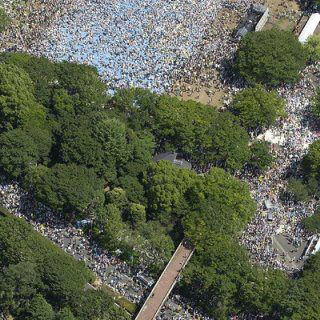 Nuclear fears galvanise Japan’s sedate society Channel News Asia: 20 July 2012 TOKYO: Japan’s usually sedate societyis angry and getting organised against nuclear power, with the kind of snowballing protest movement not seen for decades. Weekly demonstrations outside the prime minister’s residence attract tens of thousands of people and a rally in west Tokyo this week drew a crowd organisers claimed at 170,000, demanding an end to atomic power in post-Fukushima Japan.
And as numbers swell there are indications the country’s usually inflexible politicians are getting worried and just might start paying attention….. “No one used to care before (the disaster),” said
Masaki Yoshida, a mother-of-three who was forced from her Fukushima
home by the radiation-spewing plant. Continue reading
1 This Month

Protect Sazan Island from the Trump family! https://secure.avaaz.org/campaign/en/protect_sazan_island_from_the_trump_family_loc/?bqFCVab&v=174511&cl=22707147157&_checksum=5e9dde668860e8231c33699735e16a1fbf22ab2cb01da50c999fe8732b9775ef&utm_source=email&utm_medium=blast_email&utm_campaign=174511


Cuba Is Not a Failed State – It Is a Besieged State
PETITION: “Global Appeal to Endorse Palestinian Right of Return of Refugees”
To see nuclear-related stories in greater depth and intensity – go to https://nuclearinformation.wordpress.com
-
Archives
- June 2026 (129)
- May 2026 (306)
- April 2026 (356)
- March 2026 (251)
- February 2026 (268)
- January 2026 (308)
- December 2025 (358)
- November 2025 (359)
- October 2025 (376)
- September 2025 (257)
- August 2025 (319)
- July 2025 (230)
-
Categories
- 1
- 1 NUCLEAR ISSUES
- business and costs
- climate change
- culture and arts
- ENERGY
- environment
- health
- history
- indigenous issues
- Legal
- marketing of nuclear
- media
- opposition to nuclear
- PERSONAL STORIES
- politics
- politics international
- Religion and ethics
- safety
- secrets,lies and civil liberties
- spinbuster
- technology
- Uranium
- wastes
- weapons and war
- Women
- 2 WORLD
- ACTION
- AFRICA
- Atrocities
- AUSTRALIA
- Christina's notes
- Christina's themes
- culture and arts
- Events
- Fuk 2022
- Fuk 2023
- Fukushima 2017
- Fukushima 2018
- fukushima 2019
- Fukushima 2020
- Fukushima 2021
- general
- global warming
- Humour (God we need it)
- Nuclear
- RARE EARTHS
- Reference
- resources – print
- Resources -audiovicual
- Weekly Newsletter
- World
- World Nuclear
- YouTube
-
RSS
Entries RSS
Comments RSS
 nuclear-news