“Uprating” – a cheap way to increase power from nuclear reactors, but is it safe?
nuclear watchdogs have warned that these bigger uprates also carry bigger risks.
“This trend is, in principle, detrimental to the stability characteristics of the reactor, inasmuch as it increases the probability of instability events and increases the severity of such events, if they were to occur,” the Advisory Committee on Reactor Safeguards, which is mandated by Congress to advise the NRC, has warned

 How to expand nuclear power without attracting (too much) attention
Washington Times, by Brad Plumer July 18, 2012 Since the 1970s, construction on new nuclear reactors in the United States has largely ground to a halt, thanks to public protests, regulatory obstacles and tight financing. Yet over that same period, U.S. utilities have managed to increase the amount of electricity they get from nuclear power. By quite a lot, in fact.
How is that possible? Through a process known as “uprating.” According to a new analysis by the U.S. Energy Information Administration, the operators of 98 of the country’s 104 commercial nuclear reactors have asked regulators for permission to boost capacity from their existing plants. All in all, the Nuclear Regulatory Commission has approved more than 6,500 megawatts worth of uprates since 1977. That’s the equivalent of building six entirely new nuclear reactors—and during a period when fresh plants were impossible to build.
Under the public radar, nuclear power is “uprated”, bringing safety concerns
nuclear watchdogs and the U.S. Nuclear Regulatory Commission’s own safety advisory panel have expressed concern over larger boosts — some by up to 20% — that the NRC began approving in 1998. Twenty of the nation’s 104 reactors have undergone these “extended power uprates.”
U.S. is increasing nuclear power through uprating Turning up the power is a little-publicized way of getting more electricity from existing nuclear plants. But scrutiny is likely to increase in the wake of Japan’s nuclear crisis. LA Times, April 17, 2011|By Alan Zarembo and Ben Welsh, Los Angeles Times
The U.S. nuclear industry is turning up the power on old reactors, spurring quiet debate over the safety of pushing aging equipment beyond its original specifications.
The little-publicized practice, known as uprating, has expanded the country’s nuclear capacity without the financial risks, public anxiety and political obstacles that have halted the construction of new plants for the last 15 years.
The power boosts come from more potent fuel rods in the reactor core and, sometimes, more highly enriched uranium. As a result, the nuclear reactions generate more heat, which boils more water into steam to drive the turbines that make electricity. Continue reading
It’s already happening – solar hot water, and solar energy cooling systems
According to the International Energy Agency, solar heating and cooling (SHC) could make a dramatic impact on the world’s electricity grids, providing 17 per cent of all energy required for heating in buildings, industrial processes, swimming pools, and 17 per cent of cooling needs.
 Solar cooling technologies are relatively new, and not widely deployed – only 711 systems were deployed in the world in 2011, according to the IEA …..The IEA suggests that solar cooling particularly useful in handling electricity peaks, because it produces at the time of highest demand. It says the technology is already competitive in tropical regions with high electricity costs, including a 1.47MW capacity installation installed at a college in Singapore, was reportedly fully cost competitive without subsidies.
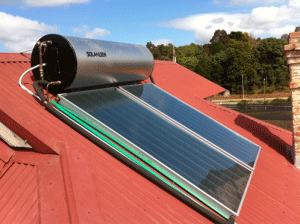 Solar Insights: Is solar hot water (and cooling) the next big thing? REneweconomy, By Giles Parkinson 19 July 2012 Amid the dramatic cost reductions and soaring demand for solar PV (photovoltaic) technologies in Australia and across the world, the long established idea of using the sun to heat water has taken a back seat. In Australia, where SHW once dominated the local rooftop industry, installations were outpointed by rooftop PV by a factor of 5 in the last year.
But now SHW it is tipped to make a return to centre stage, along with relatively new solar thermal technologies that use the sun to provide heating and cooling for office and building spaces, district heating and under-floor heating in cooler climates, as well as for industrial processes and in hybrid systems with solar PV (known at PV-T). At a larger scale, it could one day be used for water treatment and desalination. Continue reading
New Zealand art show a reminder of that country’s proud anti nuclear history
Her first-hand experiences and those of her fellow protesters feature in an anti-nuclear exhibition called Blast! Pat Hanly – The Painter and His Protests, on now at the Voyager New Zealand Maritime Museum….. Blast! is a travelling exhibition featuring the paintings
of anti-nuclear artist Pat Hanly and his wife Gil Hanly’s photographs.
 Memories of anti-nuclear era Western Leader, Auckland NZ NICOLA MURPHY 19 July 12, PEACE PROTESTER: Jody Lusk doesn’t regret participating in New Zealand’s anti-nuclear protests, despite getting injured after attacks by French police. Continue reading
Russia ahead in the race to sell off nuclear technology to South Africa
Russian nuclear group opens office in South Africa Engineering News, By: Keith Campbell 18th July 2012 South Africa has become only the third country to host a marketing office of Russia’s State-owned nuclear energy group Rosatom. The registration of the office was announced by the group on Wednesday….. Rusatom (spelt with a u) Overseas is a subsidiary of Rosatom (spelt with an o).

Another Rosatom subsidiary, Tenex, already supplies enriched uranium products for the production of nuclear fuel for South Africa. The country currently has one two-reactor NPP, at Koeberg near Cape Town, which has a capacity of 1 800 MWe. This started operation in 1984… http://www.engineeringnews.co.za/article/russian-nuclear-group-opens-office-in-south-africa-2012-07-18
No sign of restart to Fort Calhoun nuclear power plant, shut since April 2011
Nebraska nuclear plant not restarting soon Bloomberg, By Josh Funk July 18, 2012 OMAHA, Neb. (AP) — Utility workers continue inspecting the Fort Calhoun nuclear power plant, but it’s not clear whether the plant will be ready to restart in September as Omaha Public Power District officials hoped.
The nuclear plant about 20 miles north of Omaha is being scrutinized closely by regulators because it has been offline since April 2011 and several safety violations have been found…..
http://www.businessweek.com/ap/2012-07-18/nebraska-nuclear-plant-not-restarting-soon
Amid USA heatwave, loss of power to cooling equipment brings shutdown to Pennsylvania nuclear reactor
Exelon shuts Pa. Limerick 1 nuclear power reactor, Reuters Jul 19, 2012 By Scott DiSavino July 18 – Exelon Corp shut down the 1,130-megawatt (MW) Unit 1 at the Limerick nuclear power plant in Pennsylvania early Wednesday following an electrical disturbance on the non-nuclear side of the plant, the company said in a release.
The outage came at a bad time for the power grid: Homes and businesses in the U.S. Mid-Atlantic are cranking up their air conditioners amid a brutal heat wave blanketing the region.
The electrical disturbance caused a loss of power to generator cooling equipment, the company said. The unit will remain offline until repairs, inspections and testing are
completed, it said…. http://in.reuters.com/article/2012/07/18/utilities-operations-exelon-limerick-idINL2E8II8A620120718
USA’s heatwave contributes to nuclear power plant shutdowns
 Limerick among four nuclear power reactors shut down Wednesday Leigh Valley Morning Call, 18 July Several nuclear plants on the U.S. East Coast, including Exelon’s Limerick nuclear plant, were shut down early Wednesday and New York’s Consolidated Edison power company reduced the voltage in parts of Manhattan as the obsessive heat wave stressed the region’s power system…..
Temperatures in New York City — the biggest metropolitan region in the United States — hit 91 degrees Fahrenheit (33 Celsius) on Monday, 96 F on Tuesday, and were expected to reach 96 F again on Wednesday before thunderstorms Wednesday night were likely to drive temperatures back to near-normal levels in the 80s F on Thursday, according to AccuWeather.com. Continue reading
For relicensing nuclear plants, Nuclear Regulatory Commission does not consider costs of spent fuel disposal
Paradoxically, while the NRC allows potential earnings from a re-licensed plant to be considered as a way to cover the costs of plant shut-down, it does not consider the potential for those added years of operation to generate additional spent fuel when calculating the cost of shutting the plant down.
Group seeks to have spent fuel a factor in re-licensing Limerick plant The Mercury By Evan Brandt 07/17/12 LIMERICK — Despite a recent federal court ruling invalidating a rule that would allow storage of radioactive spent nuclear fuel rods at nuclear power plants for 60 years after they’ve closed, the Nuclear Regulatory Commission has no plans to consider the issue when deciding on whether to re-license Exelon Nuclear’s Limerick Generating Station for an additional 20 years.
The National Resources Defense Council disagrees with that position and filed papers July 9 seeking to amend its challenge to Exelon’s re-licensing application Continue reading
Research shows cancer develops from small doses of radiation, especially to children
 “Thanks to recent studies, we are now certain that small doses of radiation can seriously affect the thyroids of young children, causing cancers or other illnesses,”
 Victims of French nuclear tests see hope in cancer link finding http://www.france24.com/en/20120717-france-nuclear-tests-polynesia-algeria-radiation-cancer-victims-compensation-health Victims of French nuclear tests say a report establishing a link between exposure to radiation and cases of cancer may prove decisive in their lengthy battle for compensation. By Andrea Davoust
Thanks to a landmark medical expert’s report, a new link has been established between France’s nuclear testing in the Pacific and North Africa and cases of cancer among civilians and former military personnel.
The findings, revealed by daily Le Parisien on Tuesday, could help speed up the lengthy legal process to compensate potential victims of these tests. Continue reading
Can Japan’s government continue to ignore the growing anti nuclear protests?
“There’s something wrong in this country when even if thousands of people protest in front of the prime minister’s residence they still reactivate the plants,”
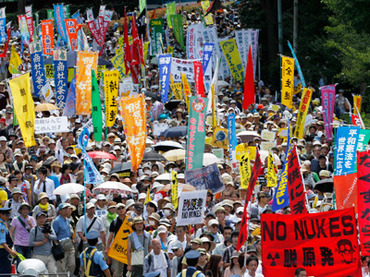
Tokyo Anti-Nuclear Rally Attracts Thousands As Protests Grow Bloomberg, By Aya Takada, Shunichi Ozasa and Scilla Alecci – Jul 16, 2012 Tens of thousands of people packed Tokyo’s Yoyogi Park yesterday for Japan’s biggest anti-nuclear rally since the Fukushima disaster last year in growing protests against government moves to restart atomic reactors. Continue reading
Burying dead nuclear reactors – expensive, but lucrative for some!
consultancy Arthur D. Little has put the total costs at no less than €18 billion…..
Dismantling a nuclear plant until it has completely vanished can take several decades, depending on which technique is used.
the process of fully decommissioning a plant can take more than 40 years,
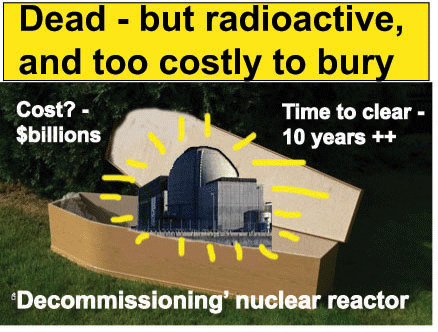
 Germany’s pricey nuclear burial, Climate Spectator , 18 Jul 2012, Christoph Steitz and Tom Käckenhoff “…..by 2014, almost nothing will be left of what once was Germany’s first commercial boiling water reactor. Germany’s decision to shut down all nuclear plants by 2022,
sparked by last year’s Fukushima nuclear disaster in Japan, is a done deal……
… a giant hole in the ground where the reactor vessel used to be. Work to decommission plants mainly includes removing and disposing of contaminated material as well as decommissioning the plants themselves while making sure that no radiation spreads.
Spent fuel from reactors needs to be encased and then transported to safe fuel dumps while cooling towers, often regarded a blight on landscapes, then need demolishing…..
Today, the four operators of nuclear plants in Germany – E.ON, RWE, EnBW and Vattenfall – have made a total of more than €30 billion ($36.7 billion) in provisions for the dismantling of the plants and the disposal of nuclear waste. Continue reading
France used soldiers as guinea pigs for radiation effects
 An excerpt published in the newspaper refers to the “Gerboise verte”, code name for the test firings of April 25, 1961. It states that the experiment “should allow for a study of the physiological and psychological effects of atomic weaponry on humans, with the goal obtaining the necessary elements to prepare physically and morally for modern combat.”
 Soldiers deliberately exposed to nuclear tests, says report According to the Tuesday edition of the French daily Parisian, a confidential military report proves that soldiers were deliberately exposed to nuclear tests that France conducted in Algeria in the 1960s. By FRANCE 24 17 July 12 Continue reading
At last France accepts liability for cancers in nuclear test victims
Under the provisions of the bill the new compensation scheme will apply to former soldiers and civilians that developed cancers and other illnesses after exposure to radiation from nuclear tests carried out in Algeria and French Polynesia.
Parliament approves compensation bill for nuclear test victims The French parliament voted Tuesday to pay compensation to victims of nuclear tests France carried out in Algeria and French Polynesia over the course of more than three decades. By FRANCE 24 17 July 12
The French parliament on Tuesday approved a compromise bill offering compensation to the victims of nuclear tests carried out by France between 1960 and 1996, overturning decades of official failure to accept general liability for health problems suffered by those present at or near the test sites. Continue reading
Delhi High Court considers radiation poisoning of university researcher
 “Strontium 90 is a toxic radioactive substance having a half life of about 28 years, a beta rays emitter and is one of the most hazardous products … Which if enters the human body, it accumulates within the bone marrow and over a period of time would cause certain type of cancers/tumors of the bone and of the blood cell….
they mixed the “hazardous and radioactive Strontium in a liquid form in cups of tea which the petitioner used to consume without knowing that those were contaminated.”

 Researcher Affected by Radiation: Centre’s Reply Sought http://news.outlookindia.com/items.aspx?artid=769120 PTI | NEW DELHI | JUL 17, 2012 The Delhi High Court today sought the Centre’s response to a plea by a researcher in a Haryana university accusing his guide and other staffers of making him drink tea, laced with radioactive element Strontium 90. Continue reading
1 This Month

Protect Sazan Island from the Trump family! https://secure.avaaz.org/campaign/en/protect_sazan_island_from_the_trump_family_loc/?bqFCVab&v=174511&cl=22707147157&_checksum=5e9dde668860e8231c33699735e16a1fbf22ab2cb01da50c999fe8732b9775ef&utm_source=email&utm_medium=blast_email&utm_campaign=174511


Cuba Is Not a Failed State – It Is a Besieged State
PETITION: “Global Appeal to Endorse Palestinian Right of Return of Refugees”
To see nuclear-related stories in greater depth and intensity – go to https://nuclearinformation.wordpress.com
-
Archives
- June 2026 (129)
- May 2026 (306)
- April 2026 (356)
- March 2026 (251)
- February 2026 (268)
- January 2026 (308)
- December 2025 (358)
- November 2025 (359)
- October 2025 (376)
- September 2025 (257)
- August 2025 (319)
- July 2025 (230)
-
Categories
- 1
- 1 NUCLEAR ISSUES
- business and costs
- climate change
- culture and arts
- ENERGY
- environment
- health
- history
- indigenous issues
- Legal
- marketing of nuclear
- media
- opposition to nuclear
- PERSONAL STORIES
- politics
- politics international
- Religion and ethics
- safety
- secrets,lies and civil liberties
- spinbuster
- technology
- Uranium
- wastes
- weapons and war
- Women
- 2 WORLD
- ACTION
- AFRICA
- Atrocities
- AUSTRALIA
- Christina's notes
- Christina's themes
- culture and arts
- Events
- Fuk 2022
- Fuk 2023
- Fukushima 2017
- Fukushima 2018
- fukushima 2019
- Fukushima 2020
- Fukushima 2021
- general
- global warming
- Humour (God we need it)
- Nuclear
- RARE EARTHS
- Reference
- resources – print
- Resources -audiovicual
- Weekly Newsletter
- World
- World Nuclear
- YouTube
-
RSS
Entries RSS
Comments RSS
 nuclear-news