Nuclear companies compete desperately for sales, prices offered below costs!

 French Nuclear Watchdog Says Orders Won At Too-Low Prices Bloomberg, By Francois de Beaupuy – Jun 6, 2012 Nuclear-reactor makers are offering prices too low to cover costs to win orders abroad in a strategy that puts earnings at risk, the head of the industry’s watchdog in France said. “Export contracts for nuclear plants are being obtained at pure dumping-level prices,” Andre-Claude Lacoste, head of the Autorite de Surete Nucleaire regulator, said today at a conference organized by L’Usine Nouvelle magazine in Paris.
“Prices accepted by vendors and obtained by buyers are unsustainable,” Lacoste said. “There aren’t many tenders, which is why competitors are ripping each other off. It’s already a serious matter, and we need to make sure that there’s no dumping on safety on top of that.”
Areva SA (AREVA), the world’s largest provider of nuclear equipment and services, has booked more than 2.8 billion euros ($3.5 billion) of costs since 2005 because of delays and cost overruns at an atomic plant it’s building in Finland. The Paris-based company and General Electric Co. (GE) were beaten in 2009 on a four- reactor order in the United Arab Emirates by Korea Electric Power Corp. (KEP) in the Seoul-based company’s first export contract……. Areva is preparing
bids or in talks to sell reactors in countries including China, India, the U.K., the Czech Republic and Poland. In Finland, Areva faces GE Hitachi Nuclear Energy, Korea Hydro & Nuclear Power Co., Mitsubishi Heavy Industries Ltd. (7011) and Toshiba Corp. (6502) in a tender next year. http://www.bloomberg.com/news/2012-06-06/french-nuclear-watchdog-says-orders-won-at-too-low-prices.html
Vogtle nuclear power project – a money pit?
 A lot is at stake in the Vogtle project. The new breed of reactors being built at the site — featuring advanced standardized design, streamlined licensing and new construction techniques — are supposed to keep costs steady and bring projects in close to budget and on schedule.
That in turn is supposed to spur a new golden era for nuclear power.
Cost overruns of almost $1 billion — so far — at Ga. nuke reactors June 6, 2012, by Jay Bookman Last month, a consortium of utilities including Atlanta-based Southern Company announced cost overruns of almost $1 billion at two new nuclear reactors being built near Waynesboro.
That’s an arresting number under any circumstances, but it looms even larger when you realize that major construction on the Vogtle 3 and 4 reactors has basically just begun, with at least five more years of construction to come.
And if costs soar, who’s going to pay for it? Southern Company and its subsidiary, Georgia Power, own 45.7 percent of the project, so its ratepayers’ share of these recent overruns would come to more than $400 million. But according to Buzz Miller, Southern’s executive vice president of nuclear development, that cost will be borne by contractors who are building the project. Continue reading
The resuscitation of the nuclear industry is failing, because of costs
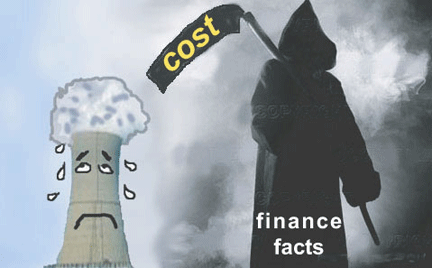 Nuclear Europe: a dream unwinding, China Dialogue, Steve Thomas June 06, 2012“…”…….If Europe’s governments have been jolted by the aftermath of Fukushima, the big energy companies have been violently shaken. Nuclear has long been an attractive option for the major operators because the massive demands placed on plant-builders effectively rule out entry by new competitors – unlike smaller-scale decentralised technologies, which allow scope for small companies to join in. ….
On cost, the promise was that these reactors could be built for US$1,000 (6,300 yuan) per kilowatt of capacity. That would bring a 1,700-megawatt EPR in at US$1.7 billion (10.8 billion yuan). At that price, it was claimed their power would be competitive with the cheapest option, natural gas. Today, even before any of these designs have entered service, the cost estimates are five to six times that level, and there is no sign that they have stopped rising.
On finance, the mandatory opening up of European electricity systems to competition has extinguished the assumption that consumers will underwrite whatever costs are incurred. That means the financial risk falls on the owner, not consumers. Financiers don’t like that equation, especially for a technology with as poor a record for being built to time and cost and operating reliably as nuclear power. Consumers always pay, but plant owners can go bankrupt losing money lent to them by banks.
It has become increasingly clear that a nuclear-power plant will struggle to find finance if destined to operate unprotected in a competitive market. The disastrous Olkiluoto and Flamanville projects suggest the promise of “buildability” was also fanciful – and will have made financiers even more sceptical…. . http://www.chinadialogue.net/article/show/single/en/4956
Vigourous and organised opposition to nuclear power in China
many of the companies building nuclear power plants and the government have not held honest discussions with stakeholders and are unwilling to provide adequate information. The Ministry of Environmental Protection rejected Caixin’s application for more information on documents related to the Pengze plant’s environmental assessment.
“Our actions are divided into three phases: official, media and litigation,” Wang said. Petitioning the government was the first step, and using the media to attract attention the second. “If this still doesn’t work, we can only move to litigation. In the next step, we’ll sue whichever departments approved construction of the Pengze nuclear plant, and we’ll sue to the end.”

 Ex-officials battle China nuclear plant plan, Market watch,Retired officials vigorously battle China nuclear power plant plan By Cui Zheng BEIJING ( Caixin Online ) —”… the meltdown on March 11, 2011, is still fresh on the minds of four retired cadres in Wangjiang County.
They petitioned against the Pengze nuclear power project in neighboring Jiangxi Province and ultimately convinced their local government to oppose the plan. This kind of official opposition to a nuclear undertaking is almost unheard of in China. Continue reading
Japan having “just a bump on the road” to nuclear renaissance?
 An Unexpected Bump on the Road to Oi Restarts By Toko Sekiguchi WSJ, June 6, 2012, Japan’s prime minister is encountering unexpected opposition to his quest to bring two nuclear reactors back online in the next few weeks: lawmakers from his own party.
More than a third of the legislators from the ruling Democratic Party of Japan submitted to Prime Minister Yoshihiko Noda a petition Tuesday urging him to exercise “greater caution” over restarting the No. 3 and 4 reactors at the Oi nuclear plant in western Japan, run by Kansai Electric Power Co.
“Most of the public are of the opinion that we should overcome this summer’s energy needs through conservation and flexibility,” the petition said, signed by 117 members of the DPJ. At issue is what to do with Japan’s fleet of 50 nuclear reactors, …. Critics — including
the popular mayor of Osaka, and the 117 DPJ petitioners — have questioned just how safe the reactors are, and how prepared utilities are should another accident happen.
http://blogs.wsj.com/japanrealtime/2012/06/06/an-unexpected-bump-on-the-road-to-oi-restarts/
China raising funds to launch nuclear power, but public sentiment is “fragile”
China to Stoke Nuclear Power, WSJ 6 June 12, State-Owned Firm Plans IPO to Fund Reactors; $5.4 Billion Deal Is Possible BEIJING—China National Nuclear Power Co. said it is planning a Shanghai initial public offering that will go toward financing part
of five power projects worth 173.5 billion yuan ($27.2 billion), in a multibillion-dollar deal that signals that the country’s ramp-up of nuclear power is moving forward..
… China National Nuclear Power, according to a statement on the environmental ministry website, will sell shares to raise funds for nuclear-power projects in Fujian, Zhejiang, Hainan and Jiangsu provinces, the statement said, adding that these projects were approved by China’s National Development and Reform Commission between 2008 and 2010. Those projects require 173.5 billion yuan in funding,…
the IPO could be asking a lot of the country’s equity markets. The commission hasn’t approved any sizable IPOs since May, when the regulator gave the green light to China Postal Express & Logistics Co.’s potentially 9.98 billion yuan deal, though that has yet to
launch. Since early May, the benchmark Shanghai Composite Index is down 4%.
“A big IPO would weigh on the stock market further as it would divert funds from the secondary market, especially when the sentiment remains fragile,” said Yang Delong, a fund manager at China Southern Fund….. http://online.wsj.com/article/SB10001424052702303665904577449784005256706.html?mod=googlenews_wsj
France’s nuclear dilemma – costs of shutting aged reactors
Nuclear Europe: a dream unwinding, China Dialogue, Steve Thomas June 06, 2012“…… the real challenge – regardless of whether Hollande or Sarkozy had won the election – was always going to be what to do about France’s existing plants when they reach the end of their lives. Under present plans, these ageing reactors will be retired at a rate of five to six per year from 2017 onwards. The cheaper option for the country’s power giant EDF would be to do as the Americans and extend the plants’ lifespans from 40 to 60 years, though thanks to post-Fukushima regulatory requirements that existing plants be made more robust for “extreme situations” this is not such a cheap option as it once was.
On the other hand, if France takes the route of replacing old reactors with EPRs, assuming problems around cost, licensing and construction can be solved, and the EPR remains a viable option, then the cost to EDF of replacing old capacity would be astronomical – far higher than first time around. It is doubtful that France could sustain the logistical and financial challenge of ordering and building four or five EPRs a year for a decade. It would also have to start paying huge sums for decommissioning existing reactors. That leaves France facing some tough choices…. http://www.chinadialogue.net/article/show/single/en/4956
Enthusiasm for solar power in Japan
The recent rush by home owners to cover their roofs with panels and companies to build “mega solar” farms have made solar cells a hot commodity.
“We are almost at grid parity here. Think of what would happen if Japan allows things to run their natural course and solar reaches grid parity
That all of Japan’s 50 nuclear reactors lie dormant amid public concern in the wake of Fukushima is an added boost for solar power
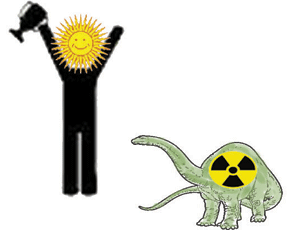
 Solar makers bet on Japan nuclear crisis being a game-changer
* Solar power firms to get boost from feed-in tariff
* Foreign players looking to grab slice of Japan’s solar market
* Companies say FIT will encourage economies of scale
* Public faith in nuclear power still in tatters after Fukushima
By Shinichi Saoshiro TOKYO, June 5 (Reuters) – Solar power firms are betting that the nuclear crisis in Japan will become a game-changer for renewable energy in the world’s third largest economy, with new foreign entrants such as Canadian Solar looking to go toe-to-toe there with some of the biggest utilities in Asia.
They will be given a big helping hand next month when the government introduces a generous subsidy for renewable energy via a so-called feed-in tariff (FIT), in a bid to encourage alternative energy sources, which currently only generate about 1 percent of power in Japan.
The FIT, which excludes large hydro-electric schemes, will require utilities to buy electricity generated by renewable sources such as solar, wind and geothermal heat at a premium for 20 years. Continue reading
80 year plan for old nuclear reactors – invites catastrophe
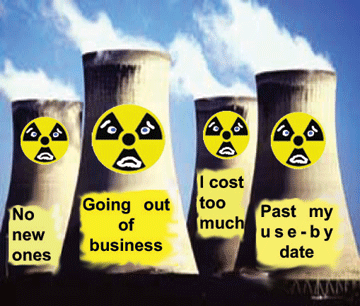 Nuclear regulators know that embrittlement of the reactor vessels limits nuclear plant life but are willing to expose the public to greater risks from decrepit, old and leaking reactors. As we learned from Fukushima, the nuclear industry is willing to expose the public to catastrophic risks
Getting operating license extensions “is a lucrative deal for operators,”
a concern by the nuclear industry that “they’re not going to build any new reactors anytime soon”–thus the push to keep existing plants running.
Inviting Atomic Catastrophe OPEd News 4 June 12By Karl Grossman The U.S. Nuclear Regulatory Commission will be holding a meeting this week to consider having nuclear power plants run 80 years–although they were never seen as running for more than 40 years because of radioactivity embrittling metal parts and otherwise causing safety problems. Continue reading
Distributed solar energy plan launched in the Philippines
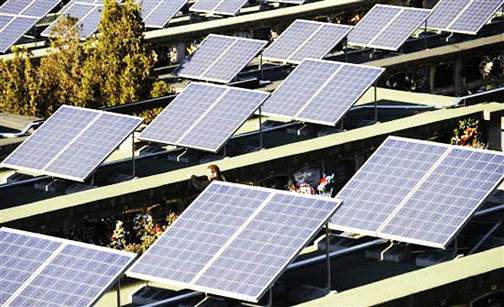 Such facilities in the Philippines should be installed mostly on rooftops because there is a lot of arable and productive land which should be used for food production rather than for solar power generation,
Rooftop solar power project launched to prove viability, Business World, 5 June 12, THE ASIAN Development Bank (ADB) said yesterday it expects solar power capacity in the Philippines to reach up to 115 megawatts (MW) by next year, as it launched yesterday its solar rooftop facility to prove the viability of this renewable energy thrust.
The multilateral lender said it estimates most of solar projects in the country will consist of small clusters that generate lower capacities of electricity rather than large facilities. ADB installed 2,040 solar panels on its rooftop which can generate around 500 kilowatts of energy or around 613 MW a year. Continue reading
First solar powered transcontinental flight
Pilot completes first solar-powered transcontinental flight from Madrid to Rabat THE AUSTRALIAN, AP June 06, 2012 AN experimental solar-powered plane has landed in Morocco’s capital after a 20-hour trip from Madrid in the first transcontinental journey by a craft of its type.
With the wing span of a Boeing 777, the plane appeared out of the pitch darkness over the runway, suddenly turning on its lights and gliding to a landing in Rabat, its four propellers already still. “It was perhaps the most beautiful flight of my life,” said pilot
Bertrand Piccard, who has already circumnavigated the world by balloon.
“I have dreamed since I was a child of flying without using fuel.”
The single-seat aircraft is fitted with 12,000 solar cells across its immense wings and but only weighs just as much as the average family car, according to organisers. The plane is the first of its kind to fly both during the night and day as the solar panels charge the batteries for night flying….. http://www.theaustralian.com.au/news/world/pilot-completes-first-solar-powered-transcontinental-flight-from-madrid-to-rabat/story-e6frg6so-1226386003212
A year after Fukushima disaster, and Japanese are growing even more opposed to nuclear power
“It is clear from surveys that the majority of the people think that we can survive this summer by conserving energy and transferring electricity among regions,”
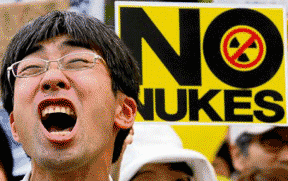 Japanese more opposed to nuclear power a year after the tsunami, LA Times, 5 June 12, As Japanese authorities this week ponder whether to resume producing nuclear energy, a poll shows that opposition to nuclear power is strong and growing more than a year after the earthquake, tsunami and nuclear catastrophe that killed 20,000 and contaminated a broad swath of farmland.
Seventy percent of Japanese surveyed by the Washington-based Pew Research Center said they wanted nuclear power reduced or eliminated, while a year ago the nation was nearly evenly divided on the subject, with 44% urging a phaseout and 46% backing continued generation. Continue reading
Solar panels – five of their greatest advantages
 5 Advantages of Solar Power http://www.greenfudge.org/2012/06/04/5-advantages-of-solar-power/ by Murielle, 64 June 12, Everyone these days is talking about renewable sources of energy and protecting the environment. If you are considering solar power as a means of helping to lower energy usage, there are a few things that you should consider. Solar power offers major advantages and understanding these advantages will help you to
know just how much of an impact your contribution will make.
The first advantage of solar power is that it costs nothing. Solar power is completely free. Continue reading
Flight over nuclear reactor, smoke bombs dropped on reactor building
Activists fly over nuclear plant in Spain http://gulfnews.com/news/world/other-world/activists-fly-over-nuclear-plant-in-spain-1.1032248 Stunt designed to prove lack of security at the plant AFP June 6, 2012 Madrid Two Greenpeace activists flew over Spain’s oldest nuclear power plant on Tuesday in a motorised paraglider to draw attention to the alleged lack of security at the facility, the organisation said.
The activists threw smoke bombs on the roof of the building that houses the reactor of the Garona nuclear plant located near the northern city of Burgos from the paraglider, which carried a banner that read “Garona close now”.
In February Spain’s conservative government extended by five years the operating licence of Garona, which began operating in 1971. “With this action Greenpeace reiterates that there is no economic or energetic reason that justifies the extension of Garona’s licence,” Continue reading
New crisis dividing Japanese – dealing with radioactive debris
 Japan’s Latest Nuclear Crisis: Getting Rid of the Radioactive Debris, The Atlantic, JUN 4 2012, A plan to disperse the waste to incineration facilities across the country, meant to instill national unity, is doing the opposite, and further delaying Japan’s ability to move beyond Fukushima. KITA KYUSHU, Japan — Disposing the more than 20 million tons of rubble caused by the March 11 earthquake and tsunami is proving to be a difficult problem for Japan, not least because much of the rubble has been irradiated by the Fukushima nuclear disaster. The government’s plan — to destroy 4 million tons of potentially radioactive earthquake debris in garbage incinerators around the country — is dividing the nation and further delaying the country’s ability to put Fukushima behind it. Continue reading
1 This Month

Protect Sazan Island from the Trump family! https://secure.avaaz.org/campaign/en/protect_sazan_island_from_the_trump_family_loc/?bqFCVab&v=174511&cl=22707147157&_checksum=5e9dde668860e8231c33699735e16a1fbf22ab2cb01da50c999fe8732b9775ef&utm_source=email&utm_medium=blast_email&utm_campaign=174511


Cuba Is Not a Failed State – It Is a Besieged State
PETITION: “Global Appeal to Endorse Palestinian Right of Return of Refugees”
To see nuclear-related stories in greater depth and intensity – go to https://nuclearinformation.wordpress.com
-
Archives
- June 2026 (129)
- May 2026 (306)
- April 2026 (356)
- March 2026 (251)
- February 2026 (268)
- January 2026 (308)
- December 2025 (358)
- November 2025 (359)
- October 2025 (376)
- September 2025 (257)
- August 2025 (319)
- July 2025 (230)
-
Categories
- 1
- 1 NUCLEAR ISSUES
- business and costs
- climate change
- culture and arts
- ENERGY
- environment
- health
- history
- indigenous issues
- Legal
- marketing of nuclear
- media
- opposition to nuclear
- PERSONAL STORIES
- politics
- politics international
- Religion and ethics
- safety
- secrets,lies and civil liberties
- spinbuster
- technology
- Uranium
- wastes
- weapons and war
- Women
- 2 WORLD
- ACTION
- AFRICA
- Atrocities
- AUSTRALIA
- Christina's notes
- Christina's themes
- culture and arts
- Events
- Fuk 2022
- Fuk 2023
- Fukushima 2017
- Fukushima 2018
- fukushima 2019
- Fukushima 2020
- Fukushima 2021
- general
- global warming
- Humour (God we need it)
- Nuclear
- RARE EARTHS
- Reference
- resources – print
- Resources -audiovicual
- Weekly Newsletter
- World
- World Nuclear
- YouTube
-
RSS
Entries RSS
Comments RSS
 nuclear-news