Opposition in Japan’s ruling party to restart of nuclear reactors

 Japan PM warned over nuclear restarts, TV NZ June 05, 2012 Nearly a third of Japan’s ruling party lawmakers are petitioning Prime Minister Yoshihiko Noda to be cautious about restarting nuclear reactors given safety concerns after last year’s earthquake and tsunami, an organiser said on Tuesday.
Noda, keen to restart two reactors in western Japan before electricity demand peaks this summer, could decide as early as this week to reconnect them to the grid – despite the risk of a backlash that would weaken his already sagging voter ratings.
“It is clear from surveys that the majority of the people think that we can survive this summer by conserving energy and transferring electricity among regions,” said the petition, to be presented to Noda’s government later in the day. “We urge you to consider the fact that there is insufficient agreement within the party and among the people and the feelings of the 160,000 victims of the disaster, and be all the more cautious about a decision to restart the reactors.”….
Satoshi Arai, an ex-national strategy minister sponsoring the petition, said Noda had failed to meet conditions for resuming operations at the two Kansai Electric Power Co reactors at its Ohi plant in Fukui, western Japan. The government has been struggling to win support from local authorities for the restarts, but on Monday the governor of Fukui said the ball was in Noda’s court. http://tvnz.co.nz/world-news/japan-pm-warned-over-nuclear-restarts-4912228
Thousands of Japanese protest against restarting nuclear reactors
Thousands gather outside PM’s office to protest against the restart of nuclear reactors Japan Daily Press, By Radhika Seth / June 4, 2012 For some, the wounds are still raw and for others, the scars will take time to heal. The bottom-line is that many citizens still fear the use of nuclear power as an energy resources, despite claims from the government that some of the shut-down facilities are complete safe and reliable.
Thousands of drum wielding, slogan chanting, anti-nuclear protesters gathered outside the prime minister’s office on Friday, after the government announced plans to restart some of the shut down reactors…… http://japandailypress.com/thousands-gather-outside-pms-office-to-protest-against-the-restart-of-nuclear-reactors-043323
Japan’s “wide area incineration” plan to manage radioactive debris
 Japan’s Latest Nuclear Crisis: Getting Rid of the Radioactive Debris The Atlantic, JUN 4 2012“.……While the government insists on the necessity of removing rubble from the earthquake region as quickly as possible, critics point out that the government plan calls for 80 percent of the debris to be burned locally, and say that transporting only 20 percent of the feared waste to incinerators around the country makes little sense. After all, if the goal is to remove debris from the area, why is the vast majority of it staying there? Continue reading
Cree people say No to uranium mining and nuclear power
 Chief Shecapio explained that the Crees “have always been the guardians and protectors of the land and will continue to be. For the Crees of Mistissini, the land is a school of its own and the resources of the land are the material and supplies they need. Cree traplines are the classrooms. What is taught on these traplines to the youth is the Cree way of life, which means living in harmony with nature.
“We do not believe that nuclear energy, which is the primary use for uranium in Canada, is a sustainable form of energy. We do not want to see a resource extracted from our land be responsible for causing pollution and waste. We do not want this to be our impact on the world..
Uranium Exploration: Mistissi Says “No” and Calls for a Moratorium MISTISSINI, Market Watch, EEYOU ISTCHEE, Jun 05, 2012 (MARKETWIRE via COMTEX) 5 June 12, — The Chief of Cree Nation of Mistissini, Richard Shecapio, made it clear at the Canadian Nuclear Safety Commission’s (CNSC) public hearing, held today (June 5) in Mistissini, that his
community is firmly against uranium development in Eeyou Istchee. “We want to put an end to the question of uranium development once and for all, right now. We know where this is going and we don’t want any uranium mining at all”, said Chief Shecapio. Continue reading
Australia’s hypocrisy as it toes the USA line about Julian Assange
The Australian government has liaised closely with the US from the beginning of the US WikiLeaks investigation, which rapidly gathered steam following Bradley Manning’s arrest in Iraq in March 2010.
the released cables showed that the Australian embassy had confirmed through US officials that the US Justice Department was conducting an ”active and vigorous inquiry into whether Julian Assange can be charged under US law, most likely the 1917 Espionage Act”.
ever anxious to demonstrate its loyalty to the US alliance, the Australian government has not uttered any objection to the prospect that Assange may be prosecuted for espionage.
 Ministers cagey over Assange, The Age, Philip Dorling, June 2, 2012, Julian Assange fears extradition to Sweden to be questioned about sexual assault allegations.
PRIME Minister Julia Gillard, Attorney-General Nicola Roxon and Foreign Minister Bob Carr all sang from the same hymn sheet this week on the continuing legal saga of WikiLeaks publisher Julian Assange. But they chose their words very carefully.
The issue was whether the United States intends to charge and extradite Assange – the Australian journalist labelled by US Vice-President Joe Biden as ”a high-tech terrorist” – with criminal offences for WikiLeaks’ publication of hundreds of thousands of secret US military and diplomatic reports…..
Well aware of successive polls that show a high level of support for WikiLeaks and Assange across the Australian political spectrum, the Australian government has been insistent this week that it has no knowledge whatsoever of any intention by the US to prosecute and extradite the WikiLeaks publisher……. Continue reading
Radiation therapy can lead to later breast cancer
Radiation treatment has saved countless children from lymphoma, leukemia, soft-tissue tumors and other cancer types, but it can damage the DNA of healthy cells, too, and lead to cancer decades later.
 Study finds breast cancer risk in women treated with radiation as kids, even at lower doses Winnipeg Free Press, By: Marilynn Marchione, The Associated Press 06/4/2012 CHICAGO – Women treated with chest radiation for cancer when they were girls have a higher risk of developing breast cancer than previously thought, doctors warn. Continue reading
USA govt understates the cost of its nuclear weapons arsenal
Study: Government Low-Balls Cost of Nuclear Fleet, USA News, June 5, 2012 The federal government is low when calculating the amount it spends on the U.S. nuclear weapons arsenal, says a new report, and several longtime atomic arms analysts say government officials have no clue how much the world’s most lethal weapons really cost.
The Stimson Center released a study Tuesday that concludes Washington will spend between $352 billion to $392 billion over the next decade to modernize its nuclear fleet. The think tank’s researchers dove into Pentagon budget documents to conclude the Defense Department pegs the same costs between $221 billion to $244 billion.
“Official estimates [rely] on a narrow definition of the nuclear enterprise, or even of strategic nuclear offensive forces, understate the actual costs the United States spends on nuclear weapons without settling once and for all what is the single right cost of the nuclear
enterprise,” states the report…… http://www.usnews.com/news/blogs/dotmil/2012/06/05/study-government-low-balls-cost-of-nuclear-fleet
Need for probe on Nuclear Regulatory Commission’s dubious safety culture
U.S. Nuclear Agency Needs Independent Probe, Markey Says Bloomberg News, By Katarzyna Klimasinska June 04, 2012 An independent investigation is needed of alleged lapses in the safety culture at the U.S. Nuclear Regulatory Commission, Representative Edward Markey said, citing worker concerns about a lack of management support. Continue reading
David Suzuki on Germany’s example in renewable energy
with conservation and improved efficiency, along with better storage and smart grid management, we could switch to renewables without the need for large-scale baseload.
Renewable energy solutions exist. We just need governments with as much foresight as Germany’s to implement them
David Suzuki: Germany shows that renewable energy is possible, Straight.com. By David Suzuki, June 5, 2012 Germany recently reached a renewable energy milestone. On Saturday, May 26, the country met half its midday energy needs with solar power. On the preceding workday Friday, it met a third with solar. According to German renewable energy expert Norbert Allnoch, during those midday periods, the country’s solar plants produced 22 gigawatts of electricity, as much as 20 nuclear power stations running at full capacity.
Granted, those were sunny days, but Germany gets about 20 percent of its overall annual electricity from renewable sources, including solar, wind, water, and thermal. A Reuters article reports that “Germany has nearly as much installed solar power generation capacity as the rest of the world combined and gets about four per cent of its overall annual electricity needs from the sun alone. It aims to cut its greenhouse gas emissions by 40 per cent from 1990 levels by 2020.” Continue reading
Seabrook nuclear power plant fails safety test
NRC reports Seabrook nuclear plant failures in emergency test, SeaCoast online, By Shir Haberman, June 05, 2012 SEABROOK — The operators of the Seabrook Station nuclear power plant failed to properly detect a simulated radiological release and also failed to advise state emergency planning officials during a test of the emergency preparedness process held in April.
Plant staff also failed to detect the lapse until Nuclear Regulatory Commission inspectors pointed it out, an NRC report dated May 29 indicated.
“The finding (by NRC inspectors) is more than minor because it … affected the … objective to ensure that the licensee is capable of implementing adequate measures to protect the health and safety of the public in the event of a radiological emergency,” the report reads.
Multiple errors occurred during the full-scale, biennial emergency planning exercise conducted April 16-17 at the Seabrook plant, according to the NRC report. The test assigned to the plant’s emergency staff was a large-break loss of reactor coolant…..
http://www.seacoastonline.com/articles/20120605-NEWS-120609849
Nuclear capable missile tested by Pakistan
Pakistan tests nuclear-capable Hatf VII cruise missile By: Online | June 05, 2012 Pakistan on Tuesday test-fired another medium range cruise missile Hatf-VII (Babur) having a range of 700 km, the third successful test in a week. “It’s a multi tube, indigenously developed cruise missile Hatf-VII having a range of 700 kms,” ISPR said in a statement. “Babur Cruise Missile is a low flying, terrain hugging missile with high maneuverability, pin point accuracy and radar avoidance features. It can carry both nuclear and conventional
warheads and has stealth capabilities,” ISPR says. …..
http://www.nation.com.pk/pakistan-news-newspaper-daily-english-online/national/05-Jun-2012/pakistan-tests-nuclear-capable-hatf-vii-cruise-missile
AREVA looks to China to save its nuclear export industry
 Areva sets nuclear sights on China http://www.brecorder.com/fuel-a energy/193/1196628/ JUNE 04, 2012 RECORDER REPORT French nuclear group Areva said it is prepared to put its mid-sized Atmea1 reactor into direct competition with a future Franco-Chinese reactor it hopes to help develop in an effort to sweep into China’s booming electricity market.
The head of Areva’s reactors and services division told Reuters it expects to know this year if it has a role to play in the construction of a 1,000 megawatt (MW) third-generation reactor alongside China Guangdong Nuclear Power Holding Co (CGNPC) and French utility EDF. That reactor would compete with the 1,100 MW Atmea1 pressurised water reactor (PWR) that Areva and Japan’s Mitsubishi Heavy Industries (MHI) have developed through their Atmea joint venture.
“If the new product or the development of the product corresponds to a clear opening of the Chinese market, to important industrial returns for us and with the support of EDF and CGNPC, I have no qualms about cannibalising Atmea1, and neither does MHI,” Claude Jaouen said in an interview.
The Franco-Chinese project is in a preliminary phase with EDF, CGNPC and Areva, in agreement with MHI, looking to see to what extent the reactor can resemble Atmea1 and at what cost.
Under France’s previous government, the Nuclear Policy Council last year decided to forge a partnership with China to build a new type of nuclear reactor, widening France’s nuclear range with a cheaper and smaller model than the 1,600 MW EPR reactor, which has suffered from cost overruns and delays.
Fewer nuclear weapons, but still great nuclear danger
Budget woes curb arms trade but nuclear threat strong: SIPRI JUNE 05, 2012 RECORDER REPORT World military spending failed to rise last year for the first time since 1998 in what could herald a major trend break, but the global nuclear threat remains strong, think tank SIPRI said Monday.
As the global economic crisis cuts into defence spending, conflicts around the world are also becoming smaller, shorter and less deadly, and the number of wars between states are at historically low levels, the Stockholm International Peace Research Institute said. …. Nuclear arsenals declined last year, the report said, as the United States and Russia further reduced their inventories of strategic nuclear weapons.
At the start of 2012, eight countries – Britain, China, India, Israel, France, Pakistan, Russia and the United States – held some 19,000 nuclear warheads, compared to 20,530 at the start of 2011, it said. However, long-term modernisation programmes under way in nuclear
states “suggest that nuclear weapons are still a currency of international status and power,” SIPRI researcher Shannon Kile said.
“In spite of the world’s revived interest in disarmament efforts, none of the nuclear weapon-possessing states show more than a rhetorical willingness to give up their nuclear arsenals just yet,” he said. The report noted that Iran and Syria came under intensified scrutiny in 2011 for allegedly concealing military nuclear activities. …
Climate change, hot summers, having a bad effect on nuclear power plants

 US, European nuclear and coal-fired electrical plants vulnerable to climate change: study Phys Og, June 3, 2012 Warmer water and reduced river flows in the United States and Europe in recent years have led to reduced production, or temporary shutdown, of several thermoelectric power plants. For instance, the Browns Ferry Nuclear Plant in Alabama had to shut down more than once last summer because the Tennessee River’s water was too warm to use it for cooling.
A study by European and University of Washington scientists published today in Nature Climate Change projects that in the next 50 years warmer water and lower flows will lead to more such power disruptions. The authors predict that thermoelectric power generating capacity from 2031 to 2060 will decrease by between 4 and 16 percent in the U.S. and 6 to 19 percent in Europe due to lack of cooling water. The likelihood of extreme drops in power generation—complete or almost-total shutdowns—is projected to almost triple. Continue reading
Summer days doubling solar electricity output in Britain
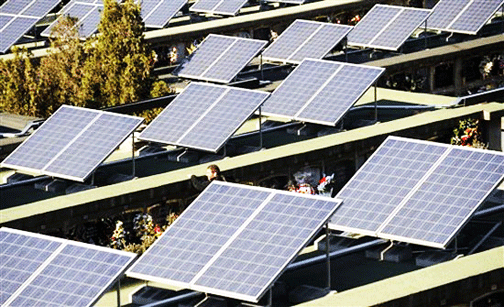
 Weatherwatch: long days of sunshine double electricity output http://www.guardian.co.uk/news/2012/jun/03/weatherwatch-sunshine-solar-power?newsfeed=true Paul Brown 3 June 2012 The last nine days of May saw a record production of solar power in Britain. The clear dry air meant sunlight was strong, more than doubling the daily average electricity output. Long hours of daylight are currently giving the thousands of households that invested in solar power under the original high level of subsidy considerable income. Continue reading
1 This Month

Protect Sazan Island from the Trump family! https://secure.avaaz.org/campaign/en/protect_sazan_island_from_the_trump_family_loc/?bqFCVab&v=174511&cl=22707147157&_checksum=5e9dde668860e8231c33699735e16a1fbf22ab2cb01da50c999fe8732b9775ef&utm_source=email&utm_medium=blast_email&utm_campaign=174511


Cuba Is Not a Failed State – It Is a Besieged State
PETITION: “Global Appeal to Endorse Palestinian Right of Return of Refugees”
To see nuclear-related stories in greater depth and intensity – go to https://nuclearinformation.wordpress.com
-
Archives
- June 2026 (129)
- May 2026 (306)
- April 2026 (356)
- March 2026 (251)
- February 2026 (268)
- January 2026 (308)
- December 2025 (358)
- November 2025 (359)
- October 2025 (376)
- September 2025 (257)
- August 2025 (319)
- July 2025 (230)
-
Categories
- 1
- 1 NUCLEAR ISSUES
- business and costs
- climate change
- culture and arts
- ENERGY
- environment
- health
- history
- indigenous issues
- Legal
- marketing of nuclear
- media
- opposition to nuclear
- PERSONAL STORIES
- politics
- politics international
- Religion and ethics
- safety
- secrets,lies and civil liberties
- spinbuster
- technology
- Uranium
- wastes
- weapons and war
- Women
- 2 WORLD
- ACTION
- AFRICA
- Atrocities
- AUSTRALIA
- Christina's notes
- Christina's themes
- culture and arts
- Events
- Fuk 2022
- Fuk 2023
- Fukushima 2017
- Fukushima 2018
- fukushima 2019
- Fukushima 2020
- Fukushima 2021
- general
- global warming
- Humour (God we need it)
- Nuclear
- RARE EARTHS
- Reference
- resources – print
- Resources -audiovicual
- Weekly Newsletter
- World
- World Nuclear
- YouTube
-
RSS
Entries RSS
Comments RSS
 nuclear-news