Increasing global danger from nuclear weapons and nuclear power
the calculations used to assess risks posed by nuclear weapons and nuclear power are “fallible.”…. the risks posed by nuclear accidents, regional war, and nuclear terrorism are increasing…. “no nation is immune from risks involving nuclear weapons and nuclear power.”
 Risks from nuclear power and weapons are on the rise, Even established power faces a riskier nuclear environment. ArsTechnica, by James Holloway – June 7 2012, The risks posed by both nuclear weapons and nuclear energy are increasing. Nowhere is immune from these risks, and the methods used to assess them are imperfect. Continue reading
Half of the world’s nuclear reactors will be closed down by 2030
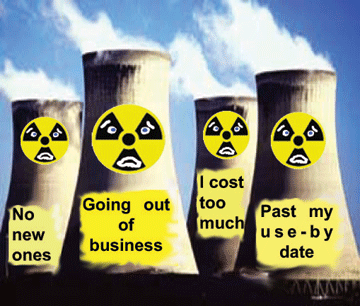 GlobalData’s report shows that more than 200 nuclear power stations across the world are expected to be closed by 2030, almost half of the number that are currently in operation.
Europe to Decommission Majority of Nuclear Power Stations by 2030 http://www.globaldata.com/PressReleaseDetails.aspx?PRID=174&Type=Industry&companyID=jpr Europe to Decommission Majority of Nuclear Power Stations by 2030 While US Bucks Global Trend 06 Jun 2012 Continue reading
Meningiomas are dangerous, ionising radiation is the only clearly known cause
meningiomas are not anywhere near so universal, and, despite the “benign” designation, can be dangerous, leading to severe disabilities, and, in rare cases, death.
 Radiation to the head and neck is the only well-defined cause found so far
No, ‘half of us’ don’t have a brain tumor like Sheryl Crow’s, MSNBC.com 7 June 12 Singer Sheryl Crow recently revealed she had been diagnosed with a meningioma, a type of brain tumor that accounts for nearly 30 percent of brain tumors in the U.S. More than 90 percent of them are benign. NBC’s Dr. Nancy Snyderman reports. By Brian Alexander Continue reading
Underwater solar panels
Solar Panels That Work Underwater, by Energy Matters, 8 June 12, Are solar powered submarines on the horizon? Not quite, but solar panels that can produce electricity under water could soon be used for a variety of important aquatic applications.
Scientists at the U.S. Naval Research Laboratory, Electronics Science and Technology Division, are working on developing “high bandgap” solar cells with the ability to generate enough electricity to operate equipment such as electronic sensor systems at depths of up to 9 meters. http://www.energymatters.com.au/index.php?main_page=news_article&article_id=3242
San Onofre nuclear power plant shut throughout the summer
 San Onofre nuclear plant out of service for the summer, LA Times, June 7, 2012 The top official at Edison International said Thursday that the troubled San Onofre nuclear plant will remain out of service through the summer.
The plant has been shuttered since Jan. 31 while officials probe the extent and cause of unusual wear on tubes that carry radioactive water in the plant’s newly replaced steam generators. Continue reading
Japanese lawmakers plan for new nuclear regulatory body
Opposition wins on nuke watchdog, Japan Times, Kyodo 7 June 12, The administration will effectively accept a plan proposed by opposition parties to set up an independent “nuclear regulatory commission,” lawmakers said following talks between ruling and opposition parties to explore amending a bill to create a new nuclear regulatory agency. Continue reading
UK’s Thorpe nuclear reprocessing plant not economically viable
Extending Thorp’s life would require investment “well in excess of £1bn”, the NDA said, including the construction of £600m of storage tanks for the highly-radioactive “liquor” that is produced by reprocessing.
 “It would be very expensive to carry on much longer,” said Bill Hamilton, head of stakeholder relations at the NDA. “If there was a market out there, there would be a reason to invest, but there is no major appetite.”
Cumbria’s reprocessing plant to close Financial Times -8 June 12 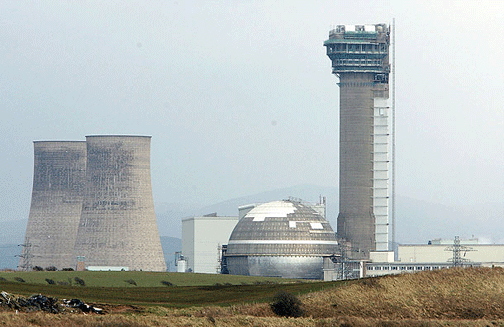
 By Rebecca Bream One of the more problematic facilities in the UK nuclear industry, the Thorp reprocessing plant at Sellafield in Cumbria, is set to close, reflecting a worldwide drop in demand for its services.
The Nuclear Decommissioning Authority, which is responsible for cleaning up the UK’s nuclear reactor sites and dealing with radioactive waste, said on Thursday that Thorp would close in 2018 when its existing reprocessing contracts end. Continue reading
Sellafield nuclear reprocessing to shut, but no plan for waste disposal!
and they still want to keep on making the stuff!
the authority said it was “still many years from making final decisions on the design” of the dump and even where it would be located.
Construction on the UK’s national nuclear waste dump, to be built deep underground, is expected to start in 2075, though a location has not yet been chosen.

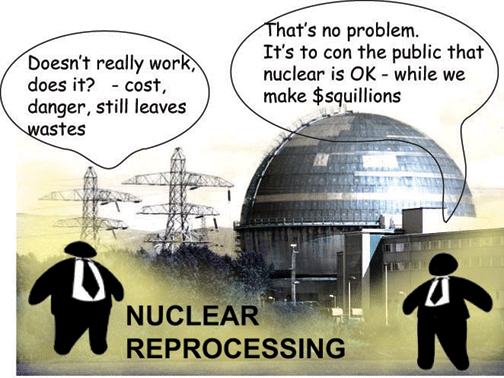 Controversial Thorp plant at Sellafield to be shut down, Irish Times, MARK HENNESSY, London Editor, 7 June 12, SELLAFIELD’S CONTROVERSIAL Thorp nuclear reprocessing plant is to close. The facility will be shut down in six years’ time, Britain’s Nuclear Decommissioning Authority has said.
The decision will mean that spent nuclear rods produced by the British nuclear industry after 2018 will have to be buried untreated in a temporary nuclear storage dump for up to a century.
“Our strategy to close Thorp following completion of the reprocessing contracts has potentially wider policy implications for spent fuel management in the UK,” the authority acknowledged. Continue reading
UK’s nuclear reprocessing plant to close
Sellafield’s Thorp plant to close, The Independent, ALAN JONES , EMILY BEAMENT 07 JUNE 2012 A nuclear reprocessing site which has been in operation for 20 years is to close in 2018 after current contracts are completed, it was confirmed today.
The Thermal Oxide Reprocessing Plant (Thorp) at Sellafield in Cumbria,
… was commissioned in the early 1990s…. The NDA said in a statement that the closure decision was confirmed after it completed a strategic review of the options for the management of oxide fuels.
It added: “Oxide fuels include the remaining overseas-derived spent fuels that are being stored at Sellafield pending reprocessing in Thorp and also the spent fuels coming from the UK’s fleet of AGR (advanced gas-cooled reactors) power stations owned and operated by
EDF Energy….. Other decommissioning and reprocessing facilities and waste treatment plants on the Sellafield site remain in operation.
Anti nuclear Pilgrim Watch in hearing by Atomic Safety and Licensing Board
Anti-nuclear activists in Mass. seek hearing, Boston Herald, By Associated Press, June 7, 2012 – Activists who say federal regulators haven’t done enough to fix nuclear power plant flaws exposed by last year’s accident in Japan are arguing a nuclear safety board should hear their case.
The Atomic Safety and Licensing Board met in Boston today to hear from attorneys for Pilgrim Watch, which opposes the Pilgrim Nuclear Power Station in Plymouth. The board was trying to determine if it should hold a broader evidentiary hearing about Pilgrim Watch’s claims….. A Pilgrim Watch attorney said even if the fixes make plants marginally
safer, they still don’t adequately protect the public, and that gives Pilgrim Watch standing to try to overturn them. ww.bostonherald.com/business/general/view/20120607anti-nuclear_activists_in_mass_seek_hearing/
The week that was, in nuclear news

Christina Macpherson’s websites & blogs
Renewable energy is where it’s all happening – from IRENA’s report on rapidly falling costs, and increasing investment – to the solar-powered plane that made a transcontinental journey. In recent hot days, solar power delivering high levels of electricity in Germany, UK, and USA (Massachusets)
Climate change is affecting nuclear reactors – due to heating of river waters . A problem which is likely to get worse, and cause frequent shutdowns
Nuclear power’s financial crisis. Nuclear companies scrambling to compete for overseas sales are now offering prices below their costs. Nuclear ‘dumping’ going on in the market? European countries – some abandoning nuclear power, others – England struggling with finance. France has huge problem as so many aging reactors near to closing
Japan‘s government mulling over 4 future energy options – 3 of which contain little or even no, nuclear power. Government wants to restart 2 nuclear reactors, but public opposition to that is growing, including opposition from MP’s in Japan’s ruling party. Japanese govt planning controversial “wide area incineration” of radioactive debris.
USA. New Vogtle nuclear power plant is turning out to be a money pit, cost overruns about $1 billion already, and they’ve only just started the build. NRC considering relicensing nuclear reactors so that they can run for 80years!
China. With an organised anti nuclear group campaigning, and concerns over costs, China’s new nuclear build is not yet happening – and the global nuclear lobby is watching China, anxiously.
Spain. Antinuclear activists fly over a nuclear reactor, drop smoke bombs on it – to demonstrate security risks.
Falling costs of renewable energy – International Renewable Energy Agency
 Renewable energy costs falling: Agency http://finance.ninemsn.com.au/newsbusiness/aap/8479949/renewable-energy-costs-falling-agency 7 June 12, Power from renewable energy sources is getting cheaper every year, according to a newly-released study, challenging long-standing myths that clean energy technology is too expensive to adopt.According to the study by the Abu Dhabi-based International Renewable Energy Agency and released on Wednesday, the costs associated with extracting power from solar panels has fallen as much as 60 per cent in just the past few years.
The price of generating power from other renewables, including wind, hydro power, concentrating solar power and biomass, was also falling.
“One of the (myths) out there perpetuated by industry lobby groups is that renewable energy is too expensive,” said Adnan Amin, IRENA’s director general. The numbers tell a different story, however, as “costs are falling
exponentially … and will continue (to do so) in the future,” said Amin arguing that electricity generation “is now cost-competitive with many traditional fossil fuel technologies”.
According to Dolf Gielen, director of IRENA’s innovation and technology centre, investment in renewables is no longer a niche but rather represents the “bulk of investments in global power generation,” accounting for half of the total annual capacity additions worldwide. ”The markets are growing very fast… and further cost reductions are
very likely,” he said adding that in 2011, investments in the supply side of renewable energy sources reached about $US260 billion ($A267.70 billion).
A second IRENA study released on Wednesday estimates renewables will create a minimum of four million jobs just in the electricity sector in rural areas of the developing world. Today, there are five million jobs world-wide in the renewable energy sector and more than 1.3 billion people, mainly in Africa and Asia, who do not have access to electricity, according to IRENA. ”There is considerable employment potential,” said Amin.
Founded in 2009, IRENA is an intergovernmental organisation established to promote the widespread use of renewable energy sources. It has more than 155 member states and is headquartered in Abu Dhabi.
Japan’s energy future could be nuclear free
 Japan considers nuclear-free future Options require big boost for renewable energy sources. Nature, David Cyranoski 06 June 2012 It’s official: nuclear power will have a much smaller role in Japan’s energy future than was once thought. Since the meltdowns and gas explosions at the Fukushima Daiichi nuclear power station in March 2011, all of Japan’s remaining reactors have been shut down for inspections and maintenance.
Last week the government offered a glimpse of their future, and that of the country’s nuclear power in general, when it published an outline of four ways to satisfy Japan’s future energy demands. One scenario recommends using a market mechanism to determine the nuclear contribution. Under the other three, nuclear power would supply at most one-quarter of Japan’s energy by 2030 — and in one case, none at all. Continue reading
The unraveling of Europe’s nuclear dream
And, no doubt, new technologies will be proposed that promise to solve all the problems of the past, while utilities will fight tooth and nail to keep existing plants online long after their expected life-span is complete.
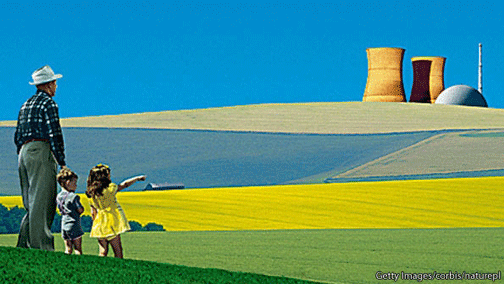
 Nuclear Europe: a dream unwinding, China Dialogue, Steve Thomas June 06, 2012“ Francois Hollande’s election victory is the latest blow to an industry struggling to revive the optimism of pre-Fukushima days. But the seeds of crisis were there well before Japan’s disaster, writes Steve Thomas. Prospects for nuclear power in post-Fukushima Europe are looking grim. Since the reactor meltdown in Japan last year, Germany, Switzerland and Italy have imposed phase-outs or abandoned attempts to start ordering new nuclear plants; the British programme has been delayed and one of the two remaining potential investors has dropped out; foreign investors are walking away from projects in eastern Europe, for example in Bulgaria and Romania; and France has elected a new president on an apparently anti-nuclear ticket.
With the leaders of Germany and France – two of Europe’s most powerful economies – now firmly in the “anti” camp, the outlook for nuclear power on the continent more widely is distinctly ropy. The Fukushima nuclear disaster of 2011, it seems on first glance, has been a devastating pill.
But while there is little doubt that the crisis in Japan significantly worsened the chances of a nuclear-powered Europe, it did so mainly by exacerbating problems that were already there – around cost, finance and public acceptance. It’s worth taking a moment to look at how these dynamics are playing out across the continent, and how they might impact Europe’s long-term energy agenda. Continue reading
China the nuclear lobby’s great hope – or is it?
Public opinion could also pose an obstacle. In a poll carried out by research agency Ipsos MORI after Fukushima, 42% of those surveyed in China were supportive of nuclear power – but that 48% were opposed. It
is also reported that public opposition and environmental concerns have led to the delay in construction of three inland nuclear power sites.
China’s nuclear developments probably matter more to the rest of the world than they do to China.

 Chinese nuclear goes global? China dialogue Antony Froggatt June 06, 2012 From Parisian boardrooms to Kazakh uranium mines, the nuclear industry anxiously awaits news from Beijing. …….
“…… the Fukushima crisis in Japan has had a significant – and under reported – impact on Chinese nuclear developments, triggering a freeze on the start of new construction, a re-consideration of the safety standards of domestic designs and unprecedentedly visible opposition to the building of new, inland nuclear plants. Continue reading
1 This Month

Protect Sazan Island from the Trump family! https://secure.avaaz.org/campaign/en/protect_sazan_island_from_the_trump_family_loc/?bqFCVab&v=174511&cl=22707147157&_checksum=5e9dde668860e8231c33699735e16a1fbf22ab2cb01da50c999fe8732b9775ef&utm_source=email&utm_medium=blast_email&utm_campaign=174511


Cuba Is Not a Failed State – It Is a Besieged State
PETITION: “Global Appeal to Endorse Palestinian Right of Return of Refugees”
To see nuclear-related stories in greater depth and intensity – go to https://nuclearinformation.wordpress.com
-
Archives
- June 2026 (129)
- May 2026 (306)
- April 2026 (356)
- March 2026 (251)
- February 2026 (268)
- January 2026 (308)
- December 2025 (358)
- November 2025 (359)
- October 2025 (376)
- September 2025 (257)
- August 2025 (319)
- July 2025 (230)
-
Categories
- 1
- 1 NUCLEAR ISSUES
- business and costs
- climate change
- culture and arts
- ENERGY
- environment
- health
- history
- indigenous issues
- Legal
- marketing of nuclear
- media
- opposition to nuclear
- PERSONAL STORIES
- politics
- politics international
- Religion and ethics
- safety
- secrets,lies and civil liberties
- spinbuster
- technology
- Uranium
- wastes
- weapons and war
- Women
- 2 WORLD
- ACTION
- AFRICA
- Atrocities
- AUSTRALIA
- Christina's notes
- Christina's themes
- culture and arts
- Events
- Fuk 2022
- Fuk 2023
- Fukushima 2017
- Fukushima 2018
- fukushima 2019
- Fukushima 2020
- Fukushima 2021
- general
- global warming
- Humour (God we need it)
- Nuclear
- RARE EARTHS
- Reference
- resources – print
- Resources -audiovicual
- Weekly Newsletter
- World
- World Nuclear
- YouTube
-
RSS
Entries RSS
Comments RSS
 nuclear-news