So far, 2012 USA’s warmest year on record
 Warmest U.S. Spring On Record: NOAA, PLanet Ark, 08-Jun-12, Deborah Zabarenko, So far, 2012 has been the warmest year the United States has ever seen, with the warmest spring and the second-warmest May since record-keeping began in 1895, the U.S. National Oceanic and Atmospheric Administration reported on Thursday. Continue reading
Japan should have evacuation plans, and evacuation costs paid by nuclear plant operatrors
Post-Fukushima safety standards should include a .. mechanism to deal with a large nuclear accident. For example, the owner of a plant could be required to work with the regulator to come up with a credible evacuation plan for the residents within an 80-kilometer (50-mile) radius of the installation…… The plan should aim for a complete evacuation within 24 hours….
It is also important to specify who pays for an evacuation…
Since power-plant operators have the largest influence on the probability of an accident, those companies should be required to bear this cost.

 How Japan Can Avert Nuclear Disaster Bloomberg, By Takeo Hoshi and Anil K Kashyap Jun 7, 2012 On May 5, the Tomari nuclear plant in Hokkaido shut down for routine maintenance, leaving Japan with no operating nuclear-power plants.
There is a confused debate over what to do next. Prime Minister Yoshihiko Noda has called for restarting the reactors at Ohi plant in Fukui, insisting that bringing them online is
imperative for the economy. Although the government may prevail, many Japanese remain skeptical about nuclear safety…… Continue reading
USA legislation introduced to boost renewable energy investment
Legislation Would Give Renewable Energy Investors Access To Tax Advantage in News Departments Policy Watch by SI Staff 08 June 2012 Sens. Chris Coons, D-Del., and Jerry Moran, R-Kan., have introduced the Master Limited Partnerships Parity Act (MLP Parity Act), legislation that is designed to level the energy playing field by giving investors in renewable energy projects access to a decades-old tax advantage that is currently available only to investors in fossil-fuel-based energy projects.
The Solar Energy Industries Association, among other organizations, has endorsed the legislation….. http://solarindustrymag.com/e107_plugins/content/content.php?content.10485
Natural Resources Defense Council (NRDC) ranks G20 nations on renewable energy
G20 Nations to be Ranked in Global Renewable Energy Scorecard, Sacramento Bee, By Natural Resources Defense Council, Washington, D.C., Jun. 8, 2012
WASHINGTON, – /PRNewswire-USNewswire/ –– On the eve ofthe Rio+20 Earth Summit, a new Natural Resources Defense Council (NRDC) report ranks the world’s biggest countries on their deployment of renewable energy and shows how better policies can significantly increase renewable energy deployment in the G20 countries and worldwide….. http://www.sacbee.com/2012/06/08/4548242/g20-nations-to-be-ranked-in-global.html#storylink=cpy
India’s solar-powered buses
Apoorva Renewable Energy to make solar-electric buses for transport body Business Line, BANGALORE, JUNE 8: Buses in Bangalore may soon be powered by solar energy. The Bangalore Metropolitan Transport Corporation (BMTC) has placed orders with Apoorva Renewable Energy Products to design solar-electric hybrid buses, the company CEO, Mr Suresh Babu, said on the sidelines of the Global Investors Meet 2012.
“The BMTC has asked us to provide a sample hybrid vehicle and we have accepted the order and will start working on it,” Mr Babu said. Several other government bodies such as the Bruhat Bengaluru Mahanagara Palike (BBMP) are in talks with the company too, he said.
The company makes three-wheeled vehicles powered by electric and solar power, and customises products for Indian conditions. “Using a common technology, we design products as per customer requirements and outsource the manufacturing,” Mr Babu said.
EXPORTS Currently, the company’s vehicles are used in Delhi and parts of Karnataka and it will start exporting in two months from now….. http://www.thehindubusinessline.com/companies/article3505672.ece
Japan’s re-opened nuclear plants will not be safe until after 2015
Filtered vents that could substantially reduce radiation leaks in case of an accident ; a radiation-free crisis management building; and fences to block debris washed up by a tsunami won’t be ready until 2015. This means the plant, as well as plant workers and residents, won’t be fully protected from radiation leaks in case of a Fukushima-class crisis…
Japan readies for reopening of nuclear reactors amid safety concerns, guardian.co.uk, 8 June 2012 Prime minister Yoshihiko Noda assures citizens’ safety and says reactors must be restarted to boost economy… Prime minister Yoshihiko Noda said the government has taken ample safety measures to ensure the two reactors in western Japan would not leak radiation ifan earthquake or tsunami as severe as last year’s should strike them. Continue reading
All Africa Renewable Energy Conference for October
Africa: First African Renewable Energy Confab in Accra All Africa, BY AYUUREYISIYA KAPINI ATAFORI, 8 JUNE 2012 The first conference in Africa solely focused on off-grid renewable energy technologies will be held in Accra in October this year with a special look at applications in rural communities of developing countries….. Continue reading
Russia’s Putin backs Iran’s nuclear developments
Putin says Iran has ‘absolute’ right to nuclear energy, Tehran Times, 8 June 12 TEHRAN – President Vladimir Putin calls Iran a close friend of Russia and says Iran has “absolute right” to nuclear technology for peaceful purposes.
In a meeting with President Mahmoud Ahmadinejad on the fringes of the Shanghai Cooperation Organization summit in Beijing on Thursday, Putin also said, “Russia has always defended the rights of the Iranian nation in all international organizations and considers peaceful use of nuclear energy as the absolute right of the Islamic Republic of Iran.”
The remarks by Putin come as Iran and the 5+1 group (the five permanent members of the UN Security Council and Germany) are preparing to hold nuclear talks in Moscow on June 18-19…. http://tehrantimes.com/politics/98558-putin-says-iran-has-absolute-right-to-nuclear-energy
Japan mulling over energy options for the future
A key element in the national dialogue will be the future energy mix for Japan to 2030. Three advisory committees – to METI, Environment and Cabinet – have been consulted and the government is ready to put out three options for public consultation
The government appears to have got the message that the public want more choice in their energy supply.
It will be interesting to see what happens when they let the public have their say.
Japan’s energy dilemma: a renewables embrace?, Climate Spectator, 8 Jun 2012. Gwen Andrews “……..modeling by the Institute of Energy Economics of Japan demonstrates the immensely difficult choices the country is facing……
The announcement of the restarts may be twinned with another announcement, of a ‘national dialogue’ on future energy policy. Japan reviews its energy policy plan every three years, with the last review completed in June 2010. The events of ‘3/11’, as the Japanese call the tsunami disaster, has brought forward a fierce debate on where the
country goes from here.
The debate is notable in that it is front page news, Continue reading
Ambitious solar energy plans in Middle East and North Africa
 Solar Power Rises in the Mideast, North Africa, CNBC, 7 June 12, ”….A number of recent developments highlight the push for renewable energy in the MENA region, from Saudi Arabia’s ambitious solar plans to Qatar’s first-ever polysilicon plant and massive concentrated solar power plants across North Africa. Continue reading
Legislation to help USA renewable energy, by way of tax code
Tweaking US tax code could spur green energy: senator, Climate Spectator, 8 Jun 2012, Reuters WASHINGTON, – A freshman U.S. Democratic senator thinks he may have found a way to encourage investment in wind, solar and biofuel projects without sapping too many taxpayer dollars or injecting new venom into a bitter partisan battle over energy incentives.
Chris Coons introduced legislation on Thursday that would allow a broad range of renewable power generation and transmission projects to qualify for a tax structure used widely by pipeline and other energy-related companies.
The bill is unlikely to be considered until after the November presidential election, but may give lawmakers food for thought as they wrestle with whether to extend tax breaks for green energy set to expire this year….. http://www.climatespectator.com.au/news/update-1-tweaking-us-tax-code-could-spur-green-energy-senator-0
Indian government treats anti nuclear citizens as mentally ill
If anything, then, the really delusion-prone people are on the other side, in the Department of Atomic Energy (DAE) and Nuclear Power Corporation of India Limited (NPCIL). The day the Fukushima crisis took a turn for the worse last year, with hydrogen explosions ripping through three reactors, DAE secretary Sreekumar Banerjee said the blasts were “purely a chemical reaction and not a nuclear emergency …”. NPCIL chairman SK Jain went one better: “There is no nuclear accident….It is a well-planned emergency preparedness programme …“

 No margin for error Hindustan Times Praful Bidwai June 04, 2012 When it comes to thrusting nuclear power down the throats of unwilling people, official India sets a record of violations of dignity and rights that is embarrassing. Which other government but India’s maligns all anti-nuclear protesters as foreign-inspired and lacking any agency? Where else would the police file 107 FIRs against 55,795 peaceful anti-nuclear protesters, but at Koodankulam, charging 6,800 with “sedition” and ”waging war against the State”?
And which other government has asked a psychiatric institution, in this case, the National Institute of Mental Health and Neuro-Sciences (Nimhans), to “counsel” people and convince them that the project, despite the hazards, is good for them?
To its discredit, Nimhans despatched psychiatrists to Koodankulam to ”get a peek into the protesters’ minds” and help these insane people to “understand the importance” of the plant. According to reports quoting its director, Nimhans has “commenced the collection of primary data” and is now seeking “field reactions” to write “multiple strategies” to address “the problem” (the opposition to nuclear power).
Such opposition is thus equated with schizophrenia, fear of sexual intimacy, paranoia or craving for victimhood, to be cured by drastic means. By this criterion, more than 80% of the people of Japan, Germany, France and Russia – who oppose new nuclear plants – must be considered abnormal. Continue reading
Ionising radiation moves up in the marine food chain
 Radiation and Mercury in Fish: Should Americans be Concerned? One Green Planet June 5, 2012 by Joseph Keon: The May 29th issue of the Proceedings of the National Academy of Sciences reported that fish caught off the California coast in 2011 by researchers from Stony Brook University in New York were contaminated with radioactive waste from the crippled Fukushima nuclear power facility.
The radioactive isotopes cesium-137 and cesium-134 were found in blue fin tuna at levels ten times higher than in the years prior to the accident, roughly four months after the waste was released into the ocean. Seven months after the accident, Japan’s Fisheries Agency reported broad-spread radioactive contamination (up to 100 percent) in fish caught both in Japanese coastal waters and hundreds of miles away.
Problems with Radioactive Waste Predate Fukushima Even before Fukushima, fish have been shown to carry radioactive waste from the nuclear industry. Tests of salmon from six British supermarkets revealed contamination by the radioactive isotope technetium-99, which has also been found in lobster and shellfish, and has been traced to Britain’s Sellafield nuclear reprocessing plant, even though the fish were raised hundreds of miles away.
According to James Waczewski of Florida State University, author of Legal, Political, and Scientific Response to Ocean Dumping, the United States has dumped an estimated 112,000 containers of long-lived radioactive nuclear waste into the Pacific and Atlantic oceans at 30 different sites. A U.S. Senate ruling has since imposed a moratorium on this practice, but nuclear power plants continue to discharge radioactive waste-water into the world’s oceans daily.
No Fish from the Ocean Is Protected Because ionizing radiation from nuclear waste is a carcinogen,
radioactivity in fish is a disturbing reality. Yet even without the Fukushima disaster, the world’s fish supply has become a dubious source of nutrition…….
Although we seldom see the waste floating on the surface of the oceans, if we’re willing to test it, we find that sea life has become our proverbial “canary in the coal mine,” clearly revealing the hidden truth of all that has infiltrated the world’s oceans. Some bodies of water are vastly more polluted than others, but one toxin, mercury, permeates the world’s oceans to such a degree that no fish (and no one who eats fish) is protected.
Mercury in Fish Mercury is a toxic substance that can devastate the nervous system,
leading to lower intelligence and compromised fine motor skills. …..
http://www.onegreenplanet.org/animalsandnature/radiation-and-mercury-in-fish-should-americans-be-concerned/
Fukushima nuclear disaster remains a problem for the whole world
324 Civic organizations from all over the world have submitted a petition called “An Urgent Request for UN Intervention to Stabilize the Fukushima Unit 4 Spent Nuclear Fuel”, Mr. Murata said noting that those organizations are also demanding a moratorium on Japan’s nuclear reactors.
”the nuclear village and nuclear dictatorship is exposed, and public opinion and their movements are strong.”Nuclear village is a term for the Japanese distorted social structure in which the pronuclear politicians, scholars and companies have more power than those who are skeptical of nuclear energy. Anti-nuclear protests have been ignored for more than 40 years.
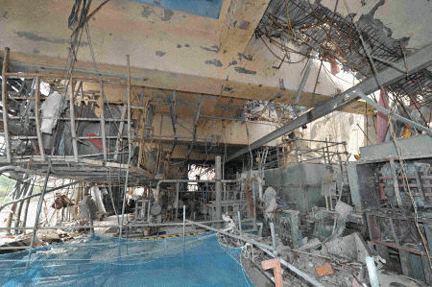 Fukushima Reactor Global Security Issue: Japanese Former Diplomat http://www.panorientnews.com/en/news.php?k=1784, June 7, 2012 Tokyo- (PanOrient News)The Fukushima Daiichi Nuclear Plant Number 4 reactor presents a security problem for the entire world, Mitsuhei Murata, Japan’s former ambassador to Switzerland said.
Fukushima Daiichi plants are “not under control at all… and the situation with nuclear reactors in Japan is like vehicles being driven without a license,” Mr. Murata told a news conference at the foreign correspondents’ club of Japan on June 5. Continue reading
Despite local government opposition, China funding new nuclear plant in Wangjiang
The Pengze project made headlines in February, when the Wangjiang County government openly opposed its construction on grounds that the site selection was based on unreliable population and seismic activity data.
The County government also alleges that the firm used gifts to entice villagers into agreeing to the plans.
 Controversial China nuclear plant funding resumes, Market Watch, Jiangxi nuclear plant gets funding in sign building freeze is ending By Lu Bingyang and Wang Yong BEIJING ( Caixin Online )7 June 12, — One of China’s pioneering inland nuclear power projects has received another capital injection after the government put nuclear development on hold due to last year’s disaster in Japan. Continue reading
1 This Month

Protect Sazan Island from the Trump family! https://secure.avaaz.org/campaign/en/protect_sazan_island_from_the_trump_family_loc/?bqFCVab&v=174511&cl=22707147157&_checksum=5e9dde668860e8231c33699735e16a1fbf22ab2cb01da50c999fe8732b9775ef&utm_source=email&utm_medium=blast_email&utm_campaign=174511


Cuba Is Not a Failed State – It Is a Besieged State
PETITION: “Global Appeal to Endorse Palestinian Right of Return of Refugees”
To see nuclear-related stories in greater depth and intensity – go to https://nuclearinformation.wordpress.com
-
Archives
- June 2026 (129)
- May 2026 (306)
- April 2026 (356)
- March 2026 (251)
- February 2026 (268)
- January 2026 (308)
- December 2025 (358)
- November 2025 (359)
- October 2025 (376)
- September 2025 (257)
- August 2025 (319)
- July 2025 (230)
-
Categories
- 1
- 1 NUCLEAR ISSUES
- business and costs
- climate change
- culture and arts
- ENERGY
- environment
- health
- history
- indigenous issues
- Legal
- marketing of nuclear
- media
- opposition to nuclear
- PERSONAL STORIES
- politics
- politics international
- Religion and ethics
- safety
- secrets,lies and civil liberties
- spinbuster
- technology
- Uranium
- wastes
- weapons and war
- Women
- 2 WORLD
- ACTION
- AFRICA
- Atrocities
- AUSTRALIA
- Christina's notes
- Christina's themes
- culture and arts
- Events
- Fuk 2022
- Fuk 2023
- Fukushima 2017
- Fukushima 2018
- fukushima 2019
- Fukushima 2020
- Fukushima 2021
- general
- global warming
- Humour (God we need it)
- Nuclear
- RARE EARTHS
- Reference
- resources – print
- Resources -audiovicual
- Weekly Newsletter
- World
- World Nuclear
- YouTube
-
RSS
Entries RSS
Comments RSS
 nuclear-news