USA’s nuclear plant relicensing now stalled by a federal appeals court
at Indian Point and other facilities going through license renewal, those [radioactive waste] issues will be back on the table

 Court Forces a Rethinking of Nuclear Fuel Storage , NYT, By MATTHEW L. WALD , June 8, 2012, WASHINGTON — The Nuclear Regulatory Commission acted hastily in concluding that spent fuel can be stored safely at nuclear plants for the next century or so in the absence of a permanent repository, and it must consider what will happen if none are ever established, a federal appeals court ruled on Friday .
The commission has relied on its conclusion that spent fuel rods can be safely stored at plants to extend the operating licenses of dozens of power reactors in recent years and to license four new ones. Continue reading
Comparing USA nuclear reactors with Fukushima reactors
nuclear reactors in the United States were built during the same time period as the Fukushima reactor, before 1980. These reactors were all built using the same 80-year-old technology, which is to say they’re all just as outdated as Fukushima and the materials and equipment used are all beginning to show the same signs of wear and tear.
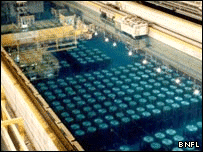 What makes this scenario even more alarming is that Gundersen says the reactors in the United States hold 4-5 times more nuclear waste than the Fukushima reactor.
Fukushima forum: Arnie Gundersen compares U.S. and Japanese nuclear reactors http://www.examiner.com/article/fukushima-forum-arnie-gundersen-compares-u-s-and-japanese-nuclear-reactors by Donna Anderson, 10 June 12 John B. Wells was at the helm for the Fukushima forum on the Saturday, June 9, 2012 edition of Coast to  Coast AM . The first guest was Arnie Gundersen who appeared on the show to share his expertise in the area of nuclear engineering and to make the American public more aware of the potential danger hiding in their own backyard.
Gundersen, who holds a master’s degree in nuclear engineering, has manged and coordinated design efforts for 70 nuclear reactors in the United States and has more than 40 years experience in nuclear power engineering. He’s currently working on the AP1000 nuclear power generator being built in South Carolina.
According to Gundersen the nuclear reactors in the United States were built during the same time period as the Fukushima reactor, before 1980. These reactors were all built using the same 80-year-old technology, which is to say they’re all just as outdated as Fukushima and the materials and equipment used are all beginning to show the same signs of wear and tear. Continue reading
Nuclear weapons industries control USA policy on military spending
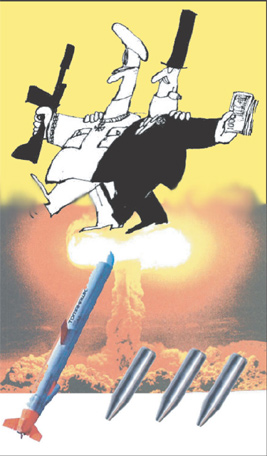 The Nuclear Weapons Industry’s Money Bombs, How millions in campaign cash and revolving-door lobbying have kept America’s atomic arsenal off the chopping block. — Mother Jones, By R. Jeffrey Smith, Center for Public
Integrity Jun. 6, 2012 Employees of private companies that produce the main pieces of the US nuclear arsenal have invested more than $18 million in the election campaigns of lawmakers that oversee related federal
spending, and the companies also employ more than 95 former members of Congress or Capitol Hill staff to lobby for government funding, according to a new report. Continue reading
Taxpayers’ huge costs for nuclear power mishaps
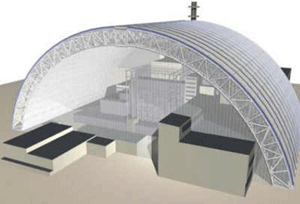 During a visit to Chernobyl in April, I learned about a new project to build, by 2015, a “shelter” to lock in the radiation still emanating from the reactor. The price tag is estimated at 1.5 billion euros ($1.9 billion). But this sarcophagus is no more than a wildly expensive Band-Aid, which will be ripped off a still-festering wound in 100 years.
Then there is the issue of who pays to build such facilities. In principle, private capital does not flow to nonprofit activities. In fact, it is flowing to renewable energy sources, not atomic.
It is governments—and thus taxpayers and bondholders—that finance nuclear plants. Moreover, the alleged “cost-savings” of nuclear power never include the price tag for direct and indirect governmental subsidies, decommissioning of aging facilities, and emergency cleanup and remediation of impacted communities when disasters occur—all, again, at taxpayers’ expense.

The road from Chernobyl, By: Alexander Likhotal, Philippine Daily Inquirer, June 11th, 2012 “……. While nuclear energy’s advocates often claim that there have been only two major calamities, a very different picture emerges if we consider other “accidents” that caused loss of human life or significant property damage.
Between 1952 and 2009, at least 99 nuclear accidents met this definition worldwide, at a cost of more than $20.5 billion, or more than one incident and $330 million in damage every year. This recurrence rate demonstrates that many risks are not being properly managed or regulated, which is worrying, to say the least, especially given the harm that even a single serious accident can cause. Continue reading
World Health Organisation dancing to nuclear lobby’s tune on Fukushima radiation?
 Dr. Caldicott says the WHO only focuses on
  thyroid cancer and ignores all other cancers and other radiation related diseases.
“There is a substantially increased incidence of thyroid tumors among exposed children, up to 50 percent of those tested by ultrasound. But instead of biopsying these tumors, they are ‘following’ them, i.e. doing nothing, which means they are
not being diagnosed and many of these children are therefore destined to die, because almost certainly
many of the tumors will be malignant,” …. She is far from alone in her views.
The Fukushima Battleground Over Science, By Aron Lamm, Epoch Times, 8 June 12, More than a year after the Fukushima nuclear incident, there is still much disagreement about many aspects of its actual consequences. A recent example is a report by the World Health Organization, which estimates radiation doses and cancer risks in the wake of the disaster.
Its findings are being criticized by other medical professionals who use different assumptions and different science, and accuse the WHO of downplaying the gravity of the health risks for people living in the affected area…… Continue reading
Decommissioning nuclear reactors, expensive, but prudent, and cheaper than an accident
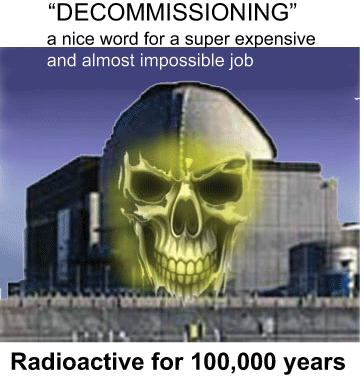 Europe’s approach is the prudent one…….America’s approach is to play russian roulette with 105 reactors that are already showing plenty of signs of serious wear and tear
 Pro uranium mining bias in Nunuvat’s supposedly independent report
 “It is not clear why the GN chose to have its background document prepared by Golder and Associates, a consultancy that depends on the mining industry (including uranium mining), rather than either developing it internally or seeking an independent consultant,”
Nunavut group says uranium policy process biased, Questions hiring of consultant with mining industry clients CBC News Jun 8, 2012 A Nunavut group opposed to uranium mining says the territorial government’s consultation process for forming its official uranium policy , which supports mining — with conditions, was biased. Continue reading
Decommissioning is far cheaper than radioactive fallout cleanup!
1. The TEPCO Gang controlled Labor Middlemen are also making a killing off this Trillion Dollar Eco-Disaster, by providing disposable labors like the original 50 responders whose records seem to have vanished, while making BIG money for TEPCO… See: http://is.gd/Ljj4Ff
2. Regarding the highly radioactive material itself:
I wonder if any of the Japanese Leaders are asking (on or off the record), what happened to all the highly radioactive materials that are now missing from Fukushima and what they are doing to recover them ASAP. Since it is true that that TEPCO is using GANG supplied labor then it must be worrisome that much of this highly radioactive material may have been stolen to be later sold to terrorist organizations because of it’s dirty weapon potential for BIG money! I hope some future terrorist dirty explosion does not contain Fukushima radioactive debris, as it will give the phrase “Made in Japan” a new meaning!
A comment from Capt D on http://www.washingtonpost.com/blogs/ezra-klein/post/how-hard-is-it-to-dismantle-150-nuclear-reactors-europes-about-to-find-out/2012/06/09/gJQA2EH0PV_blog.html
How to get USA off its energy addiction
1. First priority is to shut down Nuclear reactors and eliminate the
….. destroy any land based nuclear reactor, any place anytime 24/7/365!
2. Modernize all existing Coal generation to ultra clean exhaust (like Germany will do)
…..until newly installed Solar can take their “load” starting with the dirtiest ones NOW!
3. Use Natural Gas to supply “fuel” where coal will not be as cost effective.
4. Increase DEMAND (pun intended) for Solar of all flavors supplied by requiring them
… To be MADE IN THE USA units, and also create a huge number of new JOBS here…
5. Require 10 mpg increases to vehicle fleet averages every five (5) years, if not sooner.
6. New tax rebates for electric vehicles, if they replace ones over 10 years old!
7. Improve CA’s grid, so that many more residential panels can help power the State…. + Pay all energy providers the same amounts for Energy put into the grid.
Europe’s challenge in decommissioning 150 nuclear reactors
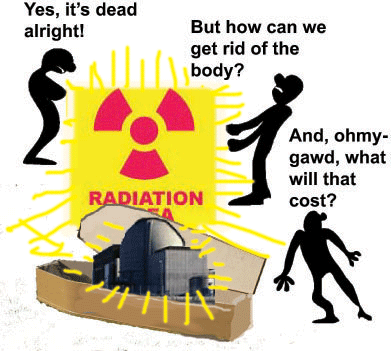 How hard is it to dismantle 150 nuclear reactors? Europe is about to find out http://www.washingtonpost.com/blogs/ezra-klein/post/how-hard-is-it-to-dismantle-150-nuclear-reactors-europes-about-to-find-out/2012/06/09/gJQA2EH0PV_blog.html
Brad Plumer, 06/09/2012 Last year, after the tsunami and reactor meltdown in Fukushima, Japan, many European nations decided to phase out their existing fleets of nuclear power plants. Germany and Belgium are aiming to end all atomic generation by 2030. Switzerland is shooting for 2035.
Not so easy to get rid of. Yet the mere act of shutting down those reactors is going to pose a huge challenge in the years ahead. Continue reading
Fukushima radiation worse than we’ve been told
The meltdown at Fukushima is releasing far more radiation into the atmosphere [than the Nagasaki A bomb] and if unit 4 were to tumble, it would have the same effect as 1,100 A-bombs….. much more radiation than we’ve been led to believe has made its way to the American shores.
Fukushima forum: Dr. John Apsley says U.S. is feeling the effects of radiation, Donna Anderson Coast to Coast Radio Examiner 10 June 12, Dr. John Apsley appeared on the Fukushima forum on Coast to Coast AM on Saturday, June 9, 2012 .
For more than 30 years Dr. Apsley , author of “Fukushima Meltdown & Modern Radiation: Protecting Ourselves and Our Future Generations ” has specialized in cell regeneration and accelerated wound repair. He appeared on the show to deliver his findings on the effects of
Fukushima radioactive fall-out on the Japanese people, as well as Americans. Continue reading
African and Islander nations going for small scale, off-grid, renewable technology
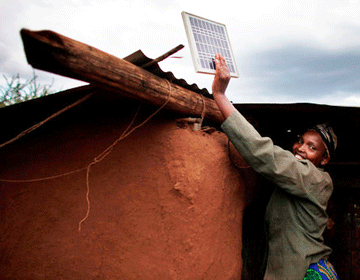 Africa: First African Renewable Energy Confab in Accra All Africa, BY AYUUREYISIYA KAPINI ATAFORI, 8 JUNE 2012 “….Off-grid technology is extremely important throughout Africa with many of the continent?s inhabitants without access to the grid.
…….A pioneering role in renewable energy development in Africa has been taken by Cape Verde. The West African islands have set a goal of 50 per cent renewable energy by 2020. Abrao Andrade Lopez, Director General of the Ministry of Industry and Energy, announced that the country was currently running a study to explore how to achieve 100 per cent renewable energy.
In a related development, decreasing dependency on oil imports encouraged 39 of the small island developing states (SIDS) in Africa, the Caribbean, the Indian Ocean and the Pacific to meet in Barbados to work out energy efficiency plans.
Islands like Tonga and Tokelau plan to become fully energy independent by 2013, and others are following suit. The small island developing states are writing the stories of their future, said Veerle Vandeweerd, Director of Environment and Energy at the United Nations Development Programme (UNDP). Continue reading
Japanese government ‘in the pocket of the nuclear industry’ will restart reactors
“By ignoring them and continuing his reckless push to restart Ohi, prime minister Noda is compromising the health and safety of millions, and showing just how deep his government is in the pocket of the nuclear industry,”

U-turn on nuclear as Japan PM decides: ‘We can’t do without it’ Scotsman.com 9 June 2012 Japan’s prime minister has ruled that two mothballed nuclear reactors in the west of the country must be restarted to protect jobs and ensure the “survival of society”, risking a backlash amid safety fears more than a year after the Fukushima disaster. Continue reading
USA federal ruling means delay in licensing of nuclear power plants
The New York attorney general’s office said the ruling means the NRC cannot license or relicense any nuclear power plant until it examines those risks. That process could take a couple of years, Geoff Fettus, an attorney who argued in court on behalf of the Natural Resources Defense Council, told msnbc.com.
“The need for a new strategy is urgent,” the panel wrote in its report, “not just to address these damages and costs but because this generation has a fundamental, ethical obligation to avoid burdening future generations with the entire task of finding a safe, permanent solution for managing hazardous nuclear materials they had no part in creating.”

 Nuclear headache: What to do with 65,000 tons of spent fuel, By Miguel Llanos, msnbc.com http://usnews.msnbc.msn.com/_news/2012/06/08/12127578-nuclear-headache-what-to-do-with-65000-tons-of-spent-fuel?lite In a blow to the nuclear energy industry, a federal appeals court on Friday threw out a rule allowing plants to store spent nuclear fuel onsite for decades after they’ve closed, and ordered regulators to study the risks involved with that storage – 65,000 tons now spread across the country, and growing at 2,000 tons a year.
The Nuclear Regulatory Commission “apparently has no long-term plan other than hoping for a geologic repository,” the unanimous ruling stated . “If the government continues to fail in its quest to establish one, then SNF (spent nuclear fuel) will seemingly be stored on site at nuclear plants on a permanent basis. The Commission can and must assess the potential environmental effects of such a failure.” Nuclear plants have been storing spent fuel onsite for decades and the NRC recently said, barring a repository, they may continue to do so even after they shut down. Continue reading
Fukushima radiation added to human impact on oceans
 Fukushima radiation is showing up in tuna caught off the California coast. A new study published in The Proceedings of the National Academy of Sciences says that bluefin tuna caught off America’s West Coast are carrying radiation from the nuclear power plant in Fukushima badly damaged in a tsunami last year. Fortunately, the radiation is not at levels that would be harmful to humans…… Video bonus: It’s hard to find a better ambassador for the sea than Sylvia Earle, who’s been exploring the deep for more than 40 years. Here’s her TED talk from a few years ago, but it’s more relevant than ever
Roiling in the Deep, Smithsonian.com, 8 June 12“…… marine biologist Callum Roberts wrote in Newsweek, “With an ever-accelerating tide of human impact, the oceans have changed more in the last 30 years than in all of human history before……. Since today is World Oceans Day, here’s a rundown of 10 things we now know about the sea that we didn’t a year ago. Continue reading
1 This Month

Protect Sazan Island from the Trump family! https://secure.avaaz.org/campaign/en/protect_sazan_island_from_the_trump_family_loc/?bqFCVab&v=174511&cl=22707147157&_checksum=5e9dde668860e8231c33699735e16a1fbf22ab2cb01da50c999fe8732b9775ef&utm_source=email&utm_medium=blast_email&utm_campaign=174511


Cuba Is Not a Failed State – It Is a Besieged State
PETITION: “Global Appeal to Endorse Palestinian Right of Return of Refugees”
To see nuclear-related stories in greater depth and intensity – go to https://nuclearinformation.wordpress.com
-
Archives
- June 2026 (129)
- May 2026 (306)
- April 2026 (356)
- March 2026 (251)
- February 2026 (268)
- January 2026 (308)
- December 2025 (358)
- November 2025 (359)
- October 2025 (376)
- September 2025 (257)
- August 2025 (319)
- July 2025 (230)
-
Categories
- 1
- 1 NUCLEAR ISSUES
- business and costs
- climate change
- culture and arts
- ENERGY
- environment
- health
- history
- indigenous issues
- Legal
- marketing of nuclear
- media
- opposition to nuclear
- PERSONAL STORIES
- politics
- politics international
- Religion and ethics
- safety
- secrets,lies and civil liberties
- spinbuster
- technology
- Uranium
- wastes
- weapons and war
- Women
- 2 WORLD
- ACTION
- AFRICA
- Atrocities
- AUSTRALIA
- Christina's notes
- Christina's themes
- culture and arts
- Events
- Fuk 2022
- Fuk 2023
- Fukushima 2017
- Fukushima 2018
- fukushima 2019
- Fukushima 2020
- Fukushima 2021
- general
- global warming
- Humour (God we need it)
- Nuclear
- RARE EARTHS
- Reference
- resources – print
- Resources -audiovicual
- Weekly Newsletter
- World
- World Nuclear
- YouTube
-
RSS
Entries RSS
Comments RSS
 nuclear-news