Nuclear power plans on the back burner in Southeast Asia
 In Malaysia, the government has quietly put a proposal to build two 1,000 MW nuclear power plants “on the back burner,” said a senior government source.
The decision came after environmentalists targeted a plan by Australian rare earths miner Lynas Corp to commission a processing plant in central Malaysia that would have to dispose of radioactive waste….
 Analysis: Southeast Asia goes slow on nuclear, Reuters, By John Ruwitch HANOI Feb 2, 2012 ”…..Vietnam, Indonesia, Malaysia, the Philippines, Thailand and Singapore are among some 35 countries considering going down the nuclear path, likely doubling the number of operational reactors in the next few decades, according to Lloyds Register.
But even the most ambitious plans will run up against barriers and constraints. In most Southeast Asian countries where there is interest in nuclear power, politics are holding it back. Indonesia’s National Atomic Energy Agency has been researching reactors for more than four decades and preparing the human resources, but the political will is lacking. Continue reading
Malaysia facing radioactive threat from Australian rare earths company Lynas
 Malaysian group to file suit to challenge approval for Aussie rare earth plant Washington Post, : February 2 LAWSUIT PLANNED: A Malaysian group representing villagers and civil groups will file a legal challenge to the government’s decision to approve a $230 million rare earths plant by Australian miner Lynas Corp., a lawmaker said Thursday. http://www.washingtonpost.com/business/industries/malaysian-group-to-file-suit-to-challenge-approval-for-aussie-rare-earth-plant/2012/02/02/gIQAmIwDlQ_story.html
 Key victory, but battle is not over yet BY: ROWAN CALLICK, : The Australian February03, 2012 ”….Environmental concerns have been driving greater political involvement in Malaysia as the population becomes better educated.
Growing ecological awareness has provided a common cause for middle-class activists of the three races — Malays, Chinese and Indians — who have tended otherwise to be divided by the country’s political parties…. The plant approval intensifies the need for Lynas to operate it impeccably and to build its community relations, because an election is almost certain to be called in Malaysia later this year. Opposition leader Anwar Ibrahim has already warned that his three-party coalition would scrap the plant if it wins the election.
 Fuziah says Lynas plant will scare off other investors, The Malaysian Insider, By Shannon Teoh January 31, 2012 KUALA LUMPUR, — Kuantan MP Fuziah Salleh has hit back at Lynas Corp, insisting that the presence of the Australian miner’s RM2.5 billion rare earth plant would deter investors from Pahang.
Earlier today, Lynas executive chairman Nicholas Curtis warned against any move by Pakatan Rakyat (PR) to shut the company’s refinery, which has raised fears of radiation pollution, saying such action would deter foreign investors.
Fuziah, who has led protests by locals and environmentalists against the plant, said yesterday the federal opposition would shut down the plant if it won a general election that must be called by May next year.
“Would any foreign investor want to site their operations right beside a rare earth plant? Would companies like Siemens want to set up near Lynas?
“This is not a strategic investment in terms of risk versus benefit. We don’t need rare earth to be high-tech. Germany doesn’t have rare earth,” she told The Malaysian Insider……
“(PAS spiritual leader) Datuk Nik Abdul Aziz Nik Mat has said if you want to close down Lynas, vote for Pakatan. (Opposition Leader) Datuk Seri Anwar Ibrahim has also said the same.
“I am not just anybody. I am PKR vice president and a member of the Pakatan leadership council,” she said.
The Australian miner said last week it expects the start of operations to be delayed to the second quarter from the first quarter of this year.
The plant was due to start operations in September last year but Putrajaya bowed to public pressure last April after sustained opposition from local residents and environmentalists and put the project on ice pending the review by the International Atomic Energy Agency (IAEA).
In July 2011, the government agency adopted 11 recommendations set out by the review of the refinery and said it would not allow Lynas to begin operations or import rare earth ore until all conditions, which include a comprehensive, long-term and detailed plan for managing radioactive waste, are met.
However, AELB has said Lynas Corp failed to meet any of the conditions in its first proposals…. http://www.themalaysianinsider.com/malaysia/article/fuziah-says-lynas-plant-will-scare-off-other-investors
Nuclear power has huge, ? insuperable problems
Disadvantages of nuclear energy, Biofuelswatch, by Max Rutherford, February 1st 2012 Nuclear Waste The biggest problem with nuclear power plants is the waste created during the generation of energy as an unwanted and dangerous byproduct. All waste products from a nuclear power plant are radioactive and thus they are detrimental to almost all kinds of living beings. What is even more hazardous is the fact that they remain radioactive and dangerous for thousands of years, which makes them virtually a permanent hazard. Continue reading
Birds and radiation fallout
not sure of the reliability of this one
Bird life badly hit by nuclear fallout in Japan The Irish Times – February 3, 2012, DAVID McNEILL in Tokyo RESEARCHERS WORKING in the irradiated zone around the disabled Fukushima nuclear plant say bird populations there have begun to dwindle, in what may be a chilling harbinger of the impact of radioactive fallout on local life. Continue reading
USA govt does not want monitoring of radiation near Savannah River Nuclear Site
 U.S. Department of Energy won’t help Georgia monitor radiation near Savannah River Nuclear Site The Augusta Chronicle By Rob Pavey Feb. 2, 2012 The U.S. Department of Energy will not honor its 2010 offer to help Georgia’s Environmental Protection Division restore a program to monitor radiation levels in Georgia counties near Savannah River Site…..
The intent of the monitoring, which includes analysis of water, soil, vegetation and air, is to determine off-site effects from SRS – and to provide independent data to compare with
extensive sampling already conducted by DOE on both sides of the Savannah River.
Anti-nuclear activists who lobbied for the restoration of the Georgia program said the Department of Energy’s about-face is disturbing. “The DOE’s obstruction to environmental monitoring in Georgia is a gross example of environmental injustice,” said Bobbie Paul, the
director of Georgia Women’s Action for New Directions. “Radiation does
not acknowledge state boundaries.” In 2010, then DOE Assistant Secretary Ines Triay pledged that monitoring would be restored to Georgia with a five-year contract independent of any restrictions from SRS.
“The money was never sent and in July 2011, DOE reported they would only fund $300,000 annually, less than half of what the program received annually when the its funding was cut in 2003,” Paul said. “Now, the offer is off the table.”
Giusti said SRS has a half century of experience at monitoring programs, which will remain intact to protect health and the environment. http://chronicle.augusta.com/news/government/2012-02-02/us-department-energy-wont-help-monitor-georgia-radiation-near-savannah?v=1328205850
Indian Point nuclear plant was refused exemptions from fire safety regulations
NRC won’t grant exemptions to nuclear plant, Legal News Line BY BRYAN COHEN, 2 Feb 12, NEW YORK – New York Attorney General Eric Schneiderman said Wednesday that the Nuclear Regulatory Commission has sided with his office by rejecting Indian Point’s request for more than 100 exemptions from major fire safety requirements.
Schneiderman filed a petition in March over what he says is Indian Point’s continual failure to comply with federal regulations for fire safety that were established to keep nuclear plants safe in an emergency. Continue reading
Hawaii’s smart grid will show the way to efficient renewable energy
Smart Grid Program Will Help Integrate More Renewable Energy Onto Hawaii’s Grid North American Wind Power, 02 February 2012 Honeywell and Hawaiian Electric Co. (HECO) have launched a pilot program that aims to demonstrate how smart grid technology can help integrate more intermittent renewable energy – such as wind power and solar energy – onto the electric grid.
During the two-year program, the utility will connect with commercial and industrial customers to temporarily reduce the need for electricity – which the companies say is critical to maintaining gridreliability as Hawaii reduces its dependence on fossil fuels….
http://nawindpower.com/e107_plugins/content/content.php?content.9328
A rather murderous nuclear weapons cult – Aum Shinrikyo
Aum Shinrikyo In Pursuit Of Nuclear Weapons – Analysis, Eurasia Review by: Muhammad Jawad Hashmi February 2, 2012 Aum Shinrikyo has an apocalyptic belief structure where the world is divided into two opposing forces, good and evil. Shoko Asahara, who is leader of the cult, firmly believes that they will prevail after the apocalypse and are motivated to trigger the apocalypse because their own salvation depends upon fighting the final fight and eliminating the enemy. The prospect of nuclear war shaped Shoko Asahara’s concerns to preach that Aum followers would be the only survivors of a coming Armageddon.
Radioactive drinking water risk for 11 million people

 New York nuclear plant threatens drinking water for 11M people, (philstar.com) February 01, 2012 NEW YORK –– The drinking water for more than 11.3 million people could be at risk of radioactive contamination from a leak or accident at the Indian Point Nuclear Plant, located in Buchanan, New York, said a new study released on Tuesday.
According to the report by Environment New York, the state environmental advocacy organization, the drinking water intakes for 11.3 million people in New York, New Jersey, and Connecticut are within 50 miles of Indian Point — the distance the U.S. Nuclear Regulatory Commission uses to measure risk to food and water supplies.
The report also showed that the Indian Point Nuclear Plant threatens drinking water supplies for more than twice as many people compared to any other nuclear facility in the United States.
Environment New York is urging the state to deny the plant relicensing and to move toward a future with no nuclear power and use clean, renewable energy such as wind and solar power. The Indian Point Nuclear Plant, which is 80-minute ride from New York City, has a long history of leaks and accidental releases of radioactive material. One of its nuclear reactors was recently shut down to repair a pump, which was leaking radioactive coolant. http://www.philstar.com/Article.aspx?articleId=773362&publicationSubCategoryId=200
65,000 tons of spent nuclear fuel, and still adding more: no solution in sight!
Nuclear-Waste Overhaul by U.S. Will Take Years, Panel Chief Says February 01, 2012, By Brian Wingfield Feb. 1 (Bloomberg) — The U.S. will need more than a year to create an organization that will oversee federal nuclear- waste policies, according to a co-chairman of the panel that studied the issue for President Barack Obama.
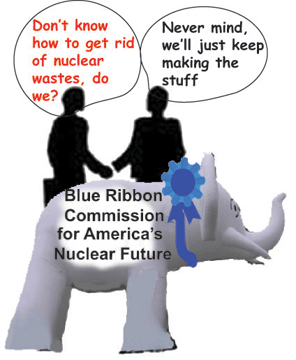
“You’re at least talking a year, maybe two years, maybe more,” to set up the entity, Lee Hamilton, a co-chairman of the Blue Ribbon Commission on America’s Nuclear Future, said today at a House subcommittee hearing in Washington.
Lawmakers are studying a recommendation by the commission to create a government-chartered corporation to oversee nuclear- waste management, taking over from the Energy Department. The corporation would license, build and operate storage and disposal sites, according to the Jan. 26 report..
.. More than 65,000 tons of spent nuclear fuel are stored at about 75 operating and closed U.S. reactor sites, and about 2,000 tons are added a year, according to the commission….
http://www.businessweek.com/news/2012-02-01/nuclear-waste-overhaul-by-u-s-will-take-years-panel-chief-says.html
SMRs – Small Modular nuclear Reactors the latest probably dud design
Small Modular Reactors, the latest ‘rabbit out the nuclear hat’ are generally based on scaled down BWR or PWR technology and illustrate the nuclear industry’s schizophrenic attitude to reactor size.
 SMRs may turn out to be the latest in a long lineof nuclear designs that looked good on paper, but could not make the transition to commercial technology.
Prospects for Nuclear Power in 2012, Platts, London, 30 January 2012 “……..Technological cul-de-sac If plant life extensions can be achieved in France and the US and Gen III+ does prove a blind alley, it raises the question of what options are open to the nuclear sector. Ten years ago, the industry answer would have been Generation IV designs. Unlike Gen III+, which evolved from existing Pressurised and Boiling Water Reactors, these would be based on radical new technologies. Six technologies were selected by the major nuclear countries as the most promising.
Little regulation of increasing non-medical use of radiation
 Customs and the New York Police Department have deployed unmarked X-ray vans that can drive to a location and look inside vehicles for drugs and explosives.
The FDA has little authority to regulate the use of electronic products emitting radiation. Because security scanners are not classified as medical devices, the agency doesn’t approve them for safety before sale.
the scanners fall under voluntary guidelines set by a nonprofit group made up largely of
manufacturers and agencies that wanted to use the X-ray machines.
 Drive-by X-rays: Security screeners expanding radiation use Michael Grabell, Tucson Sentinel, ProPublica, 2 Feb 12, U.S. law enforcement agencies are exposing people to radiation in more settings and in increasing doses to screen for explosives, weapons and
drugs.
In addition to the controversial airport body scanners, which are now deployed for routine screening, various X-ray devices have proliferated at the border, in prisons and on the streets of New York.
Not only have the machines become more widespread, but some of themexpose people to higher doses of radiation. And agencies have pushed the boundaries of acceptable use by X-raying people covertly, according to government documents and interviews. Continue reading
Problem of nuclear regulator in bed with nuclear industry
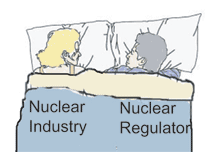
 Nuclear regulatory reform must weed out entrenched interests, Mainichi Daily News, 2 Feb 12, Bills relating to a shift in the nation’s nuclear power policy were approved by the Cabinet on Jan. 31. In addition to the establishment of a new nuclear regulatory agency under the Environment Ministry, the government is aiming to legislate the lifespan of nuclear reactors, and require plant operators to outline specific measures against severe nuclear accidents.
Significant harm has been done by allowing the Nuclear and Industrial Safety Agency (NISA), an administrative body tasked to regulate nuclear power safety, to exist under the umbrella of the Ministry of Economy, Trade and Industry (METI), a major promoter of nuclear power.
Divorcing nuclear regulation from nuclear promotion and centralizing regulatory duties into one agency stands to reason.Changing the agency’s name from the originally proposed “nuclear power safety agency” to “nuclear power regulatory agency” is likewise pertinent, considering the new agency’s nature. Continue reading
End of the line for Japan’s dangerous, super expensive fast breeder nuclear reactor
Japanese parliamentarian and a critic of nuclear power Taro Kono said: ”We spend billions of yen every year just to maintain Monju. It’s crazy. We spend so much money just to keep things not running.”…
critics and nuclear watchdog groups call Monju Japan’s most dangerous reactor, because it uses plutonium fuel and cools its reactor with sodium, which can explode if it comes into contact with water.
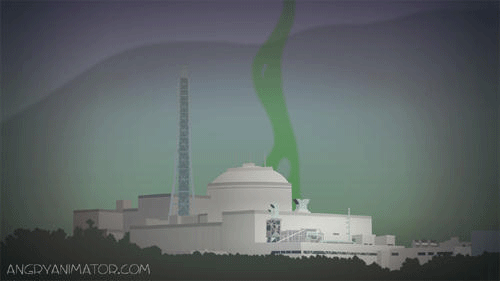
Fast-breeder reactor faces closure, The Age, February 2, 2012 TSURUGA: Japan’s long and expensive pursuit of a super-efficient nuclear reactor is on the brink of failure amid new government concerns about its runaway costs.
The four-decade project to develop a so-called fast-breeder reactor has consumed more than $13 billion in funding, so far producing onlyaccidents, controversies and a single hour of electricity. Continue reading
Nuclear Regulatory Commission’s State of the Art Spin on ionising radiation
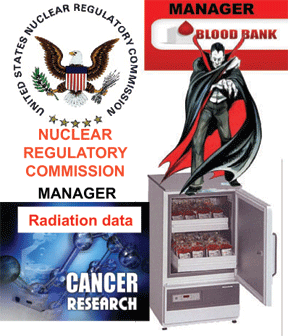 Nuclear accidents pose little risk to health: NRC The study found there was “essentially zero risk” to the public of early fatalities due to radiation exposure following a severe accident.
The long-term risk of dying from cancer due to radiation exposure after an accident was less than one in a billion and less than the U.S. average risk of dying from other causes of cancer, which is about two in one thousand.
The study, called the State-of-the-Art Reactor Consequence Analyses (SOARCA), looked at the radiological health consequences for potential severe accidents at Exelon Corp’s Peach Bottom nuclear plant in Pennsylvania and Dominion’s Surry nuclear plant in Virginia.
1 This Month

Protect Sazan Island from the Trump family! https://secure.avaaz.org/campaign/en/protect_sazan_island_from_the_trump_family_loc/?bqFCVab&v=174511&cl=22707147157&_checksum=5e9dde668860e8231c33699735e16a1fbf22ab2cb01da50c999fe8732b9775ef&utm_source=email&utm_medium=blast_email&utm_campaign=174511


Cuba Is Not a Failed State – It Is a Besieged State
PETITION: “Global Appeal to Endorse Palestinian Right of Return of Refugees”
To see nuclear-related stories in greater depth and intensity – go to https://nuclearinformation.wordpress.com
-
Archives
- June 2026 (129)
- May 2026 (306)
- April 2026 (356)
- March 2026 (251)
- February 2026 (268)
- January 2026 (308)
- December 2025 (358)
- November 2025 (359)
- October 2025 (376)
- September 2025 (257)
- August 2025 (319)
- July 2025 (230)
-
Categories
- 1
- 1 NUCLEAR ISSUES
- business and costs
- climate change
- culture and arts
- ENERGY
- environment
- health
- history
- indigenous issues
- Legal
- marketing of nuclear
- media
- opposition to nuclear
- PERSONAL STORIES
- politics
- politics international
- Religion and ethics
- safety
- secrets,lies and civil liberties
- spinbuster
- technology
- Uranium
- wastes
- weapons and war
- Women
- 2 WORLD
- ACTION
- AFRICA
- Atrocities
- AUSTRALIA
- Christina's notes
- Christina's themes
- culture and arts
- Events
- Fuk 2022
- Fuk 2023
- Fukushima 2017
- Fukushima 2018
- fukushima 2019
- Fukushima 2020
- Fukushima 2021
- general
- global warming
- Humour (God we need it)
- Nuclear
- RARE EARTHS
- Reference
- resources – print
- Resources -audiovicual
- Weekly Newsletter
- World
- World Nuclear
- YouTube
-
RSS
Entries RSS
Comments RSS
 nuclear-news