USA: S3322 legislation to promote nuclear industry
Senator George Voinovich (R-OH) called for a “nuclear renaissance” and introduced S. 3322 to establish the United States Nuclear Fuel Management Corporation. …..The legislation has transparent ties to the nuclear industry….are they truly nonpartisan representatives of the public or are they already in the pockets of the nuclear industry?.

The Blue Ribbon Commission on America’s Nuclear Future: Doing Important Work or Already Irrelevant?, DC Bureau, 08 October 2010, by Hannah Karns President Barrack Obama established the Blue Ribbon Commission on America’s Nuclear Future (BRC) by presidential memorandum on January 20, 2010 to review and recommend solutions to a problem that has plagued the nuclear weapons and power industry for generations: how to safely dispose of radioactive waste. Its mandate is to “conduct a comprehensive review of policies for managing the back end of the nuclear fuel cycle, including all alternatives for the storage, processing and disposal of civilian and defense used nuclear fuel, high-level waste, and materials derived from nuclear activities.”The commission is required to release its first report in June 2011. But, apparently, it, is not acting quickly enough for some members of Congress.
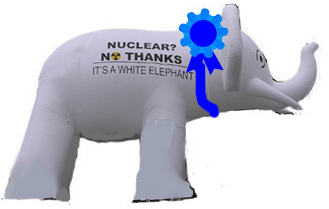
Earlier this year, Senator George Voinovich (R-OH) called for a “nuclear renaissance” and introduced S. 3322 to establish the United States Nuclear Fuel Management Corporation. The new organization would “assume responsibility for the activities, obligations, and use of resources of the federal government with respect to spent nuclear fuel management.” He introduced the bill without regard for the information being collected by the BRC or its future recommendations.
S. 3322 as it currently stands would usurp the current Secretary of Energy’s oversight of the Nuclear Waste Fund and the Office of Civilian Radioactive Waste Management. Additionally, it would be charged with administering the high-level radioactive waste disposal program, which is currently primarily under DOE’s jurisdiction. Far from Voinovich’s claim of creating “a successful framework for addressing the question of where to safely place used nuclear fuel,” this legislation would essentially overhaul the manner in which the nuclear industry operations are overseen at the federal level.
The BRC
met late this September to discuss issues of radioactive waste management, the international implications of U.S. energy policy, and the ethics surrounding the nuclear industry. At thismeeting, Edward Sproat, former head of DOE’s Office of Civilian Radioactive Waste Management, testified that “I haven’t met anybody in my experience that thinks the low-level waste program in this country is working well, and, as a matter of fact, the greater-than-Class-C low-level waste, we don’t have a clue what we’re going to do with it.” The existing organizations, such as the Department of Energy, Nuclear Regulatory Commission, and Environmental Protection Agency, have been unable to develop a solution to the nuclear waste issue.Voinovich’s legislation is not only presumptive with regard to the future of nuclear energy in the United States, but poorly devised. Why should this issue be entrusted to a nascent organization? Does the country need yet another government-funded board? What is behind such drastic revisions to federal policy before the BRC can even finish its work?
The legislation has transparent ties to the nuclear industry. When announcing the legislation, Voinovich touted that it was supported by the Nuclear Energy Institute, the American Nuclear Society, and the U.S. Nuclear Infrastructure Council.
The merit of these endorsements can be debated.The U.S. Nuclear Infrastructure Council, for example, essentially serves as a “Who’s Who” regarding corporations currently involved in the nuclear waste clean-up process in this country.Westinghouse Electric, CH2M Hill, Fluor, and Duke Energy have all had investments, at one time or another, in nuclear waste sites across the country.Their support for this legislation, which will enable “stakeholders” to serve as a majority of the board that will direct the very operations from which they profit, seems obvious. As for NEI, it doesn’t appear to be happenstance that the individual who recommended the legislation to the BRC, Henry Barron, previously worked for NEI and currently serves as the President of Constellation Energy Nuclear Group. Constellation Energy wants to increase the number of nuclear power plants in the United States.
Perhaps not coincidentally, the same companies that make up the U.S. Nuclear Infrastructure Council also made major contributions to Voinovich’s campaign. According to Federal Election Commission records, members of the organization gave the senator over $130,000 in campaign contributions. Including donations made by other key players in the American nuclear industry, he has received more than $180,000 from these corporations………some commissioners of the Blue Ribbon Commission appear to support the legislation, begging the question: are they truly nonpartisan representatives of the public or are they already in the pockets of the nuclear industry?….Apparently in an effort to reduce the influence of Washington politics on the nuclear waste industry, the solution is to radically remove the responsibility from the government to a new corporation with the influence of stakeholders institutionalized. Removing government oversight, or “interference” as some aptly described it at the BRC meeting, raises several warning flags……..
The Blue Ribbon Commission hearings are available to the public. I highly recommend watching the footage online.
The Blue Ribbon Commission on America’s Nuclear Future: Doing Important Work or Already Irrelevant?
No comments yet.
1 This Month

of the week – Shut Down Drone Warfare!


Tell the Ukrainian Government to Drop Prosecution of Peace Activist Yurii Sheliazhenko

Petition to revoke the licensing of the Near Surface Nuclear Disposal Facility (NSDF) at Chalk River. https://www.ourcommons.ca/petitions/en/Petition/Details?Petition=e-7247
To see nuclear-related stories in greater depth and intensity – go to https://nuclearinformation.wordpress.com
-
Archives
- March 2026 (244)
- February 2026 (268)
- January 2026 (308)
- December 2025 (358)
- November 2025 (359)
- October 2025 (376)
- September 2025 (257)
- August 2025 (319)
- July 2025 (230)
- June 2025 (348)
- May 2025 (261)
- April 2025 (305)
-
Categories
- 1
- 1 NUCLEAR ISSUES
- business and costs
- climate change
- culture and arts
- ENERGY
- environment
- health
- history
- indigenous issues
- Legal
- marketing of nuclear
- media
- opposition to nuclear
- PERSONAL STORIES
- politics
- politics international
- Religion and ethics
- safety
- secrets,lies and civil liberties
- spinbuster
- technology
- Uranium
- wastes
- weapons and war
- Women
- 2 WORLD
- ACTION
- AFRICA
- Atrocities
- AUSTRALIA
- Christina's notes
- Christina's themes
- culture and arts
- Events
- Fuk 2022
- Fuk 2023
- Fukushima 2017
- Fukushima 2018
- fukushima 2019
- Fukushima 2020
- Fukushima 2021
- general
- global warming
- Humour (God we need it)
- Nuclear
- RARE EARTHS
- Reference
- resources – print
- Resources -audiovicual
- Weekly Newsletter
- World
- World Nuclear
- YouTube
-
RSS
Entries RSS
Comments RSS
 nuclear-news
Leave a comment