Canadian Nuclear Safety Commission will allow shipment of steam generators across Great Lakes
Bruce Power asked Canada’s nuclear regulator for a licence to ship the steam generators from its power plant on Lake Huron to Sweden, where 90 per cent of the metals inside the generators are to be recycled and resold. The remaining materials that are too radioactive to be recycled will then return to the Bruce plant to be contained for the rest of their radioactive lives.
Public hearing to be held on shipment of nuclear waste through Great Lakes – thestar.com, Brett Popplewell , Jul 30 2010 Canada’s nuclear safety regulator has agreed to hold a public hearing into a controversial plan to ship 1,760 tonnes of radiation-laced steel through Lake Ontario.
The Canadian Nuclear Safety Commission said in a statement Thursday that “in light of public concern” over a proposal by Bruce Power to ship 16 steam generators through the Great Lakes and St. Lawrence Seaway the commission will hold a one-day hearing to consider the plan.
Though opponents to the shipment had been lobbying for such a hearing, the wording in the commission’s statement has only added to their concerns that the proposal will be approved with or without any public debate or input.
In its statement announcing the hearing, the commission said it “will not issue a licence unless it is satisfied the shipment will be completed safely,” but added that the commission’s staff had already “concluded that there are no safety significance issues associated with the proposed shipment.”
Mike Bradley, mayor of Sarnia, one of several cities along the planned shipping route said Friday “there is no question the coalition of individuals and groups opposed to the shipment have forced the hearing. However, the position of (the commission) would suggest it’s simply a formality. It’s like a referee announcing the outcome of the game before the puck is dropped.”…..
On April 1, Bruce Power asked Canada’s nuclear regulator for a licence to ship the steam generators from its power plant on Lake Huron to Sweden, where 90 per cent of the metals inside the generators are to be recycled and resold.
The remaining materials that are too radioactive to be recycled will then return to the Bruce plant to be contained for the rest of their radioactive lives.
The generators, which spent more than 30 years inside the reactors at Bruce Power’s nuclear plant, contain thousands of small tubes that emit beta, gamma and alpha radiation.
Each generator, which weighs 110 tonnes and is the size of a school bus, has a 5-cm-thick steel shell and any holes in those shells would be welded shut before transport.
Though the shipment would go through the jurisdictions of two countries and multiple states and provinces, the commission, which generally acts as a public tribunal, had designated just one person to decide whether the shipment would proceed……….
The public hearing will be held in Ottawa at the commission’s public hearing room on Sept. 29. Requests to take part in the hearing must be filed with the commission by Sept. 13.
Public hearing to be held on shipment of nuclear waste through Great Lakes – thestar.com
18 Comments »
Leave a reply to Klas2k Cancel reply
1 This Month
26 April – Chernobyl: Inside the Meltdown airs on National Geographic on Sunday 26th April from 4pm

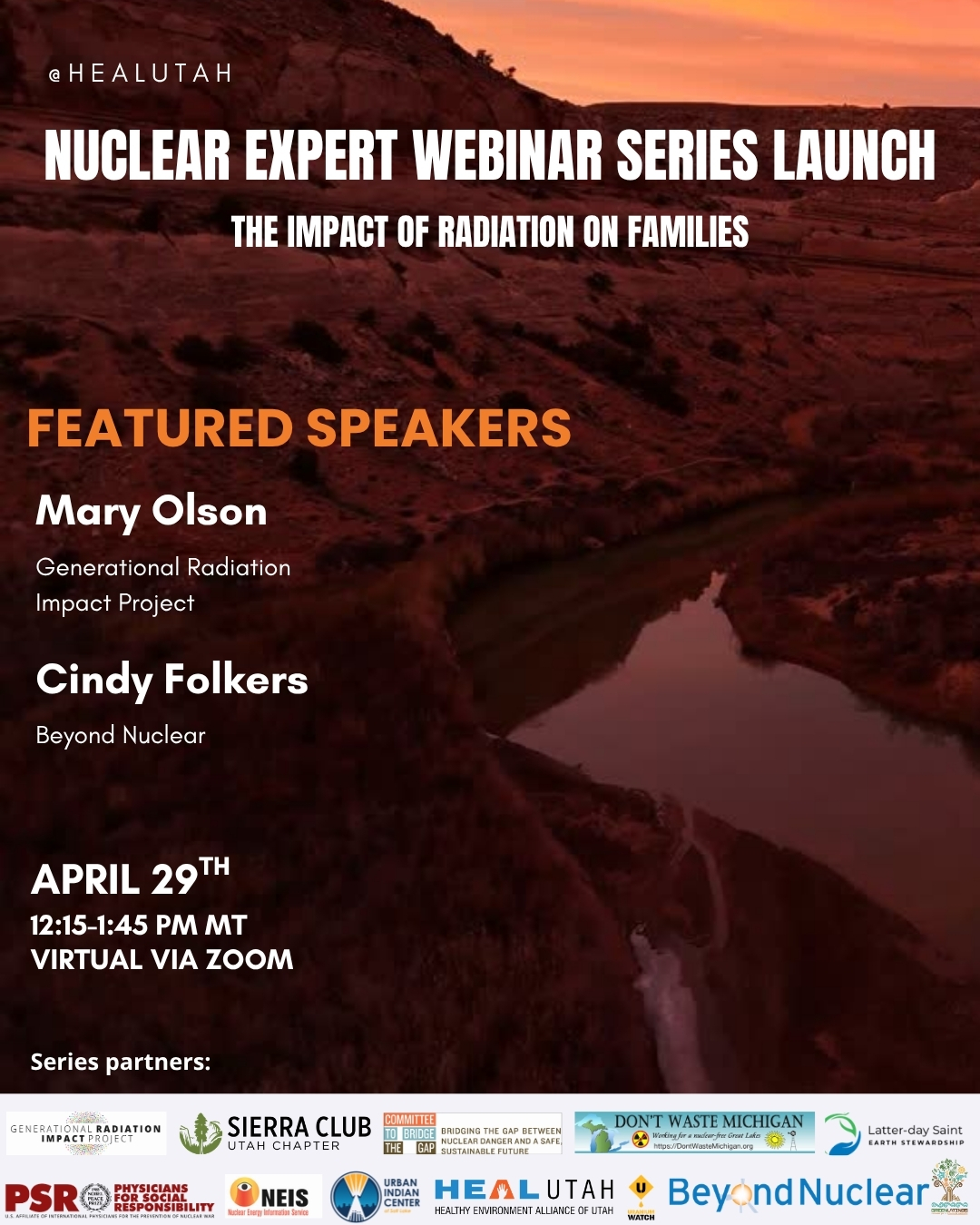
29 April – Nuclear Expert Webinar #1 – Radiation Impacts on Families with Mary Olson and Cindy Folkers
- 12:15 PM MT – 1:45 PM MT
- Location: Virtual – REGISTER TODAY

4 May -West Suburban Peace Coalition to discuss Iran war at May Educational Forum
Monday, May 4, 7:00 – 8:00 PM Central Standard Time
Title: : How Trump’s Narrative Tries to Shape the Reality of the War on Iran.
Contact Walt Zlotow, zlotow@hotmail.com 630 442 3045 for further information
14 May – online event From Bombs to Data Centres: the Face of Nuclear Colonialism

Pine Ridge Uranium is the real threat, not Tehran- Tell Burgum: Stop the Extraction.
Chernobyl: The Lost Tapes – A good documentary on Chernobyl on SBS available On Demand for the next 3 weeks– https://www.sbs.com.au/ondemand/tv-program/chernobyl-the-lost-tapes/2352741955560
To see nuclear-related stories in greater depth and intensity – go to https://nuclearinformation.wordpress.com
-
Archives
- May 2026 (12)
- April 2026 (356)
- March 2026 (251)
- February 2026 (268)
- January 2026 (308)
- December 2025 (358)
- November 2025 (359)
- October 2025 (376)
- September 2025 (257)
- August 2025 (319)
- July 2025 (230)
- June 2025 (348)
-
Categories
- 1
- 1 NUCLEAR ISSUES
- business and costs
- climate change
- culture and arts
- ENERGY
- environment
- health
- history
- indigenous issues
- Legal
- marketing of nuclear
- media
- opposition to nuclear
- PERSONAL STORIES
- politics
- politics international
- Religion and ethics
- safety
- secrets,lies and civil liberties
- spinbuster
- technology
- Uranium
- wastes
- weapons and war
- Women
- 2 WORLD
- ACTION
- AFRICA
- Atrocities
- AUSTRALIA
- Christina's notes
- Christina's themes
- culture and arts
- Events
- Fuk 2022
- Fuk 2023
- Fukushima 2017
- Fukushima 2018
- fukushima 2019
- Fukushima 2020
- Fukushima 2021
- general
- global warming
- Humour (God we need it)
- Nuclear
- RARE EARTHS
- Reference
- resources – print
- Resources -audiovicual
- Weekly Newsletter
- World
- World Nuclear
- YouTube
-
RSS
Entries RSS
Comments RSS
 nuclear-news
You guys did take science in high school, right?
What is the big risk when shipping these steam generators ?
/K – Sweden
are we talking to sweden or from sweden? the crap they are shipping back is non reuseable takeing the same route up our waterways. what can we do once it’s enroute don’t dare stop the shipment for fear someone may blow it up and kill everything that lives in the seaway
It is apparently not a huge risk. However there are some radioactive materials in these shipments.
There is a fear that this might set a precedent for further radioactive transport across the Great Lakes
apparently you know little or nothing about nuclear reactors and how they perform. a fissionable material,Uraniun or Plutonium is subjected to a water cooled radiator which in turn is superheated, subsequently produceing a large amount of off gass (steam) which is sent to a turbine which in turn produces the nesecary pressure to spin it to produce electricity. the steam is recovered through cooling and sent back to the reactor to be reheated. in the process there is a certain amount of unrecoverable water through dissapation, taleing ponds are set up for unreuseable water. each time the water passes by the radioactive material it absorbes some of the radioactivity. the isotopes are transfered through the system on a small scale at first but build up over years of use. even dirt can absorb plutoniun or uranium isotopes so why do you think something a solid as steel can’t. the contaminated material that is being sent through the great lakes is the greatest threat to our way of life
I’m sorry, but these are not “reactors”. They’re the steam generators that actually produce the electricity. Hydro electric dams have similar devices. They’re not exposed to the reactor core and are actually some distance away. They’re probably no more radioactive than the cars the employees drive to work.
It might behoove you to get a better grasp of how a nuclear power plant works, and what parts present hazards and which do not.
Best Regards
if there was no risk of contamination . why would the holes be welded shut before shipment. as it states in the editorial the remaining radioactive material will be shipped back to it’s original place for burial. either it’s radioactive or it’s not. whichever the case, revelations speaks of the consequences. the waters are turned to acid, impalatable but the people are so thirsty they drink from it and are consumed by their need. watch what you do! we need to be careful what happens in our lands. i live on the st laurence seaway and require water to sustain my life. we have the greatest natural water supply in the world. would you take the chance of ruining it for the sake of saveing money because it’s cheaper to ship by that mode than another?????
Thank you. I have now changed the headline of the article, to reflect content more accurately. Still – there are some radioactive materials in the proposed shipments. And still, there’s the question of precedent- setting
Actually, more radioactive medical isotopes are sent across the great lakes every day. A small bx of medical isotopes carries more radiation that all of these steam generators. This is not precident setting, the precident is set and approved by the ministry of the environment since it has no effect.
medical isotopes aren’t shipped in tonnage specifically 1760 tonnes. are you blind? would this be a single shipment or 16 ships passing through our seaway. send it in one shipment it only gives the terrorists one opportunity to blow our side of the garden away and help destroy the worlds greatest supply of fresh water, or ship it in 16 ships and give them sixteen chances. what is up with you non seers
as we speak the governments of the usa and canada are in cohoots to allow terrorists an attempt at ruining our water supply. the usa and canada have formed a policeing body to protect the important stations of our supplies ei power distribution food distribution, next the water will be at risk. stand up and be counted, we canadians have been to laid back for too long. time to take a stand. the aboriginals in our community have stood up, we should stand with them in this time of need. what can be done once the shipment begins? if we hang it up in the process after its loaded on the ships. perfect opportunity for a terrorist threat. its upstream’, everything downstream will be destroyed right out to the gulf. we must stop it from being loaded. course these are just the banterings of an old man who cares about his children and everyone elses
god save us all. after searching the web i have found some rather enlightening articles. for instance the 1st wind generator was invented in 1887. the silicon solar cell was invented the same year as the first nuclear plant opened in the soviet union. don’t you think the countries of the world would better have taken the road to salvation than the road to destruction. we had the capability to produce power through alternative sources than thermo nuclear plants,(they knew the outcome of the waste at that time)and had questioned it’s eventual disposal. this is apparent now to
the public. we were kept in the dark then. we are enlightened now. power and money drive people, (the controllers of our lives) politicions, bankers, lending institutions, the illuminate to have their will be done on earth but not in heaven. don’t blind yourselves with what is said but allow yourselves the ability to question what is at sight. i say unto you watch what is to come, only devestation is among us
@John: TO get the same amount of electricity as 1 (one) nuclear reactor one would have to build 200 wind power plants !!! (5 Mw (35% effeiciency) va
1000 Mw (95% efficiency))
Solar power is not even near those figures, and certainly wasnt back in the 50-60’s event though wind and nuclear power plants were smaller as well…
The reason for all the precautions of this transport is that people, like you, do not understand radioactivity, and thus precautions are taken to calm you (this doesnt work apparently).
Do you know by the way that a banana (normal banana) contains about 5000 Bq…maybe we should prohibit the shipments of bananas 🙂
The shipment in quiestion is obviously metal parts which will not be solvable in for instance the ground water. Furthermore they will be handled with care and sealed – thus – what is the big risk ?
Radioactive elements are all around us – the risk lies if there are solvable elements or elements which radiates high doses of radioation and may be hazardous as they are…
/K
i gather you don’t live close to the st laurence seaway. so you can’t fathom the risks, remember the materials that are unusable (too high in radioactivity) are going to be SHIPPED back. what better time for a terrorist attack. smaller more concentrated materials on possibly one ship would be a great target now wouldn’t it. on another note what is the half life of plutonium? the swiss are ship builders. what will the steel be used for? death ships? i doubt they’ll build blenders from it!!!!
Well – no I dont live in Canada – I am on “the receiving” ned so to say – CLAB in Sweden (not Switzerland !), is from what I have understood, to process the materials, separate the radioactive parts, and then ship those back. CLAB is our facility which handles radioactive waste from both nuclear power plants and the industry/hospitals etc
The metals separated will have a lower radioactive content than the banana mentioned above – so sure: Why not use it for ship building (although we dont have that much here in Sweden nowadays), or maybe wind power plants (which we do build a lot of – but that is mainly from aluminium of course)…
BTW:
a. Why would terrorists want to strike against the St Lawrence area? It isn’t really densly populated, or is it ?
b. The amount of radioactive material (it isn’t plutonium but more likely isotopes of cobolt etc), and the composition would mean that even a really, really powerful bomb, wouldnt do much i terms of radioactive downfall – the fairly low amount of materials would either mean very low concentrations or a very small conterminated area…
/K
i suppose you may be right. is it more humane to chance contamination of a nations food supply rather than to walk them to the gas chamber
Well – once again: The materials are not of a kind that is easily dissipated into nature.
And volumes are not that high that they would threat more than a very local wild-life if something happened, and maybe put some restrictions when it comes to picking berries etc in that particular area. That is why we must ensure that precautions are taken – for that very unlikely event that something could hapen which may affect the soroundings, even if the impact would be very local. Remember -we are talking about metals here – not dust och radioactive concrete etc which could form a dust cloud.
But I really don’t see the target for any attack here – what would be the headline? “Bomb causes radioactive material to leak out into nature. Doses will be raised by thousands of one percent for a couple of years” ?
Such headlines would only scare people with very little knowledge about these matters, and I am pretty sure that experts called in to evaluate any damage would see that there is little cause for alarm.
It is all about the dose, and I would actually, for myself, be much more frightened if I were to live near a coal power plant, which emmits mercury and other pretty bad stuff, and also emitts radioactive particles, even more so than what leaks out form a nuclear PP.
However, as always with these discussions, it is once again about doses. A human receives avout 360 mrems anually from background radiation, living next to a coal PP will give you about 1.9 mrems more per year, and a nucelar power plant less than that…
If one is worried about radioactive dosage, the first thing is to quit smoking. Then one should measure radon in the house – especially if you have a house which is partly below ground, and particuallry if one sleeps down there.
/K
I have a correction to make:
It seems that there can indeed be small amounts of U and Pu in the steam generators, which will be packaged and returned to Canada after clean up and recycling of the rest of the material.
I thought it was just a case of the metalls being ionized by radiation.
/K